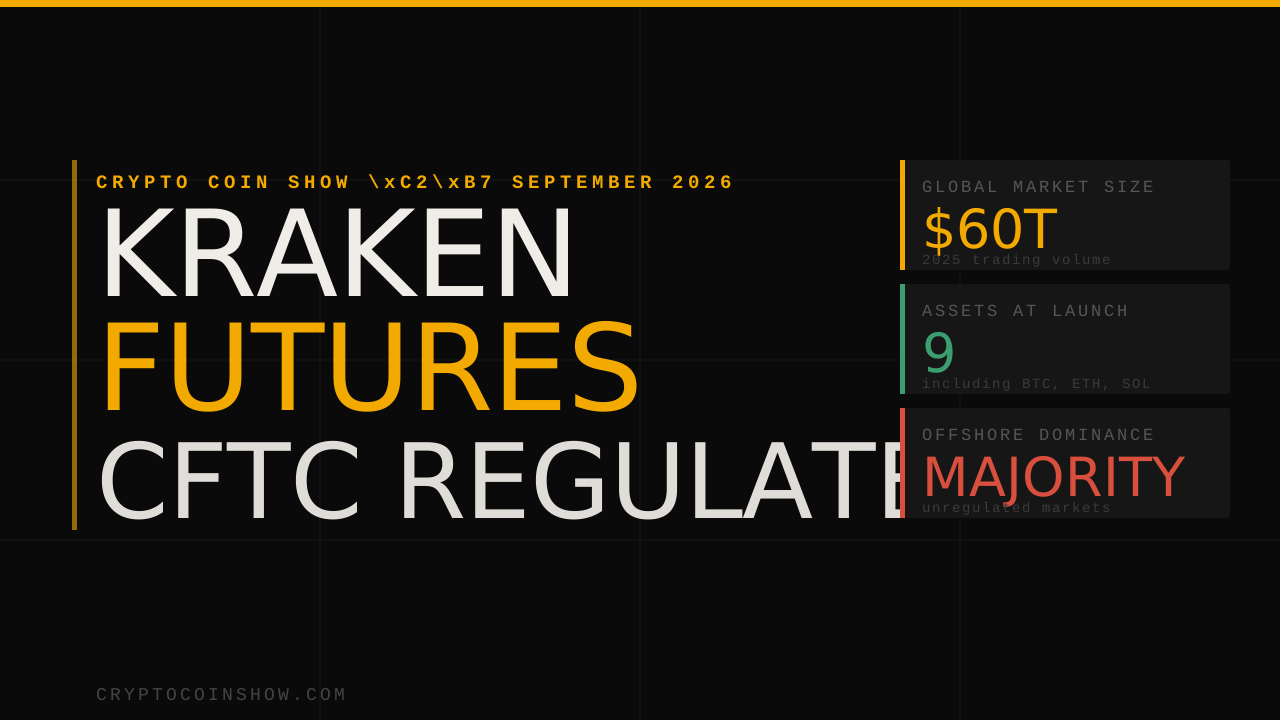
Kraken is preparing to bring one of crypto’s most heavily traded derivatives products into a regulated US framework, with the exchange saying eligible clients will soon be able to access CFTC-regulated perpetual futures through Bitnomial.
TL;DR
Kraken says the products are expected to launch within the next 30 days.
The contracts will be listed on Bitnomial, a CFTC-regulated Designated Contract Market recently acquired by Payward.
Supported assets at launch are expected to include BTC, ETH, SOL, XRP, ADA, LINK, DOGE, LTC and AVAX.
The rollout is aimed at eligible US clients rather than broad retail access at launch.
Kraken Pushes Perps Into A Regulated US Structure
Perpetual futures have long been central to global crypto trading, but US access has remained constrained because the most liquid versions of these products have typically lived on offshore venues. Kraken’s announcement matters because it points to a domestic structure that keeps the core mechanics traders recognize — continuous pricing, no fixed expiration date and recurring funding payments — while placing the contracts inside a CFTC-regulated venue.
The exchange says the products will sit alongside spot margin and CME-listed futures inside a unified Kraken Pro wallet. That is an important operational point, because the appeal is not only regulatory clarity. For active traders, being able to manage collateral, spot positions and derivatives exposure from one interface reduces friction at a time when institutional crypto desks are becoming more sensitive to venue risk and custody structure.
John Palmer, Kraken’s Global Head of Derivatives, framed the launch around domestic access, saying US traders have been waiting for a regulated way to trade the product that defines global crypto derivatives markets. That phrasing is notable because perpetuals are not a niche product globally; they are the core liquidity layer for much of crypto’s directional speculation and hedging.
Why It Matters For Bitcoin And Crypto Traders
The launch could help pull some derivatives activity away from offshore exchanges if eligible US traders decide the regulatory trade-off is worth it. That does not mean global liquidity shifts overnight, but it gives institutional and qualified participants another route to express leveraged views on major assets while staying within a US-regulated framework.
The asset list also matters. By including BTC and ETH alongside SOL, XRP, ADA, LINK, DOGE, LTC and AVAX, Kraken is not limiting the product to the two largest tokens. That wider initial scope suggests the exchange is positioning the venue as a broader crypto derivatives hub rather than a narrow Bitcoin-only product line.
For Bitcoin specifically, the bigger story is market structure. More regulated venues can deepen institutional participation, improve risk management and potentially reduce the gap between offshore liquidity and US-accessible products. The caveat is that access restrictions mean this is not a sudden retail floodgate.
What To Watch Next
Traders will be watching whether the product launches on schedule, how broad the eligibility criteria are, and whether liquidity builds quickly enough to compete with offshore perpetual futures markets. The central risk is access: if participation remains limited to a narrow institutional tier, the market impact may be more structural than immediate.
Popular crypto exchange Kraken has on Monday launched perpetual futures trading to eligible US users through Kraken Pro. The exchange will route the contracts through its recently acquired Bitnomial exchange, with full CFTC regulation.
The newly launched product helps to fulfill a deficit that has kept most U.S. traders on the sidelines of the global perpetual futures market. According to the exchange’s announcement, that market exceeded $60 trillion in trading volume in 2025, with the vast majority of activity running through offshore platforms beyond the reach of the U.S. regulatory bodies.
Kraken’s perpetual futures contracts
Perpetual futures allow traders to take leveraged long or short positions on an asset’s price without a specific expiration date. Perp positions continue to remain open as long as margin requirements are met.
Kraken plans to use a funding rate that resets every eight hours, particularly at 7 p.m., 3 a.m., and 11 a.m. CT. The company’s blog post explains that long holders would pay short holders when the price of the perpetual contract trades above spot, with the reverse happening when it trades below. The trading structure is designed to keep contract pricing firmly tethered to the underlying asset.
At launch, the cryptocurrencies covered by the product include Bitcoin (BTC), Ether (ETH), Solana (SOL), Ripple (XRP), Cardano (ADA), Chainlink (LINK), Dogecoin (DOGE), Litecoin (LTC), and Avalanche (AVAX). The exchange also mentioned that it plans to add more assets and a bigger pool of collateral options over time.
Bitnomial and NInjaTrader importance
Payward, Kraken’s parent company, purchased derivatives exchange Bitnomial in May 2026. A year before, the company also bought NinjaTrader, the futures brokerage now revamped as Kraken Derivatives US and registered with the CFTC as a Futures Commission Merchant.
Perpetual contracts will be held in the same futures wallet as the exchange’s existing CME-listed products, so traders can manage both types of positions with the same funds.
“The most useful thing an exchange business can do for a serious trader is to put everything in one place,” Payward and Kraken co-CEO Arjun Sethi said. “Spot, margin, futures, and now perpetuals all live in the same account at Kraken.”
Darius Tabatabai, head of Kraken Pro, said in the company’s announcement that Bitnomial’s regulated infrastructure made a fast rollout possible. “Their work on the regulatory and market structure side, combined with Kraken’s distribution and technology, is what brings this to US traders at scale,” Tabatabai added.
CFTC increasingly open to perpetual futures
The launch follows signals from the CFTC in May that opened a path for regulated venues to list perpetual futures. The agency approved Bitcoin perpetual contracts from prediction market Kalshi that month, and also allowed for Coinbase to connect US customers to global options and perpetual markets. Kalshi recorded more than $1 billion in perpetual trading volume within its first week.
Kraken’s move is the latest in a string of derivatives releases platformed for its U.S. customers. It launched CME-listed crypto futures in July 2025 and added margin trading for eligible US clients earlier in June 2026.
Kraken’s head of derivatives, John Palmer, told CoinDesk that adoption could follow the pattern set by spot bitcoin exchange-traded funds (ETFs), with sophisticated traders entering first and institutional funds following after internal compliance reviews.
Kraken says it now supports USDCx deposits and withdrawals on the Canton Network.
USDCx is described as a Canton-native stablecoin backed 1:1 by USDC locked in Circle’s xReserve on Ethereum.
Canton is a permissioned, privacy-enabled Layer-1 network built for regulated financial institutions and tokenized real-world assets.
The move adds another exchange connection to institutional stablecoin and settlement infrastructure.
Kraken has added support for deposits and withdrawals of USDCx on the Canton Network, expanding its stablecoin infrastructure at a time when regulated financial institutions are paying closer attention to tokenized settlement rails.
In a June 11 product update, Kraken said USDCx deposits and withdrawals are now available on Canton. The exchange framed the integration as part of its broader effort to support new stablecoin rails and institutional finance infrastructure.
USDCx is a Canton-native stablecoin. According to the source material, it is minted when users deposit ERC-20 USDC into Circle’s xReserve on Ethereum, with the Canton version backed 1:1 by USDC locked in that reserve. That distinction matters because USDCx is not simply standard ERC-20 USDC on a new exchange page; it is designed to operate natively within Canton’s privacy-focused network.
What Canton Adds To The Stablecoin Stack
Canton Network is a permissioned Layer-1 system built specifically for regulated financial institutions, tokenized real-world assets, and privacy-sensitive financial workflows. Unlike public networks where transaction details are broadly visible, Canton uses a structure described as sub-transaction privacy.
In simple terms, that means only the parties involved in a transaction can see its details, while the system can still support selective disclosure for compliance and regulatory purposes. For institutions, that is a major design point. Banks, asset managers, and market infrastructure firms often cannot expose sensitive transaction data to the entire market.
The Canton model is sometimes described as a “network of networks,” allowing different applications and institutions to interoperate without making every piece of transaction data public. That gives it a different role from open retail-focused chains, where transparency is often treated as the default.
Why USDCx Matters
Stablecoins are already one of crypto’s clearest product-market fits, but most activity still happens across public networks and centralized exchange rails. USDCx is aimed at a different setting: institutional workflows where privacy, compliance, and settlement certainty are central requirements.
By supporting deposits and withdrawals, Kraken gives users a way to move USDCx through its platform rather than treating Canton-native stablecoin activity as isolated infrastructure. The exchange also noted that Canton’s native utility token, CC, is used to pay transaction fees on the network.
The integration does not mean Canton has suddenly become a mainstream retail chain. The more realistic takeaway is that stablecoin infrastructure is fragmenting into specialized environments. Some networks optimize for open DeFi liquidity, while others are being built around regulated institutions and tokenized assets.
Institutional Rails Keep Expanding
The USDCx integration comes as exchanges, stablecoin issuers, and institutional networks compete to define how tokenized cash should move across regulated markets. That competition is no longer only about which stablecoin has the most supply. It is increasingly about where that stablecoin can settle, who can use it, and what privacy or compliance guarantees come with the network.
Kraken’s Canton support is therefore best understood as an infrastructure step rather than a flashy retail launch. It gives market participants another route into Canton-native stablecoin activity and adds exchange connectivity to a network built for regulated finance.
For crypto users, the immediate impact may be narrow. But for the market structure behind stablecoins and tokenized assets, integrations like this show how exchanges are preparing for a future in which digital dollars move across multiple specialized settlement environments.
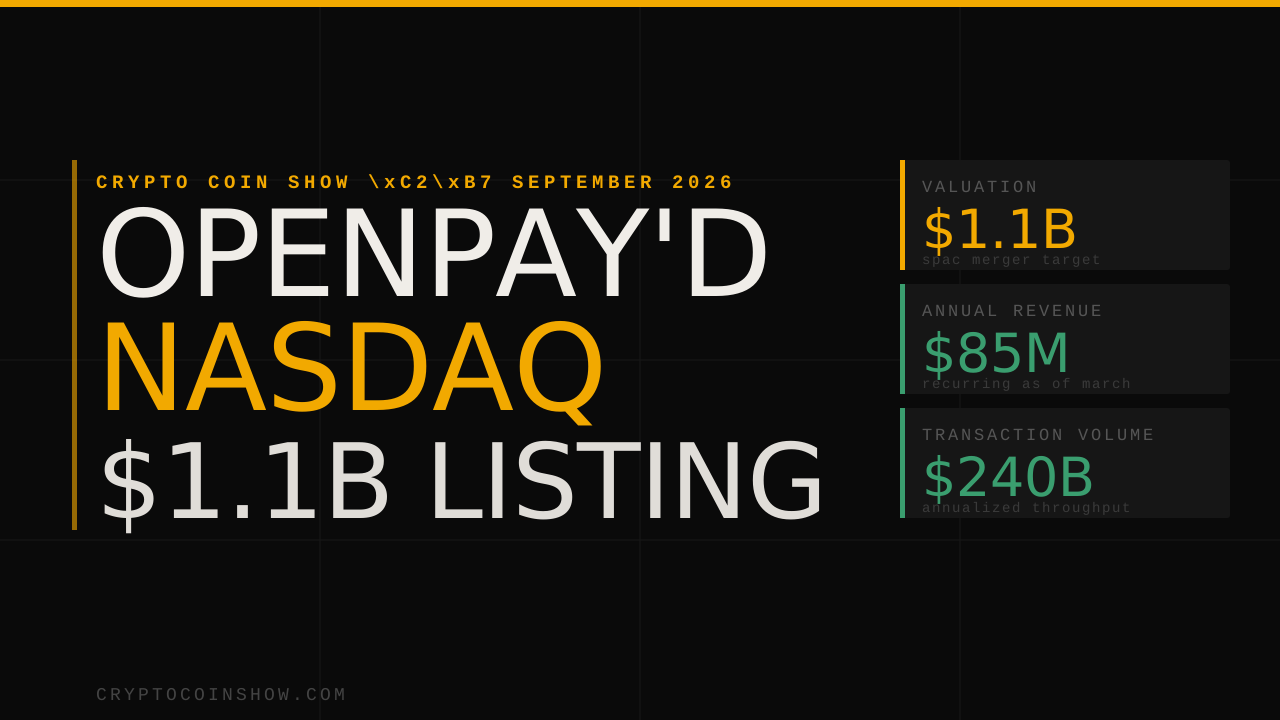
OpenPayd has announced a merger agreement with Titan Acquisition Corp. that would list the company publicly on Nasdaq at a valuation of roughly $1.1 billion.
If OpenPayd follows through as planned, it would be a rare sighting of a crypto-linked firm advancing its listing plans after a string of digital asset and fintech companies recently paused or abandoned their own ambitions due to weak markets and falling token prices.
Which crypto firm is listing on the Nasdaq?
OpenPayd and Titan, a special purpose acquisition company (SPAC) trading on Nasdaq under the ticker TACHU, have signed a definitive business combination agreement that would list OpenPayd under the symbol “OP.”
If no Titan shareholders redeem their holdings, OpenPayd stands to receive up to $276 million in gross proceeds from Titan’s trust account to expand its business and strengthen its finances.
The company reported annualized recurring revenue above $85 million as of March 2026 and processes more than $240 billion in annualized transaction volume. OpenPayd’s client list includes eToro, Kraken, and OKX, and it operates across more than 180 countries. The deal values OpenPayd at $1.1 billion.
The boards of both companies approved the deal unanimously. The final closing is expected in the fourth quarter of 2026, dependent on shareholder approval and other standard conditions.
OpenPayd’s CEO, Iana Dimitrova, said that the transaction is a major milestone that shows the strength of the company’s platform. Founder Ozan Ozerk added that he believes the next decade of finance will be driven by autonomous systems, and that going public will give his firm the money and mission to lead that market
OpenPayd’s listing comes as crypto listing plans stall across the industry
OpenPayd’s timing stands out as several major crypto firms have delayed or shelved public offerings this year due to a decline in prices and a lack of investor interest.
Cryptopolitan reported that Consensys, the company behind the MetaMask Ethereum wallet, pushed its planned U.S. IPO to at least fall of 2026 after crypto markets dropped sharply earlier in the year. JPMorgan and Goldman Sachs were working on the offering.
Grayscale, one of the largest crypto asset managers and the firm behind the Bitcoin Trust ETF (GBTC), also paused its IPO preparations and is unlikely to restart before the fourth quarter.
Kraken suspended its own multibillion-dollar IPO earlier in 2026, just months after raising $1.3 billion across two funding rounds that valued the exchange at over $20 billion. Cryptopolitan also previously reported that the hardware wallet maker, Ledger, paused a planned $4 billion listing.
BitGo is the only crypto-native firm to complete a U.S. IPO so far this year. The digital asset custodian raised about $213 million in January, but its shares now trade roughly 36% below the offering price.
Titan CEO Frank Mastrangelo called OpenPayd what he believes to be “the first publicly traded, pure-play global payments infrastructure platform at the intersection of traditional finance and digital assets,” per the joint announcement.
Kraken is moving its wrapped Bitcoin (kBTC) to Chainlink CCIP as bridge-security fears continue spreading across DeFi, turning the bridge-security debate into a decision about wrapped-Bitcoin infrastructure.
In a recent announcement, the exchange said it is deprecating its existing cross-chain provider and moving all Kraken Wrapped Bitcoin to Chainlink’s Cross-Chain Interoperability Protocol. CCIP will become the exclusive cross-chain infrastructure for kBTC and future Kraken Wrapped Assets.
The move adds a centralized exchange‘s Bitcoin wrapper to the migration wave that followed the KelpDAO exploit. It places exchange-issued BTC distribution inside the same risk debate that has already pushed DeFi-native projects to reassess how tokens move between chains.
The asset itself is the difference. kBTC is Kraken’s 1:1 Bitcoin-backed wrapper, designed to make BTC usable across networks outside Bitcoin’s native environment.
Kraken says kBTC can be used on Ink, Unichain, Ethereum, OP Mainnet, and other DeFi ecosystems, with Bitcoin backing held through Kraken Financial and public reserve and contract links available for verification.
That structure creates a trust stack with several layers. Users face a stacked decision involving Kraken custody, the wrapper’s smart contracts, cross-chain messaging, destination networks, and DeFi venues where kBTC is used.
Kraken’s CCIP decision addresses one part of that stack, while also showing why wrapped Bitcoin distribution is now a market-structure question rather than a simple product expansion.
Why kBTC makes the migration different
Wrapped Bitcoin exists because BTC remains the dominant crypto asset, while the Bitcoin network connects poorly with most DeFi applications.
CryptoSlate data shows Bitcoin trading below $80,000 on May 15, with a market value of nearly $1.6 trillion, about 60% market dominance, and $45 billion in 24-hour volume. Even amid the dip, that scale explains why exchanges and protocols keep trying to move Bitcoin liquidity into smart-contract environments.
Kraken’s answer is kBTC. The exchange’s product page describes the token as fully backed and exchangeable for BTC, with each kBTC collateralized by Bitcoin held in Kraken’s custody.
Its whitepaper says that eligible Kraken users can deposit or withdraw kBTC at a 1:1 rate with BTC, with applicable fees deducted, and that BTC backing is held at Kraken Financial, a Wyoming-chartered Special Purpose Depository Institution.
The same materials point users to reserve and contract data, including the SPDI custody wallet and kBTC smart contracts on Ink, Unichain, OP Mainnet, and Ethereum. That transparency is important because wrapped assets depend on the market believing that the issued token remains redeemable for the asset it represents.
The remaining risk remains even with transparency. Kraken’s whitepaper lists smart contract vulnerabilities, possible peg divergence on third-party platforms, regulatory changes, and problems on third-party blockchains or protocols as risks tied to kBTC.
It also says that Kraken effectively controls token management functions through a Kraken-controlled wallet.
That is the tension Kraken’s CCIP decision brings into focus. Wrapped Bitcoin needs distribution to matter in DeFi.
Every added chain and venue can increase utility, but it also makes cross-chain infrastructure choices more visible to users, integrators, and risk teams.
Risk layer
Known facts
What remains to watch
Custody and reserves
kBTC is backed 1:1 by BTC held at Kraken Financial, with reserve links published by Kraken.
Whether future Kraken Wrapped Assets use the same level of public reserve transparency.
Smart contracts and token control
Kraken cites internal reviews, a Trail of Bits audit, and Kraken-controlled token management functions.
How users and protocols assess issuer control alongside contract security.
Cross-chain messaging
Kraken is moving kBTC and future wrapped assets to Chainlink CCIP as exclusive cross-chain infrastructure.
The exact CCIP configuration, migration timing, and rate-limit or attestation design.
Market peg and liquidity
Kraken says kBTC is redeemable 1:1 through eligible Kraken accounts, while third-party markets can diverge.
Whether kBTC liquidity grows across DeFi while peg stress stays limited.
Destination-chain and protocol risk
Kraken discloses technical risks on third-party chains and protocols where kBTC may be used.
Whether broader distribution increases exposure to weak DeFi venues or chain incidents.
How CCIP changes kBTC routing
Chainlink markets CCIP as a cross-chain standard for DeFi and institutional use cases. Its materials say CCIP supports Cross-Chain Tokens, uses decentralized oracle networks and risk-management features, and is covered by ISO 27001 and SOC 2 Type 2 security statements.
Those claims help explain why asset issuers would evaluate it after a major bridge incident.
The safer interpretation is that Kraken is changing the infrastructure layer it wants kBTC and future wrapped assets to depend on. That may reduce some configuration or vendor-risk concerns, while custody risk, smart contract risk, peg risk, and exposure to destination chains remain outside the bridge-provider decision.
The move lands in a specific post-KelpDAO context. CryptoSlate previously reported that more than $3 billion in DeFi value had moved toward Chainlink CCIP after the $292 million KelpDAO exploit intensified scrutiny of bridge security and LayerZero-linked configurations.
LayerZero later said its protocol remained unaffected, but acknowledged that allowing its decentralized verifier network to act as a 1/1 DVN for high-value transactions was a mistake. It recommended stronger multi-DVN configurations and said the affected incident involved a single application.
That admission frames the issue less as a simple bridge-brand fight and more as a debate over defaults, issuer responsibility, and how much security configuration should sit with the application.
Kraken’s move now brings that debate to exchange-issued wrappers. The exchange is deciding how kBTC moves and signaling which interoperability stack it wants future wrapped assets to inherit.
Other migrations show why context matters. Solv Protocol said it moved more than $700 million in SolvBTC and xSolvBTC cross-chain infrastructure from LayerZero bridges to CCIP after a security review.
Re said it moved from LayerZero to CCIP for reUSD after evaluating cross-chain infrastructure, citing $475 million-plus in TVL, $160 million-plus reUSD market cap, 16 independent node operators, native rate limits, and institutional controls.
Those moves make Kraken part of a broader risk reset. But kBTC adds the Bitcoin and exchange-custody dimension.
The test now moves to execution
For users, the practical question is whether Kraken’s migration gives kBTC holders and DeFi integrators a clearer, more resilient operating model.
The first signal will be an operational detail. Kraken has said kBTC and future Kraken Wrapped Assets will use CCIP, but the exchange has yet to disclose the migration timeline, chain-by-chain cutover process, and the exact configuration that will apply to kBTC.
For an asset marketed around reserve transparency and exchange custody, those details matter because infrastructure changes can affect how users evaluate deposits, withdrawals, bridging, and downstream protocol integration.
The second signal will be liquidity. kBTC’s value proposition depends on Bitcoin becoming useful in places outside its native network.
If the CCIP migration helps Kraken expand kBTC usage across Ink, Unichain, Ethereum, OP Mainnet, and future networks while keeping redemption and reserve visibility clear, the move could strengthen the case for exchange-issued wrapped assets in DeFi.
Lagging usage would make the announcement look more like a vendor rotation than a change in wrapped-Bitcoin market structure.
Strong usage would sharpen the tradeoff: kBTC may gain more reach, but users will still be relying on Kraken as issuer and custodian, CCIP as cross-chain infrastructure, and third-party chains and protocols as execution venues.
That is why the migration matters. Kraken is moving more than a token route.
It is putting a Bitcoin-backed exchange wrapper into the same security debate that has already reshaped DeFi bridge decisions after KelpDAO. The next test is whether that decision turns into safer, clearer BTC distribution across DeFi, or simply shifts wrapped-asset trust to a new set of dependencies.
French hardware wallet maker Ledger has paused its planned US initial public offering (IPO), joining Kraken on the sidelines and thinning what was set to be crypto’s biggest listing year.
Sources familiar with the process said Ledger has not filed a confidential S-1 with the Securities and Exchange Commission (SEC), the formal first step toward a US listing, and may pursue private fundraising instead.
A Thinning 2026 IPO Pipeline
Ledger had hired Goldman Sachs, Jefferies, and Barclays earlier this year to lead a potential New York listing valued above $4 billion.
The pause leaves that mandate idle and removes one of the most anticipated crypto issuances from the 2026 schedule.
LEDGER PAUSES US IPO PLANS AMID MARKET UNCERTAINTY
Crypto security firm Ledger has paused its planned U.S. IPO due to unfavorable market conditions, according to a report.
The company has not yet filed a confidential S-1 with the SEC, and may instead pursue private fundraising…
Pausing comes with tradeoffs. Existing Ledger investors and employees lose a near-term exit, leaving secondary sales as the main liquidity option.
The company tapped that route in March with a $50 million share sale, but private rounds rarely match the depth of public markets.
“Going public in US, yes it’s a strong consideration,” says Ledger CEO when talking to “Bloomberg Crypto” earlier today. Digital asset firm Ledger completed a $50 million secondary share sale https://t.co/7cNekAyXB5pic.twitter.com/ekty74eeTD
BitGo, the only crypto firm to complete a US listing this year, debuted in January at $18 per share and now trades near $12, more than 30% below its offer price.
That performance gives peers a clear reason to wait rather than test investor appetite.
Ledger’s Growth Story Continues
Notwithstanding, the Paris-based firm is growing US operations, recently hiring a chief financial officer from stablecoin issuer Circle and building enterprise custody products for banks.
Founded in 2014, Ledger says it secures over $100 billion in client crypto assets.
The IPO pipeline reopening by the second half of 2026 depends on token prices, trading volumes, and how the next crypto-adjacent listing performs.
In the meantime, the pause keeps Ledger private and the broader sector waiting.
For most of its life, crypto lived outside the financial system. If you wanted to move dollars in or out of an exchange, that money still had to pass through a regular bank somewhere along the way. Most people assumed it would stay that way until Washington finally decided how to regulate it.
But that assumption is now breaking down. In March 2026, a regional Federal Reserve bank approved a limited account for Kraken, the first time a crypto exchange has ever been allowed to plug directly into the US central bank’s payment system. More approvals could follow, and the GENIUS Act, passed last year, has cleared a path for ordinary banks to start issuing their own digital dollars.
None of this needed a sweeping “crypto law”: it was a series of smaller, technical decisions that have added up and changed the picture entirely.
Crypto may not be waiting for permission anymore. It may already be finding a way in.
What a “backdoor into the system” actually means
The US financial system runs on a set of payment networks operated by the Federal Reserve. Banks use them to move money between each other, settle transactions at the end of the day, and tap dollar liquidity when they need it. The most important, called Fedwire, moves trillions of dollars between banks every single day.
To use those networks, an institution needs an account at the Fed, which was historically reserved for licensed banks. Everyone else had to rent access by going through a partner bank that already had one.
That’s what just changed. Kraken’s banking unit now has its own direct line into the Fed’s payment system, without routing dollars through another bank first. The account is limited, which means it won’t have interest on reserves or access to the Fed’s emergency lending, but it lets Kraken settle its own dollar transactions on the same infrastructure banks use.
Think of the difference this way: instead of using a third-party app to talk to your bank, you have your own connection to the bank’s back end. Faster, cheaper, and no longer dependent on a middleman that can say no.
For years, US crypto policy has moved slowly, pulled between agencies that didn’t agree on the basics. At the same time, demand for crypto services from big institutional investors hasn’t gone away. They want cleaner, regulated ways to touch the asset class.
So the system is adapting practically, not politically.
The GENIUS Act gave digital dollars their first real federal rulebook and effectively invited regulated banks into the market. Regulators began handing out special charters that let nonbank firms like Circle operate with bank-like privileges.
The Fed opened a public comment period on a lighter-weight account designed for payment-focused firms. Wyoming’s crypto-friendly bank charter, once treated as an experimental oddity, became the legal vehicle that carried Kraken through the door.
All of this means that your bank’s exposure to digital assets is going up, either through partners, products, or its own tokens. Citi has said it’s targeting a 2026 launch of crypto custody. A group of major global banks, including JPMorgan, Bank of America, and Goldman Sachs, has explored a jointly-backed digital dollar. Even if you never buy crypto, it will now sit on the edges of the account you already have.
This comes with quite a few risks for markets, though. When the pipes between crypto and traditional finance get wider and shorter, money moves faster in both directions, and so do shocks.
For crypto, direct access to payment systems is a stamp of legitimacy that would have been unthinkable a few years ago. But it also means it loses the “outside the system” identity that defined it, and takes on some of the same responsibilities.
The more connected crypto becomes, the less isolated its risks are.
The real tension: stability or contagion for crypto?
One view (call it the normalization case) is that pulling crypto inside the regulated perimeter makes everyone safer. Companies with direct Fed access have to meet stricter standards, and reserves get easier to monitor. This is a net positive for users, as they end up with fewer opaque middlemen between their dollars and the exchange. When seen through this lens, integration reduces risk rather than creating it.
The other view is hard to ignore, as the scares from the 2008 financial crisis are still fresh for many.
The US banking lobby reacted to the Kraken decision by warning that lightly regulated companies like this with direct access to the payment system introduce all kinds of money-laundering and operational risks. However, they would also open a Pandora’s box of new risks: in a panic, money could actually flood into these new accounts, draining deposits from the community banks and credit unions that fund the real economy.
The Bank Policy Institute, representing the country’s largest banks, said the approval happened before the Fed Board had even finished writing its own rulebook for these accounts.
The question underneath this fight is pretty simple: if crypto becomes part of the system, does it make the system stronger or more fragile?
Financial crises are rarely about the risk everyone is watching. They’re a result of the connections no one modeled, and many believe that the new direct connection between crypto markets and the Fed’s payment rails is exactly that kind of linkage.
The subtle part
Part of what makes a huge shift like this hard to see is that nobody is announcing it as one.
There’s no press conference where “crypto joins the banking system,” because there doesn’t need to be. A regional Fed approval here, a stablecoin rulebook there, and a charter granted to a firm most people have never heard of.
Each of these items is boring on its own terms, which is why they clear without the kind of political fight that most comprehensive crypto laws have been stuck in for years.
More crypto firms will almost certainly follow Kraken once the Fed finalizes its lighter-weight account framework, and the approvals will be granted one at a time, in different Federal Reserve districts, with conditions that take pages of legal language to unpack.
Big banks will keep rolling out custody services and their own digital dollars as ordinary product launches, not ideological statements, while the Kraken cybersecurity incident this spring (an extortion attempt built around insider access) hands the banking lobby exactly the kind of material it needs to argue that lightly regulated firms shouldn’t be sitting on the same rails as JPMorgan.
A comprehensive crypto market-structure law may still pass, and probably will eventually, but by the time it does, the thing it’s meant to govern will already have been built around it, and the interesting question will no longer be what the rules say but how much of the system has stopped needing them.
Kraken Security Update: Exchange Targeted by Extortion Group — Crypto Coin Show
Breaking · Security
Kraken Is Being Extorted.
It Won’t Pay.
A criminal group is threatening to release videos of internal systems and client data unless the exchange complies. Kraken says no breach occurred, no funds were at risk — and it will not negotiate.
By Crypto Coin ShowApril 13, 2026Security & Exchange News
~2,000Accounts Potentially Viewed
0.02%Of Kraken’s Client Base
2Separate Incidents
$0Paid to Criminals
Kraken, one of the world’s largest cryptocurrency exchanges, disclosed on Monday that it is currently the target of an extortion campaign by a criminal group threatening to release videos of internal systems and client data. The exchange says it will not comply, has never had its core systems breached, and is actively working with federal law enforcement across multiple jurisdictions.
The disclosure came directly from Nick Percoco, Kraken’s Chief Security Officer, in a public statement posted to X. It is unusually direct — a company naming the threat, confirming the two incidents behind it, and publicly refusing to pay — in an industry where security disclosures are typically delayed, minimized, or handled quietly.
Confirmed
Two insider access incidents occurred
~2,000 client accounts potentially viewed
Affected clients have been notified
Both individuals had access revoked immediately
Law enforcement engaged across multiple jurisdictions
Extortion demands received and rejected
Did Not Happen
Core systems were not breached
Customer funds were not at risk
No external hack or network intrusion
Kraken has not paid and will not pay
No negotiation with the extortion group
What Actually Happened
According to Percoco’s statement, both incidents involved insider access — individuals within Kraken’s support infrastructure who gained inappropriate access to limited client support data. Neither incident was the result of an external hack or network breach. The criminals now threatening Kraken obtained their leverage through these insider access events, not through a technical compromise of exchange infrastructure.
The two incidents are separated by over a year, and Kraken was tipped off to both through external intelligence — the first from a trusted source in February 2025, the second more recently. In each case, the exchange says it moved immediately: access revoked, full investigation launched, affected clients notified.
Incident Timeline
FEB 2025
First incident identified. A trusted source shares a video circulating on a criminal forum showing access to Kraken client support systems. Kraken launches an investigation, identifies a member of its support team as responsible, revokes access immediately, adds security controls, and notifies a limited number of affected clients.
APR 2026
Second incident identified. Kraken receives another tip and a new video showing similar activity. The individual involved is quickly identified and access is terminated. Another investigation is conducted. A small number of clients are notified.
APR 13, 2026
Extortion demands begin. Shortly after access is terminated in the second incident, criminals threaten to distribute materials from both incidents to media outlets and on social media unless Kraken complies. Kraken goes public and refuses.
An Insider Recruitment Problem, Not Just a Kraken Problem
One of the more significant details in Percoco’s statement is the scope of what Kraken says it has been investigating. Since the February 2025 incident, the exchange has been collaborating with industry partners and law enforcement to investigate and disrupt what it describes as organized insider recruitment efforts — targeting not only crypto companies, but also gaming and telecommunications organizations.
This reframes the incident from a Kraken-specific failure to something broader: a coordinated campaign to place or leverage insiders across multiple industry verticals. The implication is that the criminal group behind the extortion didn’t get lucky — they’ve built a playbook, and Kraken isn’t their only target.
“We believe there is sufficient evidence to support the identification and arrest of those responsible.”
— Nick Percoco, Chief Security Officer, Kraken
Percoco’s statement is careful to note that Kraken cannot share additional details due to the ongoing investigation — but the public confidence here is notable. The exchange is not hedging. It believes it knows who is responsible, and it is saying so publicly while working with federal law enforcement to pursue arrests.
What Was Actually Accessed
Across both incidents, approximately 2,000 client accounts were potentially viewed. Kraken describes this as “limited client support data” — consistent with what a customer support employee would have access to in the normal course of their work. The exchange does not describe any bulk data extraction, system compromise, or access to trading infrastructure, wallets, or private keys.
Note to Affected Clients
Kraken states that if you are a client potentially affected by either incident, you have already been directly notified. If you haven’t received a notification, your account was not among those viewed.
The 2,000 figure represents approximately 0.02% of Kraken’s client base — a very small fraction, though not one that will feel small to anyone whose account appeared in those videos.
The Public Refusal
Exchanges that get extorted typically don’t announce it this way. The standard playbook is to handle things quietly — negotiate behind closed doors, involve lawyers, hope the story doesn’t get out. Kraken’s approach is different: go public, refuse explicitly, and make clear that law enforcement is already involved.
There are strategic reasons for this. Once an extortion demand becomes public, the leverage largely evaporates. The criminals were threatening to go to media — Kraken got there first, on its own terms, with its own framing. The narrative now belongs to the exchange, not the extortionists.
It also signals something to future bad actors: Kraken won’t pay, and going public is the response. That’s a harder posture to sustain than it sounds — it requires confidence that the underlying facts are as clean as the company says they are. Percoco is putting that confidence on record.
The broader story here isn’t just about Kraken. Insider threats are one of the most difficult security problems in any industry — harder to detect than external attacks, often more damaging, and almost impossible to fully prevent at scale. The fact that a single criminal group appears to be running coordinated recruitment campaigns across crypto, gaming, and telecom suggests this is an increasingly organized threat category, not just opportunistic misbehavior by a few bad employees.
Kraken says anyone with relevant information is encouraged to contact them directly. Federal law enforcement across multiple jurisdictions is involved. The exchange says arrests are supported by the evidence gathered.
For now, the message from Kraken is straightforward: systems weren’t breached, funds weren’t at risk, the affected clients have been told, and the criminals aren’t getting paid.
The Ether Machine and Dynamix Corporation (NASDAQ: ETHM) have mutually terminated their business combination agreement, effective April 8, 2026.
In a post on X, the firm stated that the deal fell through due to unfavorable market conditions.
Ether Machine Cites “Unfavorable Market Conditions” as SPAC Merger Dies
The Ether Machine first unveiled plans to go public in July 2025, targeting more than $1.5 billion in fully committed capital and an initial treasury of more than 400,000 ETH.
The proposed deal drew backing from major industry players, including Pantera Capital, Kraken, and Blockchain.com.
However, the deal did not reach the finish line.
“The Ether Machine, a planned public company following a pending business combination with Dynamix Corporation (Nasdaq: ETHM) and The Ether Reserve LLC, together with certain other parties thereto, announced today that they have mutually agreed to terminate their previously announced Business Combination Agreement, effective immediately, as a result of unfavorable market conditions,’ the post read.
The termination comes as the crypto market continues to face headwinds. Asset prices have declined sharply since October, and Q1 2026 has added further pressure.
While geopolitical tensions briefly lifted Ethereum, the token still remains nearly 55% below its all-time high set in August 2025.
The impact is not limited to The Ether Machine. BitMine, the largest corporate ETH holder, is sitting on roughly $6.5 billion in unrealized losses, with its stock down 31.7% year to date.
The pattern extends beyond ETH as well. Bitcoin treasury firms have also faced pressure, with some moving to liquidate their holdings.
$50 Million Termination Fee and Indemnification Provisions
According to the 8-K filing with the SEC, the termination agreement includes mutual releases, a covenant not to sue, and non-disparagement clauses. The designated “Payor” also must pay $50 million to Dynamix within 15 days of the agreement’s effective date.
“The Termination Agreement further provides that the Payor will indemnify Dynamix, the Sponsor and their affiliates and the Berns Parties for certain losses arising out of or caused by or based upon certain actions brought by any ETHM Investor other than an ETHM Investor that is a SPAC Releasing Party and that Dynamix will indemnify Pubco, the Company, the Seller, the Payor and their affiliates and the Berns Parties for certain losses arising out of or caused by or based upon certain actions brought by any Dynamix shareholder, in their capacity as a shareholder, who is not an ETHM Investor,” the filing reads.
Dynamix has until November 22, 2026, to complete a business combination or face liquidation. If no deal is finalized, public shareholders will receive pro-rata redemptions from the trust account.
The Kansas City Federal Reserve Bank is being investigated by Senator Maxine Waters for granting Kraken access to a limited-purpose master account.
On the other hand, an investigation into Balmain’s ties to President Trump’s family has been launched just days after Eric Trump publicly claimed the family’s crypto ventures have generated over $1 billion in revenue.
Rep Waters pushes investigation into Kansas City Federal Reserve Bank
Representative Maxine Waters, the ranking Democrat on the House Financial Services Committee, has launched an investigation into the Federal Reserve Bank of Kansas City over its decision to grant the crypto exchange firm, Kraken, a limited-purpose master account.
In a letter sent to Kansas City Fed President Jeff Schmid, Waters pointed out that neither federal statute nor the Federal Reserve Board’s Account Access Guidelines mentions a “limited purpose account” as a valid account type.
She requested that Schmid clarify the account’s terms and provide information about the approval process.
Waters’ questions include whether Kraken’s account gives it access to FedACH, Fedwire, or FedCash services, and whether the exchange faces any balance limits, overdraft restrictions, or enhanced supervisory requirements beyond Wyoming’s Special Purpose Depository Institution rules.
The Kansas City Fed granted the account to Payward Financial, which does business as Kraken Financial, for an initial one-year term. The regional bank said at the time it was trying to maintain a system that “supports a level competitive field and reinforces the stability and resilience” of Fed payment systems.
The Bank Policy Institute said it was “deeply concerned” that the approval came before the Federal Reserve concluded on a policy framework for such accounts. The group criticized the lack of transparency around both the approval process and risk measures.
Waters gave the Kansas City Fed until April 10 to respond. She described the matter as one of “critical importance to the development and oversight of our financial system.”
Bitmain and Trump family ties under scrutiny
Senator Elizabeth Warren has written to the Commerce Department specifically requesting for records of communications between Bitmain and Eric Trump and Donald Trump Jr., as well as communications between the company and Commerce Department officials.
She also requested information about the specific actions the agency has taken to keep the Commerce Department’s national security decisions uninfluenced by firms that have business ties to the Trump family.
In late 2025, the Department of Homeland Security reportedly launched an investigation codenamed “Operation Red Sun” to examine whether Bitmain’s ASIC miners could be remotely accessed for espionage or to disrupt the U.S. power grid.
Previous shipments of Bitmain equipment have been halted, and the use of its mining machines near U.S. military bases has been flagged as a significant national security concern.
Bitmain has so far denied the allegations. American Bitcoin Corp, a Trump-backed company, previously purchased 16,000 Bitmain mining machines for $314 million.
The senator is in the minority in the Senate, so she cannot force a response from the Commerce Department, but her request for documents puts public pressure on the agency.
Trump family’s billion-dollar crypto earnings
Days before either investigation was launched, Eric Trump publicly claimed that his family’s crypto projects, including a memecoin, NFT collections, and the World Liberty Financial platform, have brought in over $1 billion in revenue
The TRUMP memecoin, launched in early 2025, contributed approximately $350 million in revenue from token sales and trading activity.
The family also entered the NFT market between 2022 and 2024, releasing four collections of Trump-themed digital collectibles.
World Liberty Financial (WLFI), a crypto platform associated with the family that includes a governance token and a dollar-backed stablecoin called USD1, has reportedly raised substantial funds through token sales and partnerships.
“Crypto’s been incredible and it came out of us being debanked,” Eric Trump said. “It is the future of finance and as a family we’re all in.”