
AscendEX shut down on July 1, leaving some customers unsure whether they will recover their funds.
The exchange said in a July 6 notice that it does not hold authorization under the European Union’s Markets in Crypto-Assets framework. It also cited financial and operational pressures, including a failed strategic transaction expected to provide liquidity.
Customers can no longer use AscendEX to open accounts, deposit funds, trade, swap, stake or lend. They should retain access only to withdraw assets and complete other exit steps, provided the platform remains available, and no legal or insolvency restrictions intervene.
Withdrawal risk is separate from the MiCA shutdown
AscendEX drew a distinction between losing access to the market and processing money owed to customers.
Automated withdrawals were paused on July 6. Every request now requires manual review, including identity, sanctions, and fraud checks; asset and balance reconciliation; network availability; and any legal or insolvency requirements.
AscendEX warned that some withdrawals may be delayed, face further checks or be rejected. Customers have no firm payment date and no assurance they will recover their full balances.
The exchange has disclosed too little financial information to determine whether it is insolvent. The uncertainty leaves customers facing creditor risk as the platform winds down.
AscendEX said a counterparty failed to complete an agreed transaction intended to provide liquidity. It is assessing its financial position and warned that unresolved balances could become subject to a formal insolvency or similar process if one begins.
The gaps in AscendEX’s disclosures leave customers guessing. They do not know whether manual reviews reflect routine compliance checks, a short-term cash squeeze or a deeper hole in the exchange’s finances. AscendEX has also left unclear which legal entity holds customer assets and where any insolvency case would be handled.
It has yet to disclose how many withdrawals are waiting, how much money is tied up or when customers will hear more.
ESMA told unauthorised providers to stop onboarding EU clients after the MiCA transition ended on July 1 while allowing only the services needed for an orderly exit. AscendEX’s warning goes further by tying withdrawals to liquidity pressure and possible insolvency constraints.
Customers should stop sending deposits, review their balances, and make sure their KYC information is complete. Withdrawal requests should be submitted only through the official platform flow.
Users should also export their transaction histories and retain copies of withdrawal submissions and written complaints. Those steps preserve account records and a paper trail, but they do not guarantee processing or payment.
Withdrawal concerns had circulated before the notice. On June 26, on-chain investigator ZachXBT asked AscendEX about reports of delayed or incomplete withdrawals and warned users not to deposit.
On July 6, he said multiple users had faced suspended withdrawals. His claims about wallet balances and individual losses have not been independently established.
AscendEX customers still do not know when withdrawals will resume or whether the exchange can repay them. They can file claims, but there is no timeline for receiving their assets and no guarantee they will be returned in full.
Binance is set to miss Europe’s July 1 MiCA authorization deadline, moving the bloc’s exchange-access fight from a policy countdown into a live test of where users, assets, and trading liquidity move next.
Binance is still saying it wants a European authorization rather than signaling a full retreat.
CEO Richard Teng told users the company remains committed to securing a MiCA license “in the coming months,” while providing clarity, minimizing disruption, and keeping customers informed. He also said, “Your funds remain safe and secure.”
If Binance cannot actively serve EU customers after July 1, users face a practical decision that policy debates often avoid: whether compliant alternatives can replace the convenience, product breadth, stablecoin routes, and order-book depth that made Binance the default venue for many traders.
What changes on July 1
In a June 23 public statement, ESMA said crypto-asset service providers that are not authorized under MiCA should stop onboarding new EU clients, stop marketing or soliciting services in the bloc, and restrict activity to orderly exits, transfers, position closures, or custody needed for the transition.
The July 1 date can therefore decide whether an affected exchange account remains a trading venue or becomes a way to leave, close, or transfer assets.
Binance’s position is complicated by its June 24 withdrawal from Greece. The company said in an official statement that it would seek authorization in another EU Member State and that some users may be affected as it works through the process.
Binance’s official X account stated that the exchange would pursue a new EU authorization path. The company has not provided a replacement authorization date.
As of June 26, the key gap is the period between the July 1 cutoff and any later approval in another member state.
Question after July 1
What it tests
Can users still trade?
ESMA’s guidance points to an end of active service for unauthorised providers, rather than only a pause in marketing.
Can users withdraw or transfer?
Orderly exits, transfers, position closures, and short transition custody remain central to the wind-down path.
Where does trading volume go?
Licensed venues may gain users, but licensing alone does not prove equivalent liquidity, product coverage, or execution quality.
Does Binance find another EU route?
Teng’s “coming months” language keeps the story open rather than making this a permanent exit.
Binance argues that access to deep liquidity is itself a consumer-protection issue. CZ framed the debate that way on June 26, writing on X: “Sad to see EU cutting their users off from the best liquidity in the world. Liquidity is the best consumer protection.”
The argument is self-interested, but it is material for active traders. Poorer liquidity can mean wider spreads, more slippage, thinner markets in stressed conditions, and fewer efficient stablecoin routes.
For active users, those costs can be more visible than the regulatory status of the venue executing the trade. MiCA’s logic runs in the opposite direction, moving EU crypto access toward authorized providers that meet capital, governance, conduct, and consumer-protection requirements.
From that perspective, users are better protected when they use licensed firms, even if the transition forces them away from the deepest global venue.
The conflict is now concrete. Europe has licensed crypto-asset service providers under MiCA, and ESMA’s register gives the market a compliant path.
But a register does not answer whether those providers can absorb potentially affected Binance users at comparable depth, comparable cost, and comparable asset coverage.
In reality, the cutoff is less uniform than a single EU date suggests. MiCA’s grandfathering regime was implemented through national transition periods, so Binance’s practical position can differ depending on where a customer is booked and which local registration, if any, the relevant entity relied on before the bloc-wide deadline.
That does not remove the July 1 cliff, but it means some local regimes had already expired or required earlier action, while others ran to the final EU-wide date. After July 1, the question narrows: without a MiCA authorization, Binance can no longer offer active crypto services to EU clients and should be limited to orderly exits, transfers, position closures, and custody needed to complete the transition.
The test is where flow goes next
The market impact cannot be measured before the cutoff takes effect. Binance telling users it cannot meet the deadline turns July into a real-time test of customer behavior.
One outcome is orderly migration. Users move to licensed EU exchanges, complete fresh onboarding, adjust to different asset lists and stablecoin pairs, and keep most of their activity within the regulated perimeter.
That would strengthen MiCA’s consumer-protection case because it would show compliant access can replace offshore scale without obvious damage to execution.
The other outcome is fragmentation. Users may move assets to self-custody, pause trading, search for offshore access, rely more on wallets or decentralized venues, or split activity across platforms.
If that happens at scale, Binance’s liquidity argument becomes more politically uncomfortable: a rule designed to protect users may also push some of them toward less consistent, less transparent, or less convenient routes.
Recent CryptoSlate coverage has already shown why the issue extends beyond a single exchange account. A June 14 report explained the broad mechanics of MiCA exchange cutoffs, while a June 19 analysis focused on Binance access and USDT liquidity before the deadline.
A June 25 article examined why Europe was struggling to grant Binance the license it needs. The new development is that the customer-facing consequence is now close enough to test.
CryptoSlate’s Bitcoin and Ethereum pages highlight that Binance remains a major venue for BTC/USDT and ETH/USDT trading. The figures do not measure EU customer flow, but they explain why the venue question is high-stakes: Binance is tied to the dollar-stablecoin liquidity that still underpins much of crypto trading.
The cleanest post-July signal would be routine execution: users withdraw or transfer smoothly, licensed venues absorb new customers, spreads do not widen meaningfully, and Binance announces a credible new authorization path without emergency restrictions or prolonged uncertainty.
The weaker signal would be messier. Watch for support notices that limit what users can do, complaints about withdrawals or product closures, unusual onboarding pressure at licensed venues, visible changes in stablecoin-pair availability, wider spreads in euro-facing markets, or a larger shift toward offshore and self-custody workarounds.
If the largest exchange can be cut off from EU customers without visible execution damage, MiCA’s licensing model gets a market-structure win.
If users scatter and liquidity fragments, Binance and CZ will have a stronger argument that consumer protection cannot be separated from market depth.
For now, MiCA is about to test whether regulated access is liquid enough to feel like protection, while Binance is about to test whether its liquidity advantage remains a public-policy asset after telling users it cannot meet the deadline to serve Europe under the new rules.
Binance is refusing to retreat from Europe after its Greek bid for a MiCA license collapsed. Multiple reports claimed European Central Bank President Christine Lagarde pushed Athens to reject the world’s largest crypto exchange.
The reversal leaves the company barely a week to find another route into the bloc before its temporary permissions lapse on July 1. Binance insists it has no intention of leaving.
Binance is officially withdrawing its MiCA application in Greece.
This major shift comes just days before the strict July 1 deadline for European crypto licensing.
Binance filed its Greek application in January 2026 through a local subsidiary. Approval there would have unlocked passporting rights across all 27 member states under the Markets in Crypto-Assets (MiCA) framework.
Without it, unlicensed platforms must stop serving EU clients once the MiCA transitional deadline passes.
Binance had reportedly cleared key reviews before Greece’s approval process unraveled in mid-June. The same reports allege Lagarde told Greek Prime Minister Kyriakos Mitsotakis the exchange was not welcome.
I am reliably informed that ECB president Christine Lagarde directly ordered Greece to reject Binance’s MiCA license application.
My source said Binance had essentially been given the green light by Greece’s regulator, before the ECB stepped in.
None of the ECB, Greek officials, or Binance has confirmed this claim.
Reuters reported that regulators balked at Binance’s past penalties for money laundering, its sprawling structure, and what they viewed as a risk-taking culture.
In 2023, it pleaded guilty in the US to Bank Secrecy Act and sanctions breaches, paid $4.3 billion, and founder Changpeng Zhao (CZ) stepped down.
“Binance is not leaving Europe,” Gillian Lynch, Head of Europe and UK, reportedly told Reuters.
Reports tie the resistance to Binance’s dominant role in dollar-pegged stablecoin liquidity. The ECB casts such dollar tokens as a threat to monetary sovereignty and is advancing its own digital euro, which it hopes to issue by 2029.
Still, the central bank holds no formal veto over MiCA approvals. National regulators grant the licenses, so Lagarde’s leverage runs through political pressure rather than direct authority.
That structure cuts both ways:
One approval passports across all 27 states, and Binance needs a single yes.
Meanwhile, blocking it everywhere would require pressure in every capital it approaches.
Dozens of rivals have already cleared MiCA, including Kraken in Ireland, leaving the biggest exchange a holdout.
Binance contacted four or five regulators but filed only in Greece. France is the likely next test, where Binance has held an AMF registration since 2022 but also faces an aggravated money-laundering investigation by French prosecutors.
Overriding a second national regulator would carry a higher political cost, and Binance has abandoned EU markets before.
Compliance Culture, Not Headcount
Binance’s defense leans on scale, pointing to heavy investment and about 1,500 compliance staff.
Critics argue that it misses the point, because hiring thousands of compliance staff means little if those teams lack authority.
This is much like Binance’s 2022 clash with UK regulators.
“Let’s see how Binance plays the regulatory arbitrage game again…Regulators are ultimately evaluating outcomes, not organizational charts,” OKX CEO and vocal CZ critic, Star Xu, chimed.
Not everyone sees a cliff edge. Analyst Paul Barron called the July cutoff a priced-in consolidation, arguing the headline “90%” counts dormant shell registrations, not active venues.
🔥90% of EU crypto platforms die on July 1st due to MICA enforcement? – FACT OR FICTION
That 90% counts entities, not volume. Most are dead shell registrations that never had real users (Estonia: 641 VASPs → 40). ~70% of EU crypto volume already runs through licensed venues.… pic.twitter.com/fLaB8U8hWP
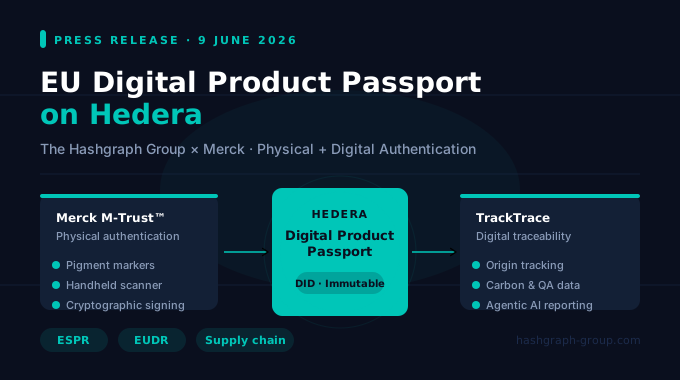
The Hashgraph Group (THG) has announced a strategic collaboration with science and technology company Merck that extends its TrackTrace Digital Product Passport (DPP) platform. Built on the Hedera network and designed to support compliance requirements for the global supply chain industry, the collaboration aims to meet the EU’s incoming product transparency regulations — ensuring product trust, quality, and improved sustainability across physical goods from first mile to last.
The Integration
A Single Trust System for Physical and Digital Proof
The technical integration brings together THG’s Hedera-powered digital traceability infrastructure with Merck’s M-Trust™ physical authentication technology system. The combined architecture provides the global supply chain ecosystem with a unified proof framework: proof of quality, proof of traceability, proof of authenticity, and proof of value transfer — all anchored to Hedera as a single source of truth.
Where TrackTrace creates tamper-proof digital records of a product’s origin and lifecycle, Merck’s M-Trust™ technology adds the layer digital systems alone cannot deliver: verification that the physical product in your hand is the real thing, not a counterfeit.
Chain of Proof Architecture
Physical Authentication — M-Trust™
Invisible security markers embedded into the product and packaging using Merck’s patented pigment technology. Verified at any point in the supply chain via M-Trust™ handheld scanner.
Cryptographic Signing & On-chain Recording
Each physical verification is cryptographically signed and recorded on the Hedera network, creating a permanent and immutable entry in the product’s Digital Product Passport.
Digital Traceability — TrackTrace
Real-time tracking of origin, ethical sourcing, carbon emissions, and quality assurance data. Every tracked process is issued a decentralised identifier (DID) as a verifiable, immutable record.
Independent Audit & Agentic AI Reporting
Any authorised third party can independently audit a product, process, or claim without relying on a central authority. Integrated Agentic AI automates reporting workflows end to end.
An initial supply chain pilot has already been demonstrated, with a full announcement forthcoming. The combined solution is designed to function across any sector where authenticity, provenance, and regulatory compliance are non-negotiable — from foods and pharmaceuticals to luxury goods and industrial components.
Regulatory Context
Regulation Is Raising the Bar
New EU rules are tightening what companies must prove about the products they sell. The collaboration between THG and Merck is designed to support the entire supply value chain in meeting these requirements, with traceability and authentication built into the trust system from the ground up.
ESPR — Ecodesign for Sustainable Products Regulation
Requires Digital Product Passports via QR code detailing a product’s origin, composition, sustainability credentials, and full lifecycle. Taking effect from 2026 onwards.
EUDR — EU Deforestation Regulation
Requires importers of commodities including cocoa, coffee, and timber to provide verified, farm-level traceability data — with deforestation-free certification that can be independently audited.
Reliable product traceability also underpins sustainability commitments, ethical sourcing, carbon reporting, and consumer trust. The consequences of weak traceability are already visible: in 2026, cocoa and food fraud risks have risen sharply due to high commodity prices and strict new regulations, leading to increased adulteration and falsified sourcing documentation.
Leadership
In Their Own Words
“Digital records alone are not sufficient for high-stakes supply chains. Enterprises need to prove the physical product is genuine, not just the paperwork. This unique integration with M-Trust covers all layers from the first mile to the last mile — physical authentication through Merck’s technology and digital verification through TrackTrace — creating the foundation for trusted Digital Product Passports across any industry.”
Stefan Deiss — CEO and Co-Founder, The Hashgraph Group
“Product authentication has always required bridging the physical and digital worlds. Integrating M-Trust’s verification with TrackTrace’s digital traceability creates exactly the kind of end-to-end trust infrastructure that enterprises and regulators are asking for. This is what product authentication looks like when it is built for the scale and complexity of modern supply chains.”
Dr. Thomas Endress — Executive Director, Head of M-Trust, Group Science & Technology Office, Merck
Building Momentum
A Rapid Sequence of Milestones
The Merck collaboration is the latest in a series of platform launches and deployments for The Hashgraph Group as it positions Hedera-based infrastructure for enterprises and governments navigating complex regulatory environments.
EcoGuard carbon credit platform launched — now deployed with government institutions in India and the Philippines.
May 2026
BrandBoost product launched.
Jun 2026
TrackTrace × M-Trust™ integration announced, with EU Digital Product Passport compliance at its core.
With EU Digital Product Passport deadlines approaching and global demand for verifiable supply chain data intensifying, THG is positioning its enterprise Web3 suite for further integrations and sector-specific deployments throughout 2026 and beyond.
About The Hashgraph Group
The Hashgraph Group (THG) is a Swiss-based Web3 and AI technology engineering company operating within the Hedera ecosystem. Specialised in the design, development, and deployment of enterprise-grade solutions on Hedera, THG focuses on building business without barriers by converging agentic intelligence and workflow automation with decentralisation and trusted data infrastructure.
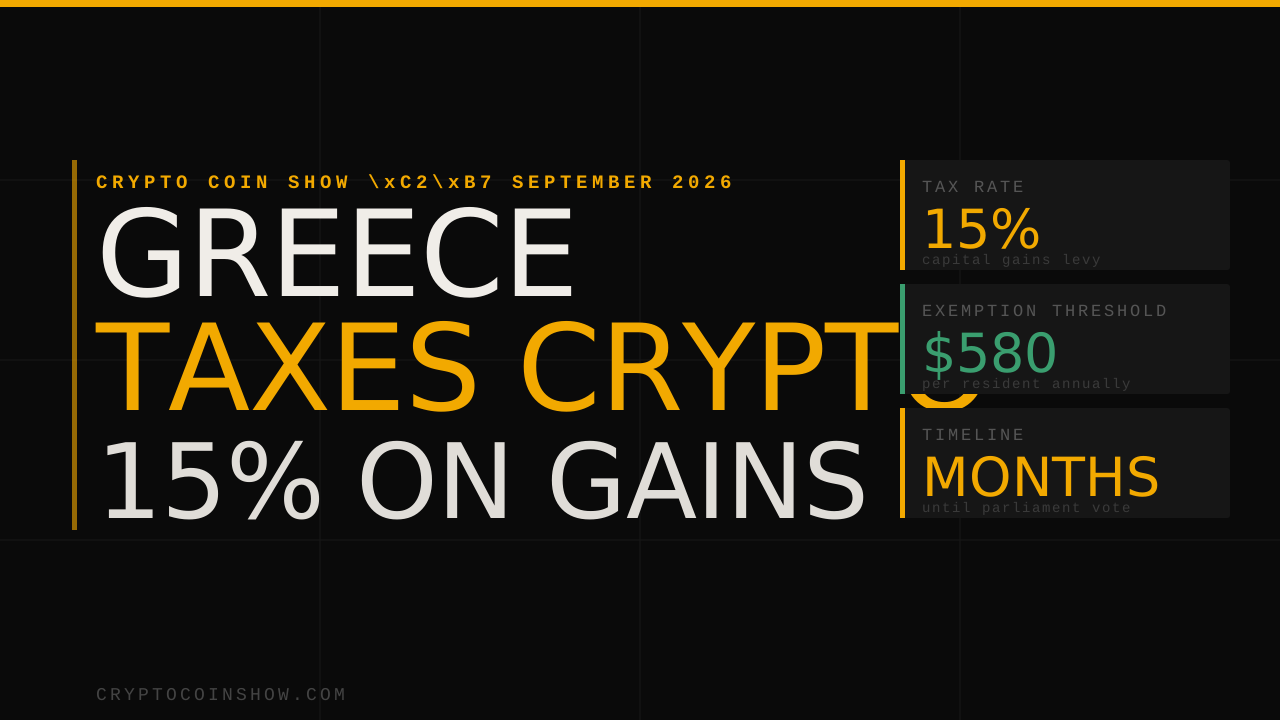
Greece’s Finance Ministry is drafting a bill that would impose a 15% capital gains tax on cryptocurrency profits.
The information was reportedly shared with Reuters by some government officials. If the bill is passed, it would bring digital assets into the country’s formal tax code for the first time.
It is expected to reach parliament in the coming months.
A tax-free threshold and carve-outs for individual miners
The planned regime includes a 500-euro ($580) exemption on gains, meaning residents would owe nothing on their first profits up to that amount, according to one of the officials.
Individual cryptocurrency miners would also be exempt from the new levy; however, that exemption was not extended to corporations engaged in mining.
Both officials acknowledged a practical challenge, which is that estimating the size of Greece’s crypto market is difficult. This is because most Greek investors trade through platforms based outside the country.
No specific revenue projection for the new tax has been published.
Where Greece fits in Europe’s crypto tax patchwork
EU member states each set their own rules on taxing digital assets, and the rates vary across the states.
Cyprus charges 8% on crypto capital gains at the low end, while France applies rates as high as 30%. Greece’s proposed 15% would bring it close to the middle of that range.
This proposed bill is also coming at a time when Athens is working to bring its own crypto regulatory framework up to the EU’s set standards.
Last August, the Hellenic Capital Market Commission (HCMC) overhauled its licensing regime for exchanges and wallet providers to align with the EU’s Markets in Crypto-Assets (MiCA) regulation, as Cryptopolitan reported at the time.
The rules require that platforms must clear a formal licensing process that can take up to 40 working days, and unlicensed providers are barred from offering services in the country.
How does Binance’s bet on Athens come into the picture?
Greece’s regulatory push carries extra weight because Binance, the world’s largest crypto exchange by volume, chose the country as its EU base earlier this year.
Binance co-CEO Richard Teng cited Greece’s talent pool and security environment when explaining the decision at the Global Finance & Technology Network forum in Tokyo, according to Reuters and Greek broadcaster ERT.
The company applied for a MiCA license through the HCMC in January, and Greek regulators signaled they would fast-track the review, Cryptopolitan reported in February.
The tax legislation would add another layer to an environment Athens is building to attract crypto business while ensuring oversight.
Prime Minister Kyriakos Mitsotakis made his intentions to regulate the “dubious” crypto market known as early as January 2025. He reportedly told cabinet members the government aimed to “bring order to a largely ambiguous and unregulated domain.”
Passive income taxed differently
The Waltio tax guide for Greece outlines the current Greek framework, pointing out that gains from staking, mining, and airdrops fall under the progressive income tax scale rather than the flat 15% rate.
That scale runs from 9% on the first 10,000 euros of income to 44% on amounts above 40,000 euros. Crypto-to-crypto swaps also count as taxable events, with the gain calculated at the moment of the exchange.
Capital losses can be carried forward for five years to offset future gains, and the filing deadline for crypto-related income is June 30 of the year following the tax period, according to Waltio’s summary of the legislation.
The proposal is not final
The bill still needs to clear parliament, and final details could shift before submission. Investors trading through foreign platforms face an open question about enforcement, given that Greek authorities have acknowledged limited visibility into offshore activity.
The July 2026 MiCA licensing deadline for crypto firms across the EU will add further pressure on Athens to have its tax and regulatory framework fully in place.
Patrick Hansen, Circle’s EU strategy and policy lead, says the bloc’s crypto tax revenue projections may fall short. The European Commission has modeled up to $23 billion across the 2028 to 2034 EU budget cycle.
Hansen argued that a transaction-based crypto tax would push users toward DeFi protocols. Self-custody wallets and non-EU venues would erode the centralized exchange volume Brussels expects to capture.
What the Commission’s Proposal Includes
The leaked Commission services paper outlines two crypto tax models for member states to consider:
A 0.1% levy on the value of crypto transactions could generate $3.5 billion to $4.7 billion per year.
Crypto-asset service providers (CASPs) would act as collection and reporting points.
A separate capital gains tax on realized crypto profits would raise an estimated $1.2 billion to $2.8 billion annually.
Combined, the two options could yield close to $23 billion across the seven-year EU budget. Officials acknowledge the figures depend on market volatility.
Capital gains taxation generally would not apply to dollar-pegged tokens either, given their minimal price movement.
Why Hansen Thinks the Forecast Misses
Hansen pointed to three structural weaknesses in the modeling:
Reliable data from DAC8, the EU’s crypto reporting framework, will only arrive from 2027. Early estimates rest on incomplete inputs.
The proposal also requires unanimous Council approval and a harmonized EU tax base.
France has pushed hardest for new EU revenue sources. Crypto tax compliance burdens and resistance from exchange-heavy economies like Malta could harden opposition.
The behavioral risk looms largest, according to Hansen.
Users facing a centralized exchange levy can move activity to self-custody wallet options, DeFi protocols, or non-EU platforms. Any transaction tax depends on that volume.
“Any transaction-based crypto tax would likely accelerate migration towards non-taxed channels…and/or non-taxed assets…In practice, imo, that would significantly reduce the revenue potential on which these projections are based,” he stated.
Cyprus, which holds the rotating Council presidency, plans to share a revised budget proposal around June 10.
The outcome will signal whether crypto stays on the menu, and how it interacts with the bloc’s MiCA review consultation.