ETHWomen Returns to Toronto, Bringing Together Women Building the Future of Web3 and AI
A full day of networking, learning, and community takes over July 22 as part of Canada Crypto Week.
LOCATION:Toronto, ON
DATE:July 22, 2026
ETHWomen returns on July 22, 2026, bringing together women from across the Web3 and AI industries. As part of Canada Crypto Week, the event features networking, educational sessions, and community-driven experiences designed to foster connection and collaboration.
Now in its fifth year, ETHWomen continues to bring together an incredible community of women who are helping shape the future of Web3 and AI.
Featured Speakers Include:
Eve Lam, Morgan Stanley
Jaime Leverton, ReserveOne
Dr. Guneet Kaur, CCN
Lalla Asmaa Alaoui, Hello Agentic
Amber Scott, Outlier Ventures
Laura Leparulo, Futurist Conference
Ashley Wright, The Wright Success
Karin Kusano, Association for Women in Cryptocurrency
Along with more than 30 women speakers from across the Web3, AI, finance, and technology industries.
Community Experiences
In addition to speaker sessions, ETHWomen will feature a series of community experiences including:
SheFi Morning Social Breakfast presented by SheFi
Facilitated Networking presented by the Association for Women in Cryptocurrency (AWIC)
Book Signings with Amanda Wick, Audrey Nesbitt, and Annelise Osborne
The SheFi Morning Social Breakfast presented by SheFi kicks off ETHWomen with breakfast and community-building alongside one of the largest women’s networks in Web3. SheFi is known for its 8-week MBA-style program, global community events, and career development opportunities designed to help women grow in the Web3 industry.
Supporting Organizations
ETHWomen is proud to bring together a growing network of organizations supporting women in Web3, including:
CryptoChicks
SheFi
Association for Women in Cryptocurrency (AWIC)
FemTech
Babes Net
Women in Blockchain Canada
ShibWomen
Attendance is free and open to women, allies, founders, builders, investors, students, and professionals interested in the future of technology.
ETHWomen is part of the larger Futurist Conference, bringing together leaders, innovators, and builders across the blockchain and AI ecosystem during Canada Crypto Week.
Exclusive Code: Use code CCSHOW25 for special pricing
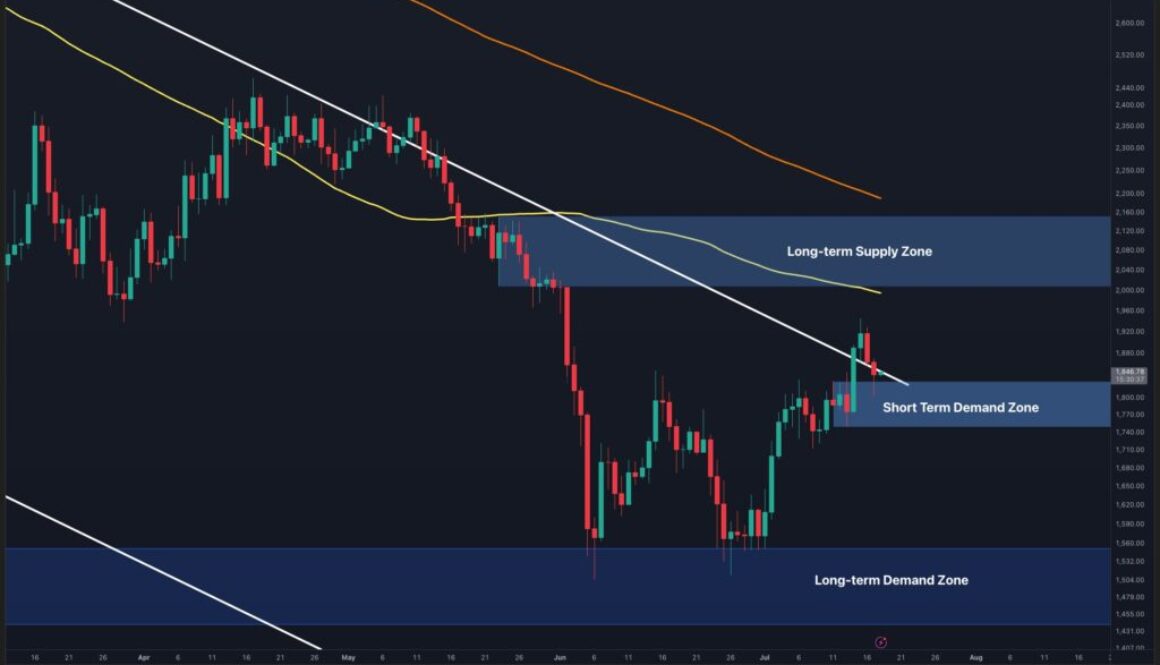
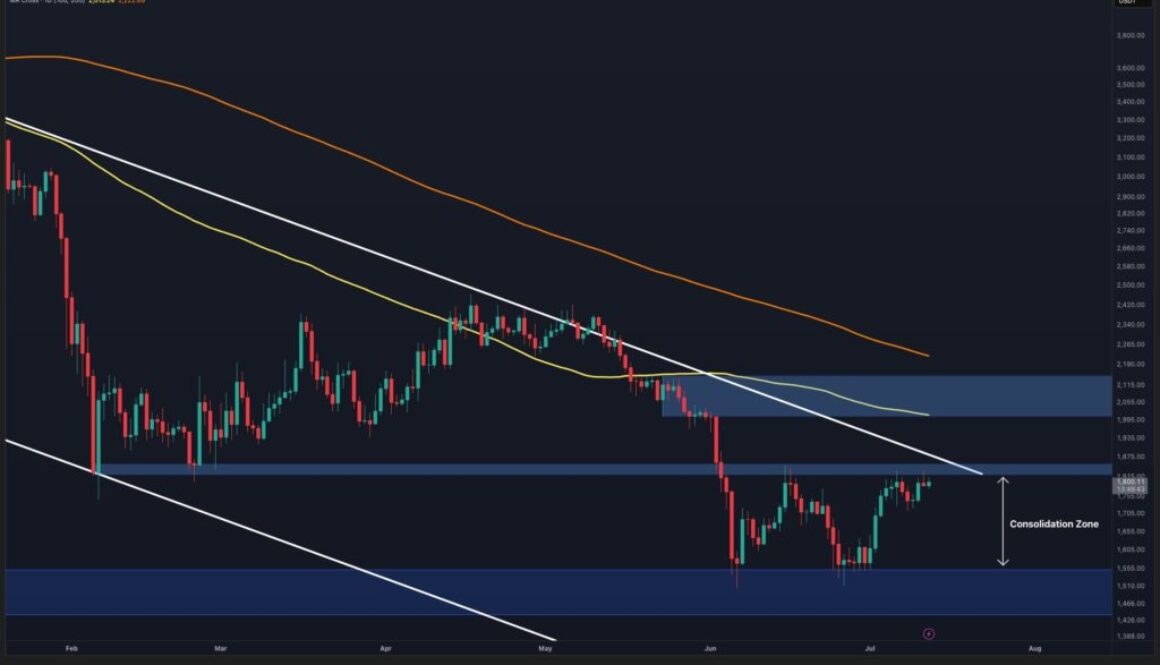
Ethereum is back in a level-by-level technical fight after a TradingView analyst mapped out a short-biased setup that puts the market’s attention on whether ETH can hold near equilibrium or slide toward a deeper demand zone.
TL;DR
TradingView analyst Champ_of_Gold says ETH has reacted from an institutional supply area.
The setup highlights $1,718.5 as an immediate reaction level.
The analyst’s deeper demand target sits around $1,562.7 down to the $1,500 psychological zone.
ETH was trading around $1,765 at the time of writing, leaving the setup close enough to matter for short-term traders.
The analysis, published on TradingView under the title “ETHUSD: The Road To Demand”, frames the current ETH structure as a possible shift from premium pricing back toward discount levels. The analyst says price had moved into a supply zone between roughly $1,732.4 and $1,761.9 before showing a change of character on a lower time frame.
ETH Price Setup Turns On The $1,718 Area
The key level in the post is $1,718.5, described as an equilibrium point where ETH was reacting after tapping the supply area. A clean break beneath that area, in the analyst’s view, would open the door to a liquidity sweep lower.
That does not mean the move is guaranteed. It does, however, give traders a clear map: if ETH holds above the reaction zone, the bearish continuation idea loses urgency. If price breaks below it, the chart shifts toward the lower target zone where buyers may look for a stronger response.
Demand Zone Becomes The Main Watch Area
The projected downside destination in the TradingView post sits around $1,562.7 to $1,500. That band is important because it combines a previous demand area with a large psychological level. In market-analysis terms, these zones often become places where traders expect either a reaction or a continuation failure.
Current market data shows ETH trading near $1,765, with the asset up on the day after an intraday low near $1,704. That means ETH has not yet confirmed the deeper breakdown described in the setup, but the distance between spot price and the key invalidation/reaction levels is narrow enough to keep the chart relevant.
What Would Invalidate The Bearish Read?
The analyst places invalidation above the supply-zone high. In plain English, ETH needs to reclaim and hold above the zone that sellers are expected to defend. A move like that would challenge the short-biased interpretation and could force traders to reassess whether the current pullback is just a reset before another attempt higher.
For now, the setup leaves ETH traders watching two things: whether the $1,718 area gives way, and whether any move lower draws a meaningful bid before the $1,500 region comes into play.
This article was written by the News Desk and edited by Samuel Rae.
This article is based on technical analysis by Champ_of_Gold, available at TradingView
In times when investors are pulling funds out of the spot exchange-traded funds tracking ETH and especially BTC, their behavior toward XRP, HYPE, and SOL has been entirely contrasting.
The ETFs following the three altcoins’ performances continue to see more net inflows even as the market stagnates and uncertainty builds.
XRP, SOL, HYPE ETFs Keep Gaining Capital
CryptoPotato has repeatedly reported on the Ripple ETFs’ impressive performance over the past several weeks, in which most assets, including XRP, recorded fresh losses and dipped to multi-year lows. However, investors using the Wall Street-trading financial vehicles have remained active, with net inflows dominating for months. In fact, there have been only two weeks in the red since mid-March.
The last one, which had only four trading days, also ended in the green. The ETFs attracted $2.82 million on Monday, $5.30 million on Tuesday, and $2.55 million on Thursday. Since Wednesday was a $0.00 day, according to SoSoValue data, that means that the week ended with net inflows of $10.66 million. The cumulative net inflows have tapped a new all-time high of $1.45 billion.
The Solana ETFs also attracted over $7 million in net inflows in the past week, following a red one with $2.58 million in net outflows. HYPE and its ETFs continue to be the current market superstar. The funds saw their third-best week to date, with almost $28 million entering. Moreover, the HYPE ETFs have been on a six-week streak of net inflows since their inception in mid-May.
Their performance has been particularly promising since they have attracted nearly $185 million in net inflows in six weeks. The same six weeks have been highly emotional and full of FUD for the entire crypto market, especially June’s start when most assets tumbled to multi-year lows.
Net Inflows Spot HYPE ETFs. Source: SoSoValue
BTC, ETH ETFs Deep in Red
And while the aforementioned altcoins continue to enjoy fresh ETF capital, the same cannot be said for the funds tracking the two largest cryptocurrencies by market cap. As reported earlier, the spot BTC ETFs bled more than $226 million in the past week, and are down by roughly $5 billion in the same six weeks in which the HYPE and XRP ETFs have been only in the green.
The spot Ethereum ETFs are in no better shape. In fact, they are on the same six-week negative streak, pushing the total inflows down by nearly $1 billion. So the question now is whether investors are simply seasonally rotating from larger-cap digital assets into smaller altcoins, or have they completely abandoned BTC and ETH for the new kids on the block.
Robert Kiyosaki says he is watching gold, silver, Bitcoin (BTC), and Ethereum (ETH) for a technical reversal before buying, arguing that the macro backdrop, not falling prices, decides whether hard assets are worth holding.
Precious metals extended a steep retreat this week, and a fresh dispute over the Strait of Hormuz tested a days-old US-Iran ceasefire. BTC and ETH edged higher over 24 hours.
Bitcoin and Ethereum Prices After Reported Strait Closure. Source: Coingecko
Kiyosaki Watches Gold and Silver Context, Not Price
Kiyosaki built his case around the environment rather than the chart. The Rich Dad Poor Dad author said a falling market alone never tells him whether to buy or sell.
He pointed to whether political and banking leaders are fixing the economy or making it worse, and has called dips buying opportunities before.
“I have learned to understand the ‘context’ or the environment the asset is in….not the price… So I am watching prices of gold, silver, Bitcoin, and Ethereum on technical charts and will buy when prices reverse their decline,” Kiyosaki wrote in a post.
The metals he is eyeing set records before the pullback. Gold hit an all-time high near $5,595 an ounce in late January and silver topped $100 for the first time.
Both records capped a run nearly doubling gold and quadrupling silver in a year.
This week’s ceasefire then drained the safe-haven premium the February war and Hormuz threats had rebuilt.
Kiyosaki keeps backing silver and Bitcoin and claims the charts point to a rebound, with no price target or timeline.
Hormuz Dispute Keeps the Safe-Haven Bid Alive
The backdrop Kiyosaki described stayed unsettled. Iran’s Revolutionary Guard declared the Strait of Hormuz closed over alleged ceasefire violations and warned vessels away.
Vice President JD Vance countered that no evidence backed the claim. Vance said the waterway stayed open, and CENTCOM reported 55 ships moving more than 17 million barrels of oil through Hormuz on Saturday.
That is close to the 20 million a day, about a fifth of global oil demand, the EIA says the strait normally carries.
Bitcoin traded above $64,000, up about 1.4%, while ETH held near $1,740, with both gains following developments at the Strait of Hormuz.
Even so, BTC sits roughly 49% below its October record near $126,000 and ETH about 65% under its August peak, with BTC down about 17% and ETH 18% over the past month.
Earlier Hormuz tensions dragged Bitcoin lower, and a US strike on Iran under the truce sent Bitcoin, gold, and oil moving within hours.
With US-Iran talks set for Switzerland on Sunday, the next signal is whether the ceasefire holds. For Kiyosaki, the charts rather than the headlines will decide his next move.
Tokenized gold is moving deeper into crypto lending markets.
Digital asset lender Ledn has added Tether Gold, or XAU₮, as collateral for loans, according to its official announcement. The move gives borrowers another way to access liquidity without selling a tokenized claim on physical gold.
TL;DR
Ledn has added Tether Gold as a supported collateral asset for loans.
Borrowers can access liquidity against XAU₮ rather than selling the asset outright.
Ledn says collateral is held 1:1 and is not rehypothecated.
The product excludes residents of Canada and the European Union, so availability is not global.
A new collateral lane for tokenized gold
Ledn has historically been closely associated with Bitcoin-backed lending. Adding Tether Gold widens that model into the real-world asset market, where tokenized commodities have become a growing part of crypto’s institutional story.
XAU₮ is designed to represent exposure to physical gold, while still moving as a digital asset. By accepting it as collateral, Ledn is effectively treating tokenized gold as something borrowers can pledge for liquidity in much the same way they might use Bitcoin or other supported assets.
The practical appeal is straightforward. A holder who does not want to sell XAU₮ can borrow against it instead. That may help avoid losing exposure to gold while still accessing stablecoin liquidity for other uses.
The custody model is the key claim
The most important part of Ledn’s announcement is the custody language. The company says collateral is held 1:1 and is not rehypothecated or lent out to generate yield.
That point matters because crypto lending has a long memory. After the failures of several high-yield lenders in the last cycle, users are much more sensitive to how collateral is held, whether it is reused, and what happens during market stress.
A non-rehypothecation model is easier to explain to borrowers because it reduces one of the more obvious forms of counterparty risk. It does not remove all risk, but it gives the product a cleaner structure than lending models that depend on recycling client collateral through yield strategies.
Why this fits the RWA narrative
The timing also fits the broader real-world asset trend. Tokenized Treasuries, tokenized gold, stablecoin reserve products, and collateralized lending are all part of the same movement: bringing familiar financial assets into crypto-native rails.
Gold is especially interesting because it sits between old and new market habits. It is one of the oldest reserve assets, but tokenized versions make it easier to move, pledge, and integrate into digital lending platforms.
The caveat is access. Ledn’s product is not available everywhere, and the company specifically excludes Canada and the European Union. That should keep expectations grounded. This is not a universal product launch, but it is another sign that tokenized commodities are becoming more useful inside crypto credit markets.
That gives the story a wider market angle. Tokenized gold is not trying to replace Bitcoin’s role in crypto lending, but it gives lenders and borrowers another type of collateral with a very different risk profile. Bitcoin collateral is tied to crypto market beta, while gold-linked collateral is often framed around preservation, hedging, and liquidity. In a market where borrowers increasingly want more choice, that distinction matters.
This article was written by the News Desk and edited by Samuel Rae.
This report is based on information from Ledn. at Ledn
Ethereum developers are discussing an asset-level spend mandate for delegated wallets.
The idea is to bound agent spending with caps, expirations, allowed tokens, and revocation rules.
The proposal is aimed at safer AI-agent and delegated onchain payments.
It is still an early discussion draft, not a finalized ERC standard.
A Proposal Built For Delegated Onchain Spending
Ethereum developers are beginning to wrestle with a practical problem that is only going to get larger: what happens when autonomous agents, delegated wallets, or external scripts are allowed to move funds? In a normal wallet flow, the user signs each transaction. In an agent-driven flow, the user may grant permission once and expect software to act within limits.
The asset-enforced spend mandate proposal tries to place those limits at the token level. Rather than relying only on a wallet, session key, or application policy, the asset itself would consult a gate before allowing transfers. That gate could enforce rules such as per-transaction caps, expiration dates, allowed tokens, and revocation status.
Why The Asset Layer Matters
The key design idea is that controls should travel with the token, not just with a specific wallet interface. If an AI agent’s key is compromised, or if a session goes wrong, the token can still reject transfers that exceed the approved mandate. That is important because many onchain losses happen when approvals are too broad and users do not fully understand what they have authorized.
The proposal describes a small interface that can tell whether an address is gated and whether a transfer is allowed. More importantly, it introduces a machine-readable reason vocabulary. Instead of a failed transfer simply reverting with little context, the system could say whether the request failed because there was no mandate, the mandate expired, it was revoked, the token was not allowed, or the amount exceeded the transaction cap.
AI Agents Raise The Stakes
AI-agent wallets are still early, but the direction is obvious. If bots are expected to rebalance portfolios, pay invoices, manage treasury sub-accounts, or interact with DeFi protocols, users will need more than a simple yes-or-no approval. They will need boundaries that are readable, enforceable, and revocable.
That puts this proposal in the same broad family as account abstraction, delegated signing, and regulated-token pre-transfer checks. It is not trying to solve identity, compliance, or every possible permissioning problem. Instead, it focuses on a narrow safety primitive: what a holder may spend, enforced by the asset rather than by the agent’s good behavior.
Still Early, But Timely
The proposal is not a finalized ERC and has not been merged into Ethereum’s standards process. It is being floated for early feedback, which means details could change or never reach production. Still, the timing is notable. Crypto is moving toward more automated wallets, more tokenized assets, and more delegated transaction flows. Without stronger permission controls, the convenience of agentic finance could quickly turn into a new attack surface.
For Ethereum builders, the important question is whether spend limits should live primarily in wallets, apps, or assets. This proposal argues that the token contract itself should have a role. If adopted in some form, that could make AI-agent payments safer without forcing every application to rebuild its own permission system from scratch.
This article was written by the News Desk and edited by Samuel Rae.
Geneva, Switzerland, June 15, 2026 — TRON DAO, the community-governed DAO dedicated to accelerating the decentralization of the internet through blockchain technology and decentralized applications (dApps), participated in ETHConf, held June 8–10 in New York, organized by ETHGlobal. TRON DAO also extended its presence throughout the week with a dedicated TRON Academy Happy Hour alongside the ETHGlobal New York 2026 hackathon, held between June 12–14. Supporting developer education and student-led blockchain innovation through TRON Academy, whose university network now spans across leading institutions like Princeton University, Imperial College London, Yale University, Columbia University, Harvard University, MIT, Cornell University, the University of California, Berkeley, University of Oxford, University of Cambridge, Dartmouth College and more.
At ETHConf, one of Ethereum’s premier ecosystem conferences, the TRON DAO team connected with builders, founders, and technologists shaping the next wave of decentralized applications, policy regulations, and real-world blockchain adoption.
Alongside ETHGlobal New York, TRON Academy powered by niTROn co-hosted a Happy Hour with Princeton Blockchain Club at Anytime Billiards NYC, supported by a coalition of leading student blockchain organizations: Blockchain Chicago, Blockchain at Columbia, Blockchain at Emory, Blockchain & Fintech at Fordham, NYU Blockchain Lab, and Penn Blockchain. The session drew more than 70 participants from across the student and developer communities.
The happy hour also featured a panel, “Campus to Mainnet: How Student Builders Will Shape the Future of Blockchain,” moderated by TRON DAO’s ecosystem development team, with student panelists representing Blockchain Chicago, Blockchain & Fintech at Fordham, Penn Blockchain, and NYU Blockchain Lab. The discussion explored how stablecoins and digital dollars are unlocking real-world use cases across payments, cross-border settlement, and how campus clubs are moving from learning to launching real projects. Panelists also weighed the skills and career paths shaping the next wave of Web3, including the emerging role of AI agents and onchain payments.
By meeting students and developers where they build, TRON DAO continues to widen access to the people, resources, and hands-on exposure that turn early curiosity into lasting contribution across the decentralized economy. For more information about TRON’s initiatives and upcoming events, please visit TRON DAO’s official website.
About TRON DAO
TRON DAO is a community-governed DAO dedicated to accelerating the decentralization of the internet via blockchain technology and dApps.
Founded in September 2017, the TRON blockchain has experienced significant growth since its MainNet launch in May 2018. Until recently, TRON hosted the largest circulating supply of USD Tether (USDT) stablecoin, which currently exceeds $89 billion. As of June 2026, the TRON blockchain has recorded over 387 million in total user accounts, more than 14 billion in total transactions, and over $25 billion in total value locked (TVL), based on TRONSCAN. Recognized as the global settlement layer for stablecoin transactions and everyday purchases with proven success, TRON is “Moving Trillions, Empowering Billions.”
Sen. Elizabeth Warren (D-Mass.), in yet another attack on big tech, has called on the SEC to delay SpaceX’s planned initial public offering.
Wall Street was already having arguments over whether or not a $1.75 trillion price tag can be justified, and now Senator Warren has intervened just days before SpaceX is set to begin trading on the Nasdaq under the ticker SPCX.
Why does Senator Warren think the SpaceX IPO is risky?
Senator Elizabeth Warren has formally asked the U.S. Securities and Exchange Commission (SEC) to delay the IPO of Elon Musk’s SpaceX that was scheduled to begin trading on the Nasdaq as early as June 12 under the ticker “SPCX.”
Cryptopolitan’s earlier reporting states that SpaceX plans to list 555 million Class A shares priced at $135, aiming to raise roughly $75 billion. At the current target price, the offering would be the largest in U.S. history, with a valuation of approximately $1.75 trillion.
Warren, a Democratic senator from Massachusetts known for her criticism of large corporations, has built a reputation for intervening in major financial events.
Senator Warren wrote a letter to SEC Chair Paul Atkins in which she laid out several specific concerns including that the IPO is structured in a way that puts regular, non-professional investors at a disadvantage.
She argues that the $1.75 trillion price tag may be severely overvalued.
Wall Street analysts are also deeply divided over whether the company is actually worth its massive price tag. The target price gives SpaceX a price-to-sales (P/S) ratio of about 103 to a revenue of $19.3 billion over the last four quarters. This ratio is roughly 40% higher than Palantir, the current most expensive stock in the S&P 500.
Recently, rules have changed that could force major stock indexes to add SpaceX very quickly after its debut. If the stock is overpriced, index funds would have to buy it at that high price anyway, which could spread the risk of a price crash to millions of retirement savings accounts that track these indexes.
Warren has a history of launching investigations during politically charged moments. In May 2026, she investigated the approval of national charters for crypto companies like Coinbase and Ripple, accusing the government of letting them bypass banking rules.
She has sent formal demands for records to agencies ranging from the Treasury to the OCC, and her office has tracked more than a dozen separate investigations targeting the Trump administration since January.
She has also raised alarms about the rising energy costs of AI data centers, accusing private equity firms of buying utility companies to profit from the AI boom while raising prices for consumers.
Is SpaceX actually worth $1.75 trillion?
Cryptopolitan previously reported that Morningstar analyst Nicolas Owens pegged the company’s fair value closer to $780 billion, roughly half the IPO target. He said he expects investors will get a chance to buy at a lower price after the debut.
SpaceX posted a $1.9 billion operating loss in the first quarter of 2026, dragged down by xAI, which alone burned through $2.5 billion in the same period. Starlink remains profitable, generating $4.4 billion in operating income, but the satellite business cannot offset losses from Musk’s AI ambitions on its own.
Beyond the company’s financial reality and the warnings from Senator Warren and financial analysts, history shows that the 10 largest U.S. IPOs by initial market cap have trailed the S&P 500 by an average of 127 percentage points since listing.
A Motley Fool analysis of more than 100 technology stocks found only eight that ever reached 100 times sales, and all of them suffered average peak-to-trough declines of 75%.
Still, there are two large cloud computing contracts that can bolster SpaceX’s revenue outlook. An SEC filing disclosed that Google will pay the company $920 million per month from October 2026 through June 2029 for access to roughly 110,000 Nvidia GPUs.
The company has a similar deal with Anthropic for full access to SpaceX’s Colossus 1 facility in Memphis, Tennessee, which houses more than 220,000 Nvidia processors. Together the contracts carry a combined value above $70 billion if neither is terminated early.
On an annual basis, those two deals alone would generate $26 billion in revenue. Investor Ron Baron has predicted SpaceX could eventually reach $30 trillion in value, and Goldman Sachs has told prospective buyers that the company’s total revenue could exceed $474 billion by 2030.
Circle has launched cirBTC on Ethereum, but the larger play is to make wrapped Bitcoin look like collateral infrastructure institutions can route through DeFi, OTC desks, lending markets, treasury systems, market makers, and settlement flows.
cirBTC is live on Ethereum and backed 1:1 by native BTC, according to Circle’s launch materials. The company says the underlying Bitcoin is held through a Circle entity, segregated from corporate assets, and designed for onchain reserve visibility.
The product also sits inside Circle’s existing stack. Circle is positioning cirBTC around Circle Mint, USDC workflows, Ethereum DeFi, and planned support for Arc and other chains.
This moves wrapped Bitcoin into an issue of trust. BTC itself does not move natively through Ethereum contracts, so any wrapped version asks users to trust a claim on Bitcoin held somewhere else.
For retail DeFi users, that can be a bridge decision. For institutions, it is a collateral decision: who holds the keys, how reserves are checked, what happens during redemption, and whether the operational process can survive internal risk review.
Circle is selling custody before yield
Circle’s cirBTC pitch starts with the same basic promise as other wrapped Bitcoin products: one token for one BTC. The difference is the operating package around that promise.
Its materials say cirBTC is backed by native BTC, reserves are separated from corporate assets, and counterparties can verify reserves onchain. Circle also ties the product to the same institutional interface many firms already use for USDC issuance and redemption.
A desk that already moves USDC through Circle Mint could, in theory, add BTC collateral to the same account-and-settlement relationship instead of stitching together a separate custodian, wrapper, exchange, bridge, and DeFi access point.
The proof-of-reserve component supports that positioning. Proof of Reserve systems can help tokenized assets and DeFi protocols monitor backing data onchain and build safeguards around undercollateralization.
For cirBTC, the next live signal is the reserve feed or dashboard counterparties can use for the token itself.
That leaves counterparty trust in place. cirBTC still depends on custody, redemption, reserve controls, and user confidence in Circle’s process.
The institutional pitch is that those assumptions can be packaged in a cleaner way, with the BTC claim, reserve visibility, and Circle account relationship pointing in the same direction.
The comparison is clearest against cbBTC and WBTC.
Coinbase’s cbBTC is also a 1:1 BTC-backed wrapped asset, held in Coinbase custody and available across Base, Ethereum, Solana, and Arbitrum.
Coinbase also maintains a proof-of-reserves page, giving users a public reserve and supply reference for the product. Availability and terms can vary by jurisdiction.
WBTC remains the incumbent Bitcoin wrapper in Ethereum DeFi. Its own site presents WBTC as backed 1:1 by Bitcoin, with a public reserve dashboard and proof-of-reserve context.
Circle’s opportunity sits in the trust bundle it can offer: the USDC issuer, Circle Mint, reserve transparency, Ethereum access, and future Arc support under one institutional brand.
Product
Main trust promise
What is known now
Open test
cirBTC
Circle-backed BTC collateral for institutional workflows
Live on Ethereum, backed 1:1 by native BTC, with Circle stating reserve segregation and onchain visibility
Whether liquidity, protocol listings, and reserve feeds make it usable as collateral at scale
cbBTC
Coinbase custody and exchange-account workflows
Backed 1:1 by BTC held by Coinbase, with listed support across Base, Ethereum, Solana, and Arbitrum
Whether Circle can compete with Coinbase distribution and Base-native lending activity
WBTC
Incumbent DeFi collateral with public reserves
Backed 1:1 by BTC with a public reserve dashboard and proof-of-reserve context
Whether institutions prefer an incumbent DeFi asset or a Circle-controlled operating model
The comparison shows why cirBTC is more than a token launch. Wrapped Bitcoin products increasingly compete on the legal and operational identity of the issuer, the visibility of reserves, and the pathways by which collateral enters lending markets.
Coinbase has already tied cbBTC to lending through Base. CryptoSlate reported that Coinbase and Morpho introduced Bitcoin-backed loans on Base, using cbBTC and USDC in a consumer-facing borrowing flow.
That comparison shows the distribution Circle has to challenge if cirBTC is to become more than another Ethereum asset.
Circle’s Arc ambitions give cirBTC a second layer of meaning.
Arc is being pitched as infrastructure for stablecoin finance, with USDC fees, settlement tooling, privacy controls, and institutional use cases around payments, foreign exchange, tokenized assets, and capital markets.
Circle has described Arc as a chain purpose-built for stablecoin finance, and CryptoSlate has previously reported how the network pushes Circle deeper into territory also occupied by Coinbase and Base.
In that context, cirBTC could become the Bitcoin leg of a broader Circle stack. USDC provides the dollar asset. Circle Mint provides issuance and redemption access. Ethereum provides current DeFi reach.
Arc, if it develops as planned, could give Circle a venue where tokenized dollars, BTC collateral, and settlement workflows operate with fewer handoffs.
The record remains early. Circle says cirBTC is live on Ethereum and points to planned Arc and multichain support. Its launch materials stop short of showing broad DeFi protocol adoption, live Arc usage for cirBTC, or a supply figure that would show market depth.
A token can be fully backed and still fail to become preferred collateral.
Institutions and DeFi protocols still need liquidity, risk parameters, redemption confidence, oracle support, and a clear reason to add another BTC wrapper beside existing options.
The broader market context is already moving in that direction. CryptoSlate recently framed a Morgan Stanley and Galaxy arrangement as part of Bitcoin’s next institutional test in lending collateral.
The cirBTC launch fits that same issue: Bitcoin can become useful collateral for institutions when the custody and risk controls around the token are strong enough to satisfy the people managing the real BTC.
Arc also gives the Coinbase comparison more weight. Coinbase can route cbBTC through Base and its own account system; Circle is trying to offer a parallel route built around USDC, Mint, and Arc.
The adoption contest centers on which issuer can turn custody relationships into liquidity.
Acceptance decides whether the wrapper becomes infrastructure
Circle has the right ingredients for a bank-grade wrapper: a known issuer, reserve language, onchain verification, institutional access, USDC proximity, and an Arc roadmap.
Collateral infrastructure comes later, when counterparties use those ingredients in production.
That means lenders need to accept the asset, market makers need to quote it, treasury teams need clean redemption, DeFi protocols need collateral parameters, and risk desks need confidence in the reserve process.
Users also need to move between BTC exposure and dollar liquidity without wondering where the real Bitcoin sits.
That is where cirBTC will face WBTC and cbBTC. WBTC has incumbent DeFi familiarity. Coinbase has distribution, custody, and Base workflows.
Circle has USDC, Mint, compliance credibility, and an ambition to own more of the settlement stack through Arc.
Circle can turn wrapped Bitcoin into institutional collateral infrastructure if cirBTC becomes the wrapper institutions choose because the custody, reserve, and redemption model lowers operational friction.
If liquidity stays elsewhere and Arc remains future context, cirBTC will still read as a product launch rather than infrastructure.
For now, Circle has changed the frame around wrapped BTC. The debate now centers on who institutions trust to hold the Bitcoin while the token moves through programmable finance.
Ethereum’s slide to its lowest level in more than a year is testing the Wall Street trade that brought the token deeper into institutional portfolios.
Data from CryptoSlate shows that the second-largest cryptocurrency fell to as low as $1,506 during the last 24 hours, its weakest level since April 2025, extending a broad crypto selloff that has already drained leverage from derivatives markets and pushed traders toward defensive positioning.
Crucially, the downswing is not confined to ETH’s spot market as the digital asset is also experiencing a broader deterioration across regulated ETF flows, centralized exchange deposits, and derivatives positioning.
This situation comes at a time when the broader crypto market sentiment has significantly weakened, with Bitcoin falling toward a four-month low near $60,000, while Ethereum has erased much of its market support.
ETF outflows weaken Ethereum’s institutional bid
The pressure has been most visible in the ETF market, where the products that gave institutions a regulated way to buy Ethereum have turned into a source of persistent outflows.
Data from SoSoValue shows that spot ETH ETFs have recorded four straight weeks of withdrawals totaling more than $870 million.
Ethereum ETFs Weekly Flows (Source: SoSoValue)
During that period, the funds posted a 17-day outflow streak interrupted by only one day of inflows, when investors added $19.3 million.
As a result, sosoValue data show total spot Ethereum ETF assets have declined more than 70% from their $30 billion peak to $8.71 billion, which is equal to about 4.01% of Ethereum’s circulating market capitalization.
The reversal has weakened one of the main arguments behind Ethereum’s institutional expansion. The ETFs were expected to broaden access to the asset, deepen liquidity, and give traditional investors a cleaner way to gain exposure without handling tokens directly.
However, that demand has softened as ETH’s price moved lower and investors have reduced risk across digital assets.
Exchange inflows add another supply risk
As institutional demand-side forces abated, the physical supply available on liquid trading platforms experienced a sudden and substantial expansion.
CryptoQuant data show Ethereum inflows to trading platforms climbed to about 2.24 million ETH in a single day, the highest level in four months. Binance accounted for more than 1.16 million ETH of those inflows, representing more than half of the total.
Ethereum Exchange Inflows (Source: CryptoQuant)
This surge in active supply can be seen in high-profile on-chain movements that served as glaring evidence of the liquidity migration.
Notably, a wallet linked to Ethereum co-founder Joseph Lubin awoke after more than three years of dormancy, mobilizing 80,001 ETH, valued at roughly $122 million.
The massive transfer epitomized the broader trend where long-inactive capital breaks from cold storage to seek out active trading venues and liquid architectures amid the mounting market stress.
Large inflows to trading platforms do not automatically mean investors are selling. They can reflect market-making activity, collateral movement, internal transfers, or portfolio restructuring during periods of stress.
However, traders watch the metric closely because coins held on exchanges are easier to sell or use in derivatives activity than coins sitting in private wallets.
The timing has made the increase harder to dismiss. Ethereum was already trading near $1,580 when the inflows accelerated, while Bitcoin had fallen toward $59,000. That combination suggested investors were moving assets during a marketwide reset rather than during a routine period of repositioning.
If exchange deposits remain elevated, the market could face additional short-term volatility.
Derivatives deleveraging deprives market of rebound capital
The velocity of the current crypto market decline has been accelerated by an extensive deleveraging cycle across leveraged futures platforms.
As spot valuations rapidly deteriorated, automated liquidation engines on major exchanges systematically closed out underwater long positions to protect clearinghouse integrity, amplifying organic selling pressure.
Data analyzed by Santiment illustrates that this liquidation wave effectively flushed out a massive block of speculative capital over a narrow four-day window:
Bitcoin Total Open Interest: Contracted by approximately 25%, dropping to $23.2 billion, which is its lowest operational aggregate since early April.
Ethereum Total Open Interest: Decreased by 13%, settling at $9.8 billion, a structural low point not seen since March.
Bitcoin and Ethereum Open Interest (Source: Santiment)
While this aggressive deleveraging leaves the underlying market structurally healthier by purging speculative excess and over-extended margin, it introduces an immediate liquidity vacuum.
The severe drop in open interest demonstrates that the speculative floor has thinned, leaving the market highly vulnerable to further spot pressure due to the lack of immediate leveraged capital available to front-run a classic V-shaped recovery.
Consequently, retail crowd sentiment has cratered to its most pessimistic footing since mid-February.
The firm noted that social metrics reveal an exponential increase in the phraseology of capitulation, with organic social discussions increasingly pairing terms like “Bitcoin” and “altcoins” alongside terminal descriptors such as “dead,” “finished,” “over,” and “ending.”
Traders hedge for a break below $1,500
The buildup of stress across ETFs, exchange flows, whale cost bases, and leveraged markets has shifted attention to ETH’s options market, where traders are paying more to protect against another leg lower.
Deribit data show demand for downside protection has increased sharply. The ETH options put-to-call premium rose to 3.7 times on Friday and has shown consistent excess demand for put options since Monday. Put contracts give holders the right to sell at a set price, making them a common hedge when traders expect further losses or want protection against a disorderly move.
ETH’s open interest has clustered around several downside strikes. Traders have built roughly $108 million in open interest around the $1,500 strike, while the $1,400 strike has attracted about $75 million. The $1,000 strike has drawn about $78 million in positioning.
Those levels do not mean the market expects ETH to fall to $1,000 immediately. Instead, they show that traders are paying for protection after several support signals weakened at the same time.
BlockScholes data show the shift has also appeared in volatility pricing. ETH short-dated implied volatility has jumped from a year-to-date low of 36% to 67%, signaling that traders now expect larger near-term price swings.
The move has been accompanied by a sharper skew toward out-of-the-money puts. The seven-day ETH options skew has moved to about -14%, compared with roughly -3% to -4% in late May. Additionally, the demand for puts has also spread across 7-day, 14-day, 30-day, and 90-day maturities.
That broadening shows traders are not just hedging a single event or one short-term move. They are preparing for the possibility that Ethereum’s weakness could extend if ETF outflows continue, exchange inflows stay elevated, and large holders remain below key cost levels.
The next test is whether $1,500 becomes a floor or a trigger. A stabilization in ETF flows and a decline in exchange deposits could help ease pressure.
Without that, the options market’s focus on downside strikes may become the clearest signal of where traders expect the next phase of the selloff to concentrate.