
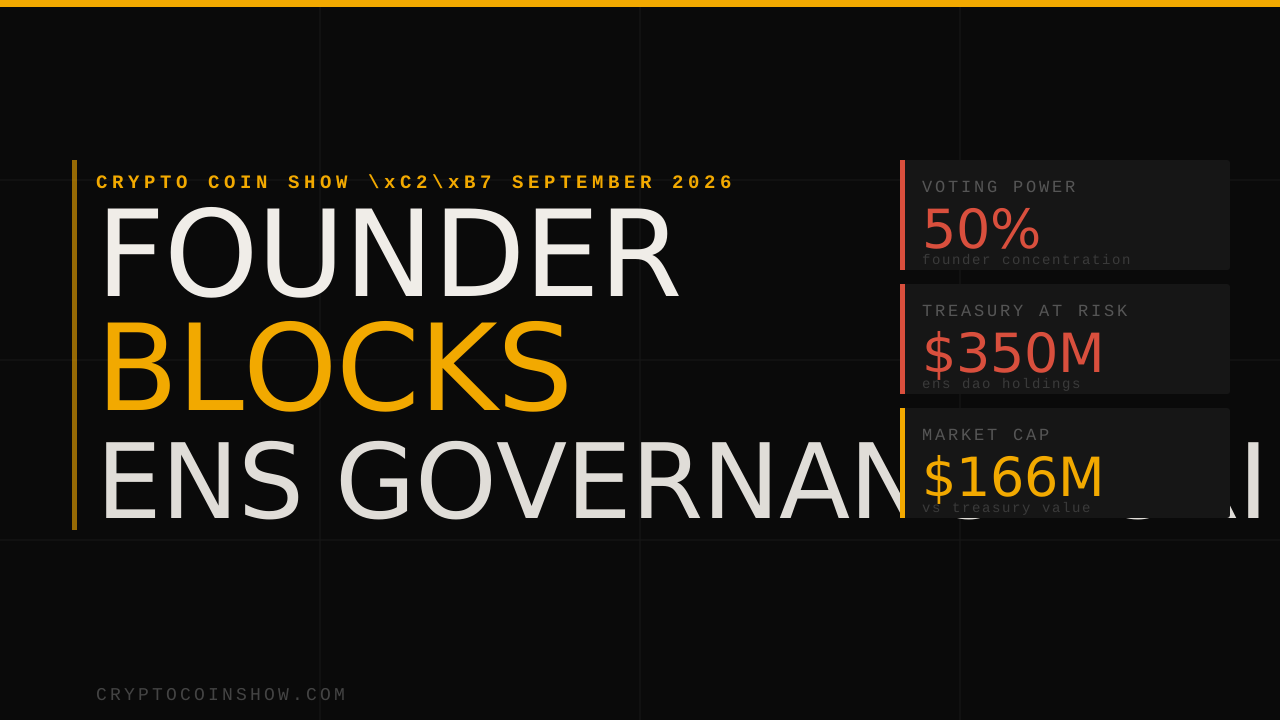
ENS DAO Security Council renewal blocked as founder wields 50% voting power
ENS founder Nick Johnson wielded approximately 50% of the protocol’s active voting power to block a Security Council renewal proposal on June 30, 2026, deepening a governance crisis that exposes the tension between decentralized control and treasury protection in major DAOs. The move leaves a $350 million treasury vulnerable to potential governance attacks while reigniting debate over whether concentrated founder influence defeats the purpose of decentralized governance.
- Nick Johnson’s 50% voting stake blocked the Security Council renewal on-chain vote ending June 30, 2026
- ENS DAO treasury holds $350 million in assets, or $88 million excluding ENS tokens, far exceeding the $166 million market cap
- A replacement Security Council proposal emerged the same day, raising supermajority requirement to 5 of 8 votes for canceling timelocked proposals
- 50% Founder voting power used to block renewal compared to distributed community governance ideal
- $350M DAO treasury assets versus $166 million circulating market cap, creating RFV raid vulnerability
- 95% ENS token decline from $85.69 peak in November 2021 to current $4.07 trading price
The ENS Protocol governance structure has fractured over the renewal of its Security Council, a body designed to prevent treasury theft through governance attacks. On June 30, 2026, an on-chain proposal to renew the Council failed after founder Nick Johnson deployed approximately half of all active voting tokens to oppose it, despite not participating in the preceding off-chain Snapshot vote.
The move has exposed a fundamental contradiction at the heart of major protocol DAOs: the mechanisms meant to protect decentralized treasuries from attack can themselves become tools of unilateral control.
The stakes are unusually high. The ENS DAO treasury contains approximately $350 million in total assets, according to data from DeFiLlama, or $88 million when excluding ENS tokens themselves. By contrast, the ENS token trades at $4.07 per unit with a circulating market cap of roughly $166 million, a 95% collapse from its November 2021 peak of $85.69.
This gap, where treasury assets dwarf the token’s market value, creates the classic conditions for what the industry calls an “RFV raid,” in which a well-capitalized attacker acquires enough voting tokens to control proposals and siphon treasury value. The Security Council exists precisely to guard against this scenario.
Yet Johnson’s use of his voting stake to unilaterally block renewal has triggered the opposite concern: that founder control over the treasury now supersedes community governance entirely.
Johnson’s 50% Voting Power Blocks Renewal as DAO Governance Fractures
Community sentiment around the blocked vote has split sharply.
Lefteris Karapetsas, a longtime Ethereum community member, declared the result unsurprising and went further, calling the DAO “dead” in a post on X. He argued that Johnson’s concentrated voting power effectively shields the $500 million treasury from outside oversight, a characterization that frames the founder’s stake not as emergency protection but as unaccountable control.
The language reflects broader frustration with how governance power has remained centralized despite the DAO’s decentralized structure.
Not all observers agree with that framing. AvsA, an active ENS community member posting on the governance forum, defended the substance of the failed proposal, arguing it represented legitimate governance rather than an attack. However, AvsA simultaneously cautioned that allowing the Security Council to expire entirely would create worse risks.
In a terse assessment, AvsA wrote: “The DAO is a $130M treasury safeguarded by at best $20M worth of tokens.” This observation underscores the core problem: whether the Council stays in place under Johnson’s influence or lapses entirely, the structural vulnerability persists.
The governance dispute has stretched over several weeks, with no clear resolution path emerging. Johnson abstained from the earlier off-chain Snapshot vote, making his deployment of voting power exclusively on the on-chain phase a decisive final move.
The timing and magnitude of his intervention signal an unwillingness to cede control over the Security Council mechanism, even as community members argue that such control is precisely what decentralized governance should prevent.
New Council Proposal Raises Supermajority Threshold to 5 of 8 Votes
Within hours of the renewal’s failure, katherine.eth introduced a draft proposal on the ENS governance forum to establish a replacement Security Council with modified rules. The plan suggests reducing the Council from its current composition to eight members, a smaller body intended to streamline decision-making.
More substantively, the proposal raises the supermajority threshold required to cancel timelocked proposals from 4 of 8 votes to 5 of 8, a change that would make it harder for the Council to exercise its most powerful authority unilaterally.
The official ENS DAO account confirmed the submission and announced that nominations would remain open until July 3. The post emphasized that the new Council would operate under a public mandate and that removal mechanisms for members failing to adhere to governance standards would be built into the charter.
These procedural additions suggest an attempt to thread between two competing risks: maintaining some ability to block governance attacks while constraining the Council’s unilateral power.
The draft proposal also attempts to define the scope of the Council’s veto authority more precisely. It specifies that cancellation power should be reserved only for “malicious, coercive, or exploitative governance attacks,” a constraint designed to prevent routine use against ordinary community proposals.
However, the draft itself acknowledges that no consensus exists on what these terms mean in practice. This definitional ambiguity, whether a proposal constitutes a legitimate governance decision or a masked attack, sits at the center of the current conflict and remains unresolved in the new draft.
Treasury Assets Exceed Market Cap by 210%, Creating Structural Vulnerability
The economic conditions underlying the governance crisis are stark and unlikely to resolve quickly. The ENS token has collapsed 95% from its 2021 peak, reducing the circulating market cap to $166 million even as the DAO treasury accumulated $350 million in assets.
This inversion, where the DAO commands substantially more capital than the token market reflects, is unusual and creates persistent incentive structures that existing governance mechanisms were not designed to handle.
From a protocol security perspective, this gap represents an open vulnerability window. An attacker with $20-30 million could theoretically accumulate enough ENS tokens at current market prices to command a voting majority, then direct the DAO to transfer treasury assets to addresses under their control. The Security Council’s veto power exists to prevent exactly this scenario.
However, the current crisis reveals that concentrating the Council’s protection in the hands of a single founder may deter attacks but at the cost of creating a different governance risk: unilateral treasury control by one actor.
The financial mathematics leave little room for compromise solutions that satisfy both security and decentralization requirements simultaneously.
July 3 Nomination Deadline Sets Timeline for New Council Governance Rules
The immediate next step in the governance process is the July 3 deadline for Security Council nominations under katherine.eth’s proposal. Assuming the nomination process completes, a follow-on vote will determine whether the community endorses the new eight-member structure with the 5-of-8 supermajority requirement.
That vote will provide the clearest signal yet of whether the broader ENS community views Johnson’s blocking action as justified protection or governance overreach.
The outcome remains genuinely uncertain. If the new proposal passes, it would represent a partial victory for reform advocates, since the raised supermajority threshold would constrain unilateral veto power. However, Johnson maintains the same 50% voting stake in any subsequent vote, meaning he could block the new proposal just as he blocked the renewal.
Conversely, if the new proposal fails, the ENS governance structure enters genuinely uncharted territory: a DAO with a massive treasury, a collapsed token price, and no active Security Council.
The path forward hinges on whether ENS token holders view the new proposal as a legitimate reform of the Council’s authority or as an insufficient check on founder power. The July 3 nomination deadline will determine which governance framework the community votes on, but Johnson