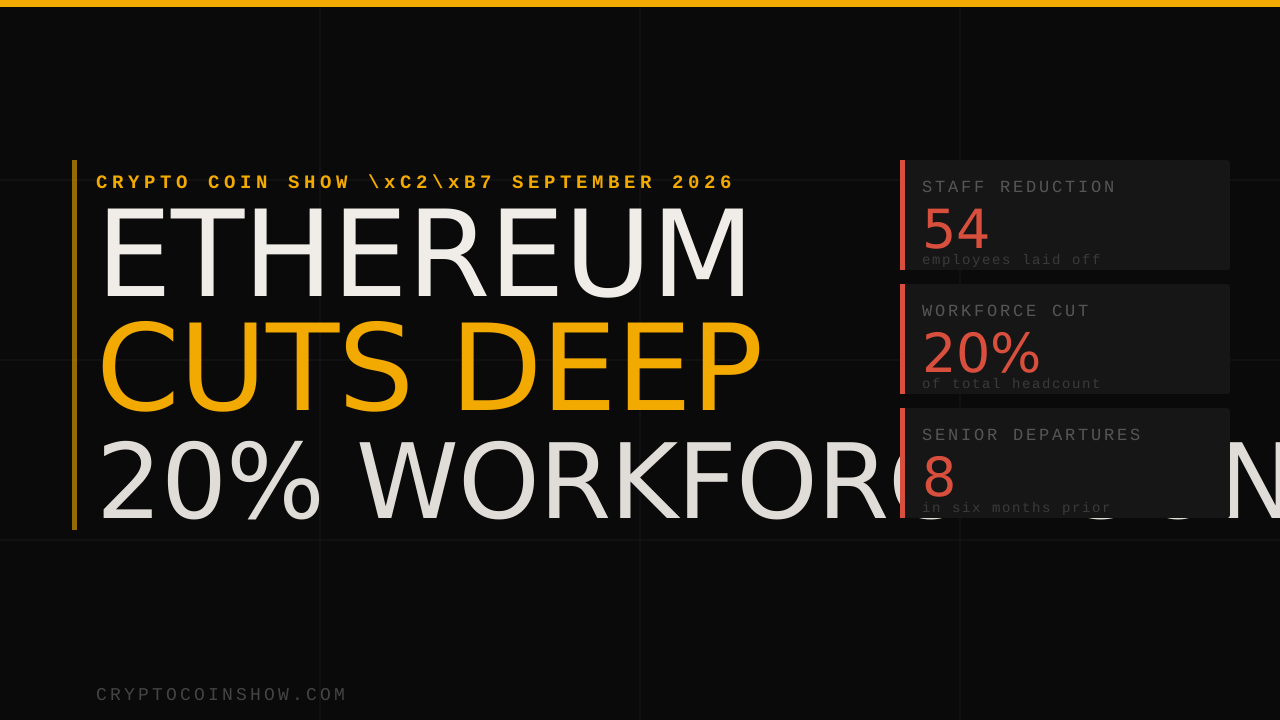
Ethereum treasury company Bitmine has filed to launch a public offering of 3 million shares of its 9.50% Series A Perpetual Preferred Stock.
The proceeds are expected to support a range of corporate and Ethereum-focused initiatives.
Bitmine’s New Offering
According to the company’s filing with the Securities and Exchange Commission (SEC), the net funds raised may be used for general corporate purposes, including the acquisition of additional ETH and other digital assets, the expansion of its staking and validator infrastructure through its MAVAN platform, working capital requirements, strategic investments tied to the Ethereum ecosystem and broader digital asset adoption, and potential repurchases of its common stock under an existing buyback program.
The preferred shares will carry cumulative dividends at a fixed annual rate of 9.50% based on a stated value of $100 per share. The dividends are payable in cash when declared by the company’s board. If any declared dividend is not paid on schedule, additional compounded dividends will accrue weekly, and the applicable rate will gradually increase up to a maximum of 15% per year until the outstanding amount is fully settled.
Bitmine has applied to list the new preferred shares on the New York Stock Exchange under the ticker symbol “BMNP,” and trading is expected to begin within 30 days of the initial issuance if the listing receives approval.
Interestingly, Bitmine’s application is based on a model similar to Saylor-led Strategy’s STRC perpetual preferred stock, which pays an 11.5% dividend. STRC has attracted investors looking for monthly income while gaining indirect exposure to Bitcoin. After raising around $2.52 billion through its initial public offering in July 2025, the program expanded through follow-on issuances. The total notional amount of STRC is approximately $10.5 billion.
Aggressive ETH Accumulation
With its Ethereum holdings rising to 5.42 million ETH, Bitmine said it has reached roughly 90% of its target to own 5% of all ETH. The company also said 4.72 million ETH are staked, with a portion of those assets secured through its MAVAN staking platform.
As one of the sector’s most active buyers, Bitmine has built the largest ETH treasury and the second-largest overall crypto treasury after Strategy. The sharp drop in Ethereum, which is down more than 45% year to date, has created significant challenges for Ethereum treasury companies. Recent data estimates indicate that Bitmine is carrying unrealized losses of more than $10 billion.
Even so, Chairman and Fundstrat co-founder Tom Lee remains optimistic on Ethereum, as he predicted the end of the bull market and the beginning of crypto spring.
Bitmine (BMNR) has once again purchased ETH this week, acquiring 26,497 ETH for about $53 million, a massive 75% cut from its last weekly purchase of 120,000 ETH. This comes amid dips in the company’s stock in addition to a drop in Ethereum’s market performance in the past week.
The approximately 75% reduction in buying pace comes as BMNR shares have fallen 38% over the past year, trading near $19.27, with a slip in Ethereum itself by almost 1.8% over the past 24 hours to roughly $1,980.
Bitmine approaches 5% target
Bitmine’s total Ether holdings now sit at about 5.42 million tokens, or 4.49% of the entire network’s circulating supply of about 120.7 million ETH, the company said. That puts the firm at about 90% of the way toward its well publicized goal of controlling 5% of ETH’s total supply.
Chairman Tom Lee, who is also Fundstrat’s co-founder, has mentioned repeatedly that the deceleration in ETH purchases are intentional. At Consensus 2026 in Miami last month, Lee said Bitmine planned to reduce its rate of accumulation as it closed in on the 5% threshold, as previously reported by Cryptopolitan.
“In our view, ETH prices are not reflecting the strengthening of Ethereum fundamentals,” Lee said in Monday’s statement. “But then again, this is not surprising given we are in the early stages of crypto spring.”
The company has purchased more than one million ETH since January, making it the largest publicly traded Ethereum treasury firm by holdings.
Bitmine’s portfolio and staking plans
Bitmine reported total crypto and cash holdings of $11.6 billion as of May 31, holding 203 Bitcoin, $446 million in cash, a $180 million stake in Beast Industries, and a $93 million position in Eightco Holdings (ORBS) beyond its total ETH holdings.
Staking has become a massive revenue stream for Bitmine, as about 4.7 million tokens of Bitmine’s 5.4 million ETH have been staked through its MAVAN platform. This makes the company the largest Ethereum staker globally. The firm estimates an annual staking revenue of $258 million currently, with projections reaching $300 million by the end of 2026.
Markets have been negative
This ETH purchase slowdown has also come during a rough stretch for the general crypto markets. Bitcoin dropped by about 2.5% and briefly fell below $72,000 after Michael Saylor’s Strategy (MSTR) disclosed its first BTC sale since 2022, selling 32 coins for $2.5 million to cover dividend payments.
Retail traders on Stocktwits also expressed frustration regarding BMNR’s stock decline, comparing its poor performance to Hyperliquid Strategies (PURR), whose stock was approaching a record high as Hyperliquid’s native token topped $74 and entered the top 10 cryptocurrencies by market cap.
Bitmine needs to purchase roughly another 61,000 ETH to hit the 5% total ETH supply ownership mark. At last week’s buying pace, that would take the company about two weeks. This means the firm is right on the cusp of its 2026 goal, and it is yet to be seen how this would positively or negatively impact the BMNR stock price.
Ethereal Ventures: Blockchain Is Now the Backend for Global Finance
Crypto Coin Show · Market IntelligenceMay 2026
Venture Capital · Research Report
Ethereal Ventures: Blockchain Is Now the Backend for Global Finance
In its Q1 2026 market insights report, Ethereal Ventures maps five core metrics — dealflow, tokenized real-world assets, payments volume, protocol fees, and token holder distributions — to argue the on-chain migration of traditional finance has barely started.
Ethereal Ventures’ Q1 2026 Digital Asset Market Insights report opens with a blunt thesis: the five metrics it tracks — dealflow composition, tokenized real-world assets, blockchain payments, on-chain protocol fees, and value returned to token holders — all point toward an industry that has moved well past proof-of-concept and into the early innings of genuine financial infrastructure adoption.
The headline number is $29.3 billion in real-world assets now tokenized on-chain, representing a 30× increase over four years. Impressive on its face — until Ethereal frames it against US equity market capitalization, where it represents less than 0.05%. Their conclusion: the migration has barely started.
01Where Founders Are Betting Their Time
Dealflow composition is the leading indicator Ethereal trusts most, on the premise that founders are the best arbiters of where value will compound. This quarter’s inbound pipeline tells a clear story.
32%
AI
20%
DeFi
8%
Payments
6%
Prediction Markets
5%
Applications
5%
Stablecoins
Key Insight
AI is drawing the bulk of talent and capital — but the parallel story is blockchains maturing into the API backend for payments and broader financial activity. Stablecoins and payments are one slice of that compounding interest, as the rails for on-chain commerce keep maturing.
02Real-World Assets: 30× in Four Years
Tokenized real-world assets — the canonical measure of how much traditional finance has actually moved on-chain — reached $29.3 billion as of April 13, 2026. US Treasuries lead the composition, followed by commodities and asset-backed credit. The growth trajectory is steep: +46% in one year, +266% over two years.
Asset Class
Description
Value On-Chain
US Treasury Debt
Tokenized government bonds — leading category
$13.4B
Commodities
Gold, silver, and physical asset-backed tokens
$5.4B
Asset-Backed Credit
Private credit structured on-chain
$3.1B
Specialty Finance
Structured lending and receivables
$1.5B
Non-US Govt Debt
Sovereign bond tokenization outside the US
$1.2B
Stocks
Equity tokenization on public blockchains
$1.0B
Active Strategies
On-chain managed funds and yield vaults
$919M
Venture Capital
Tokenized fund positions and LP interests
$818M
Corporate Credit
Tokenized corporate bonds
$716M
Real Estate
Property fractionalization and REITs on-chain
$297M
Total RWA On-Chain
$29.3B · +30× in 4 years
The Ethereal framing is important here: $29.3B is not a failure to scale, it is a starting line. US equities alone represent roughly $50 trillion. Tokenized assets at current levels are a rounding error — but the infrastructure to absorb orders of magnitude more institutional capital is, by Ethereal’s read, now mature enough to do it.
03Stablecoin Payments: $390 Billion Annualized
Monthly stablecoin payment volume has tripled over three years to $10 billion per month, driven primarily by B2B settlement flows. McKinsey and Artemis data cited in the report puts full-year 2025 stablecoin payment volume at $390 billion annualized once B2B custody flows and cross-border remittances are included.
“+3× in three years to $10bn/mo, against Visa and Mastercard’s mid-single-digit CAGR.”
The comparison to card networks is deliberate. Visa and Mastercard process roughly $2.27 trillion per month combined. Blockchain-based payments are at less than 0.5% of that — but the unit economics of on-chain settlement improve with scale in ways the card stack structurally cannot match. Ethereal’s projection: the first $1 trillion per month arrives via B2B capture; consumer flows follow as embedded wallets reach mainstream apps.
$390B
2025 Annualized Volume
+3×
Growth Over 3 Years
$2.27T/mo
Visa + Mastercard Target
04Protocol Fees: The Bear-Cycle Floor Keeps Rising
Daily protocol fees — the metric that strips away token price noise to show what users are actually paying to use blockchains — have established a structural floor of $50 million per day, holding through every major market drawdown since 2020. The 30-day moving average currently runs above that floor.
Key Insight
Zero to $50mm/day in six years at the bear-cycle floor. The baseline keeps ratcheting up regardless of price action — the clearest signal that demand is structural, not reflexive.
Ethereal projects fees scaling on two compounding curves: surface area (more product categories entering DeFi — prediction markets, perp DEXes, on-chain credit, RWA distribution) and intensity (institutional users transacting in larger size, with higher willingness to pay for settlement finality). Their target: a $500 million per day baseline.
05Token Holders Are Starting to Look Like Shareholders
Perhaps the most structurally significant finding in the report: capital returned to token holders has tripled since 2024, now running at 15–22% of protocol revenue versus 4–7% across 2022–2024. The shift is being led by Hyperliquid, whose 99%-of-fees buyback model has become the benchmark the rest of the industry is now measured against.
The implication, if the trend continues: tokens stop trading as speculative commodities and begin pricing like cash-flowing assets, attracting a fundamentally different and larger buyer base — one that includes traditional equity investors currently sitting on the sidelines.
06Six Predictions: Where We Are vs. Where We’re Going
The report closes with six explicit prediction pairs — current state versus projected destination — that frame Ethereal’s investment thesis for the next three to five years.
Money on Blockchains · Now
~$480B on-chain
↓ TRAJECTORY
Projected Destination
Majority of US M2 ($21.7T)
Stablecoin Payments · Now
$10B / month
↓ TRAJECTORY
Projected Destination
Visa + Mastercard stack ($2.27T/mo)
Companies Using Blockchains · Now
~38% of SMBs
↓ TRAJECTORY
Projected Destination
~100% of companies touching finance
DeFi Daily Active Users · Now
~300K DAU
↓ TRAJECTORY
Projected Destination
>30M DAU via embedded wallets
Protocol Fees · Now
$50M/day floor
↓ TRAJECTORY
Projected Destination
$500M/day baseline
Value to Token Holders · Now
15–22% of revenue
↓ TRAJECTORY
Projected Destination
Majority of fees flowing to holders
07Where Ethereal Sees the Next Breakthroughs
The report’s outlook section categorizes emerging opportunities across three buckets: new market infrastructure, TAM overhauls where AI is rewriting addressable markets, and blue ocean frontiers with undefined outcome shapes.
Bucket 01New Market Infrastructure
The New Intent Exchange
A neutral matching layer beneath AI agent platforms where merchants compete on price for commercial intent, settled in stablecoins.
Agentic Commerce Risk Rails
Programmable spending limits and on-chain escrow built for agent transactions — reversibility designed in, not retrofitted.
Parametric Insurance On-Chain
Instant-payout policies for measurable events: weather delays, satellite launches, AI SLA failures.
Supply-Chain Disintermediation
Agent-queryable factory profiles, attested quality data, and stablecoin settlement collapsing 40–80% intermediation margins in global retail.
Bucket 02TAM Overhauls
Agent Payments and Stablecoins
Agents can’t open bank accounts but can hold wallets. Agent-to-agent flows are the most open frontier, needing new micropayment frameworks at machine speed.
AI Fraud Defense
The next fraud stack moves from scoring events to verifying actors — portable, privacy-preserving credentials that prove identity once and plug in anywhere.
Devtools Are Now Mainstream Tools
Agentic engineering exploded what was historically a tiny market. The durable layer: tooling where the customer is the agent and the human is out of the loop entirely.
The Crypto Credit Highway
Crypto wins as rails between capital pools and origination, not as a replacement underwriter. Wedge: SMB/B2B lending where stablecoin escrow enables new cashflow mechanics.
Bucket 03Blue Oceans
Machines as Autonomous Companies
A progression from AI-native funds to agents running companies end-to-end, dispatching humans to perform tasks via real-time capital flows.
Proof-of-Human Traffic Bifurcation
Publishers charge agents at scale via micropayments; verified humans browse for free. A new content monetization stack for the post-AI-flood web.
Markets for Scarce Rights
Tokenization and dispute resolution for bureaucratically-gated rights: satellite slots, drone air corridors, spectrum bonds, congestion pricing.
Agent-Native Trust and Reputation
A canonical, queryable trust profile for suppliers, merchants, and services — built on machine-readable signals like fulfillment rates and certified quality attestations.
The full Ethereal Ventures Q1 2026 report is available on their Substack: The Maturation of the On-Chain Economy. All figures sourced from RWA.xyz, Artemis, DefiLlama, and McKinsey × Artemis (Feb 2026).
Hyperliquid (HYPE) recently broke into the top 10 cryptocurrencies by market capitalization, sitting alongside top players like Bitcoin (BTC) and Ethereum (ETH), after its price surged past $50 and set a new all-time high. Now, on-chain analytics platforms are showing what HYPE’s ultimate price could become if it surpasses Ethereum’s market cap.
Hyperliquid’s ATH Price If It Surpasses Ethereum’s Market Cap
Hyperliquid skyrocketed past $50 a few days ago, surpassing Dogecoin’s ranking to take the 9th spot as one of the largest cryptocurrencies in terms of market capitalization. The move marks the first time the token has traded above this zone since late October 2025.
Currently, HYPE has extended its rally well beyond $60. The breakout reflects a strong shift in trading activity around the token, as well as renewed interest and confidence in DeFi protocols and AI-backed tokens. HYPE’s move back into this historic price range also suggests that traders and investors are once again engaging more actively with Hyperliquid’s perpetual futures DEX.
Interestingly, the recent rally in the HYPE price has brought renewed focus on Ethereum, one of Hyperliquid’s biggest crypto and DeFi rivals. While Ethereum remains a dominant benchmark for decentralized applications, Hyperliquid is designed specifically for financial trading and derivatives.
Nevertheless, data from Marketcapof has revealed how high HYPE’s price could reach if its market capitalization of $15.99 billion surpasses Ethereum’s, which is around $250.99 billion. Projections indicate the token could move well beyond its previous all-time high, potentially reaching approximately $1,127, marking a 17.92x from present levels.
At more extreme ATH levels, where market euphoria is likely at its peak, estimates place HYPE as high as $2,633. This would represent a gain of about 42x from current prices, underscoring the scale of the cryptocurrency’s potential upside.
Competition Intensifies As HYPE Captures More ETF Inflows Than ETH
Before recording an ATH, Hyperliquid has been strengthening its market position as capital continues to rotate away from major legacy assets like Bitcoin and Ethereum toward newer, high-growth protocols. HYPE’s recent performance reflects both rising adoption of its DEX platform and a broader shift in liquidity across the crypto sector.
A key driver behind the bullish momentum was the launch of spot HYPE ETFs by investment management firms Bitwise and 21Shares in May. The products have attracted millions of dollars in inflows, underscoring steady institutional demand for HYPE amid heightened derivatives activity.
Earlier in the year, market volatility linked to the US-Iran war triggered record perpetual futures volume on Hyperliquid, pushing activity on the platform to new highs. Liquidity conditions also improved after Coinbase, the world’s largest crypto exchange, became the official USDC provider on Hyperliquid.
Against this backdrop, Ethereum dominance is waning significantly. The cryptocurrency’s price has struggled to maintain momentum, falling roughly 30% year-to-date. ETF flow data reflects this shift, with about $1 billion exiting Bitcoin and Ethereum products while XRP and HYPE funds recorded about $94 million in combined inflows.
Bankless co-founder David Hoffman said he sold his Ether holdings because he believes the long-standing “ETH is money” thesis has already largely played out. Despite this, he remains strongly bullish on Ethereum as a network.
According to Hoffman, the decision did not come lightly, given that he built his career, business, community, and identity around Ethereum.
Ethereum Chose the Hard Path Unlike Bitcoin
In his latest tweet, Hoffman stated that the “ETH is money” thesis depended on Ethereum succeeding across multiple layers of coordination, including decentralized leadership, governance, Layer 2 ecosystems, roadmap execution, and technological development.
Hoffman described Ethereum as “not Bitcoin,” and said that Bitcoin simplified its blockchain to maximize the value of BTC, while Ethereum pursued a more ambitious path by expanding utility across decentralized applications, finance, tokenization, and infrastructure. He even went on to add that Ethereum achieved part of that vision and earned the market capitalization it currently has, but said the opportunity for ETH to be significantly rerated higher by the market now appears to be closing.
The Bankless co-founder also explained that the broader “strong version” of crypto, which focused on decentralized finance, NFTs, DAOs, and crypto-native systems, failed to maintain long-term mainstream support outside the 2020 to 2022 period. He said crypto’s reputation later became associated with scams, grifts, and speculative behavior, which ended up weakening the social belief system required for ETH to function as money at a global scale.
He further stated that Ether’s utility increasingly benefits other forms of money, especially stablecoins and tokenized dollars, rather than ETH itself. Hoffman described Ethereum as a “giver, not a taker,” while saying that the network provides secure blockspace, tokenization infrastructure, and DeFi support at minimal cost rather than extracting maximum value for ETH holders. He said Ethereum’s architecture prioritizes applications, rollups, and ecosystem growth over ETH itself, which makes it difficult for the underlying crypto asset to fully achieve global money status without overwhelming market dominance.
Ethereum in Crisis?
Hoffman’s decision also comes at a time when bearish sentiment around Ethereum has been intensifying. A recent report by Santiment found that social media discussions have increasingly shifted from optimism toward frustration and concerns about further downside.
The analytics firm said traders have increasingly viewed ETH as “dead money” compared to stronger-performing crypto assets in 2026, as weakening ETF flows, declining on-chain activity, and growing competition from ecosystems such as Solana and BNB Chain added pressure on sentiment.
Rumors about prominent Ethereum figures reducing or exiting ETH positions, including discussions surrounding Hoffman, have also contributed to rising uncertainty in the market, especially as traders worried about insiders losing confidence in the asset.
Ethereum’s market sentiment has deteriorated significantly as the blockchain network’s native ETH token moves through a medium-term bear phase.
Data from blockchain analytics platform Santiment shows that while ETH-related discussions increased in frequency throughout May, the tone of that commentary has shifted toward frustration, disappointment, and concern about deeper downside potential.
Ethereum Market Sentiment (Source: Santiment)
Analysts at the firm noted that this shift in sentiment reflects a combination of market pressures building simultaneously, including weak spot price action, persistent exchange-traded fund (ETF) outflows, high-profile departures from the Ethereum Foundation, public criticism from longtime ecosystem supporters, and stronger price momentum across competing layer-1 networks like Hyperliquid, Zcash, and Solana.
Broader market data from CryptoQuant reinforces this picture of institutional deceleration. The firm’s spot market and fundamental indicators point to severe structural weakness as ETH prices drop toward the critical $2,000 support level.
This has created a split-market identity in which spot investors are steadily reducing exposure, market liquidity has thinned, and institutional buying pressure has largely vanished from major trading desks.
Spot selling leaves Ethereum without a durable bid
Indeed, CryptoQuant’s fund-tracking data highlights the extent of the contraction in the institutional bid over the last two quarters.
According to the firm, total fund holdings, which peaked above 7 million ETH in October 2025, have steadily declined to a range around 5.5 million ETH.
This persistent unwinding indicates that large-scale allocators have systematically reduced their core exposure throughout the current multi-month drawdown.
Notably, the regulated ETF market has reinforced this structural pressure. Total assets under management across Ethereum ETFs now stand near $12.14 billion, marking a 23% decline from their January peak.
Data from SoSoValue shows that May proved particularly challenging, with two consecutive weeks of net outflows totaling approximately $470 million, representing one of the largest episodes of concentrated capital flight of the year.
Ethereum ETFs Weekly Outflows (Source: SoSoValue)
This institutional withdrawal is further illustrated by the Coinbase Premium Index, which tracks the price disparity between Coinbase Pro and major offshore platforms.
The index remained negative throughout May, signaling an absence of spot demand from US institutional buyers.
At the same time, ETH liquidity has thinned alongside this reduction in fund reserves.
According to CryptoQuant, daily fund trading volume has trended downward since February 2026, dropping well below its trailing 1-year moving average to a recent range of $17 million to $42 million.
This volume compression points to a thinner spot market where dip-buying appetite has faded, leaving the asset highly exposed to volatility spikes during periods of negative news.
ETH options traders hedge as leveraged longs hold on
Beneath the spot market liquidation, derivatives data reveal an ongoing debate over whether ETH is breaking into a structural decline or forming a base for a leveraged rebound.
This disconnect has left the derivatives market divided, with professional traders aggressively hedging downside risk even as speculative perpetual futures traders maintain long positioning.
Data from Block Scholes reveals that ETH’s 25-delta risk reversal skew over a seven-day horizon has traded near-7%, indicating that options market participants are paying a premium for downside put protection.
This defensive posture is supported by clearing data from the Deribit exchange, where open interest for put options targeting the $2,100 and $2,000 strike prices has concentrated past $380 million, placing those technical areas at the center of short-term institutional positioning.
ETH Options Traders Positioning (Source: Deribit)
Market Note: This concentrated options activity reflects a market preparing for extended weakness. Having already slipped below the $2,100 support shelf, Block Scholes’ risk appetite indexes show slowing momentum, leaving the asset dependent on defensive hedging in the absence of spot accumulation.
Concurrently, the perpetual futures market sends a more complicated signal. CryptoQuant data shows that Ethereum’s derivatives funding rate has settled firmly in positive territory, reaching 0.0082 on May 21, 2026.
Ethereum Funding Rates (Source: CryptoQuant)
This positive rate indicates that speculative long bias has not fully collapsed despite declines in market capitalization, fund holdings, and spot trading volume.
The resulting split identity creates a delicate technical backdrop: while options traders position for a breakdown, perpetual futures traders continue to hold leveraged long exposure.
This structural disconnect can fuel rapid short-squeezes if spot demand unexpectedly returns, but it significantly elevates the risk of cascading liquidations if the spot price breaches the heavy open interest concentrated at the $2,000 floor.
Ethereum Foundation exits collide with a weaker ETH value thesis
Ethereum’s financial underperformance has coincided with an acceleration of senior personnel departures from the Ethereum Foundation (EF), the Swiss non-profit entity that stewards the blockchain’s core development.
The internal churn intensified following the formal resignations of research veterans Carl Beek and Julian Ma. Beek had spent seven years focused on Beacon Chain design, while Ma authored the network’s Forwarding Oversight Committee for Incentivized Labs (FOCIL) framework.
Their departures bring the total number of senior exits or step-backs to at least nine since February, with five landing in May alone.
The list includes former co-Executive Director Tomasz Stańczak, board co-steward Josh Stark, Protocol Guild contributor Trent Van Epps, and protocol cluster leads Barnabé Monnot and Tim Beiko.
Additionally, senior researcher Alex Stokes recently commenced a three-month sabbatical, further thinning the organization’s visible technical leadership during a period of acute market stress.
Ecosystem analysts trace this administrative migration back to the publication of the foundation’s “Mandate” document in mid-March.
The 38-page framework codified the foundation’s dedication to “CROPS” principles: censorship resistance, open-source deployment, privacy, and base-layer security.
Crucially, the document framed the foundation as an ecosystem steward rather than a corporate enterprise, explicitly stating that its purpose is to protect network neutrality, not to maximize token price, optimize investor returns, or aggressively coordinate commercial expansion.
This neutrality-first posture has become increasingly difficult for parts of the market to accept as alternative networks capture speculative market share.
Tommy Shaughnessy, co-founder of Delphi Ventures, noted that the departures are more serious than they appear, adding that the exit of reform-minded personnel leaves fewer internal voices to challenge the foundation’s structural direction.
Reform calls test Ethereum’s neutrality-first model
The perceived lack of commercial execution by the foundation has prompted several prominent former insiders to call for structural governance reforms.
Dankrad Feist, a notable researcher who left the foundation last year to join the Stripe-backed layer-1 network Tempo, publicly advocated creating an entirely separate entity to safeguard the network’s economic relevance.
Feist proposed establishing an independent, alternative organization backed by at least $1 billion in capital, funded in part by network staking revenues. This proposed body would be directly accountable to token holders and expressly tasked with driving ETH’s financial adoption and market value.
According to him, this leaves the ecosystem without an agile institution incentivized to promote the asset in capital markets.
Bankless co-founder Ryan Sean Adams supported this view, stating that Ethereum’s future cannot depend solely on the foundation.
Adams argued that the ecosystem requires competitive, well-capitalized institutions dedicated to capital efficiency, aggressive communication, and commercial execution. These are roles the foundation was never structurally designed to fulfill.
The consensus among these reform proposals is not to replace the foundation, but to establish a dual-institution model: one to protect base-layer neutrality and public goods, and another to promote the asset and compete for institutional capital.
This push for reform has drawn a direct response from Ethereum bulls, who argue that the market is overreacting to short-term price action and natural organizational transitions.
ETH investor member Ryan Berckmans characterized the talent turnover as a healthy handoff to a younger generation of developers.
Berckmans argued that Ethereum has successfully navigated previous periods of regulatory pressure and leadership transitions while still delivering major upgrades like the Merge, blob transactions, and a dominant position in on-chain application capital.
He noted that the expanding deployment of stablecoins and tokenized assets by global corporations continues to support the network’s long-term trajectory.
This perspective is shared by substantial institutional holders.
Thomas Lee, chairman of BitMine, dismissed the current market anxiety as typical cyclical capitulation. BitMIne is the largest publicly traded corporate holder of ETH, with a portfolio of 5.2 million ETH and over $10 billion actively staked tokens.
BitMine Key Metrics (Source: BitMine Tracker)
Lee asserted that blockchain infrastructure represents the foundational settlement highway for agentic artificial intelligence commerce and institutional finance, positions where Ethereum maintains a distinct structural advantage due to its established security record, deep liquidity, and institutional familiarity.
How Ethereum can recover from the current FUD
Market observers have noted that Ethereum’s near-term trajectory now hinges on whether its technical roadmap and commercial moats translate into a coherent investment thesis for ETH.
Strategic analysis from Galaxy Digital indicates that the network must execute a disciplined operational agenda to reverse ongoing capital flight.
According to Galaxy’s recovery framework, the immediate focus must center on shipping the Glamsterdam upgrade, keeping the subsequent Hegotá deployment on track, clarifying administrative responsibilities within the foundation, and concentrating resources on core commercial verticals.
These key areas include high-value decentralized finance, institutional asset issuance, tokenized RWAs, stablecoin settlement, and privacy-preserving financial infrastructure. These are sectors where Ethereum’s credible neutrality and security record serve as a commercial necessity rather than an abstract principle.
Galaxy also pointed to the need for Ethereum to move faster on narratives likely to define the next cycle, including layer-1 scaling, on-chain privacy, post-quantum security, and AI-native economic infrastructure.
While much of this technical architecture is documented in the open-source “Strawmap” development framework, the more complex challenge remains the coordination among commercial and institutional actors.
This coordination gap sits at the center of Ethereum’s current market friction.
The foundation’s Mandate provides a clear statement of base-layer engineering principles, but it does not provide capital markets with a simple answer on value accrual, nor does it create an entity designed to defend the asset against aggressive layer-1 competitors.
Consequently, the current drawdown has evolved into more than a simple price correction; it is an active test of whether a decentralized structure can distribute commercial responsibility across new institutions without losing operational coherence.
If the ecosystem can turn its current administrative churn into clearly defined roles and convert its technical roadmap into a concise asset case, this period of underperformance could serve as a necessary governance reset.
However, if it cannot, the market may continue to treat weak spot demand, senior departures, and the application-layer economic shift as evidence that Ethereum’s network strength no longer guarantees protection of the underlying token’s value.
Ethereum (ETH) has shed nearly 30% of its market value so far this year. Despite numerous recovery attempts, its market performance throughout May remained weak. Growing fear and frustration around the asset have become increasingly visible across social media and market activity.
According to Santiment, the downturn has not been driven by a single major negative event, but rather by several bearish narratives building at the same time.
Bearish Narratives Spiral
One of the clearest signs highlighted by the firm was the rise in Ethereum’s social dominance even as prices continued falling. While higher social dominance can often signal strong bullish attention during rallies, Santiment noted that Ethereum’s discussion volume surged after its April 17 local top precisely when the asset began losing momentum.
Instead of conversations centered around optimism or new highs, social media discussions were increasingly focused on disappointment, frustration, and concerns about further downside. Santiment also flagged a steady deterioration in sentiment ratios on social media platforms.
During late April, Ethereum maintained relatively strong sentiment levels, as it recorded more than two bullish comments for every bearish one. However, that ratio gradually declined throughout May until bullish and bearish commentary became nearly equal. The firm said this kind of sentiment erosion typically indicates weakening trader confidence in an asset’s short-term outlook.
Ethereum’s weak price performance itself has been one of the biggest contributors to the negative mood. Many traders have increasingly viewed ETH as “dead money” compared to assets that have shown stronger momentum during 2026, Santiment said in its latest post.
While Bitcoin has continued attracting institutional confidence and newer ecosystems have drawn speculative interest, Ethereum has struggled to regain the market leadership role it held in previous cycles. ETF flows also added to bearish sentiment. Several Ethereum exchange-traded funds reportedly recorded continued outflows throughout May, including significant withdrawals from BlackRock-related funds.
Santiment added that days with more than $50 million in net inflows, once relatively common for Ethereum ETFs, have not occurred for almost three weeks. Although ETF flows often follow sentiment rather than predict it, retail traders frequently interpret outflows as evidence that institutions are losing confidence in the asset, which further adds to fears already created by falling prices.
Negative headlines surrounding the Ethereum Foundation also contributed to the change in market mood. Reports about researcher departures and ongoing exits from the ecosystem spread widely across social media. Many traders see them as signs of instability within Ethereum’s leadership and development community.
At the same time, viral rumors claiming prominent Ethereum figures, such as David Hoffman, were reducing or exiting their ETH holdings further fueled uncertainty, even when some reports lacked full context. Santiment said such narratives can spread rapidly in crypto markets, especially when traders begin fearing that insiders are abandoning positions before the broader market reacts.
Contrarian Setup?
Competition from other blockchain ecosystems has also intensified pressure on Ethereum’s reputation. Data showed Ethereum still leads the crypto industry in raw development activity, as it generates millions of GitHub events and maintains one of the largest developer communities in the sector.
However, retail traders have increasingly prioritized short-term price performance over long-term development strength, while ecosystems such as Solana and BNB Chain continue to attract speculative enthusiasm. On-chain activity has weakened as well, with both daily active addresses and network growth declining from the high levels seen during Ethereum’s strongest rallies in 2024 and 2025.
Despite the overwhelmingly bearish environment, the firm said extreme pessimism can sometimes point to exhaustion among traders and potentially emerge near major market turning points.
“Growing bearishness may eventually become constructive from a contrarian perspective. Historically, markets tend to punish the crowd when consensus becomes too one-sided. Ethereum is now reaching a point where social media discussion has become overwhelmingly focused on reasons to abandon the asset. “
A long-time Ethereum investor and community figure has pushed back against growing alarm over the string of departures from the Ethereum Foundation (EF), arguing that the organization’s commitment to the network is as firm as ever.
Ryan Berckmans, who has worked full-time in the Ethereum space for eight years, offered one of the more detailed community-level defenses of the EF’s current direction since the exits started mounting this year.
Departures Caused by Differences of Opinion
According to Berckmans, people are misreading the situation.
“The EF departures are not because the people departing feel differently about Ethereum and our trajectory vs. the people staying at EF or vs. community folks like me,” he wrote.
What actually drove them, in his view, was a mix of internal disagreements over sub-strategies rather than any loss of faith in Ethereum itself, plus a deliberate generational shift.
“Some folks disagreed. Some tiny number were asked to leave for Reasons. Some few others left immediately due to Reasonable Net Feelings. Some more are leaving because the Wheel is Turning,” he explained.
Further, Berckmans added that new, younger contributors are ready to step into leadership across teams and departments. He also addressed a persistent piece of community frustration, that the EF and Vitalik Buterin do not care about ETH’s price, calling it a misconception.
According to him, they care deeply, but across a much longer time horizon than most community members track.
“They want to know, ‘How will Ethereum remain dominant after quantum computers?’ and, ‘How will Ethereum be the world’s economic hub for trillions in assets and thousands of L2s across a hundred countries?’”
His conclusion was that these are questions that can only get asked if you believe the outcome is achievable, and the EF’s programs in response to them are “gigabullish.”
Four Prominent Contributors Left in Just Four Weeks
The wave of exits has included Carl Beek, Julian Ma, Barnabé Monnot, Tim Beiko, Trent Van Epps, Josh Stark, and former co-Executive Director Tomasz Stańczak.
Stańczak’s departure, in particular, drew quite a lot of attention, considering that it came just 11 months after he’d taken the role. In addition, the exits have been concentrated, with four of the more prominent ones landing within roughly four weeks of each other in April and May.
Meanwhile, a detailed analysis by crypto researcher Nick Sawinyh pointed to unconfirmed claims circulating online that staff were asked to formally align with the Foundation’s new mandate. However, the EF has not publicly confirmed those claims, and none of the departing contributors cited the mandate as their reason for leaving.
People are also focusing on the coming Glamsterdam upgrade to Ethereum that is still under test. The protocol update includes changes tied to scaling and validator infrastructure, although some anticipated features, including FOCIL and native account abstraction, have already been delayed to a later upgrade cycle.
Despite this, many Ethereum backers believe that the entire ecosystem can now take leadership changes in stride without posing a risk to the network as a whole. One of them, author William Mougayar, described the Foundation’s shrinking role as a deliberate attempt to remove Ethereum’s remaining central point of control rather than a sign of institutional decline.
Tether has applied for seven trademarks in South Korea, including for its company name and logo, in a move that market observers see as a hint of the firm expanding into the South Korean market.
The issuer of the largest stablecoin in the world, USDT, is also expanding its reach into Africa and Asia by partnering with Lemfi. Meanwhile, Tether’s rival Circle (NYSE: CRCL) has already been meeting with major financial institutions in South Korea, setting up a potential showdown between number one and two in the stablecoin issuance business.
Tether and Circle are lining up entry into the South Korean market
Tether, the company behind the world’s largest stablecoin USDT, is making progress in its plans to enter the South Korean market. The Korea Intellectual Property Rights Information Service (KIPRIS) recently received multiple trademark applications from Tether, totaling up to seven.
Tether’s previous filings in the country focused on stablecoin product names, but this batch includes the corporate brand itself and its gold-backed stablecoin Tether Gold (XAUT).
South Korea’s proposed Digital Asset Basic Act is expected to require foreign stablecoin issuers to maintain a domestic branch if they want to distribute their tokens locally, and Tether appears to be positioning itself ahead.
Before Tether’s latest filings, Circle’s CEO Jeremy Allaire visited Seoul in April and met with executives from KB Financial Group, Shinhan Financial Group, and Hana Financial Group to discuss stablecoin payment cooperation and real-world asset tokenization.
Allaire acknowledged the potential in the South Korean market and shared Circle’s plans to establish a Korean subsidiary and obtain a license if the final regulatory framework accepts foreign issuers.
Circle has also signed partnerships with Korean exchanges Dunamu, which operates Upbit, and Bithumb to expand USDC adoption on domestic trading platforms.
Cryptopolitan reported earlier that Hana Card, part of Hana Financial Group, launched a pilot in March allowing foreign visitors to pay at local merchants using USDC through a partnership with Circle and Crypto.com. Other Korean financial firms, including BC Card and KB Kookmin Card, have been testing stablecoin payment infrastructure as well.
Tether has been on an expansion trail
Tether also recently announced an investment in LemFi, a cross-border payments platform that works across communities in the UK, US, Canada, and Europe to recipients in Africa and Asia. The deal will integrate USDT as a settlement layer across LemFi’s payment corridors, replacing multi-day SWIFT-based transfers with blockchain settlement.
Tether’s CEO Paolo Ardoino said in the announcement that the goal of the partnership is to expand financial access for its estimated 585 million users globally.
Cryptopolitan previously reported that Tether recorded $1.04 billion in profit for Q1 2026. The company holds excess reserves of $8.23 billion; enough capital to invest in distribution partners and pursue market entry in jurisdictions like South Korea.
South Korea is home to an estimated 18 million crypto investors. Exchanges in the country recorded over $663 billion in trades through mid-2025, and the country’s retail traders remain a significant part of altcoin markets.
Beyond Tether and Circle, multiple projects are building won-denominated stablecoins. Cryptopolitan reported that the Bank of Korea has been advancing “Project Han River,” its wholesale CBDC initiative, which entered a second phase of real-transaction testing earlier this year.
Regulators are still debating whether or not stablecoin issuance should be restricted to commercial banks or follow a more flexible licensing model. The discussion has been postponed until after South Korea’s June local elections.
Tether and LemFi, two financial juggernauts in different sectors, have announced a partnership. Tether, the issuer of popular stablecoin USDT, announced on Monday that it had invested in the fintech app used to transfer funds from Europe and the Americas to Africa and Asia.
The deal will embed USDT as a system for payments across LemFi’s operating regions, replacing slower bank-to-bank transfer chains with stablecoins and the blockchain.
The Tether-LemFi deal and what it means
Unlike conventional cross-border payment systems, stablecoin-based transfers allow funds to move directly across blockchain networks with fewer delays and lower operation costs. This model will enhance the speed and efficiency of international payments, especially in newly emerging markets.
According to Tether’s statement, the partnership is expected to support the wider adoption of Tether across LemFi’s platform, which could then extend the stablecoin-powered systems into other payment and financial service offerings.
The move reflects a broader trend among fintech firms and stablecoin issuers seeking to position blockchain infrastructure as an alternative to traditional banking rails for global payments, savings, and digital financial services.
The executives have their say
CEO of Tether, Paolo Ardoino, has said the investment aligns with Tether’s strategy of expanding financial access for its estimated 585 million users globally.
Ardoino framed the partnership as part of the company’s effort to strengthen the real-world utility of Tether by integrating blockchain-based settlement into everyday financial services, particularly in regions that rely heavily on cross-border payments and remittances.
“Our investment in LemFi reflects our shared vision on how money moves across borders, prioritizing speed, cost, and transparency,” Ardoino said in Tether’s announcement. “By supporting LemFi’s growth and innovation roadmap, we are helping bring the benefits of a stable digital asset to more people who rely on remittances in their daily lives.”
LemFi CEO and co-founder Ridwan Olalere called the deal “a validation of the direction we are heading.” Olalere added that integrating USDT into LemFi’s infrastructure “brings us closer to that reality” of a financial system that works regardless of where a user lives or sends money, according to Tether’s press release.
Neither company has disclosed the size of the investment.
How does this improve stablecoins’ standing?
For Tether, the LemFi deal extends the company’s push to position USDT as a practical payments infrastructure rather than just a trading instrument. The company reported $1.04 billion in profit for Q1 2026 and holds excess reserves of $8.23 billion, according to Binance Square. This financial position gives Tether capital to invest in distribution partners like LemFi that can help to put the stablecoin in front of non-crypto-native users.
LemFi, on its own part, gains access to Tether’s deep USDT liquidity pool and the technical backing to build a settlement layer on blockchain. The company described its customer base as consisting of “millions of people who live and work across borders,” many of whom, it said, have historically been underserved by traditional financial institutions.