
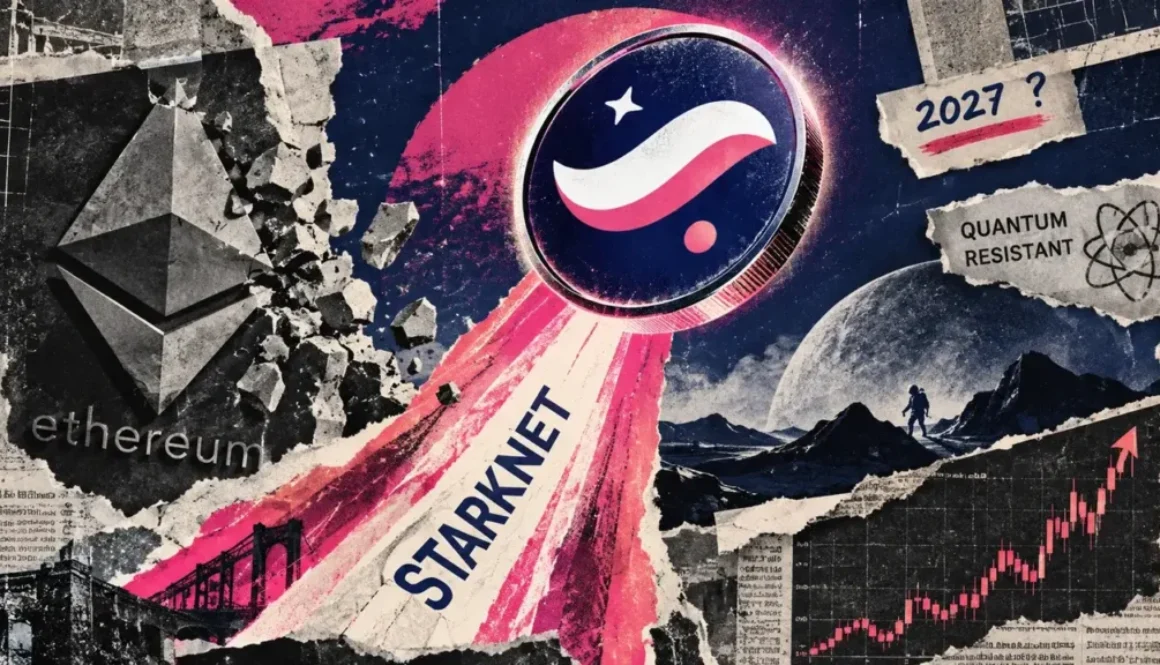
Starknet targets 2027 for full post-quantum cryptography migration
Starknet’s leadership has published a three-phase quantum-resistance roadmap targeting 2027 as the completion date for full post-quantum cryptography across its Layer 2, with plans to potentially migrate to an independent Layer 1 if needed to accelerate deployment. The announcement triggered a 117% rally in STRK over seven days, driven partly by token unlock concerns and the early strategic positioning of a major blockchain against cryptographically relevant quantum computers.
- STRK token rose 116.7% in seven days to $0.1190 by October 11, with $3.5 billion in 24-hour futures volume.
- Starknet published a three-phase roadmap replacing quantum-vulnerable Pedersen hashing with BLAKE2 across state, contract address, and consensus layers.
- Phases 1 and 2 remain under Starknet’s control; Phase 3 depends on Ethereum’s own quantum migration, which the Ethereum Foundation targets for December 2029.
- 116.7% STRK token gain over seven days versus 24-hour prior move.
- 2027 Starknet’s target date for completing full post-quantum migration.
- $3.5B STRK futures volume in 24 hours on October 11, 2026.
StarkWare, the company behind Starknet, published a three-phase quantum-readiness roadmap positioning Starknet as the first major blockchain to achieve full post-quantum cryptography by 2027. The company framed the shift as essential insurance against the arrival of cryptographically relevant quantum computers, which could undermine elliptic-curve signatures used across Bitcoin, Ethereum, and most Layer 2 networks. Starknet’s core proof system relies on collision-resistant hash functions rather than elliptic-curve arithmetic, giving it a structural advantage over competing chains. The announcement by CEO Eli Ben-Sasson, framed on X as addressing AI-accelerated advances in mathematical research, sparked a rally that doubled STRK in one week and elevated trading volumes to $3.5 billion in daily futures turnover.
Starknet’s hash-based cryptography bypasses elliptic-curve vulnerability at the proof layer
Starknet’s advantage lies in its architectural foundation: STARK proofs depend on hash functions rather than the elliptic-curve assumptions that dominate Bitcoin, Ethereum, Solana, and Cosmos. This distinction means Starknet’s proving layer has never been quantum-vulnerable by design, allowing developers to adopt post-quantum signatures without a network-wide breaking change.
The three-phase roadmap documents two phases entirely within Starknet’s control and a third contingent on Ethereum’s timeline. Phase 1 replaces Pedersen hashing, which inherits elliptic-curve assumptions, with BLAKE2 across the state commitment layer, contract address derivation, and OS configuration hash.
StarkWare estimates completion of Phase 1 items in approximately two months from start, with the OS config hash already live on testnet and scheduled for mainnet in early July. Phase 2, targeting legacy smart contracts at the storage level, follows within one month of Phase 1.
StarkWare plans to ship a migration toolkit allowing contract authors to migrate existing deployments to post-quantum alignment without manual data recomputation or breaking interface changes.
Phase 3 remains dependent on Ethereum’s own quantum migration, which the Ethereum Foundation targets for December 2029 across execution, consensus, and data layers.
Ethereum bridge and data-availability dependencies block Starknet’s full autonomy until 2029 or later
Starknet currently operates as an Ethereum Layer 2, settling transactions and posting data availability proofs to Ethereum. Two critical surfaces remain quantum-vulnerable: the bridge’s secp256k1 syscalls, which enable Layer 1-to-Layer 2 messaging, and the KZG commitments anchoring state-diff data published to Ethereum as EIP-4844 blobs.
Removing these syscalls would break the bridge until Ethereum completes its own post-quantum migration, estimated at one month after Ethereum’s transition finishes.
The December 2029 target for Ethereum’s quantum resistance creates a hard dependency for Starknet’s Phase 3. Until then, Starknet’s bridge infrastructure and data availability remain exposed to cryptographically relevant quantum computers that could compromise Layer 1-to-Layer 2 message authentication.
This structural vulnerability is why StarkWare is considering independence: an autonomous Layer 1 would allow Starknet to control its settlement and data availability model entirely, removing reliance on Ethereum’s timeline.
No formal migration timetable or Layer 1 launch date has been approved; the October 8 announcement expresses active consideration and a 2027 target for completion rather than a binding roadmap.
Account abstraction enables user opt-in to post-quantum wallets without protocol upgrades
Starknet’s native account abstraction, a structural feature absent from Bitcoin, Ethereum, and Solana, allows users to deploy post-quantum wallets today without protocol changes. S2morrow has already demonstrated a Falcon-512 account implementation in Cairo, and OpenZeppelin is developing a post-quantum account contract expected to release soon.
This means users and developers can migrate voluntarily to quantum-safe signature schemes as Phase 1 and 2 progress, avoiding the forced protocol-wide upgrades that other chains will require.
For institutional investors, this architecture difference is material. Bitcoin and Ethereum will require either consensus-driven hard forks or complex migration tooling to move existing balances to post-quantum schemes. Starknet’s design allows a smoother transition in which legacy contracts continue to operate while new deployments and opt-in users adopt post-quantum security without disruption.
The roadmap explicitly commits that users and developers can operate without interruption as phases roll out.
October 15 token unlock and futures leverage amplify price volatility independent of quantum roadmap
STRK’s 117% weekly rally coincides with an October 15 token unlock that will release up to 127 million tokens monthly for early contributors and investors through March 2027. At the October 11 price of $0.1190, the maximum tranche would equal $15.1 million and represent 1.27% of Starknet’s 10 billion token supply.
CoinGlass data from October 11 showed $258.5 million in futures open interest and $14.8 million in liquidations over 24 hours, indicating leveraged positions amplifying the move.
The unlock does not establish how many recipients will sell; market structure around the unlock and the quantum roadmap announcement have compounded price volatility.
The CCS read. Starknet has locked in the strongest post-quantum position of any production blockchain, but this advantage is contingent on Ethereum’s December 2029 migration. An independent Layer 1 would eliminate that dependency but creates execution risk: launching and securing a standalone chain is harder than migrating a Layer 2. The token rally reflects roadmap confidence, but institutional entry should weight the bridge dependency and the approval gap between consideration and migration commitment.
StarkWare targets Phase 1 mainnet deployment in early July 2027 and has committed time estimates for Phase 2 completion within one month thereafter. The critical next date is Ethereum Foundation’s December 2029 deadline for post-quantum execution and consensus; if Ethereum misses that target, Starknet’s Phase 3 completion will slip correspondingly. Watch for StarkWare’s formal Layer 1 migration proposal or governance vote, which has not yet been announced, and whether the Ethereum Foundation holds to its 2029 timeline as NIST post-quantum standards and institutional pressure accelerate.