
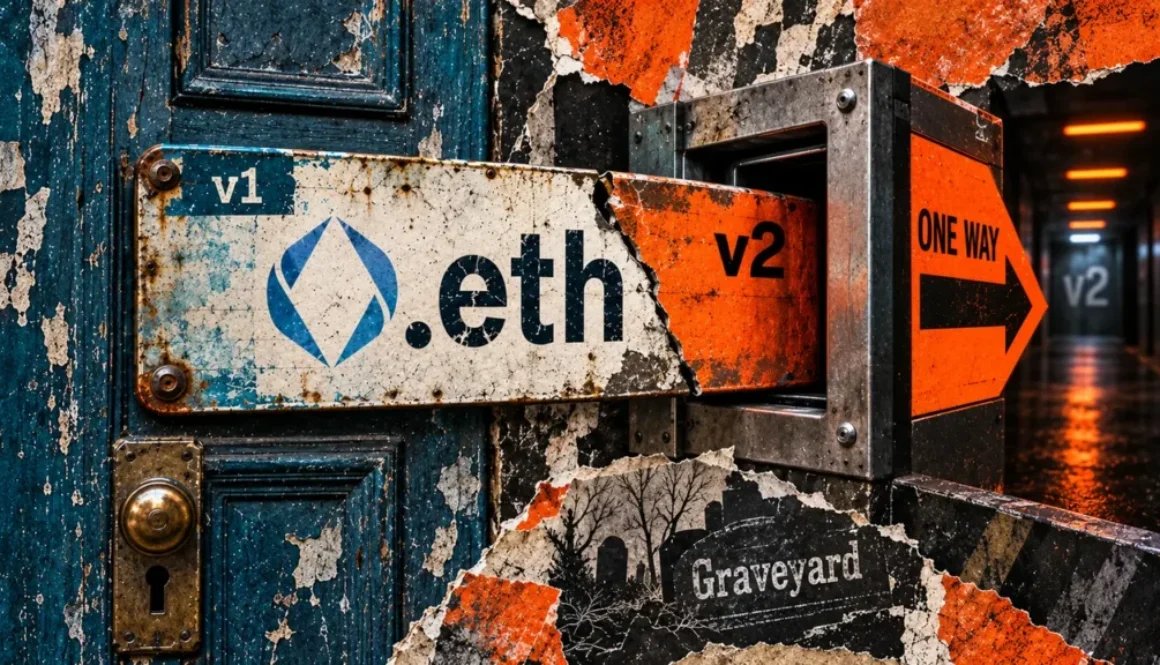
ENS DAO proposes ENSv2 activation with permanent v1 token surrender for migrants
Ethereum Name Service has proposed activating ENSv2 without forcing existing .eth holders to migrate, but those who do will permanently surrender their v1 tokens with no mechanism to reverse the move. The shift raises the stakes for domain owners: renewing costs rise 60% for common names, but staying on v1 indefinitely is permitted as long as holders keep paying.
- ENS DAO will vote on activating ENSv2, which introduces a hierarchical registry replacing the flat 2017 system and allows individual domains to control their own subdomains.
- Annual fees for 5+ character names rise from $5 to $8; three- and four-character names hold steady; multi-year purchases now receive up to 44% discounts.
- Migrated domains move to a 28-day grace period from 90 days, but expiry dates extend 62 days to preserve original deadlines; unmigrated names keep the old terms indefinitely.
- 60% Fee increase for five-plus character domain annual renewals
- 44% Maximum discount available for six-or-more-year registration purchases
- 28 days New grace period for migrated v2 names versus 90 days on v1
According to the Oct. 11 proposal on the ENS governance forum, the DAO would activate ENSv2 on Ethereum mainnet by executing a five-stage rollout that hands all privileged roles to the DAO once complete. The plan preserves backwards compatibility: domain holders who do nothing keep access to their existing names indefinitely, continuing to renew through a dedicated contract that also reserves their names on v2. However, those electing to migrate permanently transfer their v1 tokens to a smart contract called the Graveyard, which cannot return or transfer the tokens it receives. The timing of the governance vote remains unconfirmed, though first reported by CryptoSlate, the DAO flagged the proposal as pending on Oct. 12.
Hierarchical registries replace flat 2017 infrastructure, introducing granular permissions over fuses
The current ENS registry, deployed in 2017, uses a single flat mapping from namehash to owner, resolver and time-to-live settings. ENSv2 replaces that with a hierarchical structure: every name can maintain its own registry for subnames, and owners can use custom registry and resolver implementations instead of relying on ENS’s standard contracts.
This shift targets the NameWrapper, which today bolts permissions onto the flat registry through irreversible “fuses” that ENS describes as the single most complex and least understood part of the protocol.
Under v2, permissions become fine-grained roles on each name rather than permanent fuses. An owner can grant a subname holder the right to update a resolver without granting transfer rights, or vice versa, and revoke those roles later unless explicitly locked.
The change simplifies permissions for businesses and decentralized applications delegating subdomain control: a service provider can handle specific names without inheriting broader administrative power over the parent domain.
The shift also gives enterprises more flexibility in on-chain governance structures. Subdomains can now be managed by independent registry contracts, allowing protocols to assign resolver and transfer permissions to different entities without wrapping tokens or burning fuses as permanent safeguards.
Renewal costs spike 60% for common names while stablecoin pricing fixes fees in dollar terms
Annual fees for five-or-more-character .eth names rise from $5 to $8 under ENSv2, according to ENS’s official guidance. Three- and four-character names retain their existing prices. The upgrade introduces new incentives for longer commitments: registering or renewing for six or more years at once yields discounts of up to approximately 44% on annual costs.
Payments shift from ETH-denominated fees to stablecoins including USDC and DAI, fixing renewal costs in dollar terms and eliminating volatility exposure for holders. This change narrows the gap between on-chain domain renewal and traditional DNS services, which typically charge fixed annual fees.
The higher base fee and mandatory stablecoin payments narrow the utility case for small or throwaway domains while making multi-year bulk registration more economical for institutions and active users.
Migration triggers irreversible token burn and shifts grace period from 90 days to 28, offset by 62-day deadline extension
Once a domain migrates to v2, the owner’s v1 token moves into the Graveyard contract and cannot be recovered or transferred. ENS does not offer a mechanism for returning to v1 or retrieving the token, making the choice permanent and one-way.
The proposal includes no migration deadline: holders can stay on v1 indefinitely by continuing to renew, and expired names that lapsed past their grace period are not reserved on v2 and become open for registration.
The grace period shrinks from 90 days to 28 days for migrated names, but expiry dates extend by 62 days at migration to preserve the original deadline. A domain that would expire 90 days from now on v1 will expire 90 days from now on v2: the math holds. Unmigrated names retain the 90-day grace period indefinitely.
This dual-track system creates two classes of domains with different renewal economics and expiration timelines, raising questions about long-term interoperability if v1 names remain dormant.
The irreversible token burn and grace-period compression shift risk to migrators; holders who delay migration preserve favorable renewal terms at higher annual cost, while those who move early lock in new pricing and reduced recovery time if their domain lapses.
Registration freeze during activation sync leaves renewal availability during transition period uncertain
The activation process freezes new .eth registrations on both v1 and v2 while ENS Labs synchronizes records and activates the new infrastructure, a process expected to take several hours.
During this interval, existing names can continue to be renewed through the ETHRenewerV1 contract once the DAO proposal executes, but the proposal language contains conflicting provisions on renewal availability before v2 goes fully live. The documentation does not clearly specify whether holders can renew during the freeze window itself or only after Labs completes the final sync.
Wallets and applications integrating ENS must also update their resolution infrastructure to support v2. Following DAO approval, Labs commits to completing final synchronization, activating v2 registration and resolution, and transferring all remaining administrative permissions to the DAO timelock, at which point the DAO controls both v1 and v2 identically.
The CCS read. We see a protocol defending legacy users against forced migration while introducing exit friction for those who opt in, typical of network forks that trade technical sophistication for user choice. Institutional domain holders and large services face a real cost: upgrade to access hierarchical permissions and dollar-fixed pricing, or stay on v1 and absorb rising renewal costs. The Graveyard mechanism ensures no token recovery; this is a one-way move for any migrant.
The ENS DAO must now vote on the proposal; no date has been announced. The critical unresolved issue is whether holders can renew during the registration freeze or only after Labs completes the final sync, a clarification the governance forum must settle before the vote to avoid a renewal outage at migration. Once activated, all new registrations route to v2, and the protocol operates two separate systems until legacy domains expire or their holders elect to migrate. Watch for the DAO vote announcement and the timing clarification on renewal availability during the transition window.