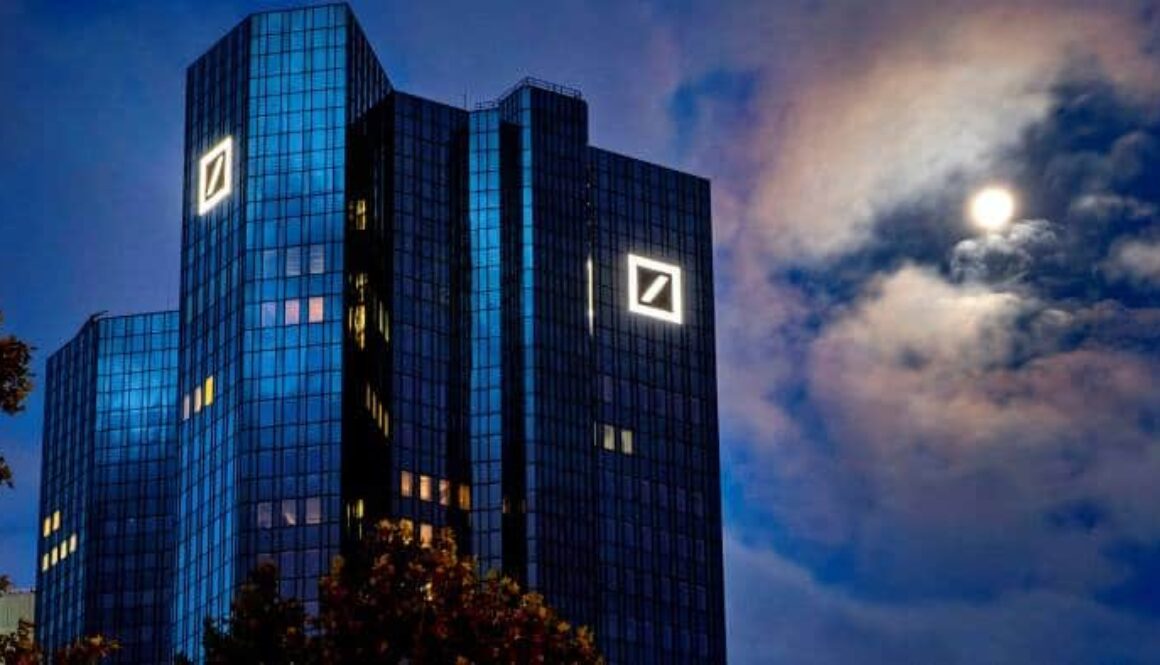
Schwab opens crypto trading to all U.S. retail clients as Deutsche Bank plans institutional custody
Charles Schwab has opened its crypto platform to all eligible U.S. retail clients, expanding a rollout that began with selected customers. The move signals institutional acceptance of retail crypto integration, but with a critical caveat: holdings sit outside SIPC and FDIC protection frameworks that shield conventional securities.
- Schwab expanded crypto trading to all eligible retail clients on Wednesday from a May 2026 launch serving selected customers only.
- Deutsche Bank plans to launch institutional crypto custody for Bitcoin and Ether within weeks, with Asia expansion targeted for 2027.
- Schwab Crypto assets held by Paxos Trust Company lack Securities Investor Protection Corporation and deposit insurance coverage despite integrated portfolio display.
- $12T in approximate client assets at Schwab.
- 0.75% per-trade fee charged by Schwab Crypto, compared to E*TRADE’s 0.50% launched May 2026.
- Three tokens, Solana, Avalanche, and Chainlink, that Schwab has indicated it will add to the platform.
Charles Schwab has opened its Schwab Crypto platform to all eligible U.S. retail clients, expanding a rollout that began with selected customers. The expansion, according to the announcement, positions Schwab as the largest traditional brokerage to embrace spot crypto trading for retail investors. The platform now includes crypto transfer functionality for Bitcoin and Ethereum networks, with clients required to pre-register withdrawal addresses as a security measure. Schwab also disclosed an equity stake in its infrastructure partner Paxos, signaling structural commitment beyond a vendor relationship.
Paxos Sub-Custody Structure Leaves Retail Crypto Outside SIPC and FDIC Safeguards
The crypto held in a Schwab account does not sit with Schwab’s broker-dealer entity but with Paxos Trust Company, NA, an Office of the Comptroller of the Currency-chartered trust company, in a sub-custody arrangement that places those assets outside traditional brokerage safety nets.
Charles Schwab Premier Bank serves as the primary custodian that appears on client statements, but Paxos handles the execution layer: private key management for digital assets, trade execution against crypto order books, and blockchain settlement. This layered architecture works within a regulated banking framework while outsourcing technical operations to a specialist infrastructure provider.
The distinction matters legally because crypto assets are classified as “digital commodities,” not securities.
The Securities Investor Protection Corporation, created under the Securities Investor Protection Act of 1970, covers cash and securities up to $500,000 per account when a SIPC-member broker-dealer fails, but it does not extend to assets held by non-member entities like Paxos Trust Company.
The same logic applies to FDIC deposit insurance: crypto assets are not bank deposits and carry no federal insurance.
Analysts studying brokerage-integrated crypto products have flagged a behavioral risk: when crypto appears in the same portfolio dashboard as SIPC-protected securities, the integrated presentation may mislead investors about which protections apply.
Schwab’s pre-registered withdrawal address requirement and explicit disclosures that assets are not securities, not SIPC-protected, and not FDIC-insured represent the primary safeguards against confusion, but they depend on clients reading account documentation fine print.
Schwab’s Competitive Fee Structure and Altcoin Timeline Reveal Market Positioning
Schwab charges 0.75% per crypto trade with a minimum of $1 and maximum of $2 million per transaction, a middle position in a rapidly evolving competitive landscape. Fidelity Crypto, live since 2022, charges 1% per trade. E*TRADE launched its crypto offering at 0.50% in May 2026, undercutting both Fidelity and Schwab and currently extending the offering to all 8.6 million of its clients.
Dedicated exchanges like Coinbase operate on tiered fee schedules ranging from roughly 0.60% to 1.00% depending on volume and account type.
For most Schwab retail clients, the 0.75% fee represents a convenience premium for integrated brokerage access with no separate account, no cash transfer to an exchange, and no new login.
At Wednesday’s Fall Business Update, Wurster tightened Schwab’s August preview of altcoin additions into a firm year-end 2026 deadline for Solana, Avalanche, and Chainlink. The selection reflects deliberate methodology: all three are established tokens with large market capitalizations and specific technical rationales.
Solana operates on proof-of-stake architecture designed for high throughput, capable of processing thousands of transactions per second at low cost, making it the leading platform for DeFi activity and NFT markets. Its March 2026 market capitalization already placed it among the top five cryptocurrencies globally.
Deutsche Bank Moves into Institutional Custody as Rivals Expand Asia
Deutsche Bank is preparing to launch institutional crypto custody for Bitcoin and Ether in Germany within weeks, according to Reuters reporting from earlier this week.
The German banking giant plans to expand beyond custody into stablecoin transactions, tokenized deposits, and blockchain-based securities issuance, including digital bonds. Gerald Podobnik, co-head of the bank, said the institution views tokenized and blockchain solutions as necessary additional services alongside traditional offerings.
I believe that, as the financial system, we will need to offer tokenized or blockchain solutions to our clients as additional services alongside our traditional ones … but not necessarily to replace what we are doing today.
Gerald Podobnik, co-head of Deutsche Bank
Deutsche Bank also intends to expand the custody business into major Asian financial centers next year as part of a broader push to capture growth in the digital economy.
The CCS read. We see custody infrastructure consolidating around regulated entities, Schwab via Paxos, Deutsche Bank in-house, which benefits institutional deployment but creates new counterparty risk concentrated in fewer trust companies. Retail investors gain easy access but outside traditional SIPC umbrella, a tradeoff that depends on custody operators maintaining operational security and regulatory standing. The real question: whether these platforms’ integrated presentation educates or obscures that difference.
Watch for Deutsche Bank’s Asia custody launch timeline in 2027 and whether competitors like Fidelity and E*TRADE close the gap to Schwab’s 40 million-client distribution, particularly as Schwab confirms the year-end 2026 altcoin deadline and the market tests whether regulatory clarity will accelerate institutional custody migration from exchange-based arrangements to bank-integrated models.