Crypto markets have had plenty to digest today, and this development adds another layer to the picture. Ethereum Institutional Backers Launch Independent Non-Profit to Target Wall Street Wealth gives NewsBTC readers a clean angle on Ethereum at a point where the market is trying to separate durable signals from short-lived noise.
According to the source material reviewed for this report, the story turns on a few concrete details rather than vague sentiment. That matters because crypto headlines can move quickly, but the pieces that tend to last are the ones backed by filings, official releases, data dashboards, or protocol-level records.
TL;DR
Ethereum co-founder Joseph Lubin, alongside ETH treasury firms BitMine and SharpLink, backed the launch of ‘Ethereum Institutional’.
The new group is an independent non-profit designed to serve as a ‘front door’ for Wall Street banks and asset managers on tokenization and stablecoins.
This organization aims to take over business development roles from the Ethereum Foundation, which is focusing more on core research.
A Fresh Signal For The Market
The immediate relevance is that this development fits into one of the market’s main themes for the day: institutional positioning, network usage, regulatory pressure, protocol development, or asset-specific rotation. In this case, the key topic is Ethereum, which is why it deserves a dedicated read rather than being buried inside a broader market recap.
For traders, the useful part is not simply that the headline exists. It is the way the facts line up with the current market backdrop. When official sources, market data, or protocol records show a fresh shift, readers get a better sense of whether the move is just a one-day reaction or part of something more structural.
The Numbers That Matter
The core source for this story is prnewswire.com with supporting data from globenewswire.com. That source trail is important because the final article should not rely on discovery-only media links or second-hand summaries.
Ethereum co-founder Joseph Lubin, alongside ETH treasury firms BitMine and SharpLink, backed the launch of ‘Ethereum Institutional’.
The new group is an independent non-profit designed to serve as a ‘front door’ for Wall Street banks and asset managers on tokenization and stablecoins.
This organization aims to take over business development roles from the Ethereum Foundation, which is focusing more on core research.
The numerical claims in the pack were tied back to specific source material before writing. ‘July 1, 2026’ sourced from Ethereum Institutional official launch release date
The Important Caveat
The caution is just as important as the headline. Do not state this is an official Ethereum Foundation spin-off; it is a separate non-profit.
That means the cleaner read is to treat this as a confirmed development with a defined scope, not as proof of a guaranteed price move or a sweeping market shift. In crypto, the difference matters. A verified data point can strengthen a thesis, but it does not remove execution risk, liquidity risk, regulatory uncertainty, or the possibility that traders fade the initial reaction.
For now, the story gives the market another piece of evidence to weigh. If follow-up filings, dashboard updates, protocol records, or official statements confirm further momentum, the angle can develop into something larger. If not, it still stands as a useful snapshot of where activity is concentrating today.
Autheo Presents ETHToronto 2026, Bringing Builders Together to Shape the Future of Web3 & AI
DateJuly 22, 2026
LocationToronto, ON
Edition5th Annual
Part ofCanada Crypto Week
The 5th Annual ETHToronto returns on July 22, 2026, bringing together builders for an afternoon of sessions, panels, and networking. Presented by Autheo and held as part of Canada Crypto Week, the event is designed to connect the people building the future of Web3 and AI.
Program
ETHToronto opens with Whitepaper Reading Club, a discussion-first session exploring blockchain whitepapers and the technical concepts shaping the future of Web3. This is followed by a full slate of speaker sessions.
Featured Speakers
Edward Johnson
Autheo
Ben Greenberg
Arbitrum
Arman Mamyan
Animoca Brands
Jerry Qian
OPTN Labs
Matthew Glezos
Toronto DAO
Elizabeth McFaul
Solana Foundation
Charles St. Louis
Ethereum Foundation
Top Sponsor
Autheo joins ETHToronto as the Top Sponsor, supporting the developers driving the next generation of Web3. Autheo is a Layer-0 Operating System with an integrated Layer-1 blockchain that combines identity, compute, storage, developer tooling, and AI capabilities into a single interoperable platform.
“Builders and developers are the foundation of every major innovation in Web3. We’re proud to support ETHToronto and help bring together the community creating the next generation of sovereign decentralized applications, infrastructure, and AI-powered technologies.”
— Edward Johnson, Chief Product Officer, Autheo
Evening Program
Following the sessions, attendees are invited to Devs & Bevs, an evening networking event designed to bring together developers, founders, and builders for meaningful conversations and new connections.
World Boss Media will also be onsite conducting live interviews with leaders throughout the event. As a leading Web3 marketing agency, World Boss Media helps companies grow through branding, influencer marketing, and community-driven campaigns.
ETHToronto takes place on July 22, 2026, as part of Canada Crypto Week and alongside Blockchain Futurist Conference — Canada’s largest Web3 and AI event.
ETHToronto is an annual gathering of developers, founders, and innovators building the future of Web3. Held as part of Canada Crypto Week, the event brings together the builder community through technical discussions, networking opportunities, and collaborative learning in the city where Ethereum was born.
About Autheo
Autheo is a Layer-0 Operating System with an integrated Layer-1 blockchain that unifies identity, compute, storage, developer tooling, and AI capabilities into a single interoperable environment. By simplifying infrastructure and providing powerful tools for builders, Autheo is helping accelerate the next generation of Web3 innovation.
The Ethereum Foundation has reportedly announced a reorganization aimed at reducing long-term operating costs.
The plan centers on lower annual spending, a tighter mandate, and a clearer set of internal work clusters.
For ETH holders, the key question is whether leaner coordination strengthens Ethereum’s long-term roadmap or creates short-term uncertainty.
Ethereum’s Core Steward Enters A Leaner Phase
The Ethereum Foundation is back in the spotlight after a reported reorganization put its staffing, annual budget and long-term treasury strategy under renewed scrutiny. The update matters because the EF is not a normal crypto company. It does not run Ethereum like a corporate network, but it remains one of the ecosystem’s most important coordination bodies for protocol research, grants, client development and public goods funding.
According to the official Ethereum Foundation announcement, the organization is moving toward a tighter mandate and a lower-spending model designed to protect long-term solvency. That is a significant signal at a time when Ethereum is trying to balance institutional adoption, scaling work, staking economics and pressure from rival networks. The Foundation’s challenge is to support core development without becoming the single point of dependency that Ethereum’s decentralization story is built to avoid.
Why The Budget Shift Matters
The headline for markets is not simply the number of roles or the size of the budget cut. It is the direction of travel. A lower operating burn can make the Foundation more durable if crypto markets remain choppy, ETH prices stay under pressure, or grant demand continues to rise. It also suggests that EF leadership is trying to move from a cycle-driven spending model toward something closer to an endowment approach.
That shift may be viewed positively by some long-term ETH investors. A leaner Foundation with a clearer mandate could reduce internal sprawl and force sharper prioritization. But there is also a trade-off. Ethereum’s roadmap is broad, and work around protocol upgrades, privacy, wallet access, user experience, institutional integration and ecosystem support all competes for attention.
Ethereum Still Needs Coordination
Ethereum’s strength has always been that no single organization controls it. Still, decentralization does not remove the need for coordination. The ecosystem depends on researchers, client teams, app developers, auditors and community groups moving in broadly compatible directions. The Foundation’s reorganization therefore lands at a delicate moment: Ethereum is becoming more important to institutions while also facing criticism over speed, complexity and user experience.
The practical question is whether the new structure can make Ethereum’s public-goods engine more focused. If the Foundation can cut costs while improving execution, the reorganization may eventually look like a sign of maturity. If it slows core work or creates uncertainty around grants and research priorities, the market may treat it more cautiously.
What ETH Investors Should Watch
For now, this is less about immediate ETH price action and more about Ethereum’s operating model. Investors and builders will be watching whether the Foundation’s new mandate translates into faster protocol progress, clearer grant priorities and a healthier relationship with independent ecosystem teams.
The timing also matters. Ethereum is already dealing with ETF flow pressure, staking debates, MEV concerns and questions over how much institutional finance will actually settle on public chains. A leaner EF does not solve those issues by itself, but it does show that the ecosystem’s core institutions are preparing for a longer, more disciplined phase.
The Ethereum Foundation is cutting its budget by roughly 40% and reducing staff by about 20%, concluding a planned shift toward a leaner, endowment-style organization with a narrower set of priorities.
Co-founder Vitalik Buterin called the cuts a deliberate trade, not an efficiency drive. Solana co-founder Anatoly Yakovenko went further, arguing the leaner foundation will move faster and prove bullish for Ethereum.
What the Budget Cut Removes
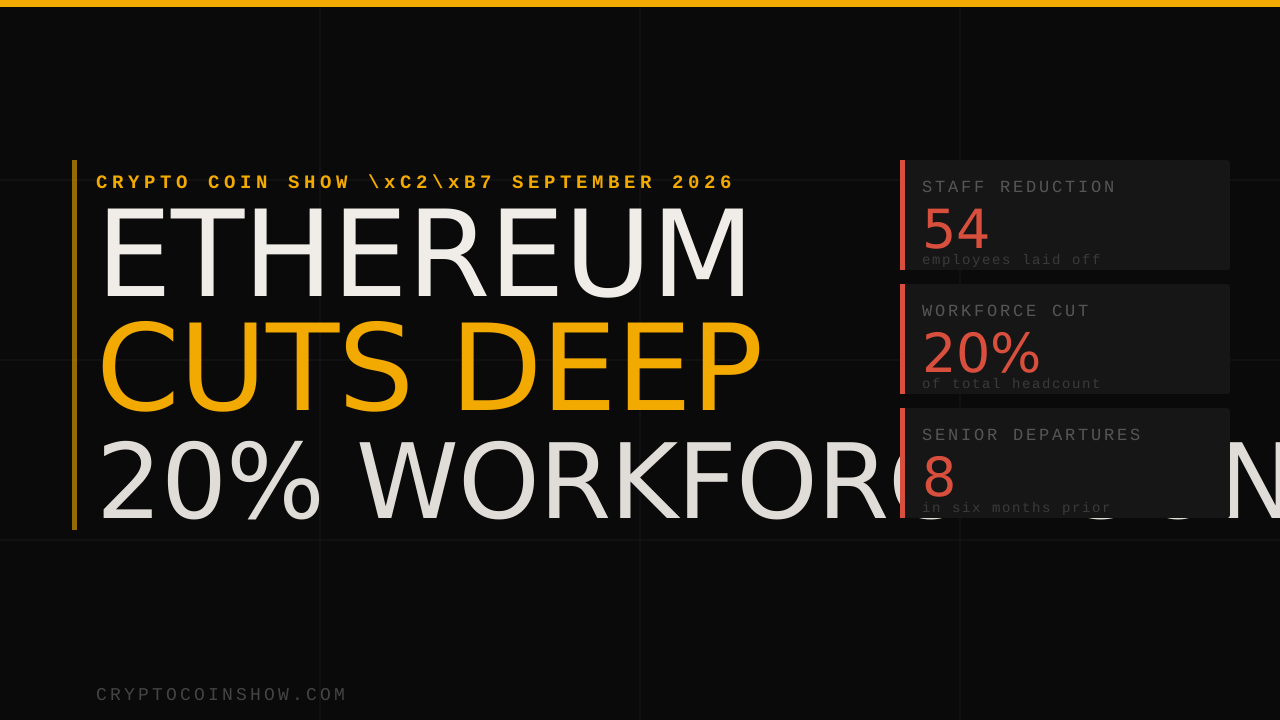
The foundation confirmed it is cutting 54 roles, close to one-fifth of its staff. It is reorganizing into a seven-cluster structure built around protocol security, censorship resistance, and privacy.
Buterin did not frame the reductions as pure efficiency. He named concrete losses. These include a smaller Devcon, the wind-down of Privacy and Scaling Explorations, and fewer projects beyond Ethereum.
The foundation’s June 2025 treasury policy set annual spending at 15% of holdings, with a 2.5-year cash buffer. It mapped a glide path to a 5% endowment baseline by about 2030.
To sell less ether (ETH), it now leans on staking and DeFi yield instead of principal.
“This year, the EF is decreasing its budget by roughly 40%, which entails some difficult decisions… the EF is transitioning into being a long-term-oriented endowment-based organization…” Vitalik Buterin wrote.
Buterin tied the budget to Ethereum’s Strawmap, which he calls the network’s third iteration after the Merge.
He wants that core protocol overhaul finished, then a higher bar for new features. He also expects leaner shipping.
Buterin said more of the protocol will shift from client redundancy to AI-assisted formal verification, reducing upgrade costs.
Solana Co-Founder Sees Upside
Not everyone reads the cuts as a decline. Solana co-founder Yakovenko argued that tight budgets force focus.
“Bullish… Budget constraints force prioritization and focus. Ethereum isn’t going away. A smaller and leaner EF will be more decisive and will move faster and will be able to course correct faster,” the Solana executive wrote.
Skeptics see risk. Former foundation contributor Trent Van Epps warned of a roughly $30 million annual funding gap for core development.
BitMine chairman Tom Lee dismissed the crisis talk, betting private backers and stakers will step in.
That bet is already taking shape. Days earlier, five former foundation researchers launched an independent nonprofit, Ethlabs. Lee and Ethereum co-founder Joe Lubin backed it to push institutional adoption.
Ethlabs is supported by a broad coalition across the Ethereum ecosystem:
Ethereum reflected the unease. Ether’s price action slid below $1,660, down about 5% over 24 hours. It retained its rank as the second-largest cryptocurrency, valued at about $200 billion.
The next treasury reports and protocol milestones will test the bet.
They will show whether a smaller foundation ships faster, as Yakovenko predicts, or whether the lost talent slows Ethereum’s most ambitious upgrade yet.
The Ethereum Foundation officially reduced its staff by 54 employees (roughly 20% of its workforce) yesterday, June 22, 2026.
The Foundation described the recent staff cuts as the final step in a restructuring process that began in June 2025 when the Foundation adopted a new set of objectives and a stricter treasury policy.
This was done to improve the Foundation’s financial discipline and focus resources on the most important development priorities.
Ethereum Foundation moves from the old structure to five new domains
The Ethereum Foundation published a blog post earlier today, sharing a new operational plan that reorganizes the company around five main areas: the protocol, access, user, community, and institutional layers.
As such, management and general operations will be handled by separate teams.
Each cluster has a specific objective. The protocol layer will be responsible for strengthening Ethereum against censorship and external control, ensuring that network upgrades are launched safely, and conducting long-term research into areas like post-quantum security and Layer 1 privacy.
The access layer will be tasked with making it practical for users to interact with the blockchain independently, such as reading data or sending transactions without needing intermediaries.
Finally, the institutional layer was created to help enterprises, governments, and non-profits easily adopt Ethereum’s cryptographic tools.
The wave of resignations before the layoffs
The restructuring comes just after eight senior contributors left the organization. The most recent exit was co-executive director Hsiao-Wei Wang’s resignation on June 22 after eight years with the research team, following the departure of her co-director, Tomasz Stańczak back in February. As a result, board member Bastian Aue is now the sole executive leader in charge of daily operations.
Researchers and engineers who departed since January include Josh Stark, Trent Van Epps, Tim Beiko, Barnabé Monnot, Carl Beek, and Julian Ma.
Former researcher Dankrad Feist attributed the exits to management problems rather than strategic disagreements. Coinbase head of engineering Yuga Cohler called the situation “dysfunction,” according to Cryptopolitan’s coverage of the departures.
Money troubles causing the layoffs
These layoffs are happening alongside growing funding concerns. As a core development coordinator from 2021 till April this year, Van Epps recently warned that developer funding could hit a crisis point within the next three to nine months. He estimated that maintaining Ethereum’s network of more than ten client teams requires roughly $30 million annually.
The Foundation’s four-year Client Incentives Program, which bankrolled the teams building and maintaining Ethereum’s core software, expired in April 2026. The Foundation has signaled plans to bring annual spending down from about 15% of its treasury to a 5% baseline by 2030, a strategy it calls “Subtraction.”
Protocol Guild, an independent collective that pools donations for Ethereum contributors, has distributed roughly $38 million since 2022. However, because it relies entirely on voluntary donations rather than a set budget, its funding remains unpredictable.
One day before the Foundation announced its cuts, five former EF researchers launched Ethlabs, an independent nonprofit research lab. Ansgar Dietrichs, Barnabé Monnot, Caspar Schwarz-Schilling, Josh Rudolf, and Julian Ma founded the organization with backing from Ethereum co-founder Joe Lubin, Bitmine Immersion Technologies, SharpLink, Anchorage, and more than 50 community partners.
What next for the Ethereum Foundation?
The Foundation will share more details about each cluster’s work by next month.
Ethereum’s co-founder, Vitalik Buterin, has also introduced the CROPS framework (censorship resistance, capture resistance, openness, privacy, and security) to anchor this new direction.
In his latest post on X, Buterin emphasized that this tighter focus is essential, and that he views the rise of independent, community-funded organizations like Ethlabs as the necessary evolution to ensure Ethereum’s core development stays strong and decentralized even as the Foundation reduces its own spending.
However, there’s still a heightened sense of uncertainty surrounding Ethereum, as shown by the significant drop in ETH’s price. The token is currently trading at $1,662 according to CoinMarketCap, which is a sharp fall from its near $4,950 peak in August 2025.
Whether this new approach (supported by independent communities) can cover the estimated $30 million annual cost of core development is now the question racing through everyone’s minds as we move into the second half of the year.
Ethereum’s market sentiment has deteriorated significantly as the blockchain network’s native ETH token moves through a medium-term bear phase.
Data from blockchain analytics platform Santiment shows that while ETH-related discussions increased in frequency throughout May, the tone of that commentary has shifted toward frustration, disappointment, and concern about deeper downside potential.
Ethereum Market Sentiment (Source: Santiment)
Analysts at the firm noted that this shift in sentiment reflects a combination of market pressures building simultaneously, including weak spot price action, persistent exchange-traded fund (ETF) outflows, high-profile departures from the Ethereum Foundation, public criticism from longtime ecosystem supporters, and stronger price momentum across competing layer-1 networks like Hyperliquid, Zcash, and Solana.
Broader market data from CryptoQuant reinforces this picture of institutional deceleration. The firm’s spot market and fundamental indicators point to severe structural weakness as ETH prices drop toward the critical $2,000 support level.
This has created a split-market identity in which spot investors are steadily reducing exposure, market liquidity has thinned, and institutional buying pressure has largely vanished from major trading desks.
Spot selling leaves Ethereum without a durable bid
Indeed, CryptoQuant’s fund-tracking data highlights the extent of the contraction in the institutional bid over the last two quarters.
According to the firm, total fund holdings, which peaked above 7 million ETH in October 2025, have steadily declined to a range around 5.5 million ETH.
This persistent unwinding indicates that large-scale allocators have systematically reduced their core exposure throughout the current multi-month drawdown.
Notably, the regulated ETF market has reinforced this structural pressure. Total assets under management across Ethereum ETFs now stand near $12.14 billion, marking a 23% decline from their January peak.
Data from SoSoValue shows that May proved particularly challenging, with two consecutive weeks of net outflows totaling approximately $470 million, representing one of the largest episodes of concentrated capital flight of the year.
Ethereum ETFs Weekly Outflows (Source: SoSoValue)
This institutional withdrawal is further illustrated by the Coinbase Premium Index, which tracks the price disparity between Coinbase Pro and major offshore platforms.
The index remained negative throughout May, signaling an absence of spot demand from US institutional buyers.
At the same time, ETH liquidity has thinned alongside this reduction in fund reserves.
According to CryptoQuant, daily fund trading volume has trended downward since February 2026, dropping well below its trailing 1-year moving average to a recent range of $17 million to $42 million.
This volume compression points to a thinner spot market where dip-buying appetite has faded, leaving the asset highly exposed to volatility spikes during periods of negative news.
ETH options traders hedge as leveraged longs hold on
Beneath the spot market liquidation, derivatives data reveal an ongoing debate over whether ETH is breaking into a structural decline or forming a base for a leveraged rebound.
This disconnect has left the derivatives market divided, with professional traders aggressively hedging downside risk even as speculative perpetual futures traders maintain long positioning.
Data from Block Scholes reveals that ETH’s 25-delta risk reversal skew over a seven-day horizon has traded near-7%, indicating that options market participants are paying a premium for downside put protection.
This defensive posture is supported by clearing data from the Deribit exchange, where open interest for put options targeting the $2,100 and $2,000 strike prices has concentrated past $380 million, placing those technical areas at the center of short-term institutional positioning.
ETH Options Traders Positioning (Source: Deribit)
Market Note: This concentrated options activity reflects a market preparing for extended weakness. Having already slipped below the $2,100 support shelf, Block Scholes’ risk appetite indexes show slowing momentum, leaving the asset dependent on defensive hedging in the absence of spot accumulation.
Concurrently, the perpetual futures market sends a more complicated signal. CryptoQuant data shows that Ethereum’s derivatives funding rate has settled firmly in positive territory, reaching 0.0082 on May 21, 2026.
Ethereum Funding Rates (Source: CryptoQuant)
This positive rate indicates that speculative long bias has not fully collapsed despite declines in market capitalization, fund holdings, and spot trading volume.
The resulting split identity creates a delicate technical backdrop: while options traders position for a breakdown, perpetual futures traders continue to hold leveraged long exposure.
This structural disconnect can fuel rapid short-squeezes if spot demand unexpectedly returns, but it significantly elevates the risk of cascading liquidations if the spot price breaches the heavy open interest concentrated at the $2,000 floor.
Ethereum Foundation exits collide with a weaker ETH value thesis
Ethereum’s financial underperformance has coincided with an acceleration of senior personnel departures from the Ethereum Foundation (EF), the Swiss non-profit entity that stewards the blockchain’s core development.
The internal churn intensified following the formal resignations of research veterans Carl Beek and Julian Ma. Beek had spent seven years focused on Beacon Chain design, while Ma authored the network’s Forwarding Oversight Committee for Incentivized Labs (FOCIL) framework.
Their departures bring the total number of senior exits or step-backs to at least nine since February, with five landing in May alone.
The list includes former co-Executive Director Tomasz Stańczak, board co-steward Josh Stark, Protocol Guild contributor Trent Van Epps, and protocol cluster leads Barnabé Monnot and Tim Beiko.
Additionally, senior researcher Alex Stokes recently commenced a three-month sabbatical, further thinning the organization’s visible technical leadership during a period of acute market stress.
Ecosystem analysts trace this administrative migration back to the publication of the foundation’s “Mandate” document in mid-March.
The 38-page framework codified the foundation’s dedication to “CROPS” principles: censorship resistance, open-source deployment, privacy, and base-layer security.
Crucially, the document framed the foundation as an ecosystem steward rather than a corporate enterprise, explicitly stating that its purpose is to protect network neutrality, not to maximize token price, optimize investor returns, or aggressively coordinate commercial expansion.
This neutrality-first posture has become increasingly difficult for parts of the market to accept as alternative networks capture speculative market share.
Tommy Shaughnessy, co-founder of Delphi Ventures, noted that the departures are more serious than they appear, adding that the exit of reform-minded personnel leaves fewer internal voices to challenge the foundation’s structural direction.
Reform calls test Ethereum’s neutrality-first model
The perceived lack of commercial execution by the foundation has prompted several prominent former insiders to call for structural governance reforms.
Dankrad Feist, a notable researcher who left the foundation last year to join the Stripe-backed layer-1 network Tempo, publicly advocated creating an entirely separate entity to safeguard the network’s economic relevance.
Feist proposed establishing an independent, alternative organization backed by at least $1 billion in capital, funded in part by network staking revenues. This proposed body would be directly accountable to token holders and expressly tasked with driving ETH’s financial adoption and market value.
According to him, this leaves the ecosystem without an agile institution incentivized to promote the asset in capital markets.
Bankless co-founder Ryan Sean Adams supported this view, stating that Ethereum’s future cannot depend solely on the foundation.
Adams argued that the ecosystem requires competitive, well-capitalized institutions dedicated to capital efficiency, aggressive communication, and commercial execution. These are roles the foundation was never structurally designed to fulfill.
The consensus among these reform proposals is not to replace the foundation, but to establish a dual-institution model: one to protect base-layer neutrality and public goods, and another to promote the asset and compete for institutional capital.
This push for reform has drawn a direct response from Ethereum bulls, who argue that the market is overreacting to short-term price action and natural organizational transitions.
ETH investor member Ryan Berckmans characterized the talent turnover as a healthy handoff to a younger generation of developers.
Berckmans argued that Ethereum has successfully navigated previous periods of regulatory pressure and leadership transitions while still delivering major upgrades like the Merge, blob transactions, and a dominant position in on-chain application capital.
He noted that the expanding deployment of stablecoins and tokenized assets by global corporations continues to support the network’s long-term trajectory.
This perspective is shared by substantial institutional holders.
Thomas Lee, chairman of BitMine, dismissed the current market anxiety as typical cyclical capitulation. BitMIne is the largest publicly traded corporate holder of ETH, with a portfolio of 5.2 million ETH and over $10 billion actively staked tokens.
BitMine Key Metrics (Source: BitMine Tracker)
Lee asserted that blockchain infrastructure represents the foundational settlement highway for agentic artificial intelligence commerce and institutional finance, positions where Ethereum maintains a distinct structural advantage due to its established security record, deep liquidity, and institutional familiarity.
How Ethereum can recover from the current FUD
Market observers have noted that Ethereum’s near-term trajectory now hinges on whether its technical roadmap and commercial moats translate into a coherent investment thesis for ETH.
Strategic analysis from Galaxy Digital indicates that the network must execute a disciplined operational agenda to reverse ongoing capital flight.
According to Galaxy’s recovery framework, the immediate focus must center on shipping the Glamsterdam upgrade, keeping the subsequent Hegotá deployment on track, clarifying administrative responsibilities within the foundation, and concentrating resources on core commercial verticals.
These key areas include high-value decentralized finance, institutional asset issuance, tokenized RWAs, stablecoin settlement, and privacy-preserving financial infrastructure. These are sectors where Ethereum’s credible neutrality and security record serve as a commercial necessity rather than an abstract principle.
Galaxy also pointed to the need for Ethereum to move faster on narratives likely to define the next cycle, including layer-1 scaling, on-chain privacy, post-quantum security, and AI-native economic infrastructure.
While much of this technical architecture is documented in the open-source “Strawmap” development framework, the more complex challenge remains the coordination among commercial and institutional actors.
This coordination gap sits at the center of Ethereum’s current market friction.
The foundation’s Mandate provides a clear statement of base-layer engineering principles, but it does not provide capital markets with a simple answer on value accrual, nor does it create an entity designed to defend the asset against aggressive layer-1 competitors.
Consequently, the current drawdown has evolved into more than a simple price correction; it is an active test of whether a decentralized structure can distribute commercial responsibility across new institutions without losing operational coherence.
If the ecosystem can turn its current administrative churn into clearly defined roles and convert its technical roadmap into a concise asset case, this period of underperformance could serve as a necessary governance reset.
However, if it cannot, the market may continue to treat weak spot demand, senior departures, and the application-layer economic shift as evidence that Ethereum’s network strength no longer guarantees protection of the underlying token’s value.
A long-time Ethereum investor and community figure has pushed back against growing alarm over the string of departures from the Ethereum Foundation (EF), arguing that the organization’s commitment to the network is as firm as ever.
Ryan Berckmans, who has worked full-time in the Ethereum space for eight years, offered one of the more detailed community-level defenses of the EF’s current direction since the exits started mounting this year.
Departures Caused by Differences of Opinion
According to Berckmans, people are misreading the situation.
“The EF departures are not because the people departing feel differently about Ethereum and our trajectory vs. the people staying at EF or vs. community folks like me,” he wrote.
What actually drove them, in his view, was a mix of internal disagreements over sub-strategies rather than any loss of faith in Ethereum itself, plus a deliberate generational shift.
“Some folks disagreed. Some tiny number were asked to leave for Reasons. Some few others left immediately due to Reasonable Net Feelings. Some more are leaving because the Wheel is Turning,” he explained.
Further, Berckmans added that new, younger contributors are ready to step into leadership across teams and departments. He also addressed a persistent piece of community frustration, that the EF and Vitalik Buterin do not care about ETH’s price, calling it a misconception.
According to him, they care deeply, but across a much longer time horizon than most community members track.
“They want to know, ‘How will Ethereum remain dominant after quantum computers?’ and, ‘How will Ethereum be the world’s economic hub for trillions in assets and thousands of L2s across a hundred countries?’”
His conclusion was that these are questions that can only get asked if you believe the outcome is achievable, and the EF’s programs in response to them are “gigabullish.”
Four Prominent Contributors Left in Just Four Weeks
The wave of exits has included Carl Beek, Julian Ma, Barnabé Monnot, Tim Beiko, Trent Van Epps, Josh Stark, and former co-Executive Director Tomasz Stańczak.
Stańczak’s departure, in particular, drew quite a lot of attention, considering that it came just 11 months after he’d taken the role. In addition, the exits have been concentrated, with four of the more prominent ones landing within roughly four weeks of each other in April and May.
Meanwhile, a detailed analysis by crypto researcher Nick Sawinyh pointed to unconfirmed claims circulating online that staff were asked to formally align with the Foundation’s new mandate. However, the EF has not publicly confirmed those claims, and none of the departing contributors cited the mandate as their reason for leaving.
People are also focusing on the coming Glamsterdam upgrade to Ethereum that is still under test. The protocol update includes changes tied to scaling and validator infrastructure, although some anticipated features, including FOCIL and native account abstraction, have already been delayed to a later upgrade cycle.
Despite this, many Ethereum backers believe that the entire ecosystem can now take leadership changes in stride without posing a risk to the network as a whole. One of them, author William Mougayar, described the Foundation’s shrinking role as a deliberate attempt to remove Ethereum’s remaining central point of control rather than a sign of institutional decline.
The Ethereum Foundation brought together some of the world’s most influential financial players in New York City for an exclusive, invitation-only institutional forum on how traditional finance is engaging with ETH. This gathering signals a growing focus on bridging the gap between decentralized technologies and traditional finance, as major players increasingly explore blockchain integration.
Institutional Participation Signals Growing Confidence In Ethereum
The Ethereum Foundation hosted a high-level invite-only institutional forum in New York City, drawing participation from hundreds of banks, asset managers, and infrastructure providers representing a combined $250 trillion in assets under management (AUM). An investor known as Milk Road on X revealed that major players, including BlackRock, Western Union, Robinhood, Moody’s, Baillie Gifford, and Securitize, took part in panels as builders, actively working on solutions within the ETH ecosystem.
Before now, institutional adoption used to be a bumper sticker, a story investors told themselves to feel better about the asset they already held. This move is different because the firms managing a combined $250 trillion in assets sat in rooms and talked about what they’re actually building on ETH.
In addition, the ETH Foundation used the event to unveil its post-quantum security strategy and launch a dedicated resource hub. Addressing such forward-looking challenges in a room filled with major financial institutions sends a signal.
Milk Road noted that the ETH Foundation is positioning its infrastructure to evolve over decades, not just short-term market cycles. For those who have questioned whether major institutions would move beyond experimentation, the developments in New York offered a compelling counterpoint.
Bitmine Launches Staking Model, ETH Network Activity Surges
Tom Lee, alongside Bitmine Immersion Technologies (BMNR), has officially launched MAVAN, the made-in-America Validator Network. According to Tom Lee Tracker, MAVAN is set to become the largest Ethereum staking platform globally, with approximately 3,142,643 ETH already staked, valued at around $6.8 billion based on an estimated price of $2,148 per ETH.
The scale of growth is accelerating, with over 101,776 ETH, worth around $219 million, staked in the past week alone. At full deployment, the network is projected to generate nearly $300 million in annualized staking rewards. Beyond ETH, MAVAN is also expected to expand into additional proof-of-stake chains and broader blockchain infrastructure.
Activity on the Ethereum network is surging, with daily transactions rising at an explosive pace. Crypto investor known as CW on X has stated that despite the price weakness, the network activity still remains at an all-time high level. Such a growth is not a signal of a bear market, as the price has dropped, but some investors are working very hard under the surface.
Ethereum co-founder Vitalik Buterin has committed $45 million in personal ether holdings to fund privacy and open-source technology initiatives, signaling a strategic shift in how the Ethereum ecosystem directs capital toward long-term research. The move comes alongside a broader call for the Ethereum Foundation to implement a five-year financial restraint period, reshaping how institutional resources support the network’s technical roadmap.
Industry Context and Market Implications
The blockchain infrastructure sector faces a critical juncture. As cryptocurrency markets mature beyond speculative cycles, sustainable funding models for long-term research have become essential. Unlike traditional software ecosystems backed by profitable enterprises, blockchain networks must create funding mechanisms aligned with decentralized governance principles while ensuring adequate resources for technical development.
Ethereum’s approach addresses this gap directly. The network currently processes billions in transaction value daily, yet its underlying cryptographic and hardware infrastructure lags commercial standards. Privacy technology research, in particular, remains underfunded relative to its strategic importance. Most venture capital gravitates toward consumer applications and DeFi protocols with clear monetization paths, leaving foundational infrastructure work chronically undercapitalized.
Buterin’s $45 million personal allocation and the Ethereum Foundation’s austerity framework represent a deliberate counterweight to market forces that would otherwise starve critical research. This decision influences how other blockchain ecosystems approach similar challenges, potentially establishing precedent for researcher-led funding in decentralized networks.
A Personal Commitment to Core Infrastructure
Buterin’s allocation of approximately 16,384 ETH reflects a deliberate choice to bypass traditional institutional funding channels for projects unlikely to attract venture capital. The capital targets a wide range of technological priorities spanning open silicon design, secure hardware solutions, and privacy-enhancing technologies.
The portfolio extends across several specialized domains. Open hardware initiatives aim to reduce dependence on proprietary chip manufacturers. Privacy infrastructure projects incorporate advanced cryptographic techniques including zero-knowledge proofs, fully homomorphic encryption, and differential privacy mechanisms. The allocation also supports local-first operating systems and encrypted messaging platforms that prioritize user control over data.
This approach ensures Ethereum’s long-term independence while advancing core technical development and supporting projects unlikely to attract commercial venture capital.
— Vitalik Buterin, Ethereum Co-founder
By withdrawing funds personally rather than through foundation governance, Buterin assumes direct responsibility for initiatives that exist outside conventional market pressures. This structural separation allows him to pursue technological objectives on timelines that prioritize technical rigor over commercial viability.
The Ethereum Foundation’s Austerity Framework
The Ethereum Foundation is entering what leadership describes as a period of measured financial restraint designed to balance two competing objectives: executing an aggressive technical roadmap while ensuring institutional financial independence for decades ahead.
This dual mandate represents a departure from typical foundation funding models. Rather than expanding institutional spending, the approach concentrates resources on essential technical work while reducing overhead. The strategy acknowledges that sustainable development requires institutional discipline, not unlimited capital allocation.
Key Context
The Ethereum Foundation’s five-year restraint period aims to strengthen the network’s long-term resilience by avoiding over-reliance on institutional spending cycles. This contrasts with traditional tech foundations that expand budgets during bull markets only to face constraints during downturns.
Foundation leadership views this period as essential for maintaining Ethereum’s core value proposition: a decentralized network that does not depend on any single institutional entity. By demonstrating financial prudence now, the foundation positions itself to remain independent and effective regardless of market conditions.
The Ethereum Foundation currently holds approximately $1 billion in assets, making it one of the largest cryptocurrency-focused research institutions globally. The five-year austerity framework will reduce annual spending to approximately $50-80 million, focusing resources on protocol research, client development, and ecosystem security. This restraint acknowledges that abundance during bull markets often leads to inefficient capital allocation and organizational bloat that impedes effectiveness during downturns.
Creating Self-Sustaining Financial Mechanisms
Buterin is exploring mechanisms to route future staking rewards into privacy and open-technology initiatives, creating what amounts to a self-sustaining financial engine. This approach transforms passive staking income into active funding for long-term research.
Decentralized staking systems could automatically direct portions of validator rewards toward designated projects. Such mechanisms would require no ongoing human intervention and would scale proportionally with Ethereum’s network growth. The approach insulates certain developmental priorities from institutional governance while maintaining transparency and community alignment.
This model addresses a persistent challenge in blockchain ecosystems: funding work that operates on long timescales or tackles controversial problems. Privacy technologies, for instance, face regulatory uncertainty in many jurisdictions. Hardware security research requires patient capital measured in years rather than quarters. By establishing dedicated funding streams, Buterin ensures these areas receive consistent support independent of market sentiment.
Funding Structure
The combination of personal allocation plus decentralized staking mechanisms creates multiple funding sources. This redundancy reduces dependence on any single capital pool and aligns incentives across different stakeholder groups within the Ethereum ecosystem.
Ethereum’s staking infrastructure currently secures approximately $25 billion in total value locked, with validators earning roughly 3.5-4% annual rewards. Directing even a small percentage of these rewards—potentially through protocol-level mechanisms—toward research could generate $100+ million annually for privacy and infrastructure initiatives without requiring additional capital infusions. This approach leverages Ethereum’s native economics to fund development aligned with network security and user privacy.
Bridging Research and Practical Application
The initiative emphasizes both theoretical advancement and real-world utility. While zero-knowledge proofs and homomorphic encryption represent cutting-edge cryptographic research, the funding also targets practical implementations that benefit everyday users.
Encrypted messaging platforms already supported by Buterin receive expanded backing under this allocation. New efforts aim to make secure hardware more accessible and transparent, reducing barriers to entry for users who prioritize privacy and security. Environmental monitoring projects demonstrate the initiative’s scope beyond pure cryptography.
This breadth reflects a recognition that blockchain technology’s long-term impact depends on solving problems beyond distributed ledgers. Privacy infrastructure, hardware security, and local-first software all contribute to a broader ecosystem where users maintain greater control over their digital assets and information.
The allocation process itself signals what types of work Ethereum’s leadership considers strategically important. By directing personal capital toward these areas, Buterin makes a clear statement about priorities that extend beyond short-term price movements or quarterly metrics.
Traditional venture capital excels at funding businesses with clear revenue models and growth trajectories. Privacy research, open-source infrastructure, and hardware security rarely fit that profile. By establishing parallel funding mechanisms, the Ethereum ecosystem creates space for work that generates long-term value without requiring immediate commercialization.
The strategy also reflects lessons from Ethereum’s own development history. The network required years of foundational research before delivering practical scalability improvements. Patient capital and freedom from short-term pressure enabled teams to pursue ambitious technical solutions that might have appeared unviable under traditional investment frameworks.
As the blockchain landscape matures, questions of sustainability and institutional structure become increasingly important. Buterin’s approach demonstrates one model for balancing decentralization principles with the practical reality that certain work requires sustained funding. The five-year austerity framework and decentralized staking mechanisms represent experiments in long-term financial planning within crypto ecosystems.
Whether these structures prove durable will depend on broader ecosystem adoption and how effectively they attract technical talent to priority areas. The allocation signals institutional confidence in Ethereum’s technical roadmap even as economic cycles fluctuate.
Implications for Ethereum’s Competitive Position
The privacy infrastructure and open hardware initiatives carry significant strategic implications for Ethereum’s positioning against competing Layer 1 blockchains. Privacy-focused networks like Monero and Zcash have demonstrated market demand, while specialized chains like Secret Network target privacy use cases. Ethereum’s commitment to privacy as an optional feature rather than fundamental property creates architectural flexibility but risks losing users prioritizing anonymity.
By investing substantially in privacy research through personal and decentralized mechanisms, Buterin signals that Ethereum intends to address this gap without sacrificing transparency or governance. Open hardware initiatives similarly position Ethereum’s ecosystem to develop independently from semiconductor supply chains controlled by nation-states or corporate entities, reducing systemic vulnerabilities affecting long-term network resilience.
These investments also attract technical talent pursuing intellectually challenging problems outside commercial constraints. Researchers in cryptography, hardware design, and privacy technologies often prefer environments emphasizing fundamental innovation over quarterly deliverables. By establishing well-funded research initiatives, Ethereum’s ecosystem becomes more competitive for attracting world-class technical talent that drives innovation cycles.
The Path Forward
The combination of personal capital commitment and institutional restraint positions Ethereum’s ecosystem differently than competitors relying on large venture-backed treasuries or hyperinflation to fund development.
This approach comes with inherent tradeoffs. Tying funding to staking rewards introduces volatility into project budgets. Decentralized mechanisms require robust governance to allocate resources effectively. Austerity frameworks risk underinvesting in critical areas if financial constraints become too severe.
Yet the underlying principle—that sustainable ecosystems require discipline, strategic focus, and alignment between incentives and long-term vision—reflects hard-won lessons from earlier technology cycles. By establishing these structures now, Ethereum’s leadership aims to ensure the network remains technically advanced and institutionally independent for decades ahead. This commitment to foundational infrastructure over short-term gains ultimately determines whether blockchain technology fulfills its potential as critical global infrastructure, or remains confined to speculative asset classes.
Get weekly blockchain insights via the CCS Insider newsletter.