Skip to content

Editor’s Choice

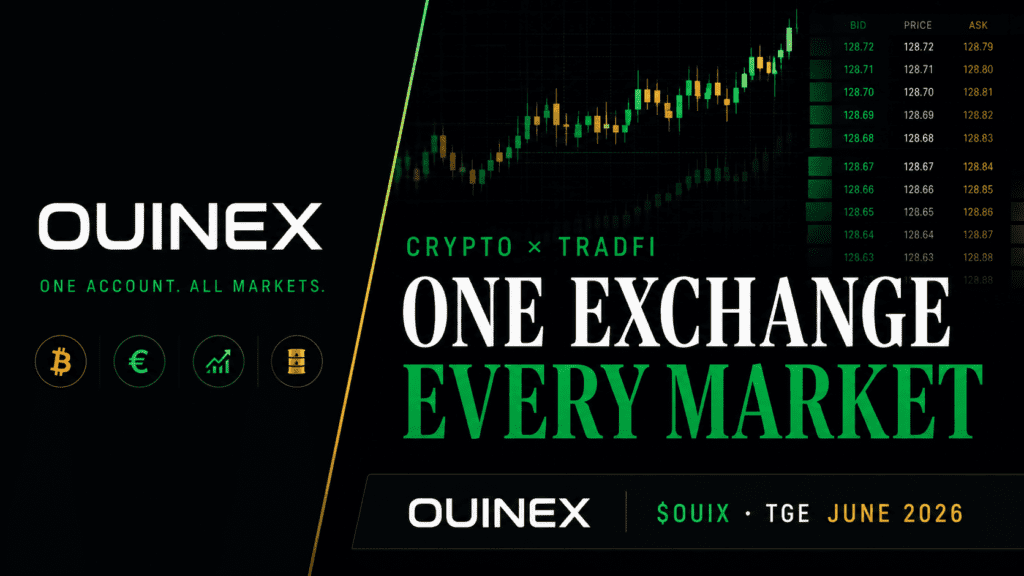
ouinex-article-thumbnail

Ouinex Launches Multi-Asset Exchange Merging Crypto and Traditional Finance Infrastructure

Ouinex Launches Multi-Asset Exchange Combining Crypto and TradFi Infrastructure

Ouinex Launches Multi-Asset Exchange Merging Crypto and Traditional Finance Infrastructure

The Swiss-based platform lets traders use Bitcoin and USDT as collateral to trade stocks, forex, commodities, and indices — with liquidity drawn from TradFi infrastructure rather than crypto perpetuals.

Ouinex, a live and regulated multi-asset exchange, is positioning itself as the first platform to give crypto-native traders direct access to global financial markets — stocks, indices, forex, commodities, and gold — using their existing crypto holdings as collateral, without converting to fiat or opening a separate brokerage account.

The Fragmented Trader Problem

For the past decade, active traders have been forced to maintain parallel accounts across multiple platforms: a crypto exchange for spot and perpetuals, a traditional broker for equities and forex, and increasingly, separate apps for commodities and indices. Every transfer between platforms introduces friction, cost, and delay — particularly damaging during fast-moving market events.

Ouinex CEO Ilies Larbi, who spent 20 years in traditional finance before founding the exchange, identified this fragmentation as the core problem in 2022. “The user journey was super fragmented,” Larbi noted. “At the end of the day, it’s all trading. The question was whether you could build a product that merges the two.”

The result is a platform that handles spot crypto trading alongside derivatives on traditional financial assets — all within the same account, using the same collateral pool.

Crypto Spot
BTC, ETH, altcoins
Crypto Perps
Leveraged perpetuals
📈
Equities
NASDAQ, DAX, Dow
Forex
EUR/USD, GBP/JPY+
🛢
Commodities
Oil, gold, and more
Indices
S&P 500, global

Why TradFi Infrastructure Changes the Liquidity Equation

The central technical distinction between Ouinex and competitors entering the multi-asset space is its decision not to build traditional financial products on top of crypto perpetual infrastructure — the approach taken by platforms like Hyperliquid, Binance, and others rolling out stock or commodity perps.

When crypto exchanges offer gold or forex exposure via perpetuals on a central limit order book, they are starting from scratch on the liquidity side. Market makers must be recruited specifically for each instrument, pricing is inefficient in the early stages, and the result is wider spreads and shallower order books compared to the established TradFi equivalents.

Ouinex routes its TradFi instrument trading through existing financial market infrastructure — the same pipes that have underpinned institutional currency and commodities trading for decades. The consequence, according to the company, is measurably better execution for retail traders.

“We’re about seven times cheaper and approximately 100x deeper in liquidity on instruments like Euro Dollar — versus platforms using the crypto perpetual approach. That’s not small. They’re a billion-dollar company. We’re barely a startup.”
Ilies Larbi — CEO and Founder, Ouinex

On the EUR/USD order book specifically, Ouinex claims its top five layers hold approximately $10 million in available liquidity, compared to roughly $500,000 on competing crypto-native platforms offering the same instrument as a perpetual. The spread advantage, the company states, is around seven times in the trader’s favour.

Metric Crypto-Native Perp Approach Ouinex TradFi Infrastructure
EUR/USD liquidity (top 5 layers) ~$500k ~$10M
Spread vs TradFi benchmark ~7x wider At par
Commission on TradFi instruments Variable Zero
Collateral accepted USDT / stablecoins USDT, USDC, BTC+
Max leverage (EUR/USD) Up to 100x Up to 500x

The 500x maximum leverage figure, while striking, applies specifically to low-volatility instruments like major forex pairs. Larbi has been explicit that volatility-adjusted risk on a 500x EUR/USD position is materially lower than a 100x position on a cryptocurrency perpetual, where daily price swings can easily exceed the margin threshold.

Crypto Collateral for Global Markets

A key feature of the Ouinex architecture is the ability to use crypto assets as collateral for TradFi positions without liquidating those holdings into fiat. Currently, traders can deposit USDT and USDC to fund their margin accounts. A forthcoming update will extend this to native crypto assets including Bitcoin.

The practical implication is that a trader holding Bitcoin during a period of low crypto volatility — or wanting to hedge their exposure — can use that same BTC as margin to take a position in oil, forex, or an equity index. The capital does not need to leave the crypto ecosystem at any point, and no traditional bank wires or card deposits are required.

This removes one of the primary structural barriers to crypto traders participating in TradFi markets: the friction of fiat on-ramps, which typically involve delays, fees, and banking system dependencies that crypto-native users are specifically trying to avoid.

$9M+ Raised from community
5,000+ Investor base
0 VC investors
37 Full-time team

Community-Funded, Zero Venture Capital

Ouinex has raised over $9 million from more than 5,000 retail investors — a deliberate strategy to avoid venture capital entirely. The company ran a multi-phase community pre-sale of its $OUIX token, using each round to demonstrate ongoing product delivery before asking investors to commit further capital.

The decision to exclude VCs is structural rather than ideological. Larbi has been direct about the mechanics: VC token allocations often come fully unlocked, creating immediate incentive to liquidate at listing. The result is a predictable pattern of sell pressure that disproportionately affects retail buyers who entered on the back of the project’s hype at launch.

“The crypto industry is mature enough now to understand what VCs do. We’ve seen those wicks. We know how it happens. There was also no need — we had a community ready to believe in the product.”
Ilies Larbi — CEO and Founder, Ouinex

Ouinex applied the same logic to its market maker relationship, opting for a retainer model rather than granting a token allocation. Under the retainer structure, the market maker has no inventory of $OUIX to sell, eliminating one of the most common vectors for token price manipulation in new listings. The exchange itself serves as the primary listing venue, meaning no tokens need to be surrendered to a tier-one exchange as a listing fee.

Regulated in
5+ Jurisdictions EU Compliant Active Licenses Full KYC/AML

The $OUIX Token and Exchange Flywheel

Ouinex is approaching its token generation event (TGE), set for mid-June 2026, with $OUIX priced at $0.1334. The token serves several functions within the exchange ecosystem: reduced trading fees, cash back on derivatives volume credited in USDT every 24 hours, enhanced APY on the platform’s earn offering, and improved allocation access through the Ouinex launchpad.

A buy-and-burn mechanism allocates a percentage of exchange revenue to repurchasing and destroying $OUIX tokens, creating a deflationary supply dynamic that ties token value directly to platform trading volume. Critically, this revenue stream is drawn from every asset class on the platform — crypto, forex, stocks, commodities, and indices — giving $OUIX a broader revenue surface than exchange tokens tied purely to crypto trading.

TGE Price

$0.1334

TGE Date

Mid-June 2026

Already Staked

50%+

Staking Cliff

3 Years

Revenue Sources

Crypto · Forex · Stocks · Commodities · Indices

Mechanism

Buy & Burn

More than 50% of the total token supply is already staked under a three-year cliff — an unusually strong signal of long-term holder conviction ahead of listing. For context, the three-year cliff means the majority of current token holders cannot sell for at least three years from their staking date, structurally constraining near-term sell pressure beyond the typical lock-up periods seen in comparable exchange token launches.

Investors in the community pre-sale fall into two categories: token holders, who participated in the $OUIX pre-sale, and equity shareholders, who took a direct stake in the operating company. The dual structure gives the project both a token-aligned community and a cap table of shareholders with economic interest in the underlying business.

Market Context: Why Now

The timing of Ouinex’s launch aligns with a visible shift in how major crypto exchanges approach traditional financial assets. Binance has introduced stock tokens; HyperLiquid has added an S&P 500 instrument; MexC and BitMEX have made similar moves. The direction of travel is clear — the largest exchanges are converging on multi-asset coverage.

The distinction Ouinex draws is one of infrastructure: building on top of proven TradFi liquidity rails rather than adapting crypto perpetual infrastructure to handle instruments it was not originally designed for. Whether that architectural choice translates into sustained competitive advantage will depend on execution at scale — but the early benchmarks on spreads and order book depth suggest the model is functioning as intended.

High commodity volatility in 2026 — driven by geopolitical events including Iran-related oil market movements — has also provided near-term validation. Ouinex has reported that oil has overtaken EUR/USD as its highest-volume instrument in recent periods, a cross-sell pattern that demonstrates traders are actively using the multi-asset functionality rather than treating it as a secondary feature.

“Bitcoin is consolidating around the 70s. But look at the oil market — amazing opportunities, lots of movement. Volatility means opportunity. The platform exists precisely for that moment.”
Ilies Larbi — CEO and Founder, Ouinex

The platform is live, regulated across five or more jurisdictions, and accepting users globally. US access is available for most features. The team consists of 37 full-time staff, and the company is accepting platform feedback directly — with confirmed rewards for bug reports and feature suggestions submitted via the platform.

Watch
Blockchain Interviews: Ilies Larbi, CEO of Ouinex — Full Interview with Ashton Addison
thg_merck_dpp_thumbnail

The Hashgraph Group and Mercjnk Introduce EU Digital Product Passport on Hedera for Regulated Supply Chains

Screen Shot 2026-06-05 at 2.01.06 PM

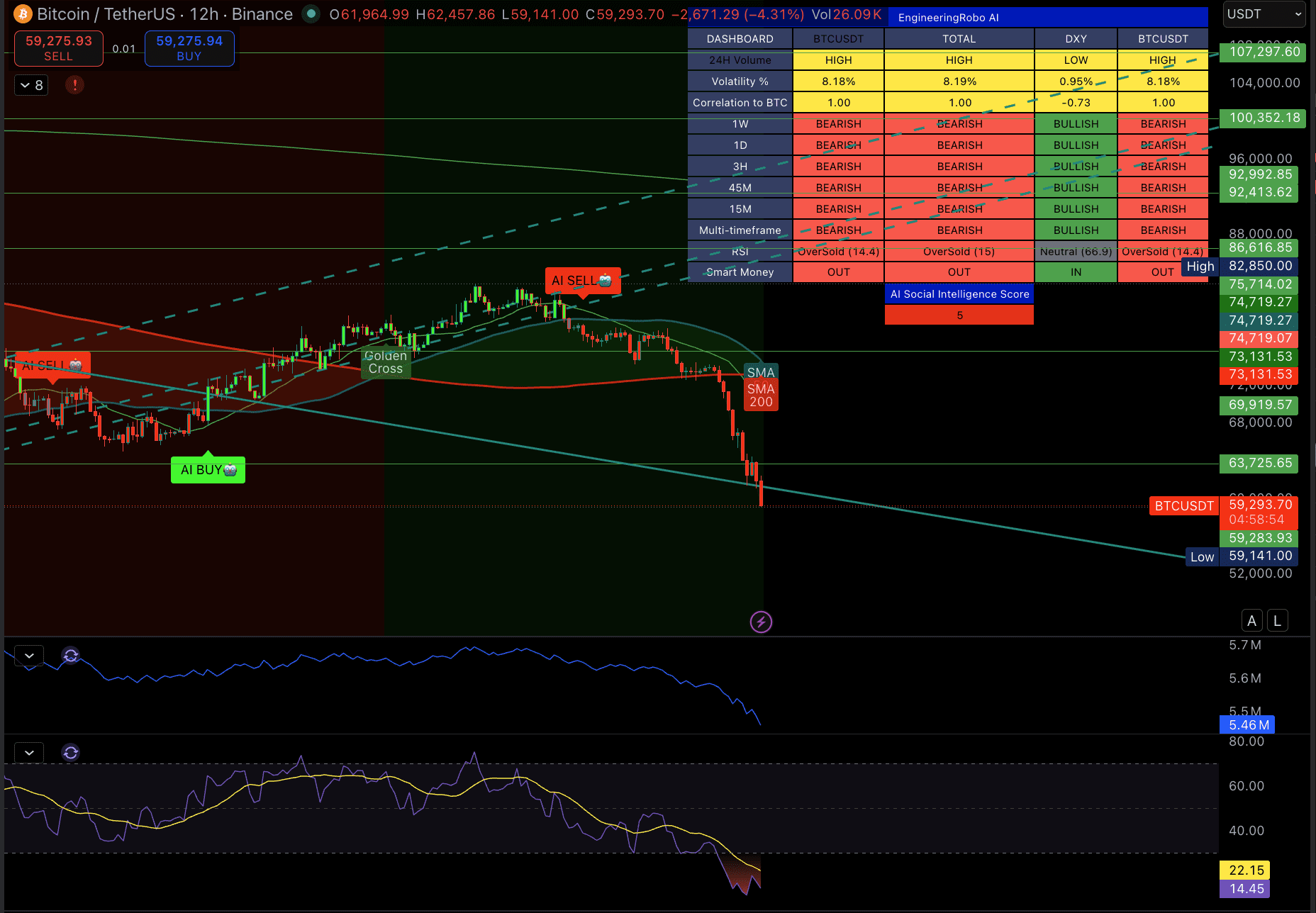
Bitcoin Dips Below $60K in Extreme Fear — Read This Before You Do Anything

zcash-article-thumbnail

The $5 Billion Shadow: Inside the Zcash Orchard Exploit

fragile-launch

How to spot a fragile Token Launch before you buy in

xyo-newarticle-thumbnail

AI Can’t Think Straight Without Verified Data. Here’s Who’s Fixing That.

dutchblockchainweek

Amsterdam Set to Welcome Thousands of Digital Asset Professionals

ev-thumbnail-report

Ethereal Ventures: Blockchain Is Now the Backend for Global Finance

Ethereal Ventures: Blockchain Is Now the Backend for Global Finance
Crypto Coin Show · Market Intelligence May 2026

Ethereal Ventures: Blockchain Is Now the Backend for Global Finance

In its Q1 2026 market insights report, Ethereal Ventures maps five core metrics — dealflow, tokenized real-world assets, payments volume, protocol fees, and token holder distributions — to argue the on-chain migration of traditional finance has barely started.

$29.3B RWA On-Chain +46% 1Y
$10B/mo Stablecoin Payments +3× 3Y
$50M/day Protocol Fees (floor) Structural
15–22% Revenue to Holders ↑ from 4–7%

Ethereal Ventures’ Q1 2026 Digital Asset Market Insights report opens with a blunt thesis: the five metrics it tracks — dealflow composition, tokenized real-world assets, blockchain payments, on-chain protocol fees, and value returned to token holders — all point toward an industry that has moved well past proof-of-concept and into the early innings of genuine financial infrastructure adoption.

The headline number is $29.3 billion in real-world assets now tokenized on-chain, representing a 30× increase over four years. Impressive on its face — until Ethereal frames it against US equity market capitalization, where it represents less than 0.05%. Their conclusion: the migration has barely started.

01 Where Founders Are Betting Their Time

Dealflow composition is the leading indicator Ethereal trusts most, on the premise that founders are the best arbiters of where value will compound. This quarter’s inbound pipeline tells a clear story.

32%
AI
20%
DeFi
8%
Payments
6%
Prediction Markets
5%
Applications
5%
Stablecoins
Key Insight

AI is drawing the bulk of talent and capital — but the parallel story is blockchains maturing into the API backend for payments and broader financial activity. Stablecoins and payments are one slice of that compounding interest, as the rails for on-chain commerce keep maturing.

02 Real-World Assets: 30× in Four Years

Tokenized real-world assets — the canonical measure of how much traditional finance has actually moved on-chain — reached $29.3 billion as of April 13, 2026. US Treasuries lead the composition, followed by commodities and asset-backed credit. The growth trajectory is steep: +46% in one year, +266% over two years.

Asset Class Description Value On-Chain
US Treasury DebtTokenized government bonds — leading category$13.4B
CommoditiesGold, silver, and physical asset-backed tokens$5.4B
Asset-Backed CreditPrivate credit structured on-chain$3.1B
Specialty FinanceStructured lending and receivables$1.5B
Non-US Govt DebtSovereign bond tokenization outside the US$1.2B
StocksEquity tokenization on public blockchains$1.0B
Active StrategiesOn-chain managed funds and yield vaults$919M
Venture CapitalTokenized fund positions and LP interests$818M
Corporate CreditTokenized corporate bonds$716M
Real EstateProperty fractionalization and REITs on-chain$297M
Total RWA On-Chain$29.3B · +30× in 4 years

The Ethereal framing is important here: $29.3B is not a failure to scale, it is a starting line. US equities alone represent roughly $50 trillion. Tokenized assets at current levels are a rounding error — but the infrastructure to absorb orders of magnitude more institutional capital is, by Ethereal’s read, now mature enough to do it.

03 Stablecoin Payments: $390 Billion Annualized

Monthly stablecoin payment volume has tripled over three years to $10 billion per month, driven primarily by B2B settlement flows. McKinsey and Artemis data cited in the report puts full-year 2025 stablecoin payment volume at $390 billion annualized once B2B custody flows and cross-border remittances are included.

“+3× in three years to $10bn/mo, against Visa and Mastercard’s mid-single-digit CAGR.”

The comparison to card networks is deliberate. Visa and Mastercard process roughly $2.27 trillion per month combined. Blockchain-based payments are at less than 0.5% of that — but the unit economics of on-chain settlement improve with scale in ways the card stack structurally cannot match. Ethereal’s projection: the first $1 trillion per month arrives via B2B capture; consumer flows follow as embedded wallets reach mainstream apps.

$390B
2025 Annualized Volume
+3×
Growth Over 3 Years
$2.27T/mo
Visa + Mastercard Target
04 Protocol Fees: The Bear-Cycle Floor Keeps Rising

Daily protocol fees — the metric that strips away token price noise to show what users are actually paying to use blockchains — have established a structural floor of $50 million per day, holding through every major market drawdown since 2020. The 30-day moving average currently runs above that floor.

Key Insight

Zero to $50mm/day in six years at the bear-cycle floor. The baseline keeps ratcheting up regardless of price action — the clearest signal that demand is structural, not reflexive.

Ethereal projects fees scaling on two compounding curves: surface area (more product categories entering DeFi — prediction markets, perp DEXes, on-chain credit, RWA distribution) and intensity (institutional users transacting in larger size, with higher willingness to pay for settlement finality). Their target: a $500 million per day baseline.

05 Token Holders Are Starting to Look Like Shareholders

Perhaps the most structurally significant finding in the report: capital returned to token holders has tripled since 2024, now running at 15–22% of protocol revenue versus 4–7% across 2022–2024. The shift is being led by Hyperliquid, whose 99%-of-fees buyback model has become the benchmark the rest of the industry is now measured against.

The implication, if the trend continues: tokens stop trading as speculative commodities and begin pricing like cash-flowing assets, attracting a fundamentally different and larger buyer base — one that includes traditional equity investors currently sitting on the sidelines.

06 Six Predictions: Where We Are vs. Where We’re Going

The report closes with six explicit prediction pairs — current state versus projected destination — that frame Ethereal’s investment thesis for the next three to five years.

Money on Blockchains · Now
~$480B on-chain
↓ TRAJECTORY
Projected Destination
Majority of US M2 ($21.7T)
Stablecoin Payments · Now
$10B / month
↓ TRAJECTORY
Projected Destination
Visa + Mastercard stack ($2.27T/mo)
Companies Using Blockchains · Now
~38% of SMBs
↓ TRAJECTORY
Projected Destination
~100% of companies touching finance
DeFi Daily Active Users · Now
~300K DAU
↓ TRAJECTORY
Projected Destination
>30M DAU via embedded wallets
Protocol Fees · Now
$50M/day floor
↓ TRAJECTORY
Projected Destination
$500M/day baseline
Value to Token Holders · Now
15–22% of revenue
↓ TRAJECTORY
Projected Destination
Majority of fees flowing to holders
07 Where Ethereal Sees the Next Breakthroughs

The report’s outlook section categorizes emerging opportunities across three buckets: new market infrastructure, TAM overhauls where AI is rewriting addressable markets, and blue ocean frontiers with undefined outcome shapes.

Bucket 01 New Market Infrastructure
  • The New Intent Exchange
    A neutral matching layer beneath AI agent platforms where merchants compete on price for commercial intent, settled in stablecoins.
  • Agentic Commerce Risk Rails
    Programmable spending limits and on-chain escrow built for agent transactions — reversibility designed in, not retrofitted.
  • Parametric Insurance On-Chain
    Instant-payout policies for measurable events: weather delays, satellite launches, AI SLA failures.
  • Supply-Chain Disintermediation
    Agent-queryable factory profiles, attested quality data, and stablecoin settlement collapsing 40–80% intermediation margins in global retail.
Bucket 02 TAM Overhauls
  • Agent Payments and Stablecoins
    Agents can’t open bank accounts but can hold wallets. Agent-to-agent flows are the most open frontier, needing new micropayment frameworks at machine speed.
  • AI Fraud Defense
    The next fraud stack moves from scoring events to verifying actors — portable, privacy-preserving credentials that prove identity once and plug in anywhere.
  • Devtools Are Now Mainstream Tools
    Agentic engineering exploded what was historically a tiny market. The durable layer: tooling where the customer is the agent and the human is out of the loop entirely.
  • The Crypto Credit Highway
    Crypto wins as rails between capital pools and origination, not as a replacement underwriter. Wedge: SMB/B2B lending where stablecoin escrow enables new cashflow mechanics.
Bucket 03 Blue Oceans
  • Machines as Autonomous Companies
    A progression from AI-native funds to agents running companies end-to-end, dispatching humans to perform tasks via real-time capital flows.
  • Proof-of-Human Traffic Bifurcation
    Publishers charge agents at scale via micropayments; verified humans browse for free. A new content monetization stack for the post-AI-flood web.
  • Markets for Scarce Rights
    Tokenization and dispute resolution for bureaucratically-gated rights: satellite slots, drone air corridors, spectrum bonds, congestion pricing.
  • Agent-Native Trust and Reputation
    A canonical, queryable trust profile for suppliers, merchants, and services — built on machine-readable signals like fulfillment rates and certified quality attestations.

The full Ethereal Ventures Q1 2026 report is available on their Substack: The Maturation of the On-Chain Economy. All figures sourced from RWA.xyz, Artemis, DefiLlama, and McKinsey × Artemis (Feb 2026).

xyo-theta

XYO and Theta Just Solved AI’s Accountability Problem

XYO and Theta Just Solved AI’s Accountability Problem

XYO and Theta Just Solved AI’s Accountability Problem

For the first time, AI agents running on decentralized infrastructure can generate independent, on-chain proof of their own performance — thanks to a new integration between XYO Layer One and Theta EdgeCloud. No centralized cloud has ever offered this.

Autonomous AI agents are already operating at scale — initiating transactions, consuming cloud services, and coordinating with other agents, all without a human in the loop. But until now, there has been no reliable, independent way to verify whether those agents actually performed as intended. When no human is watching, the record of what happened — if it exists at all — lives inside the same system that ran the workload.

That changes today. XYO Layer One and Theta EdgeCloud have announced a new integration that gives AI agents something they have never had: verifiable, tamper-proof proof-of-performance written to a public blockchain by an independent observer.

Why This Matters Now

AI agents are already running production workloads for the Houston Rockets, Olympique de Marseille, and partners across the MLS, NBA, NHL, and Ligue 1 on Theta EdgeCloud. As agentic AI scales across industries, the question of accountability — did it actually do what it said? — becomes critical infrastructure, not a nice-to-have.

XYO watches EdgeCloud from the outside — independently measuring real uptime, speed, and reliability — and writes permanent records to XYO Layer One. Those records are stored in XYO Data Lakes and can be queried by anyone, at any time. The data never touches the system it is measuring, which is precisely the point.

Centralized clouds can’t offer this — their performance data never leaves their own systems.

What AI Agents Can Now Do That They Couldn’t Before

This integration unlocks a new capability for the broader AI industry: agents can now generate cryptographic receipts of their own execution. Every task completed, every service consumed, every coordination event — recorded independently and permanently on-chain, paid for in $XL1 with a portion of each payment burned.

For developers and enterprises deploying AI agents, this means auditability without trusting the platform running the agents. For end users interacting with AI systems, it means a publicly accessible performance history. For the broader Web3 ecosystem, it means the accountability layer that autonomous AI has been missing is now real.

Agents can now prove execution
Every task, coordination event, and service call can generate an on-chain record — written by an independent observer, not the agent itself.
Infrastructure can be audited publicly
Uptime, speed, and reliability records for Theta EdgeCloud are now permanently stored in XYO Data Lakes, open to anyone.
Builders can ship in days, not months
The XYO AI SDK compresses what would traditionally take months of engineering into a days-long integration, deployed directly to XYO Layer One.
The standard is open
Theta is the first partner — but XYO and Theta Labs are building a shared standard any infrastructure provider can adopt.

A New Accountability Layer for Agentic AI

The broader significance of this integration goes beyond XYO and Theta. As AI agents take on more consequential tasks — managing funds, executing trades, coordinating supply chains — the question of whether they performed correctly becomes a legal and commercial necessity, not just a technical curiosity.

Today’s announcement establishes a blueprint: an independent, blockchain-based verification layer that operates outside the systems it monitors. Theta EdgeCloud is the first infrastructure partner to ship a verification standard built this way. The XYO team says it will not be the last.

Token Mechanics: Every Verification Is a Transaction

For $XL1 and $XYO holders, the integration ties real-world AI activity directly to on-chain economics. Every record written to XYO Layer One is a transaction. Every transaction burns a portion of $XL1. As AI agent workloads scale across EdgeCloud and beyond, that activity flows through XYO Layer One — creating deflationary pressure anchored to actual infrastructure usage, not speculation.

$XL1 Token Flow
Agent Runs
AI workload executes on Theta EdgeCloud
XYO Verifies
Independent record written to XYO L1
$XL1 Paid
Every record is a transaction
Burn
Portion of every payment permanently removed

What Comes Next

The XYO AI SDK is now open for early access testing. Developers can begin building verified AI applications and agents — with deployment directly to XYO Layer One — starting today. Theta EdgeCloud is live as the first verified partner, with more integrations expected to follow as the standard gains traction.

Two of crypto’s earliest protocols. One accountability standard built for the age of autonomous AI.

Early Access — Now Open
Build with the XYO AI SDK
Start shipping verified AI apps and agents in days — not months.
Sign Up Now →

Load More