Zcash activates NU7 upgrade, tripling block frequency to 25 seconds
Zcash’s NU7 upgrade triples block frequency and writes a fee-recycling mechanism into the protocol, changing how the network plans to pay for security as mining subsidies decline. For institutional holders of ZEC, now a top-10 asset by market cap, the 21 million supply cap stays intact while the long-term security budget is rebuilt.
- NU7 activated on Zcash mainnet at block height 3,543,405 on Thursday (November 5), cutting block targets to 25 seconds.
- Under the Network Sustainability Mechanism, 60% of transaction fees leave circulation and return through block rewards, starting around 2031.
- A separate proposal would have Zcash Community Grants contribute 50,000 ZEC from its treasury to the mechanism.
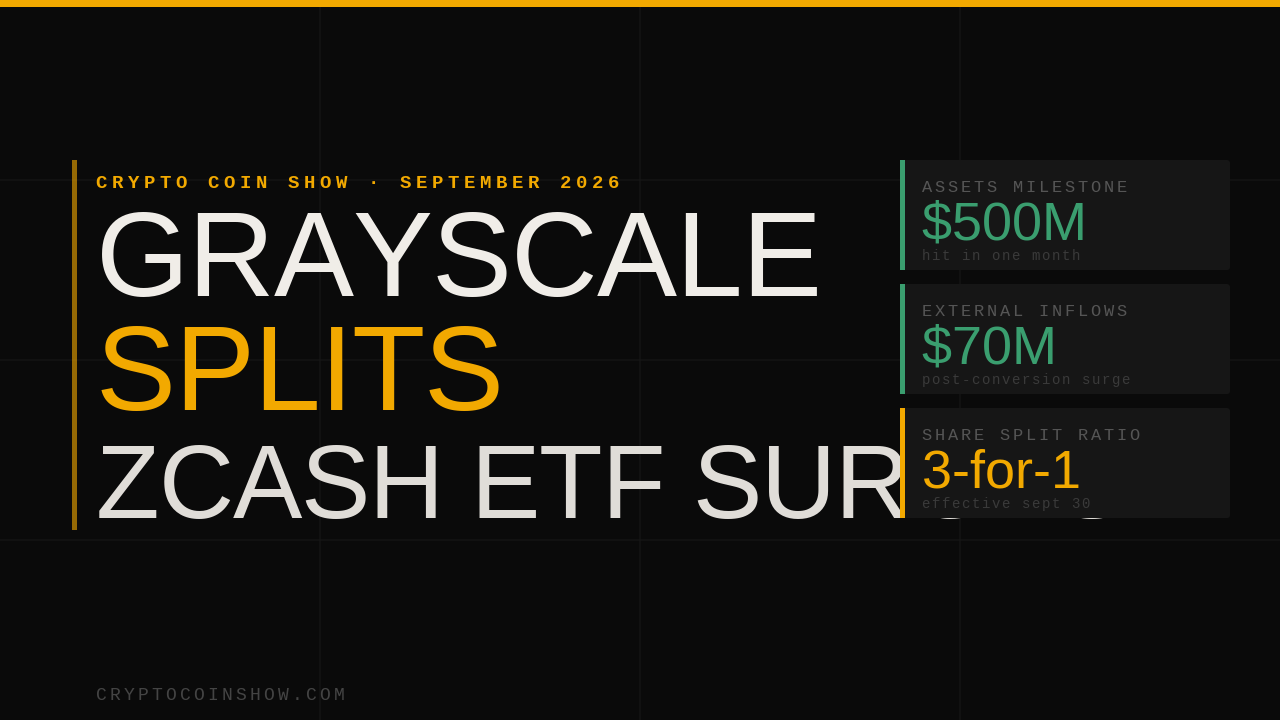
- 25 sec new target block time, down from 75 seconds before NU7
- 60% share of Zcash transaction fees removed and later reissued through the NSM
- $1,693 September multi-year high, against roughly $1,290 trading price after upgrade
Zcash activated its NU7 network upgrade on mainnet at block height 3,543,405 on Thursday (November 5), cutting the target block time from 75 seconds to 25 seconds, as first reported by CryptoPotato. Block rewards were scaled down so new ZEC keeps entering circulation at roughly the same pace, and the number of blocks between halvings was tripled to match. ZEC briefly fell to about $1,222 after the upgrade went live.
Shielded Labs’ NSM Recycles 60% of Zcash Fees Into Future Block Rewards
The Network Sustainability Mechanism (NSM) was developed by Shielded Labs, an organization that supports Zcash ecosystem development. It targets a long-standing question for proof-of-work networks: whether transaction fees alone can pay for adequate security once block subsidies shrink.
Under the NSM, 60% of Zcash transaction fees are removed from circulation and gradually reissued through future block rewards.
Reissuance begins at block 8,939,664, which is expected in 2031. The recycled funds follow a smooth curve on top of the existing halving schedule rather than replacing it, and the 21 million ZEC cap is preserved.
Jason McGee, Executive Director of Shielded Labs, described the deployment in a post on X.
This is a huge milestone for Shielded Labs. The NSM was our first project and is our first major mainnet deployment. It builds on an idea Nate Wilcox proposed years ago to help sustain the network over the long term. At the time, it was called the Zcash Posterity Fund.
Jason McGee, Executive Director of Shielded Labs
NU7 Disables Version 4 Transactions, Stranding 12,224 ZEC in Sprout Pool
NU7 also switches off version 4 transactions, an older transaction format. Funds left in Sprout, Zcash’s original privacy pool, become impossible to spend under the new rules. About 12,224 ZEC remain locked there, a sliver of the 21 million ZEC supply cap.
A separate proposal is under consideration that would require Zcash Community Grants (ZCG) to contribute 50,000 ZEC from its treasury to the NSM. If approved, the contribution could add support for future block rewards as the existing subsidy declines.
ZEC Trades Near $1,290, About 24% Below Its September High
ZEC has gained more than 150% year-to-date in 2026, climbing from the $500s to a multi-year high of $1,693 in September. The rally pushed the token into the top 10 of the crypto market by market cap.
After the upgrade, ZEC dipped to around $1,222, recovered to $1,322 and then pulled back again. It now trades near $1,290, roughly 24% under the September peak.
The CCS read. We read NU7 as a security-budget decision more than a speed upgrade. Reissuance does not start until block 8,939,664, expected in 2031, so near-term supply is unchanged and the 21 million cap holds. The dip to $1,222 looks like positioning around the activation, not a verdict on the design.
The 50,000 ZEC contribution from Zcash Community Grants is still only a proposal, and CryptoPotato reports no decision date. Until it is approved, the NSM’s future rewards rest on the 60% fee share alone. The open question is whether fee volume by block 8,939,664, expected in 2031, will be large enough for that share to matter.