
Ouinex Launches Multi-Asset Exchange Merging Crypto and Traditional Finance Infrastructure
Ouinex Launches Multi-Asset Exchange Merging Crypto and Traditional Finance Infrastructure
The Swiss-based platform lets traders use Bitcoin and USDT as collateral to trade stocks, forex, commodities, and indices — with liquidity drawn from TradFi infrastructure rather than crypto perpetuals.
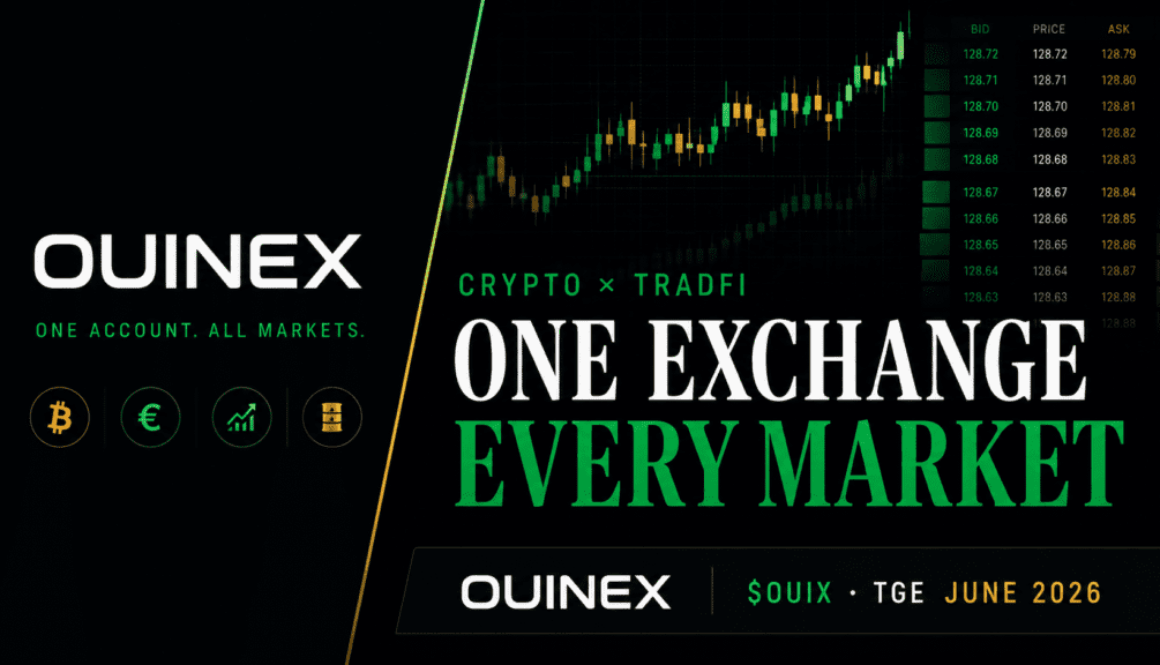
Ouinex, a live and regulated multi-asset exchange, is positioning itself as the first platform to give crypto-native traders direct access to global financial markets — stocks, indices, forex, commodities, and gold — using their existing crypto holdings as collateral, without converting to fiat or opening a separate brokerage account.
The Fragmented Trader Problem
For the past decade, active traders have been forced to maintain parallel accounts across multiple platforms: a crypto exchange for spot and perpetuals, a traditional broker for equities and forex, and increasingly, separate apps for commodities and indices. Every transfer between platforms introduces friction, cost, and delay — particularly damaging during fast-moving market events.
Ouinex CEO Ilies Larbi, who spent 20 years in traditional finance before founding the exchange, identified this fragmentation as the core problem in 2022. “The user journey was super fragmented,” Larbi noted. “At the end of the day, it’s all trading. The question was whether you could build a product that merges the two.”
The result is a platform that handles spot crypto trading alongside derivatives on traditional financial assets — all within the same account, using the same collateral pool.
Why TradFi Infrastructure Changes the Liquidity Equation
The central technical distinction between Ouinex and competitors entering the multi-asset space is its decision not to build traditional financial products on top of crypto perpetual infrastructure — the approach taken by platforms like Hyperliquid, Binance, and others rolling out stock or commodity perps.
When crypto exchanges offer gold or forex exposure via perpetuals on a central limit order book, they are starting from scratch on the liquidity side. Market makers must be recruited specifically for each instrument, pricing is inefficient in the early stages, and the result is wider spreads and shallower order books compared to the established TradFi equivalents.
Ouinex routes its TradFi instrument trading through existing financial market infrastructure — the same pipes that have underpinned institutional currency and commodities trading for decades. The consequence, according to the company, is measurably better execution for retail traders.
“We’re about seven times cheaper and approximately 100x deeper in liquidity on instruments like Euro Dollar — versus platforms using the crypto perpetual approach. That’s not small. They’re a billion-dollar company. We’re barely a startup.”Ilies Larbi — CEO and Founder, Ouinex
On the EUR/USD order book specifically, Ouinex claims its top five layers hold approximately $10 million in available liquidity, compared to roughly $500,000 on competing crypto-native platforms offering the same instrument as a perpetual. The spread advantage, the company states, is around seven times in the trader’s favour.
| Metric | Crypto-Native Perp Approach | Ouinex TradFi Infrastructure |
|---|---|---|
| EUR/USD liquidity (top 5 layers) | ~$500k | ~$10M |
| Spread vs TradFi benchmark | ~7x wider | At par |
| Commission on TradFi instruments | Variable | Zero |
| Collateral accepted | USDT / stablecoins | USDT, USDC, BTC+ |
| Max leverage (EUR/USD) | Up to 100x | Up to 500x |
The 500x maximum leverage figure, while striking, applies specifically to low-volatility instruments like major forex pairs. Larbi has been explicit that volatility-adjusted risk on a 500x EUR/USD position is materially lower than a 100x position on a cryptocurrency perpetual, where daily price swings can easily exceed the margin threshold.
Crypto Collateral for Global Markets
A key feature of the Ouinex architecture is the ability to use crypto assets as collateral for TradFi positions without liquidating those holdings into fiat. Currently, traders can deposit USDT and USDC to fund their margin accounts. A forthcoming update will extend this to native crypto assets including Bitcoin.
The practical implication is that a trader holding Bitcoin during a period of low crypto volatility — or wanting to hedge their exposure — can use that same BTC as margin to take a position in oil, forex, or an equity index. The capital does not need to leave the crypto ecosystem at any point, and no traditional bank wires or card deposits are required.
This removes one of the primary structural barriers to crypto traders participating in TradFi markets: the friction of fiat on-ramps, which typically involve delays, fees, and banking system dependencies that crypto-native users are specifically trying to avoid.
Community-Funded, Zero Venture Capital
Ouinex has raised over $9 million from more than 5,000 retail investors — a deliberate strategy to avoid venture capital entirely. The company ran a multi-phase community pre-sale of its $OUIX token, using each round to demonstrate ongoing product delivery before asking investors to commit further capital.
The decision to exclude VCs is structural rather than ideological. Larbi has been direct about the mechanics: VC token allocations often come fully unlocked, creating immediate incentive to liquidate at listing. The result is a predictable pattern of sell pressure that disproportionately affects retail buyers who entered on the back of the project’s hype at launch.
“The crypto industry is mature enough now to understand what VCs do. We’ve seen those wicks. We know how it happens. There was also no need — we had a community ready to believe in the product.”Ilies Larbi — CEO and Founder, Ouinex
Ouinex applied the same logic to its market maker relationship, opting for a retainer model rather than granting a token allocation. Under the retainer structure, the market maker has no inventory of $OUIX to sell, eliminating one of the most common vectors for token price manipulation in new listings. The exchange itself serves as the primary listing venue, meaning no tokens need to be surrendered to a tier-one exchange as a listing fee.
The $OUIX Token and Exchange Flywheel
Ouinex is approaching its token generation event (TGE), set for mid-June 2026, with $OUIX priced at $0.1334. The token serves several functions within the exchange ecosystem: reduced trading fees, cash back on derivatives volume credited in USDT every 24 hours, enhanced APY on the platform’s earn offering, and improved allocation access through the Ouinex launchpad.
A buy-and-burn mechanism allocates a percentage of exchange revenue to repurchasing and destroying $OUIX tokens, creating a deflationary supply dynamic that ties token value directly to platform trading volume. Critically, this revenue stream is drawn from every asset class on the platform — crypto, forex, stocks, commodities, and indices — giving $OUIX a broader revenue surface than exchange tokens tied purely to crypto trading.
TGE Price
$0.1334
TGE Date
Mid-June 2026
Already Staked
50%+
Staking Cliff
3 Years
Revenue Sources
Crypto · Forex · Stocks · Commodities · Indices
Mechanism
Buy & Burn
More than 50% of the total token supply is already staked under a three-year cliff — an unusually strong signal of long-term holder conviction ahead of listing. For context, the three-year cliff means the majority of current token holders cannot sell for at least three years from their staking date, structurally constraining near-term sell pressure beyond the typical lock-up periods seen in comparable exchange token launches.
Investors in the community pre-sale fall into two categories: token holders, who participated in the $OUIX pre-sale, and equity shareholders, who took a direct stake in the operating company. The dual structure gives the project both a token-aligned community and a cap table of shareholders with economic interest in the underlying business.
Market Context: Why Now
The timing of Ouinex’s launch aligns with a visible shift in how major crypto exchanges approach traditional financial assets. Binance has introduced stock tokens; HyperLiquid has added an S&P 500 instrument; MexC and BitMEX have made similar moves. The direction of travel is clear — the largest exchanges are converging on multi-asset coverage.
The distinction Ouinex draws is one of infrastructure: building on top of proven TradFi liquidity rails rather than adapting crypto perpetual infrastructure to handle instruments it was not originally designed for. Whether that architectural choice translates into sustained competitive advantage will depend on execution at scale — but the early benchmarks on spreads and order book depth suggest the model is functioning as intended.
High commodity volatility in 2026 — driven by geopolitical events including Iran-related oil market movements — has also provided near-term validation. Ouinex has reported that oil has overtaken EUR/USD as its highest-volume instrument in recent periods, a cross-sell pattern that demonstrates traders are actively using the multi-asset functionality rather than treating it as a secondary feature.
“Bitcoin is consolidating around the 70s. But look at the oil market — amazing opportunities, lots of movement. Volatility means opportunity. The platform exists precisely for that moment.”Ilies Larbi — CEO and Founder, Ouinex
The platform is live, regulated across five or more jurisdictions, and accepting users globally. US access is available for most features. The team consists of 37 full-time staff, and the company is accepting platform feedback directly — with confirmed rewards for bug reports and feature suggestions submitted via the platform.