China’s daily AI token use jumped 1,000x in two years
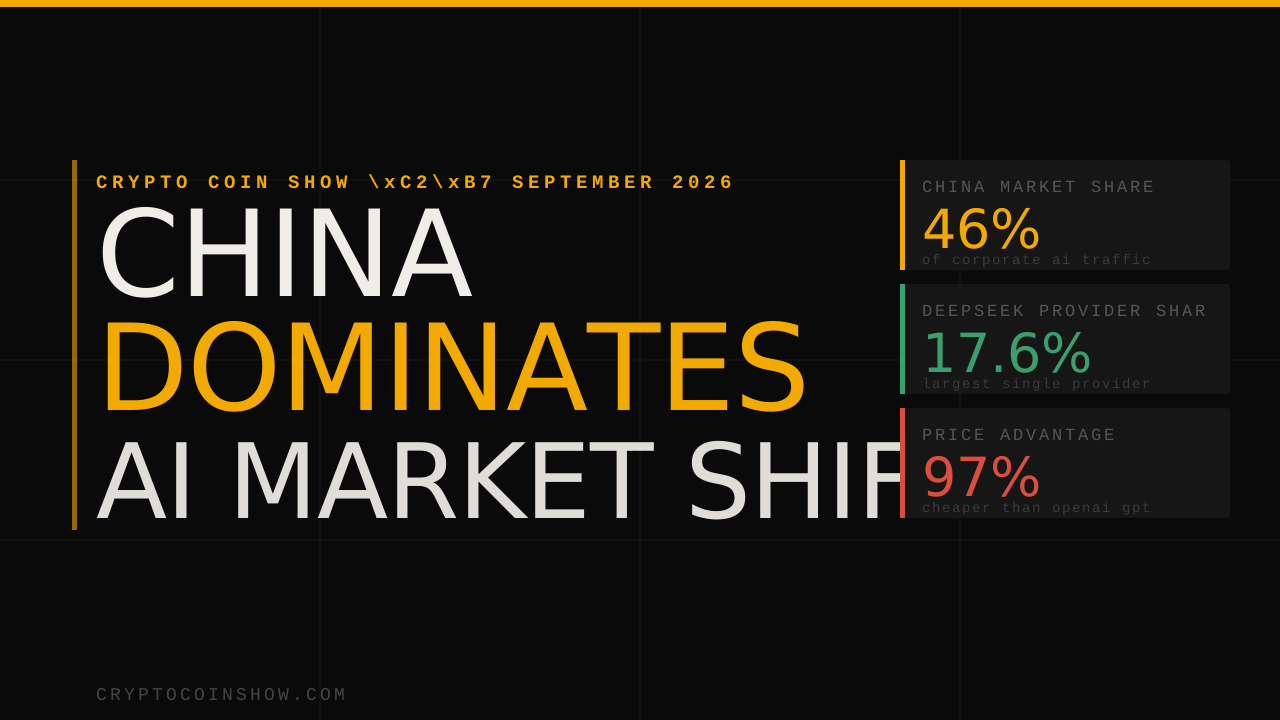
Chinese AI models have captured 46% of corporate traffic on OpenRouter, a major AI routing platform, as of mid-2026, overtaking US models for the first time and signaling a structural shift in enterprise AI procurement driven by cost and availability. This development threatens the pricing power of OpenAI and Anthropic in institutional markets and raises questions about US AI export controls’ unintended consequences.
- DeepSeek commands 17.6% of OpenRouter’s routed tokens (5.13 trillion weekly), making it the platform’s largest single provider as of June 2026.
- OpenAI’s GPT-5.5 costs $5 per million input tokens versus DeepSeek V4 Flash at $0.14, a 97% price gap driving enterprise adoption.
- Chinese models’ share of OpenRouter traffic rose from 4.5% in early 2025 to 46% by mid-2026, a tenfold increase in under 18 months.
- 46% Chinese AI model share of OpenRouter traffic by mid-2026, versus 35.7% for US models
- $0.14 DeepSeek V4 Flash price per million input tokens, versus $5 for OpenAI’s GPT-5.5
- 5.13T Weekly tokens processed by DeepSeek on OpenRouter, more than any competitor
Chinese artificial intelligence providers have achieved parity with and then surpassed US competitors on one of the industry’s largest traffic-routing platforms, marking the first sustained reversal of US dominance in enterprise AI consumption.
OpenRouter, which directs corporate API requests to various AI model providers, processed 46% of its routed tokens through Chinese models in mid-2026, compared with just 35.7% from US-origin systems.
The shift reflects not a sudden breakthrough in model capability but rather an economic calculation: Chinese models cost 60 to 90 percent less than their US counterparts, creating an irresistible incentive for cost-conscious enterprises to switch providers.
This price advantage has materialized as Chinese firms like DeepSeek and Alibaba’s Qwen have released capable open-source models that can run on corporate infrastructure without monthly subscription fees.
DeepSeek Captures OpenRouter’s Largest Share as Chinese Models Pass US Competitors
DeepSeek, a Chinese AI company, has become the single largest provider on OpenRouter by processing volume, commanding 17.6% of all routed tokens as of June 2026, roughly 5.13 trillion tokens per week. Alibaba’s Qwen model accounts for another 13.9%, meaning these two Chinese providers alone control nearly a third of the platform’s traffic.
By comparison, Anthropic, the leading US provider, holds only 14.8% of routed tokens. The crossover moment occurred the week of February 9-15, 2026, when Chinese models processed more total tokens than US models for the first time, handling 4.12 trillion tokens during that seven-day window.
This shift is not the result of performance degradation among US models. Instead, it reflects the economics of large-scale AI consumption. Enterprises deploying AI across hundreds or thousands of internal workflows face monthly bills in the tens or hundreds of thousands of dollars.
A 95-percent discount in per-token pricing translates directly to budget savings that cannot be ignored, especially as AI becomes embedded in operational software rather than reserved for premium or experimental applications.
Justin Summerville of OpenRouter noted that open-source Chinese models cost 60 to 90 percent less than the best products offered by Anthropic and OpenAI, creating a decisive advantage in price-sensitive procurement decisions.
OpenRouter’s total traffic has expanded dramatically, growing from 5 trillion tokens per week in April 2025 to over 20 trillion by April 2026, a fourfold increase in twelve months.
US Export Controls on GPT-5.6 Sol May Be Accelerating Enterprise Shift to Chinese Alternatives
US policy restrictions on access to the most powerful AI models appear to be inadvertently driving corporate buyers toward Chinese alternatives. As of July 2026, only roughly 20 authorized organizations in the US have access to Washington’s most advanced model, GPT-5.6 Sol.
The rollout was tiered: consumers can access Terra and Luna variants, but federal authorization is required to use Sol’s most potent capabilities. This gatekeeping approach creates a gap in the market between models available to the mass market and models available to enterprises, leaving most corporate customers unable to procure the most advanced US technology regardless of price.
Industry observers argue that this constraint is pushing enterprise procurement toward open-source alternatives and Chinese providers. When the most capable US model remains inaccessible to ordinary commercial users, a Chinese alternative priced at a fraction of the cost becomes not just attractive but the only viable option for many organizations.
Ara Kharazian, senior economist at Ramp, a corporate spend analytics firm, noted that DeepSeek has emerged as the top trending software provider on Ramp’s index, indicating that these Chinese technologies are now appearing in actual corporate spending rather than test projects or proof-of-concept implementations.
This shift from pilot to production represents a meaningful change in purchasing behavior.
The structural gap between restricted US models and unrestricted open-source alternatives was not created by price competition alone. If GPT-5.6 Sol were available to any enterprise willing to pay for it, the decision would hinge on cost-benefit analysis within each organization’s budget.
By restricting access, US policy makers have eliminated that choice and made the purchasing decision asymmetric: available US models are less capable than unrestricted Chinese models, whereas the most capable US model is restricted entirely.
China’s Daily AI Token Usage Reached 140 Trillion by March 2025, Reshaping Domestic Consumption
Inside China, the growth in AI consumption has been even more dramatic than the international market shift. According to China’s National Bureau of Statistics, daily AI token usage increased from 100 billion tokens at the start of 2024 to 100 trillion by the end of that year, a thousandfold expansion in twelve months. By March 2025, daily usage had climbed further to over 140 trillion tokens.
These figures translate to roughly 100,000 tokens per person across China’s 1.4 billion population, suggesting that AI consumption has penetrated far beyond software developers or tech companies into ordinary consumer and business activity.
Tokens are the fundamental unit of measurement for AI model consumption: they represent small chunks of text and data that machine learning models parse and generate, forming the basis of everything from chatbot responses to AI-generated video and image synthesis.
As token usage has exploded, the economics of AI in China have begun to center on token-based pricing, with services increasingly bought, sold, and priced by the token rather than by subscription tier or per-API-call.
This shift is laying the foundation for what Chinese industry experts describe as a token-based economy, where AI services function as commoditized inputs priced transparently by consumption volume.
The scale of China’s domestic AI consumption vastly exceeds that of the international routing platforms, suggesting that Chinese enterprises and consumers are deploying AI at a rate significantly faster than Western markets.
Institutional Investors Face Widening US-China AI Pricing Gap as Market Consolidates Around Cost Leaders
For institutional investors, the emerging competitive structure in AI markets presents a challenge to valuation models that assumed US dominance would persist. OpenAI and Anthropic have built their business models on premium pricing supported by performance advantages, but those advantages are narrowing as open-source Chinese models improve.
More importantly, the price gap is now so wide that institutional buyers are optimizing for cost rather than marginal performance differences. An enterprise spending $10 million annually on AI consumption can save $9 million by switching to a Chinese alternative, even if that alternative is marginally less capable.
That economic incentive does not require technological parity, it requires only that the Chinese model be good enough for the task.
The competitive consolidation visible on OpenRouter, where DeepSeek and Qwen now control a larger share of traffic than all US providers combined, is likely to spread to other platforms and direct enterprise purchasing as these models mature. If Chinese models capture similar market share in private enterprise deployments, the pricing power of US AI companies will contract significantly. Investors in