Uniswap trading volume explodes to record levels over 7 million per day – but actual fees lag far behind
Uniswap reached a record 7 million swaps in a single day this week, but institutional investors should focus on what that volume means for actual protocol revenue: current fee collection runs roughly 81 times lower than swap count suggests, limiting near-term UNI burns and protocol value capture. The gap between transaction velocity and fee generation exposes a structural challenge in the DEX’s path to sustainable tokenomics.
- Uniswap processed 7 million swaps in one day, equivalent to 81 swaps per second across all chains combined.
- Protocol fees accrued roughly $4 million over 30 days in August, compared to $44 million retained by liquidity providers.
- V4 fees generated approximately $300,000 in protocol revenue during its first two weeks, significantly lagging V2 and V3 combined output.
- 7M swaps processed in single day; prior record not disclosed in public data
- $4M monthly protocol fee accrual versus $44 million liquidity provider earnings
- $300K V4 protocol fees earned in two weeks versus $3.64 million from V2/V3
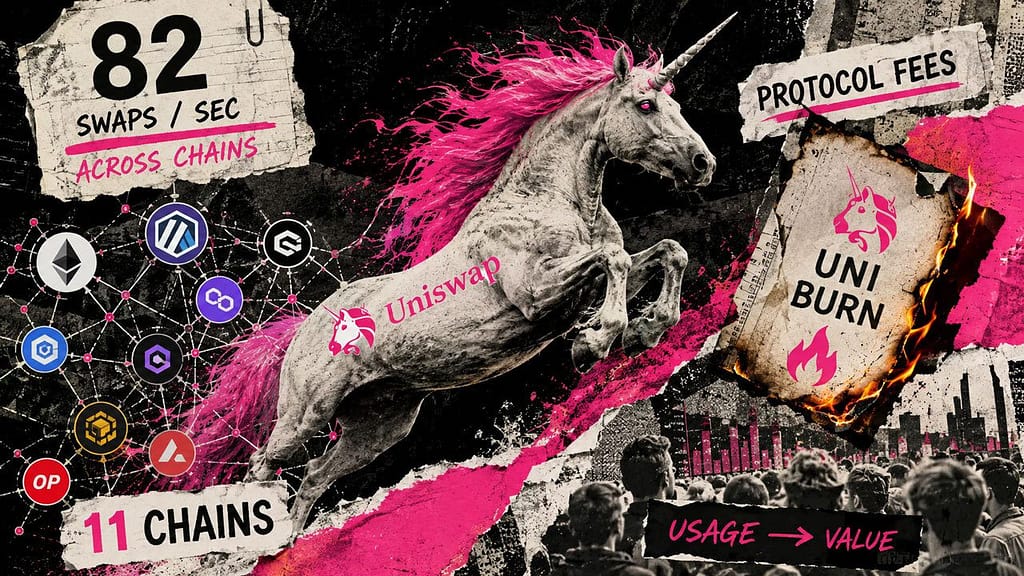
Uniswap’s decentralized exchange crossed a significant throughput milestone this week when founder Hayden Adams confirmed the protocol handled roughly 82 swaps per second across all supported blockchains, translating to approximately 7 million daily transactions.
The announcement followed research from Blockworks identifying Uniswap’s two busiest days by swap count, both exceeding 7 million transactions in a single 24-hour window. The figure, while substantial in absolute terms, masks a critical divergence between transaction volume and revenue generation that institutional investors have begun scrutinizing as the protocol matures.
The swap count itself measures transaction quantity, not dollar value traded or unique participants, making the headline figure difficult to contextualize without corresponding volume and fee data.
Fee activation accelerates across chains but trails behind transaction volumes
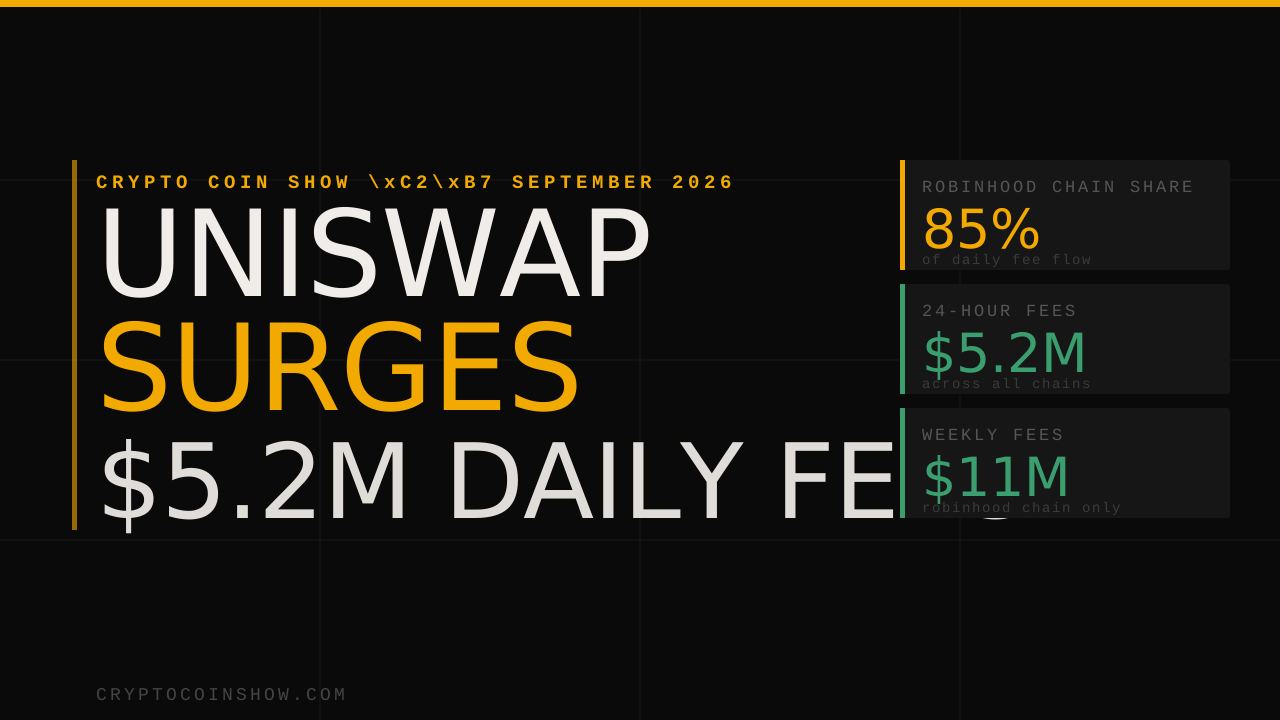
Uniswap’s expansion of fee collection has accelerated sharply since July, when governance enabled protocol fees across 11 blockchain networks for both V2 and V3 pools. On July 27, the protocol added Robinhood Chain and simultaneously activated fee controllers for V4 on seven blockchains including Ethereum, Arbitrum, Base, BNB Chain, Polygon, Optimism and Robinhood Chain.
The staggered rollout reflected governance’s cautious approach to new code while maximizing capture across its most active deployment environments.
By mid-August, Blockworks Research documented that V4 fees had activated across roughly 229,000 pools, with 10 of 12 authorized chains generating protocol fees. Nearly all pools across Uniswap’s three active versions contributed some portion of swap fees to UNI burns. Yet this broad geographic and technical coverage has not yet translated into proportional revenue growth.
V4 contributed approximately $300,000 in protocol fees during its first two weeks of operation, while V2 and V3 combined for $3.64 million over the same 30-day measurement window in August.
The disparity underscores that transaction count and fee generation operate on different timescales and economic relationships within the Uniswap ecosystem.
Protocol revenue captures only 9 percent of total swap fee economics
Uniswap’s fee architecture allocates the vast majority of swap economics to liquidity providers, limiting protocol revenue despite high activity levels. Blockworks’ analysis of August data found that liquidity providers earned approximately $44 million in fees over 30 days, while the protocol itself accrued roughly $4 million during the identical period.
This 11-to-1 ratio reflects Uniswap’s deliberate design choice to attract liquidity by allowing LP incentives to dominate while the protocol captures a defined minority share.
V2 and V3 pools accounted for $3.64 million of the $4 million protocol total, indicating that earlier versions continue to drive the bulk of protocol-level fee collection despite V4’s launch. The newer V4 version, designed with enhanced capital efficiency and customizable fee structures, has drawn significant pool deployment but generated disproportionately modest protocol revenue to date.
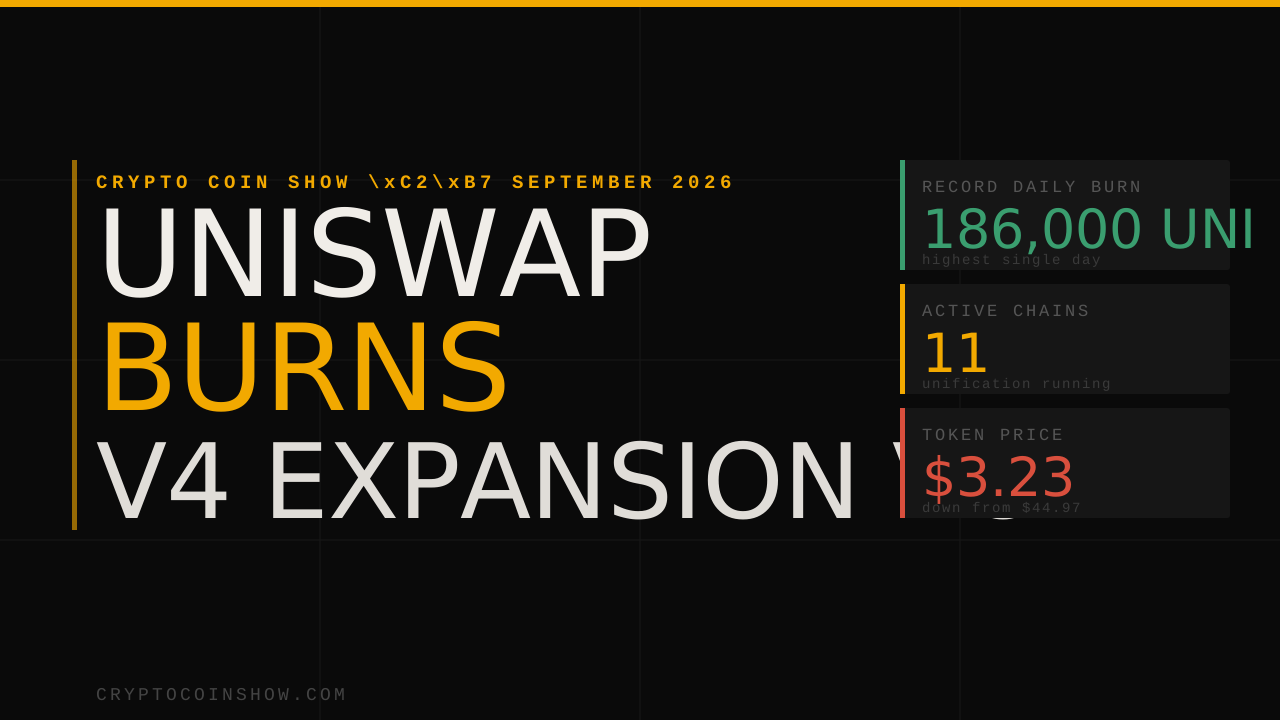
Uniswap Labs’ July 18 update noted that protocol fees had funded approximately 7.5 million UNI in burns since December, valued at roughly $25.6 million using that period’s UNI price. Monthly protocol fees had climbed from approximately $3.1 million in February to $5.1 million in June, showing momentum before the August data returned to $4 million.
Protocol fees had funded about 7.5 million UNI in burns since December, worth roughly $25.6 million at the valuation it used.
Uniswap Labs, protocol update
Missing data linking 7 million swaps to fee-enabled pool participation remains unresolved
A critical gap persists in Uniswap’s public reporting: no available data joins the September 1 swap count with corresponding fee status, transaction volume in dollars, and protocol fee generation during the same measurement window.
This opacity prevents institutional investors from determining what fraction of the record 7 million swaps occurred in fee-enabled pools or what portion of protocol revenue those record-setting transactions generated. Standard Uniswap and Blockworks public data pages do not cross-reference these metrics, leaving the narrative of record activity disconnected from its actual economic consequence.
The disconnect matters substantially for investors assessing UNI tokenomics and fee-driven burn mechanics. A record swap count concentrated in low-value transactions or fee-exempt pools would signal velocity without corresponding revenue capture.
Conversely, if the majority of record swaps occurred in high-fee V4 pools on Ethereum or Arbitrum, the activity would carry material implications for protocol revenue and token burn schedules.
Without aligned reporting across both metrics, institutional capital cannot validate whether rising transaction throughput translates into sustainable protocol value extraction or remains primarily a liquidity provider benefit.
The Uniswap protocol accrues fees through TokenJar, where third parties can claim assets and burn UNI via Firepit, separate from governance’s previously approved 100 million UNI one-time treasury burn.
V4 deployment pace and cross-chain fee penetration will determine near-term revenue trajectory
Uniswap’s path to converting transaction velocity into measurable fee economics depends on V4’s adoption acceleration and fee activation on the five deferred blockchains. Governance deferred fee implementation on five additional chains beyond the initial seven V4 launches, citing the need for separate proposals to activate fee controllers.
The timing and scope of those future activations will shape protocol fee collection over the next quarter. V4’s architecture supports governance-controlled protocol fee settings, giving the DAO flexibility to adjust capture rates if capital efficiency gains attract sufficient volume concentration.
Current data suggests V4 is early in the deployment and adoption curve. Its $300,000 two-week fee contribution pales against V2 and V3 combined output despite 229,000 pools already operating under its design. Pool distribution across versions, average transaction sizes within V4, and fee tier utilization patterns remain publicly unavailable.
Without this granularity, institutional investors cannot reliably model whether V4 revenue will compound quadratically as liquidity density increases or remain subdued pending significant capital reallocation from V2 and V3.
The next material test arrives when Uniswap governance votes on fee activation for the five deferred blockchains and publishes aligned reporting linking the September record swap count to fee-enabled pool participation and protocol revenue generated during that specific 24-hour window. Until that data surfaces, the 7 million swap milestone will remain a throughput headline disconnected from the revenue mechanics that justify institutional participation in Uniswap’s long-term fee capture thesis.