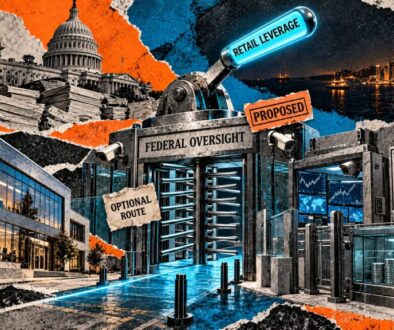
Kalshi’s court loss shows federal approval may still leave prediction markets fenced off by states
A federal judge has rejected Kalshi’s bid to block New York from enforcing state gambling law against its sports prediction contracts, leaving the market vulnerable to a patchwork of state restrictions even as the CFTC prepares to finalize national rules. The decision exposes a critical gap in federal authority: CFTC approval may not shield platforms from state-level enforcement, forcing institutional investors and platforms to navigate dual regulatory tracks simultaneously.

- Judge Analisa Torres denied Kalshi’s preliminary injunction request on July 7, rejecting preemption arguments that federal commodities law overrides New York gambling statutes.
- The CFTC’s comment period for national event-contract rules closes July 27, just weeks after the court ruled that geofencing by state is an acceptable compliance burden.
- Multiple platforms including Crypto.com, Coinbase and Gemini are already operating prediction markets with varying state restrictions, creating operational fragmentation ahead of final federal rules.
- July 27 CFTC deadline for comments on proposed prediction-market public-interest determinations and event-contract framework
- July 7 Date Judge Torres rejected Kalshi’s injunction request, denying immediate federal preemption of state gambling laws
- Multiple States now able to impose separate restrictions on prediction-market access before federal rules finalize
The New York federal court’s decision fundamentally reshapes the regulatory math for institutional participation in U.S. prediction markets. Judge Analisa Torres of the Southern District of New York rejected Kalshi’s argument that the Commodity Exchange Act preempts state gambling laws when applied to sports-event contracts traded on a federally designated contract market.
The ruling came on July 7, while the CFTC’s own proposed framework for national event-contract rules remains open for public comment until July 27. That timing collision exposes a structural vulnerability: federal approval may be necessary but not sufficient to guarantee market access.
The decision is preliminary and does not resolve the underlying merits of whether federal law actually preempts state gambling statutes. Kalshi sought immediate relief, a preliminary injunction, to prevent New York gaming officials from enforcing state law while the full case proceeds.
The court denied that relief, treating the requirement to geofence users on a state-by-state basis as a manageable operational burden rather than an irreparable harm justifying emergency intervention. That reasoning carries immediate operational consequences.
Platforms cannot claim that compliance costs or market fragmentation are severe enough to warrant federal court intervention, even before the CFTC has finished its rulemaking process.
Judge Torres treats state geofencing mandates as routine regulatory compliance, not a competitive hardship
The most operationally significant part of Torres’s ruling is her treatment of state-level user blocking as an ordinary cost of doing business. Kalshi had argued that requiring platforms to identify and restrict access by state geography would impose irreparable harm, disrupting a national market and making compliance unreasonably expensive. The court rejected this framing.
Geofencing is technically and legally possible, even if it imposes friction, cost, and operational complexity. That finding means platforms cannot use federal court to escape state restrictions on the grounds that those restrictions are too burdensome to implement.
The ruling creates a practical problem for institutional market participants and liquidity providers. If each state can impose separate restrictions on which contracts may trade and to whom they may be available, the result is not one national prediction market but a series of fragmented state-level markets with different rules, participant bases, and liquidity pools.
A derivatives trader in New York faces a different menu of available contracts than one in California or Texas. That fragmentation reduces price discovery, increases transaction costs, and creates arbitrage opportunities that flow to those who can access multiple state regimes simultaneously.
Torres’s order also rejected Kalshi’s core preemption argument: that CFTC-designated contract market rules, which require impartial access to qualified traders, implicitly mandate nationwide access that state gambling laws cannot override. The court found no such implicit requirement in federal commodities law.
A platform can comply with CFTC designation standards while still implementing state-by-state access controls, in the court’s view. That interpretation leaves room for states to press their own gambling-law authority even after a platform receives federal approval.
CFTC comment deadline arrives before court ruling clarifies federal preemption scope
The timing collision between the court’s July 7 decision and the CFTC’s July 27 comment deadline creates strategic uncertainty for both regulators and market participants. The CFTC’s June 12 Federal Register notice solicited comments on proposed public-interest determinations for event contracts, including contracts involving activities unlawful under federal or state law.
A related CFTC release specified that the framework would address growth in event contracts referencing sporting events. The agency has not yet disclosed what weight, if any, it will give to state-level restrictions when deciding whether to approve or limit certain event contracts.
The federal regulator must now decide whether to approve a national framework knowing that courts have declined to preempt state gambling law, or whether to condition approval on state-by-state compliance requirements similar to those Torres endorsed.
If the CFTC approves national rules without addressing state enforcement risk, platforms will face immediate legal exposure in states with restrictive gambling laws. If the CFTC incorporates state restrictions into its framework, it effectively surrenders claim to national authority and endorses the patchwork approach that Kalshi challenged.
Institutional investors relying on prediction markets for price discovery or portfolio hedging now face a two-track regulatory risk: uncertainty about what the CFTC will approve at the federal level, and certainty that individual states can still restrict access regardless of federal approval. This dual exposure is already visible in how platforms are responding.
Crypto.com describes its sports-event trading as a CFTC-regulated derivatives feature but has not disclosed its state-by-state access restrictions. Coinbase states that its prediction markets are available to U.S. residents but explicitly excludes Nevada. Gemini’s affiliate, Gemini Titan, received a CFTC-designated contract market license, yet it too must navigate state-level gambling law.
Existing platforms already operating under fragmented state restrictions despite federal designation
The fragmentation that Torres’s ruling protects is already embedded in how institutional-grade prediction-market venues are structured. Multiple platforms have received CFTC approval or DCM designation, yet none operates with truly national access.
The CFTC’s own designated contract market list includes QCX LLC and other venues offering event contracts, yet each platform maintains separate access rules by state. This pattern indicates that the market is already operating under an assumption that federal approval does not override state law, and platforms are adjusting their business models accordingly.
For institutional investors, the implication is that prediction markets in the United States will not consolidate into a single national market even after the CFTC finalizes its rules.
A sovereign wealth fund or asset manager seeking to hedge uncertainty about election outcomes, natural disasters, or corporate events will need to manage exposure across multiple venues with different access rules, liquidity pools, and margin requirements.
The cost of that fragmentation falls partly on participants who must maintain accounts at multiple platforms, and partly on market makers whose order flow is dispersed rather than concentrated in a single deep pool.
The question now is whether the CFTC will use its rulemaking process to override this fragmented outcome or ratify it. The agency could propose preemptive federal standards that explicitly supersede conflicting state gambling laws, forcing a direct constitutional confrontation between federal commodities authority and state gaming power.
Alternatively, the CFTC could adopt rules that require platforms to comply with whatever state-level restrictions apply to their users, effectively ceding regulatory authority to individual states and accepting the fragmentation that Torres’s decision facilitates.
The CFTC’s July 27 comment deadline will be the decisive moment. Institutional participants, platforms, and state attorneys general are now filing comments on the proposed framework, and their positions will reveal what outcome each party expects. The question remains unresolved: will the final CFTC rules treat federal approval as sufficient to override state gambling law, or will they treat state restrictions as binding compliance obligations that platforms must implement as a condition of federal designation? The answer will determine whether U.S. prediction markets consolidate into a national market or remain permanently fragmented by state line.
Original reporting: cryptoslate.com