SpaceX, Tesla to Spend $16.8B on Terafab Chip Factory in Texas
The move comes as Elon Musk’s companies look to secure chip capacity for AI, robotics and space-based data centers.
Mirendil, an AI lab founded by former Anthropic researchers, has agreed to a multi-year Google Cloud partnership worth more than $100 million.
Its CEO, Behnam Neyshabur, confirmed the partnership and stated that it was to secure the compute behind its self-improving AI.
Mirendil raised $200 million in a seed round at a $1 billion valuation in late June. It is still considered one of the largest seed rounds for an AI startup, and it was led by Andreessen Horowitz with Kleiner Perkins and Nvidia among the backers.
Neyshabur put the Google Cloud commitment at upwards of $100 million, which works out to roughly half of that seed capital going toward a single infrastructure deal.
The agreement opens access to Google’s TPUs and Nvidia GPUs. It also comes with managed training clusters.
Mirendil’s cofounder Harsh Mehta stated, “These models are really good at working with different workloads and chips, and assigning the right workloads to the right chips,” adding that the flexibility lowers cost “not just for us, but also for our customers using our systems.”
Self-improving AI, or recursive self-improvement, refers to systems that iteratively rework themselves.
Mirendil’s ambition is to build a model that will be able to do the job of a whole frontier lab.
Its CEO, Neyshabur, has worked at Anthropic and Google as a research scientist, leading teams in various projects. He is also a co-inventor of the Sharpness-Aware Minimization (SAM) optimization algorithm.
On their ambition, Neyshabur said, “You can have a self-improving AI where you can point a problem at it, and it keeps getting better with time,” citing Alzheimer’s research as the kind of open-ended goal the company wants its system to chase.
When he was at Anthropic, cofounder Mehta contributed to internal efforts to automate parts of its own research.
Mirendil says its models are meant to speed up work in medicine, biology, chemistry, and materials science.
Anthropic is also working on the trend, as it reported that more than 80% of the code it merged as of May 2026 was written by its Claude models, up from low single digits before early 2025, and that a typical engineer now merges eight times as much code per day as in 2024.
However, Anthropic mentioned that the metric overstates real productivity gains but calls the acceleration genuine.
For Google, the partnership is a bet on a customer that could sell the cloud giant’s own hardware. Neyshabur stated that Mirendil’s software layer helps customers wring more out of Google’s chips, which gives Google a pitch against rival clouds.
What Google gets in return is a strategic partner that is building frontier recursive self-improving AI, and this is a technology it can later market to enterprise buyers.
Amin Vahdat, Google’s SVP and chief technologist for AI and infrastructure, said that progress is no longer just about chip-level performance “but how we orchestrate entire systems of intelligence and break through the physical constraints of scaling.”
The deal also highlights an ongoing scramble among infrastructure providers, in this case, cloud providers.
Mirendil is not alone in chasing recursive self-improvement either, as there are newer entrants, such as Recursive Superintelligence and Recursive Intelligence, who are pursuing the same goal.
Don’t just read crypto news. Understand it. Subscribe to our newsletter. It’s free.
Situational Awareness made 439% in six months. Then margin calls took its entire stock book in one trade. Ken Griffin’s Citadel bought it.
A quarter of that fund’s last reported stock holdings were Bitcoin miners. That was not an accident, and it is why crypto investors are reading this story closely.
OpenAI hired him for its Superalignment team in 2023 and let him go in April 2024. He has said he was pushed out for raising safety concerns.
In June 2024 he published an essay series called Situational Awareness. Its central claim was blunt.
“AGI by 2027 is strikingly plausible,” Leopold Aschenbrenner, in his essay series Situational Awareness, June 2024.
Follow us on X to get the latest news as it happens
AGI means software that matches humans at most tasks. But the essay did more than predict it. One chapter argued the real bottleneck would be physical. Power contracts, transformers and electricity supply, not chips.
He then built a hedge fund on that idea. Its first stock disclosure, covering December 2024, listed six holdings worth $254.8 million.
Every one was a power or chip company. Not one was crypto. That changed quickly.
July went badly. The fund owned memory chip makers like SK Hynix, which fell hard in the AI memory stock selloff.
It had also bet against software firms such as Adobe. That trade pays off when a stock drops. Those shares rose instead. The wider market went the same way. The Nasdaq-100 fell 10% from its early June peak.
Borrowed money turned a bad month into a forced one. The fund had used loans to hold more stock than its own cash could cover.
When prices fell, its lenders wanted more money behind those loans. That demand is a margin call.
CNBC named Bank of America, Goldman Sachs and JPMorgan Chase as the brokers involved. It also reported the fund had grown to $45 billion by the start of July.
Then it unwound every public stock position, CNBC said. Griffin’s Citadel hedge fund agreed to buy them. Millennium Management and Jane Street looked and passed, Bloomberg reported.
Crypto readers mostly missed this part. Situational Awareness became one of mining’s larger shareholders, and it happened fast.
Big US funds must list their stock holdings every three months on a form called a 13F. Five exist for this fund. Read in order, they show a bet being built.
The latest filing lists 29 holdings worth $5.52 billion. Miners and their data center arms make up $1.38 billion of it.
Core Scientific was the largest at $418.7 million. IREN came next at $328.6 million, then Applied Digital at $278 million.
Cipher Mining, Riot Platforms, Hut 8, WhiteFiber, Bitdeer, CleanSpark and Bitfarms made up the rest.
The whole disclosed book grew nearly 22 times in a year. The mining share went from nothing to a quarter of it.
So the AGI fund became a mining fund by design. His essay said the bottleneck was power. Miners own power, land and cooling, which is why miners became AI powerhouses.
There is a catch for shareholders. Anyone holding these stocks in July shared the trade with a fund facing margin calls. No mining company knew, so none of them said so.
One theory spread fast. It says Citadel scared the market about rate hikes, waited for Leopold to break, then bought his stocks cheap.
The first part is true. Frank Flight, who runs macro strategy at Citadel Securities, published a note on July 27. He wrote that he now expected a rate hike at the July meeting.
Bloomberg reported the call added to market nerves. Two days later, a Griffin firm bought the stock book.
Four things break the theory.
Citadel Securities buys and sells stocks for other people. Citadel is the hedge fund. They are separate firms.
PGIM and Wrightson ICAP also called for a hike. Bond veteran Harley Bassman wanted one twice as big.
Bloomberg tied it to oil prices rising after the US and Iran clashed again, plus a strong job market.
It held rates steady, and three of its 12 voting members wanted a quarter-point rise.
That last detail matters. It was the first time since September 2016 that three officials dissented in the same direction. The pressure to raise rates was real, and it sat inside the Fed.
Did Citadel get a bargain? Nobody outside the deal knows. Neither firm will say what it paid.
Some think the forced selling mattered anyway. On CNBC, Jim Cramer argued it looked like a clearing event that could mark a bottom for the AI trade.
The tape says something simpler. Microsoft reported strong results on Wednesday night and rose about 15%.
Chip stocks jumped the next day. One big chip index rose 6.7% and snapped a five-day losing streak.
One block trade does not move a whole chip index. An earnings report can.
Six days before all of it, Aschenbrenner had told his investors to add money.
“PS. At times we call out opportunities that seem like a particularly good time to add funds, if you have been waiting for one,” Leopold Aschenbrenner, in the July 24 investor letter as reported by the Financial Times.
He got the direction right. He just did not own the stocks anymore.
The fund is not dead. It still holds private stakes, including Anthropic, which filed confidential IPO paperwork on June 1.
Miners spent 10 years being called a curiosity. It took one AI fund’s margin call to make them matter.
The post Up 439%, Then Margin-Called: Did Leopold Aschenbrenner’s Situational Awareness Actually Blow Up? appeared first on BeInCrypto.
Galaxy Digital’s $3.507 billion financing for its CoreWeave data-center build in Texas comes with a steep price: about $346.3 million in annual interest.
A Galaxy project subsidiary priced the 9.875% senior secured notes on July 23. The deal is slated to close July 28, and the notes mature on Aug. 1, 2031.
The financing is intended to cover part of two buildings with eight data halls at the Helios campus. The facilities are planned for 400 megawatts of utility capacity and 260 MW of critical IT capacity, with some proceeds also funding debt-service reserves.
The 9.875% coupon works out to $346.3 million in annual interest, paid in cash every Feb. 1 and Aug. 1 starting in 2027. The first payment covers only part of a year, but Galaxy has not disclosed the exact amount.
Principal repayment runs on a different schedule. The notes are due to amortize at 4% of original principal each year, subject to adjustment. That equals $140.28 million annually before adjustments, paid in semiannual installments, with the first payment date at least 10 months after project completion.
Interest starts on a fixed schedule, while principal repayments wait until construction is complete and can be adjusted. Creditors will hold first-priority claims on nearly all project assets and the parent company’s stake in the issuer.
The disclosed liens cover Galaxy Helios Data Centers II LLC, its project guarantor and the parent-held equity in the issuer. They do not extend to Galaxy Digital’s assets generally.
CoreWeave committed to approximately 260 MW of incremental critical IT load for Phase II in April 2025. Galaxy described the terms as substantially similar to its previously announced 15-year, 133 MW Phase I agreement.
Delivery is now the central operating test. On July 6, Galaxy said Phase I had been completed on schedule and that Phase II data-hall deliveries were expected to begin in the first half of 2027.
The construction schedule now carries a clear financial price. Interest starts in 2027, but principal repayments wait until the project is finished, putting Galaxy’s delivery timeline at the heart of its CoreWeave deal and debt obligations through 2031.
The post The brutal $346M math behind Galaxy’s high-stakes race to build CoreWeave’s Texas AI mega-center appeared first on CryptoSlate.
Across 107 enterprises, AI infrastructure spending is accelerating well ahead of the ability to see or steer its economics. Most organizations run their AI on a familiar base of hyperscalers and model-provider APIs, yet the next dollar is aimed at specialized compute almost none of them use today; a majority intend to switch or add providers within the year, many within a quarter. Buying decisions turn on integration and total cost of ownership rather than headline token price — which is fortunate, because most enterprises cannot yet see their unit economics clearly: GPUs sit at half utilization or less, and fewer than half rigorously track what their compute actually costs. The result is a compute gap — heavy, fast-moving investment running ahead of the visibility needed to control it.
This wave of VentureBeat Pulse Research examines enterprise AI infrastructure and compute: where organizations are in their deployment journey, what they run AI on today, how satisfied they are, what would make them switch, where they plan to evaluate their investments, and — most revealingly — how well they can measure and control the economics of the compute underneath it all.
The central finding is a compute gap — the distance between how aggressively enterprises are investing in AI infrastructure and how little of its economics they can see. Only about one in five (21%) run AI in production at scale, yet spending intentions are outrunning that maturity: the single largest planned area enterprises plan to evaluate over the next year is AI-specialized clouds (45%), a layer almost none of these enterprises use today. Meanwhile the compute already in place runs cold — 83% report GPU utilization of 50% or less — and fewer than half (44%) can rigorously track what their AI compute costs. Enterprises are buying more infrastructure faster than they can account for what they already own.
Enterprises are not settled on their infrastructure vendors, either: A clear majority (64%) plan to switch or add an infrastructure provider within twelve months, and 38% within the next quarter — unusually high churn intent for a category this foundational. When they choose, they choose on integration with the existing stack (41%) and total cost of ownership (35%), not on headline price: cost per million tokens is the deciding factor for just 8%. And the frontier constraint that will shape the next round of decisions — the shift from GPU compute to memory bandwidth as inference scales — is barely on the radar, with roughly one in five enterprises either unaware of it or yet to address it.
VentureBeat fielded this survey as part of its ongoing Pulse Research series, this survey focused on enterprise AI infrastructure, compute, and inference economics. Responses are filtered to organizations with more than 100 employees (n=107; the survey’s smallest size band, 1–100 employees, is excluded), drawn from a single Q2 2026 (June) wave. Because this is one wave rather than a pooled multi-month sample, the report reads cross-sectionally and does not infer month-over-month trends. Several questions were multiple-select, so those shares can sum to more than 100%.
By organization size the sample concentrates in the mid-market: 101–250 employees (36%) and 251–1,000 (27%) lead, with 1,001–5,000 (22%), 5,001–10,000 (8%), and 10,001+ (7%) above them. By role it spans managers (38%), individual contributors (28%), VPs and directors (19%), and the C-suite (13%); on purchasing authority it is buyer-credible, with 45% final decision-makers and another 30% recommenders or influencers for AI solutions. Technology/Software is the largest industry at 26%, followed by Healthcare/Life Sciences (15%), Financial Services (13%), and Retail/E-commerce (12%).
At 107 respondents the sample is large enough to read directionally but should be treated as a directional signal rather than a precise measurement; it is self-selected and is not a probability sample. It also skews toward the mid-market and toward earlier-stage adopters, so it is best read as the view from organizations actively building out AI infrastructure rather than from the largest hyperscale operators.
Only one in five run AI in production at scale
We asked where organizations sit in their AI deployment journey. Most are still building toward production rather than operating at scale.
The maturity curve is front-loaded. Three-quarters of enterprises (76%) are either experimenting or running only some workloads in production, and just 21% describe AI in production at scale. This matters for everything that follows: the infrastructure decisions in this report are being made largely by organizations still early in deployment, whose compute footprint — and whose costs — are about to grow. The evaluation and switching intentions in Findings 3 and 4 are the leading edge of that build-out, not the settled preferences of operators who have already found what works.
The specialized GPU clouds barely register — today
We asked which providers and platforms enterprises currently use to run their AI. The answer is a familiar one: the incumbents.
The current stack is hyperscaler-and-API. Google Cloud leads at 48%, and the general-purpose clouds (Google, Microsoft, AWS, Oracle) together with the major model APIs (Gemini, OpenAI, Anthropic) account for essentially all current deployment. The specialized “neocloud” GPU providers that dominate AI-infrastructure headlines — CoreWeave, Lambda, Crusoe, Nebius and peers — register at or near zero among these enterprises today. Only 6% run their own on-prem GPU clusters and 4% a custom open-source stack. Enterprises are, for now, running AI on the providers they already buy from — which makes the evaluation intentions in Finding 3 all the more striking.
(A note on reading these shares. As described in the methodology section, this sample is self-selected and skews mid-market, and this question counted every provider a respondent uses — an average of 2.1 selections each — so the figures measure presence in the stack rather than spending or primary status. A sample built this way will show a different provider mix than a spend-weighted census of the broader market; Google’s strength here, for example, is consistent with its long-standing position among smaller enterprises building on AI. Read these shares as a portrait of what this AI-active cohort runs today, and treat gaps between these figures and industry-wide market share estimates as a property of the sample rather than a contradiction of either.)
AI-specialized clouds top the evaluations list
We asked where enterprises planned to evaluate AI infrastructure over the next 12 months. Their answers point away from the stack they run today.
Here is the report’s sharpest tension. The single most-cited planned evaluation area — AI-specialized clouds, at 45% — is the very category almost none of these enterprises use today (Finding 2). Nearly a third (32%) intend to evaluate non-Nvidia accelerators, and 28% in next-generation Nvidia silicon; even decentralized compute networks (16%) and sovereign compute (11%) draw meaningful interest. Read against current usage, this is not incremental — it is the leading edge of a re-platforming. The direction-of-travel question tells the same story: every infrastructure approach is net-expanding, but specialized AI clouds carry the highest net momentum (+24), edging out even the hyperscalers (+22). Enterprises are preparing to move a meaningful share of AI compute off the general-purpose cloud.
This continues a trend we saw in our April-May survey wave. Back then, usage of the AI-specialized clouds was equally marginal — CoreWeave at 3%, Lambda at 4%, Crusoe at 2% of enterprises. When we asked enterprises what change they planned in their AI infrastructure strategy over the next twelve months, the most-cited answer was moving workloads to specialized AI clouds, at 33%. Asked in April-May which emerging compute option they were most likely to evaluate AI-specialized clouds again drew the most responses. Two waves, two differently worded questions, one consistent picture: the type of cloud enterprises are most eager to assess is the type they have barely begun to use.
Six in 10 plan to change providers within a year — many within a quarter
We asked whether and when enterprises plan to switch or add an infrastructure provider. Very few intend to stand still.
For a category as foundational as compute, this is a remarkable amount of intended movement. Only 36% have no plans to change, meaning a clear majority (64%) intend to switch or add a provider within twelve months — and 38% within the next quarter alone. Where that interest points is telling: the providers drawing the most switching consideration are again the incumbents — Microsoft Azure and Google Cloud (33% each), OpenAI (30%), and Gemini (22%) — which suggests much of the near-term movement is reshuffling among the majors and consolidating spend rather than defecting to new entrants. The neocloud interest in Finding 3 is a 12-month evaluation thesis; the switching in the next quarter is mostly incumbents trading share.
(Method note: Respondents who selected both “no plans to change” and a specific switching window are counted as switchers, on the logic that naming a timeframe is the more specific answer; three respondents were reclassified under this rule.)
Integration and total cost of ownership decide — not sticker price
We asked what matters most when enterprises select an AI infrastructure provider. Headline price finished last.
Enterprises do not buy AI infrastructure on pricing, which is the place vendors compete on hardest. Integration with the existing stack (41%) and total cost of ownership (35%) dominate, while the headline metric — cost per million tokens — is the deciding factor for just 8%, dead last. The pattern is coherent: buyers are optimizing for how a provider fits and what it truly costs to operate, not for the advertised unit rate. It also foreshadows Finding 7 — enterprises say TCO matters most, yet most cannot yet measure it rigorously. The stated priority and the measured capability are out of step.
83% report GPU utilization of 50% or less
We asked what share of their GPU capacity enterprises actually utilize. The answer is a well-known but rarely quantified inefficiency.
Disclosure: Band percentages count every selection against all 107 qualified respondents; 14 respondents selected more than one band, so bands overlap. At the respondent level, 83 of the 100 GPU-operating enterprises reported utilization at or below 50%
The compute already in place runs cold. Adding the bands at or below half capacity, 83% of enterprises that operate GPUs report utilization of 50% or less, and nearly half (49%) run at 25% or below. Only 12% clear the 50% mark, and a further 8% do not measure utilization at all. Idle accelerators are expensive accelerators, and this is the clearest single measure of the compute gap: enterprises are planning to buy more GPUs and specialized compute (Finding 3) while the capacity they already own sits substantially unused. The efficiency headroom in the current fleet is large — and largely unmeasured.
Fewer than half rigorously track what their compute costs
We asked whether enterprises can quantify the cost and return of their AI infrastructure spend, and how satisfied they are with what they run. Confidence in the ledger lags the spending.
Measurement trails money. Fewer than half of enterprises (44%) rigorously track the cost and return of their AI compute; the majority track only partially (39%), cannot quantify it yet (20%), or have not prioritized it (6%). That gap is consequential given Finding 5, where total cost of ownership was the second-ranked buying criterion — enterprises are choosing providers on an economic basis they mostly cannot yet measure. Satisfaction with current infrastructure is moderately positive but not enthusiastic: on a five-point scale, overall satisfaction averages 4.0, with ease of implementation (3.8) and value for money (3.9) trailing slightly — the softness landing, tellingly, on cost. Enterprises are spending quickly and accounting slowly.
As inference shifts from compute to memory, the field scatters
Finally, we asked how enterprises would address the emerging constraint in large-scale inference — the shift from GPU compute to memory, specifically KV-cache capacity. The responses reveal a frontier that is not yet a priority.
The memory frontier is real but barely governed. Asked which approach they would rely on as the binding constraint in inference shifts from compute to memory bandwidth, enterprises scatter: Dell leads at 31%, Nvidia follows at 16%, and the rest fragments across storage vendors, open-source tooling, and model-level efficiency techniques. Most telling is that roughly one in five (18%) either do not recognize the constraint or have not begun to address it. For a shift that will reshape inference cost and architecture, this is an early and unsettled market — and, consistent with the measurement gap in Finding 7, one where many enterprises simply do not yet have a view. It is the next chapter of the compute gap, arriving before most have closed the current one.
Organizations with more than 100 employees are investing in AI infrastructure faster than they can measure it. Most are still early in deployment, yet their spending intentions point past their current stack — toward specialized clouds and alternative accelerators almost none of them run today — and a clear majority intend to change providers within the year. They buy on integration and total cost of ownership rather than headline price, which is rational; the difficulty is that most cannot yet see those economics clearly.
The visibility gap is concrete. The GPUs enterprises already own run at half utilization or less for the overwhelming majority, and fewer than half can rigorously track what their compute costs or returns. Satisfaction is decent but unenthusiastic, softest on value for money — the dimension hardest to judge without measurement. And the next constraint, the shift from compute to memory in large-scale inference, is arriving while most enterprises are still unaware of it. At 107 respondents in a single Q2 wave this is a directional read, skewed toward the mid-market and earlier-stage adopters — but the direction is consistent: the appetite to spend is running well ahead of the instrumentation to spend well. The compute gap is not a capacity problem that more hardware will solve on its own; it is, first, a problem of seeing what the hardware already costs. The open question for later waves is whether enterprises build that visibility before the re-platforming arrives — or buy the next layer of infrastructure as blind to its economics as the last.
Based on survey responses from 107 qualified enterprise respondents (100+ employees), drawn from a single Q2 2026 (June) wave. Because this is one wave rather than a pooled multi-month sample, the results read cross-sectionally rather than as a month-over-month trend, and at 107 respondents this is a directional signal rather than a precise measurement — the sample is self-selected, skews mid-market, and leans toward earlier-stage adopters rather than the largest hyperscale operators. Respondents include managers, individual contributors, VPs/directors, and the C-suite, with buyer-credible purchasing authority, across Technology/Software, Healthcare/Life Sciences, Financial Services, Retail/E-commerce, and other industries.
The Federal Reserve released minutes from its June 16-17 meeting on July 8, showing a divided committee that unanimously held rates steady at 3.50% to 3.75% while flagging inflation risks tied to artificial intelligence spending.
The meeting was Chair Kevin Warsh’s first since taking over the Fed. All 12 voting members backed the hold, though the minutes revealed disagreement over whether a hike is still needed this year.
A few participants argued a rate increase was justified at the June meeting but ultimately supported holding steady, the minutes said. Most officials cited persistent inflation risk from tariffs, Middle East energy costs, and AI-driven demand for tech, data centers, and electricity.
Nine of 19 officials penciled in at least one rate hike before the end of 2026, a reversal from earlier projections that showed no hikes at all. Warsh did not submit a projection.
At his post-meeting press conference, Warsh described the internal debate in blunt terms.
“We had a good family fight on it for a couple of days, and we ended up, I think, in a better place.”
Follow us on X to get the latest news as it happens
Fed staff raised inflation forecasts for 2026 and 2027, citing tariff pass-through, Middle East supply shocks, and surging AI infrastructure investment. Core inflation ran at 3.3% in April and was estimated near 3.4% in May, well above the Fed’s 2% target.
Several participants said AI spending could eventually lower costs through productivity gains, though that effect would take years to appear. Meanwhile, demand for data centers and high-tech equipment keeps adding upward pressure on prices.
Bitcoin (BTC) traded near $62,240 on Wednesday, down about 2.7% over the past 24 hours, according to BeInCrypto data at press time.
The move followed a preview of the release that flagged Warsh’s silence on his own rate projection as a key source of uncertainty.
The drop follows Bitcoin options activity that turned call-heavy ahead of the minutes, days after Bitcoin’s rebound toward $64,000 on bullish ETF flows. It shows how sensitive crypto markets remain to rate-hike expectations, a dynamic also visible in the earlier Fed independence fight over Governor Lisa Cook.
The next FOMC meeting is scheduled for July 28-29. With inflation still running above target and nine officials now leaning toward a hike, upcoming inflation and jobs data will likely determine whether Warsh’s “family fight” ends in a rate increase or another hold.
The post Bitcoin Reacts As Fed Minutes Reveal Split on Rate Hikes appeared first on BeInCrypto.
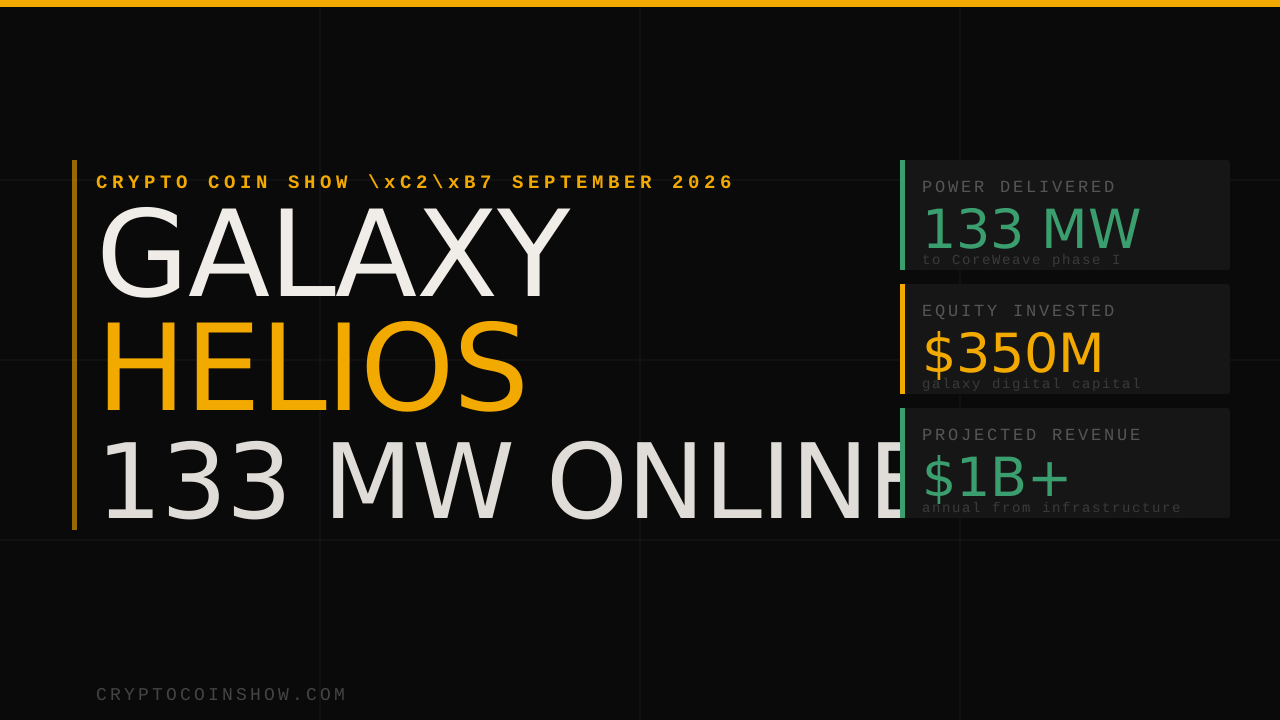
Galaxy Digital has reached a major milestone in its shift from cryptocurrency mining to artificial intelligence infrastructure. The company has reported that Phase I power is fully operational at its Helios data center campus in West Texas.
This grants CoreWeave (CRWV) 133 megawatts of critical IT capacity through a 15-year lease, marking the site’s evolution from bitcoin mining to AI operations. Phase 1 billing starts in Q2 2026.
Originally a top-tier 180 MW North American bitcoin mine, Galaxy purchased Helios in 2022 for $65 million. Galaxy has since halted crypto mining to pivot the site toward AI and high-performance computing.
Phase I met both its timeline and budget targets according to Galaxy. At the start of the project, Galaxy committed $350 million in equity, with the remaining construction cost financed through the closing of a $1.4 billion debt facility at 80% loan-to-cost.
At the time, Mike Novogratz, Founder and CEO of Galaxy, had noted, “We’re on track and excited to deliver the first phase of power to CoreWeave beginning in early 2026. This project is a key step in diversifying Galaxy’s business model as we expand beyond crypto and into the broader AI infrastructure space.”
More recently, he said that the demand for high-density, AI-ready power is not a cycle; it is a structural shift, and Galaxy is built to meet it. He further stated that the firm now operates as an even mix of data infrastructure and digital assets, reassuring investors that the firm’s financial health is increasingly independent of crypto market trends.
Now that Phase 1 is done, the company can focus fully on Phase II and III. Phase II is now in the greenfield stage, with structural work underway. Data hall deliveries are set to begin by mid-2027.
“Completing Phase I on budget and on schedule affirms Galaxy’s position as an operator capable of executing hyperscale AI data center development,” Novogratz said in the announcement.
CoreWeave will secure 526 MW of critical IT load across Phases I–III, once completed, exhausting the site’s 800 MW of approved gross power. Galaxy still expects the deal to drive over $1 billion in average annual revenue.
In total, Galaxy’s Helios campus covers more than 2,200 acres. Its approved power capacity sits at 1.63 gigawatts, with room to expand to 3.6 GW. The announcement follows Galaxy reporting a $216 m first-quarter loss. This was largely driven by declining crypto prices.
Meanwhile, Galaxy also introduced an institutional OTC prediction markets offering, managed by its Global Markets trading desk. The offering now allows hedge funds, family offices, and other institutional investors to trade in prediction markets at an institutional scale with enhanced privacy.
The service focuses purely on non-sports prediction markets on Kalshi and Polymarket, tracking everything from politics to the economy. It enables clients to pair event contracts with hedges in equities and commodities, creating a comprehensive risk plan rather than siloed exposure management.
Last month, CoreWeave also debuted CoreWeave ARIA, an integrated AI research agent within Weights & Biases that interprets experiment data to maximize model performance. ARIA was developed using W&B Weave, CoreWeave’s agent development platform.
According to the firm, the agent converts existing experiment data into better models and reliable agents. The system also rapidly evaluates thousands of runs and tens of thousands of metrics.
“ARIA has become a valuable part of my daily workflow,” said Praneeth Gangavarapu, PhD Candidate, at Scripps Research. He explained, “It helps me quickly generate reports, create sweep configurations from natural language, and automate tasks that would otherwise require a lot of manual setup.”
If you’re reading this, you’re already ahead. Stay there with our newsletter.
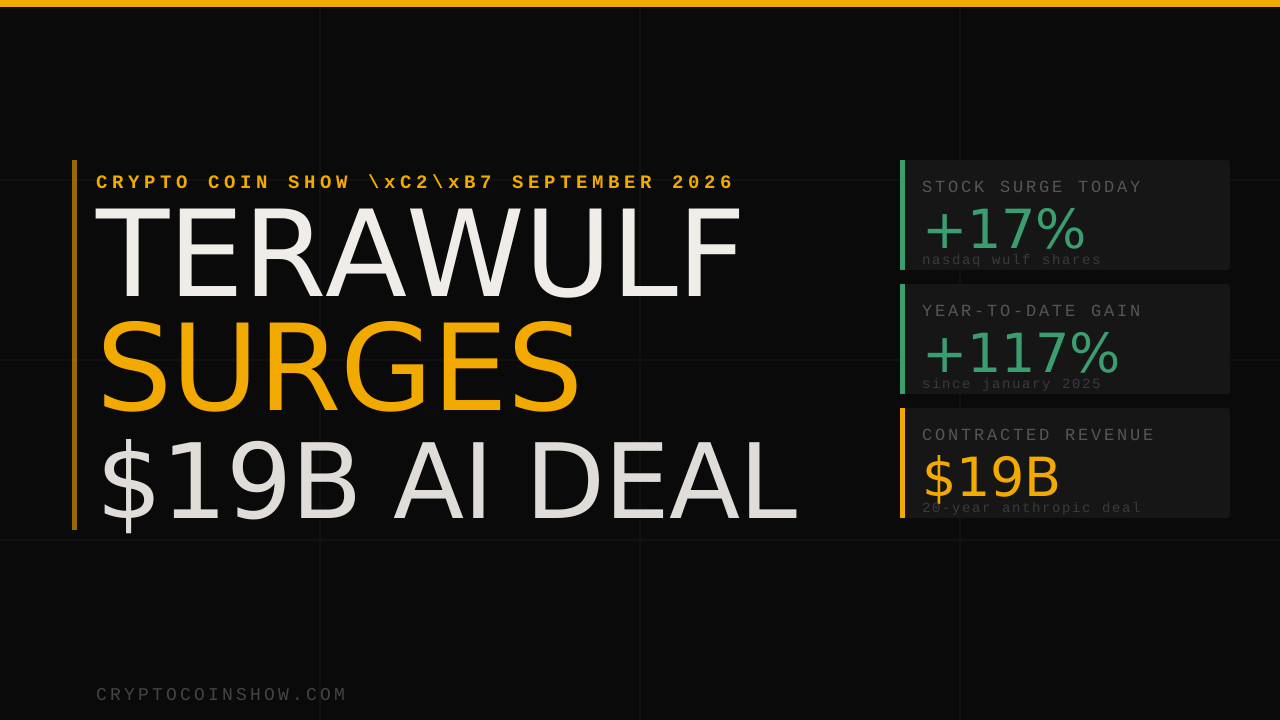
TeraWulf (NASDAQ: WULF) shares jumped 17% on Monday after the former Bitcoin miner announced it had signed a 20-year lease with Anthropic.
The company expects to bring in roughly $19 billion from the deal. This deal hands one of the most closely watched AI-infrastructure players a marquee tenant and two decades of contracted revenue.
WULF traded around $24.14 by late Monday morning, up from Friday’s close of $21.18, with an intraday range of $23.38 to $25.15, according to Google Finance. The move continues an upward trend that has seen WULF grow more than 117% since the start of the year.
The deal means Anthropic will occupy a purpose-built AI campus at TerraWulf’s Justified Data site in Hawesville, Kentucky, near Louisville. The build-out is in different stages: with the first services slated for H2 of 2027, while the full 401 megawatts of critical IT capacity will go live in early 2028. That’s enough power to run large-scale AI training workloads.
Anthropic is the brain behind the Claude family of AI models. For TeraWulf to lock in a customer of that magnitude for two decades, it means the company’s pivot is not just speculative but has the potential to build a strong revenue base.
Effectively, the lease is betting on Anthropic being a key player in the field of AI two decades from now, as Contellation Research noted.
TeraWulf paired the lease with an exit. The company agreed to sell its 50.1% stake in an AI data center joint venture in Abernathy, Texas, to an investor group led by Fluidstack, its partner in the project.
While TeraWulf did not disclose terms, the company claimed it had earned a premium on the ~$450 million it sunk into the venture. The next step is to redeploy that capital into sites fully owned and controlled by TeraWulf.
“Collectively, the transactions enhance TeraWulf’s long-term revenue visibility, strengthen its financial position, and further align the Company’s capital with infrastructure platforms where it maintains direct ownership, customer relationships, and operational control,” the company said in its announcement.
The company started as a Bitcoin mining business, with facilities in New York and Pennsylvania. In Q1 of 2026, TeraWulf generated $21 million in revenue from its high-performance computing hosting and passed the ~$13 million mark from its mining operations, for the first time ever.
That transition to AI data centers has not come cheap. In Q1, TeraWulf posted $427.63 million in losses. Q1 ended with TeraWulf having about $3.1 billion in cash and roughly the same amount in long-term debt.
TeraWulf is not the only company making a pivot. Plenty of mining companies are leasing power and ready-built space to AI firms, as this provides a stable income stream compared to the volatility of Bitcoin mining.
Demand for data centers is sky high: the International Energy Agency projects data center electricity use will nearly double to about 945 terawatt-hours by 2030, with AI the main driver.
Constellation Research believes there is a greater subtext to the deal, with Neoclouds and smaller providers moving quickly ahead of Meta’s cloud-computing launch, and TeraWulf sits among the companies most exposed to that shift.
Kentucky has become a key part of TerraWulf’s plans. The company already has hundreds of megawatts of grid-connected capacity in the Hawesville area and has a separate 285-acre site in Kentucky that can support more than a gigawatt.
What to watch next is delivery. The first phase of the Anthropic campus is more than a year out, and the $19 billion figure depends on capacity coming online through 2028 and a tenant that stays the course.
Don’t just read crypto news. Understand it. Subscribe to our newsletter. It’s free.
With public anger at AI data centers boiling over, all it takes is one bad neighbor to get every data center in town locked out.
That’s the story unfolding in Cheyenne, Wyoming, where local officials are revoking waste-dumping privileges for every data center campus connected to municipal water services. As Cowboy State Daily reported, the Cheyenne Board of Public Utilities has rolled out a sweeping ban on fill-and-flush discharge, the process in which data centers flood their cooling systems with water before powering up for the first time.
That decision came after one bad actor, the Meta-affiliated data center company Goat Systems LLC, flooded local waste water pipes with fill-and-flush swill containing a rare and deadly bacterium known as Cupriavidus gilardii. Per Cowboy State, Goat Systems was found to be in “significant noncompliance” with Cheyenne’s industrial waste regulations after a months-long investigation traced the bacteria to Meta’s discharge.
“This isn’t something we normally test for,” Frank Strong, Cheyenne Board of Public Utilities engineering and water resource division manager told the Wyoming Tribune Eagle of the investigation. Strong noted that the bacterium was first spotted during routine testing for fecal contamination, adding that it’s a bizarre pathogen to find in any wastewater, even that coming from a data center.
“We actually had to go through quite a process to figure out what it was,” he said.
Cupriavidus is a little-known, multidrug-resistant pathogen. Though human infection is extremely rare, it has nonetheless been linked to ten deaths, including three cases involving immunocompromised children. According to one review of Cupriavidus cases, the bacterial infection has a mortality rate of 31.3 percent, out of a sample size of 32 known infections dating back to 2009.
“As soon as we became aware of the bacteria, and then of where it was coming from, we shut them down immediately,” Strong told the Wyoming Tribune. Strong caveated that the exact source of the pathogen within the facility is still unknown, but that wastewater from Meta’s 800,000 square foot Cheyenne campus — which is still under construction — nonetheless contained it.
Meta, for its part, told reporters that it’s working with construction contractor Fortis to “resolve this issue.”
“When the board shared that it found a substance in the city’s wastewater — not public drinking water — Fortis immediately stopped discharging industrial wastewater and began hauling it offsite,” a Meta spokesperson told Cowboy State.
Though it seems nobody has contracted the potentially deadly bacterium as a result of Meta’s fill-and-flush, the city’s response to the incident underscores the degree to which people across the US are scrutinizing data centers — and the undeniable impact they have on their neighbors.
More on Meta AI: Meta Paid Hundreds of Contractors to Pretend to Be Teenagers While Barraging Its Competitors’ AI With Disturbing Content
The post Meta’s AI Data Center Caught Infecting Town Water Supply With Deadly Bacteria appeared first on Futurism.
K Wave Media has become a useful reminder that the Bitcoin treasury trade is not one simple story. The company once presented Bitcoin as part of a larger balance-sheet strategy. Now, after selling its BTC and shifting attention toward artificial intelligence infrastructure, it has effectively shown the other side of the corporate accumulation narrative.
That matters because Bitcoin treasury companies have been one of the loudest themes of the cycle. The market loves the clean version: a public company raises capital, buys BTC, and lets shareholders gain leveraged exposure to Bitcoin. K Wave’s reversal is messier.
For more details, visit the official Sec platform.
K Wave Media disclosed in SEC filings that it sold Bitcoin tied to its treasury strategy and used proceeds to address debt obligations. The company has also discussed reallocating capital toward AI infrastructure. For the wider market, the story is not about the size of K Wave’s BTC stack. It is about what happens when smaller treasury plays meet debt, equity-market pressure, and changing investor appetite.
Bitcoin treasury strategies work best when capital is cheap, share prices are strong, and investors reward accumulation. They become much harder when financing conditions tighten or the company’s core business needs cash.
That is the lesson here.
The corporate Bitcoin playbook is often associated with Strategy because Strategy built it at scale and stuck with it for years. Smaller companies have tried to borrow parts of that model, but not every balance sheet can carry the same risk.
Buying Bitcoin is easy to explain. Funding it sustainably is the hard part.
If a company relies on capital raises, convertible notes, preferred stock, or other financing tools to support a BTC strategy, the market has to keep believing in the premium. Once that premium disappears, the strategy can turn from accretive to stressful very quickly.
K Wave’s exit is therefore less about one company’s number of coins and more about the market’s willingness to keep funding copycat treasury models.
For BTC itself, K Wave is not large enough to move the market on its own. But the symbolism is bigger than the position.
Treasury-company demand has been part of Bitcoin’s institutional story. If investors start separating strong treasury operators from weaker ones, the market may become more selective. That is healthy in the long run, but it can create short-term pressure as weaker names unwind or pivot.
The bullish interpretation is that Bitcoin’s treasury theme is maturing. Not every company that announces a BTC plan deserves a premium. The bearish interpretation is that some corporate holders could become sellers if balance-sheet pressure rises.
Both can be true.
K Wave’s move does not kill the treasury trade. It does show that the trade is no longer automatic. Investors are now asking harder questions about debt, liquidity, business quality, and whether the Bitcoin strategy actually fits the company using it.
This report is based on information from K Wave Media SEC filings.
This article was written by the News Desk and edited by Samuel Rae.
Source: Sec