Prediction markets are transforming into aggressive derivatives platforms
Prediction market platforms are rapidly pivoting from simple betting interfaces toward leveraged derivatives trading, a structural shift that could materially increase retail exposure to margin calls and liquidations while testing regulatory tolerance for decentralized finance. For institutional investors, this evolution signals both a competitive consolidation among platforms and an emerging regulatory flashpoint that may determine which models survive U.S. enforcement scrutiny.
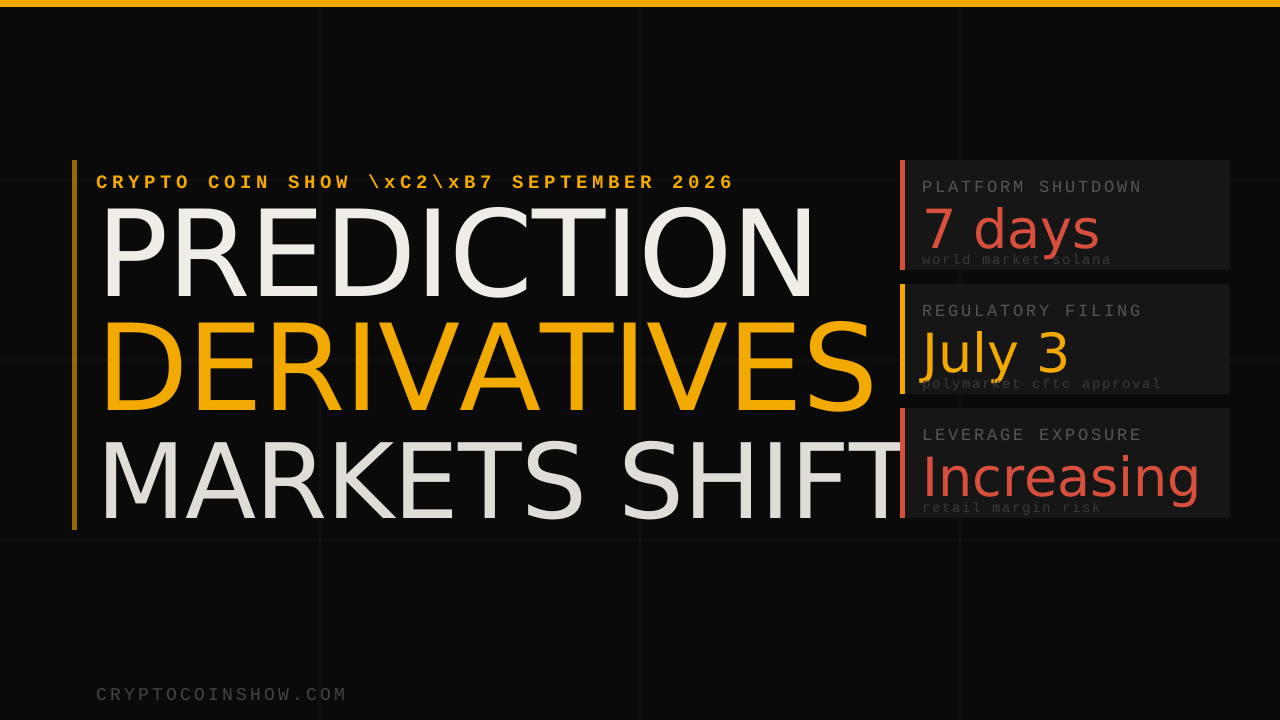
- World, a Chainlink-powered prediction market, launched on Solana in July then abruptly shut down after seven days to migrate to Robinhood Chain.
- Polymarket filed for U.S. margin trading approval on July 3, seeking futures commission merchant status from the CFTC to offer leveraged wagers.
- Kalshi achieved $33 billion in June trading volume and already holds NFA approval as a futures merchant, widening its regulatory lead over competitors.
- 28M Robinhood customers now accessible to World prediction market platform
- $33B Kalshi’s June trading volume, versus $14B for Polymarket
- July 3 Date Polymarket filed for margin trading and derivatives registration
The prediction market industry is shedding its retail-friendly betting identity and adopting the mechanics of a leveraged derivatives exchange. World, which launched in the Phantom wallet on Solana on July 1 as a Chainlink-powered venue for Bitcoin price wagers and FIFA World Cup bets, abruptly ceased operations after seven days without explanation or clarification on customer funds.
The shutdown marked the end of a two-year development cycle, but the real news lay in what came next: World announced a migration to Robinhood Chain, abandoning Solana’s 6 million monthly active users in crypto to access Robinhood’s 27.4 million funded customer accounts.
That calculus, leaving a crypto-native user base for institutional retail infrastructure, reflects a broader industry shift away from decentralized speculation toward regulated, leverage-enabled trading products that demand institutional settlement rails and compliance frameworks.
World’s Solana Launch and Immediate Pivot to Robinhood Chain Exposes Platform Shopping
World’s seven-day existence on Solana before migration to Robinhood Chain has drawn criticism from observers who see the move as opportunistic, a use of Solana’s developer ecosystem and user base as a launch pad before abandoning the network.
The platform offered users the ability to wager on Bitcoin prices and sporting events, with payouts denominated in Phantom’s CASH stablecoin and settlement validated by Chainlink oracles. Yet no technical failures, security breaches, or user complaints preceded the shutdown announcement, raising questions about whether the Solana deployment was ever intended as a permanent home.
Robinhood Chain, by contrast, offers World access to an order-of-magnitude larger addressable market. The brokerage reported 27.4 million funded accounts in Q1 2026, roughly 28 times the size of Solana’s active retail base.
Crucially, Chainlink’s oracle infrastructure remains available on Robinhood Chain, allowing World to maintain its price feed and settlement mechanism without operational redesign. CEO Vlad Tenev has also demonstrated bridges to move USDC from Solana into Robinhood Chain and swap it for USDG, a Paxos-backed stablecoin, creating a clear onramp for retail capital.
The timing and silence around World’s closure signal that infrastructure readiness, not market demand or technical issues, drove the decision.
Polymarket Files for U.S. Margin Trading Authority, Directly Challenging Kalshi’s Regulatory Position
Polymarket, the largest decentralized prediction market by user base, filed applications with the National Futures Association on July 3 to become a futures commission merchant and swap firm.
The filings, made on behalf of the Polymarket-linked entity Coming Home GBA LLC, position the platform to offer margin trading in the United States, allowing users to control larger positions with fractional capital. Kalshi, Polymarket’s primary U.S. competitor, already holds NFA approval as a futures merchant and swap firm, achieved in March.
That regulatory lead has translated into operational advantage: Kalshi reported $33 billion in trading volume during June alone, compared to $14 billion across Polymarket’s entire platform, including its U.S. operations.
Margin trading represents a material widening of risk exposure for retail participants. Users would no longer wager only capital they hold; they would borrow from the platform to fund larger positions, amplifying both gains and losses. A user with $1,000 might control a $10,000 position at 10x leverage, facing liquidation if the underlying market moved 10 percent against their bet.
Polymarket’s shift toward derivatives mirrors Kalshi’s earlier pivot. Both platforms launched crypto perpetual futures contracts in 2025, products that track the price of digital assets in real-time with continuous settlement and automatic liquidation at mark price. Perpetuals allow users to bet on Bitcoin or Ethereum without holding either asset, using borrowed capital to amplify exposure.
The race for regulatory approval reflects capital constraints in the prediction market industry. Leverage generates higher trading volumes, which in turn justify higher platform valuations and venture funding.
Kalshi’s six-month regulatory head start may prove decisive if the CFTC approves Polymarket’s application slowly or conditionally, or if regulatory scrutiny of the margin mechanics leads to restrictions on customer eligibility or position sizing.
Regulatory Approval Timeline and CFTC Scrutiny Will Determine Platform Consolidation
Polymarket’s path to margin trading approval remains uncertain. The company is under investigation by the Commodity Futures Trading Commission on unspecified grounds, and the CFTC has shown skepticism toward crypto-native derivatives platforms that operate without traditional market-maker obligations or customer protection rules.
The agency has previously challenged Polymarket’s operational status and questioned whether its markets are sufficiently regulated or transparent. Margin trading approval would require the CFTC to affirmatively grant relief or issue a no-action letter, a process that typically takes months and may never be granted.
Kalshi, by contrast, has already cleared this hurdle. Its NFA approval as a futures merchant gives it regulatory legitimacy for leverage products and positions it as the likely industry survivor if the CFTC moves to restrict other platforms. Kalshi’s $33 billion monthly volume and already-approved margined offerings make it the institutional-grade counterparty in the space.
Polymarket would need either CFTC approval or a significant regulatory shift in its favor to compete at that scale. Meanwhile, World’s migration to Robinhood Chain places it inside an established brokerage’s compliance perimeter, effectively outsourcing regulatory risk to a firm with existing SEC and FINRA relationships.
Institutional investors should monitor whether the CFTC grants Polymarket’s margin trading application within six months, or whether the agency instead restricts leverage products across all decentralized platforms.
The critical next milestone is the CFTC’s response to Polymarket’s July 3 filings. If approved, the decision would legitimize margin trading as a prediction market feature and trigger a consolidation wave as smaller platforms seek regulatory status or acquisition by larger players. If the CFTC delays or denies the application, Kalshi’s regulatory lead will become structural, and platforms like World will face pressure to prove their viability through other means, either by demonstrating that Robinhood’s retail base can generate trading volumes comparable to Kalshi’s, or by finding niche markets the incumbent has left unserved. Watch for CFTC comment letters or staff testimony on prediction market leverage before year-end 2026.