
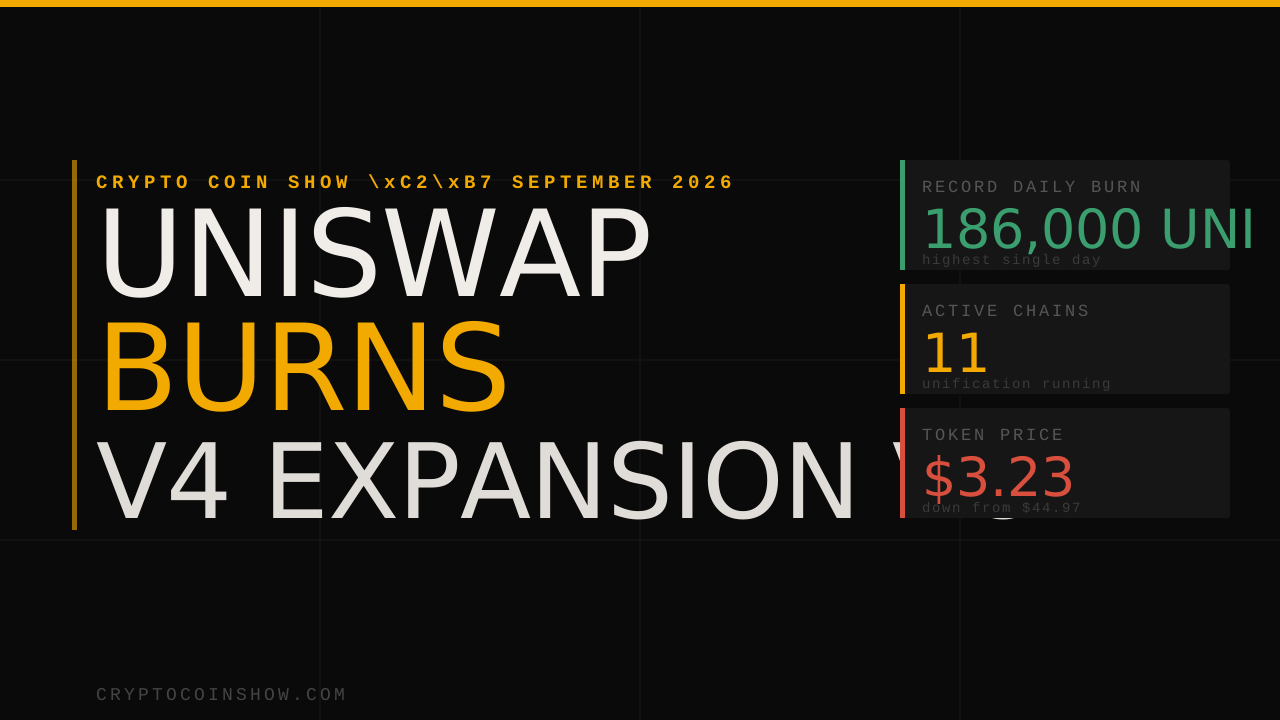
Uniswap floats extending UNIfication burns to v4 pools
Uniswap Labs is seeking token holder approval to extend its UNIfication fee-and-burn program to v4 pools, a move that would reduce UNI token supply but may alienate liquidity providers already taxed on v2 and v3. The vote, beginning July 7, tests whether the protocol can expand its tokenomics mechanism while managing growing friction between fee capture and pool economics.
- Uniswap seeks to add v4 pools to UNIfication burn program operating on 11 chains since launch
- Snapshot vote runs July 7-12, binding on-chain vote follows week of July 13
- Protocol burned 186,000 UNI in single day last month, highest daily burn on record
- 186,000 UNI burned in one day last month versus 134,000 prior daily record
- $3.23 UNI token price on July 7, down from $44.97 peak in May 2021
- $250M+ volume on Robinhood Chain in first week since Uniswap v4 launch
Uniswap Labs has initiated a governance vote to expand its UNIfication fee capture and token burn mechanism to Uniswap v4 pools, a technical and economic inflection point for the protocol.
The five-day snapshot vote, which began July 7 and concludes July 12, will determine whether the governance token UNI can be burned in exchange for claiming protocol fees generated on v4, the same mechanism already operational across 11 blockchain networks including Ethereum, Arbitrum, Base, Polygon, and Optimism.
If approved, a binding on-chain vote scheduled for the week of July 13 would formalize the change. The proposal reflects Uniswap’s effort to sustain its token buyback and burn economics as trading activity migrates to its newest pool architecture, but it exposes a growing tension between token holder incentives and liquidity provider returns.
UNIfication mechanism burns 186,000 UNI daily as expansion vote kicks off
The UNIfication program converts protocol fee revenue into UNI token burns, reducing circulating supply and mechanically supporting the token price. Under the existing model, when traders pay fees on Uniswap pools, a portion flows to the protocol treasury.
To claim those fees, a designated searcher must burn an equivalent value of UNI tokens, which are then bridged to Ethereum and sent to a dead wallet address, permanently removing them from circulation. The burned tokens are replaced with protocol revenue, creating a continuous supply reduction loop that has generated record burn volumes.
Last month, Uniswap burned 186,000 UNI in a single day, nearly 39 percent higher than the previous daily record of 134,000 tokens reached in early June. This acceleration signals rising protocol fee generation, likely driven by increased trading volume and higher-fee transactions as the network expands.
The burn mechanism directly benefits token holders by shrinking the denominator of the circulating supply, all else equal supporting the token valuation. UNI traded at $3.23 on July 7 with a market capitalization of approximately $2 billion, substantially below its May 2021 peak of $44.97 but stable following a period of institutional adoption growth in 2024.
Institutional investors have focused on UNIfication burns as evidence of Uniswap’s path to sustainable, fee-derived tokenomics, a model that contrasts with early-stage protocols lacking protocol revenue mechanisms.
V4 architecture requires new fee collection system incompatible with legacy versions
Uniswap v4 introduced a “hooks” system that fundamentally altered pool economics and fee handling compared to v2 and v3. In earlier versions, pools operated with fixed, immutable fees set at deployment; Uniswap could simply apply a uniform protocol fee rate across all pools and collect revenue through straightforward smart contract logic.
V4 pools, by contrast, can adjust fees dynamically on a block-by-block basis through custom hook contracts, allowing liquidity providers to optimize fee structures in real time based on market conditions and volatility.
This architectural change necessitates a dual-contract system to implement protocol fees on v4. The proposal specifies one contract to calculate applicable fees dynamically and a second contract to collect and route revenue to the protocol.
The vote encompasses three categories of v4 pools: standard pools without hooks, auction-created pools, and pools using aggregator hooks that integrate external liquidity sources. Fee rates vary by pool type and network. On Base, the proposed protocol fee is 3 basis points; on all other networks, it is 10 basis points.
Critically, aggregator hook pools would face a 25 basis point fee, more than double the standard rate, reflecting the protocol’s ability to capture additional value from pools that source liquidity from third-party providers.
The technical complexity of v4 fee collection has delayed the UNIfication expansion for months, despite v4’s launch in June 2023. The protocol prioritized deploying v4 across new networks and achieving sufficient trading volume before introducing fee capture mechanisms.
Uniswap’s recent launch on Robinhood Chain, a new layer 2 network by Robinhood Markets, deployed v2, v3, v4, and UniswapX simultaneously and generated over $250 million in trading volume within the first week, demonstrating sustained demand for v4 infrastructure and validating the expansion timeline.
Liquidity provider tax concerns threaten ecosystem fragmentation and defection
The expansion of protocol fees to v4 pools has already drawn criticism from key ecosystem participants, particularly liquidity providers whose earnings are directly reduced by fee capture. Guillaume Lambert, founder of Panoptic, an options protocol built on Uniswap, publicly cautioned that extending the fee switch to v4 would incentivize liquidity providers to exit the Uniswap ecosystem.
His concern reflects a structural problem: liquidity providers already face protocol fee taxation on v2 and v3 pools, leaving v4 as their sole remaining pool version without fee capture. Extending UNIfication to v4 eliminates that escape route, potentially triggering a defection to competing protocols like Curve, Balancer, or Aerodrome where liquidity providers retain full fee revenue.
Lambert argued the change prioritizes token holder interests over the capital providers who enable trading, a misalignment that could undermine Uniswap’s liquidity depth at scale.
The liquidity provider friction represents a latent risk for institutional investors. Uniswap’s competitive moat depends on deep, sticky liquidity pools that attract traders through tight spreads and reliable execution.
If protocol fee expansion triggers significant liquidity migration to v4 pools on competitor venues, total value locked and fee volume could decline, ultimately reducing the cash flow available for UNI token burns and supporting the token price.
The governance vote does not include published analysis of liquidity provider impact or retention forecasts, leaving institutional voters to assess the trade-off between short-term token supply reduction and long-term protocol competitiveness without comprehensive data.
Robinhood Chain launch signals v4 momentum but masks unresolved governance trade-offs
Uniswap’s deployment on Robinhood Chain around July 1 provided real-time evidence of v4 adoption velocity. The network launched with all four Uniswap versions, v2, v3, v4, and UniswapX, operational from day one, and protocol volume exceeded $250 million in less than one week.
This early performance suggests institutional and retail traders view v4 as production-ready and economically attractive despite nascent liquidity pools. The rapid ramp validates Uniswap’s strategy of expanding across layer 2 networks and new execution venues while extending fee capture mechanisms in parallel.
However, the governance vote on July 7-12 does not resolve the underlying economic debate between token holders and liquidity providers. Snapshot votes on Uniswap carry significant political weight but are non-binding; the actual binding on-chain vote scheduled for the week of July 13 will determine whether the proposal passes. Voting patterns on that contract execution will signal whether institutional UNI holders prioritize near-term supply reduction or long-term liquidity retention and protocol sustainability.