
Adam Back’s BSTR renegotiates Cantor SPAC after multiple delays
Adam Back’s Bitcoin Standard Treasury Company has scrapped its year-old merger agreement with Cantor Equity Partners I and indefinitely postponed a shareholder vote, forcing both sides to renegotiate deal terms and structure. The collapse of the $1.5 billion private placement signals deepening uncertainty around SPAC-to-public pipelines for crypto treasury firms and raises questions about whether traditional capital markets infrastructure can accommodate large-scale Bitcoin ownership at the institutional level.
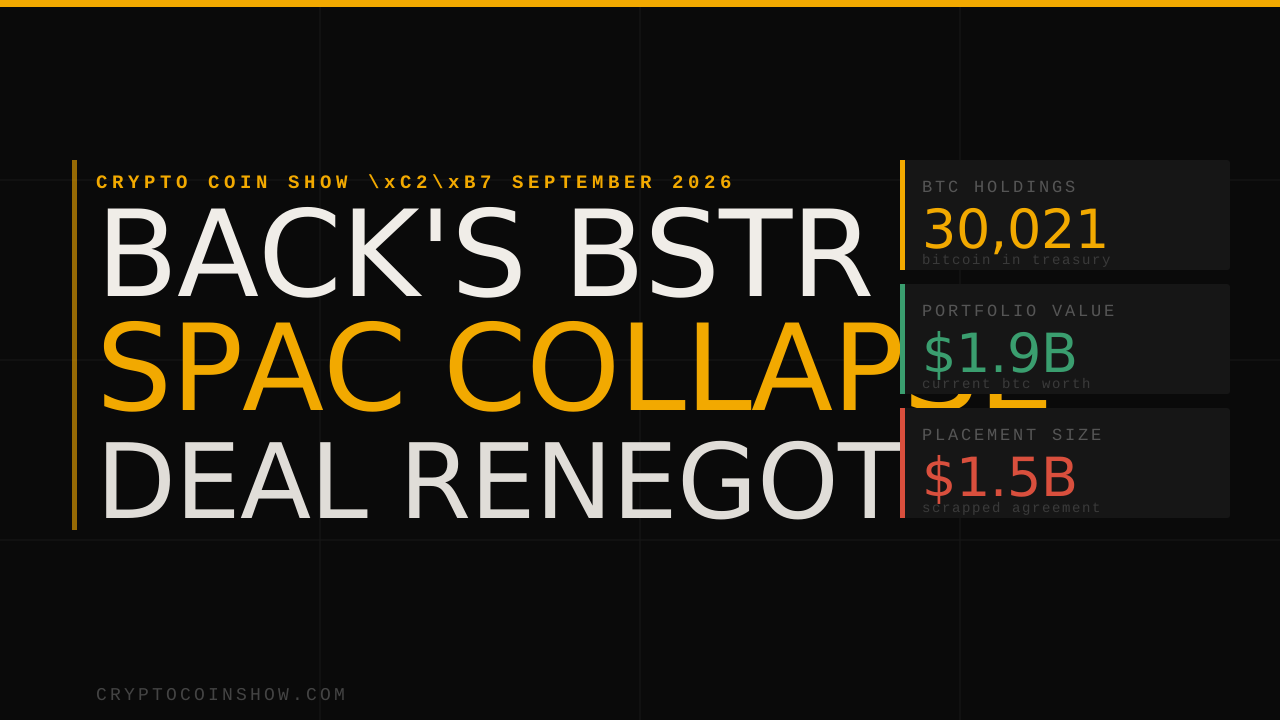
- BSTR holds 30,021 BTC worth approximately $1.9 billion, positioning it as a potential fifth-largest public corporate Bitcoin holder behind MicroStrategy and Metaplanet.
- The original merger agreement, signed July 16, 2024, envisioned a novel in-kind Bitcoin PIPE that would inject 5,021 BTC directly into the deal rather than raising cash.
- The shareholder vote, initially scheduled for July 10, has been canceled indefinitely after being delayed twice previously, with both companies now discussing revised merger structure and amended terms.
- $1.5B Private placement financing attached to original merger now scrapped
- 30,021 BTC Treasury holdings BSTR planned to bring to Nasdaq public markets
- 3 Shareholder vote delays before indefinite postponement was announced
Adam Back’s Bitcoin Standard Treasury Company and its SPAC partner Cantor Equity Partners I have dismantled the terms of their merger agreement and postponed shareholder voting indefinitely, forcing a complete renegotiation of how the Bitcoin treasury company accesses public markets.
The decision, announced Wednesday, represents a significant setback for one of crypto’s most high-profile infrastructure plays and signals broader fragility in the SPAC-to-public pathway for digital asset firms.
Both companies are now discussing a new structure intended to “better reflect current market conditions,” language that masks fundamental disagreements over deal economics and financing mechanisms that have stretched negotiations across multiple delays.
BSTR’s Bitcoin holdings would rank fifth among public companies without SPAC closure
Bitcoin Standard Treasury was poised to debut on Nasdaq with 30,021 BTC in its treasury, representing approximately $1.9 billion in value at Wednesday’s Bitcoin price of roughly $62,000 per coin. That holdings level would position BSTR as the fifth-largest public corporate Bitcoin holder, behind only MicroStrategy, Twenty One Capital, Metaplanet, and Mara Holdings.
The stash is substantial enough to move markets: it represents nearly 0.15 percent of Bitcoin’s total circulating supply, making BSTR a material holder by institutional standards.
The bitcoin composition reflected an ambitious capital sourcing plan.
Back and Blockstream Capital, the two founders, were committing 25,000 BTC from their own holdings, while a further 5,021 BTC was expected to flow in through the private investment in public equity, or PIPE. This arrangement was marketed as the first major in-kind Bitcoin PIPE in a SPAC transaction, a structural innovation that would have demonstrated institutional appetite for contributing actual crypto assets rather than cash into public equity deals.
Cantor Equity Partners I, the blank-check company sponsoring the transaction, raised approximately $200 million during its January 2026 IPO and brought $267.2 million in market capitalization into the merger process. The sponsor is affiliated with Cantor Fitzgerald and chaired by Brandon Lutnick, whose father Howard Lutnick serves as U.S. Commerce Secretary.
Multiple delays over unresolved PIPE terms foreshadowed merger collapse
The breakdown did not arrive without warning. CEPO had originally scheduled its shareholder meeting for July 10, but the company canceled that vote after earlier postponements on June 26 and July 2. Each delay was linked to unresolved terms surrounding the PIPE structure, the mechanism through which the 5,021 bitcoin would flow into the merged entity.
Those unresolved issues persisted across weeks of negotiation, signaling fundamental disagreement between the parties over valuation, timing, and the mechanics of in-kind Bitcoin contribution to a public company.
The indefinite postponement now returns all redeemed shares to shareholders who had filed redemption notices, eliminating the immediate timeline pressure that often forces SPAC deals to closure. Neither company has set a deadline for when share redemptions must be processed, granting both sides operational breathing room.
This flexibility suggests the parties view renegotiation as preferable to walking away entirely, but also indicates the original deal structure has become untenable under current market conditions or regulatory scrutiny.
BSTR and CEPO are working on a potential revised structure intended to opportunistically better capitalize on market conditions.
Adam Back, Bitcoin Standard Treasury founder, via X social media
Softer Bitcoin prices create opportunity for share buyback, Back argues
Adam Back has framed the renegotiation as a strategic repositioning rather than a failure. He suggested on X that the revised structure would allow BSTR to capitalize opportunistically on market conditions, language consistent with his earlier strategy outlined to CoinDesk: delaying the public listing to accumulate Bitcoin at lower prices before any market recovery.
Going public during a softer Bitcoin market, in this logic, permits the treasury firm to expand its holdings before institutional demand and scarcity dynamics push prices higher again.
That argument carries weight in crypto finance circles, where companies with available capital often time public debuts or capital raises to coincide with periods of relative price weakness. However, it also raises a question for institutional investors: if market conditions were truly favorable for repositioning the deal, why have CEPO and BSTR spent months negotiating in circles?
The three separate vote delays suggest the parties were unable to reach agreement on revised terms that both sides considered acceptable, not that they were deliberately waiting for better Bitcoin prices.
The original deal structure has now been officially abandoned. The $1.5 billion private placement that was meant to fund the transaction no longer exists, requiring a complete redesign of how BSTR raises capital for operations and potentially for additional Bitcoin accumulation.
This reset forces both companies to file amended SEC registration documents reflecting the new terms before any shareholder vote can proceed.
SEC filing amendments required before shareholder vote can proceed
Any revised merger structure agreed between BSTR and CEPO must be memorialized in amended SEC filings that supersede the original business combination agreement dated July 16, 2024. Those amendments will require SEC review and approval before the companies can schedule a new shareholder meeting.
The timeline for that process remains unknown: CEPO has not announced when it expects to file amendments or when a new vote might occur.
This regulatory pathway creates additional uncertainty for investors holding CEPO shares or monitoring the deal. Each amendment filing will become public, allowing the market to observe the specific concessions each party has made and whether the revised deal represents a material improvement or merely a repackaged version of the same problematic terms.
Institutional investors tracking BSTR’s path to public markets will gain visibility into the revised structure only once those filings appear, making the interim period one of information opacity.
Until CEPO and BSTR announce a revised merger agreement and file amended registration documents with the SEC, BSTR’s path to Nasdaq listing remains entirely open and its timeline completely uncertain. Institutional investors should monitor SEC filings for evidence of structural changes to the PIPE mechanism, valuation adjustments, or revised financing terms that might signal whether the two parties have genuinely resolved their disagreements or are merely deferring a more difficult reckoning.