The United Kingdom’s asset regulator, the Financial Conduct Authority (FCA), has proposed a new standing for investment funds which would allow them to have up to 10% of their assets in crypto exchange traded notes (ETNs), in a move geared towards opening regulated funds to digital asset exposure.
This proposal was published as part of the FCA’s 52nd quarterly consultation paper, with the consultation window closing on July 13.
FCA proposal
Portfolio managers at authorized funds could be allowed to hold crypto ETN positions so long as the total allocation stays at or below 10% of the entire asset holding, according to the published proposal. Fund managers would also need to show that any ETN holdings align with the fund’s stated investment objective and risk profile.
The FCA has set a 10% cap to limit risk exposure and prevent funds from being pushed into “restricted mass market investment” territory at higher allocation levels, which could complicate their regulatory classification as retail products.
Based on the proposal plan, funds will be permitted to hold crypto ETNs listed on recognized investment exchanges in the UK. Products traded in the EU and other global markets that satisfy existing market criteria for eligibility are also expected to qualify for listing.
Possible proposal benefactors
The proposal covers a wide scope of financial institutions and investment funds, but still has clear boundaries on who it applies to and who it doesn’t. Some investment schemes serving professional investors and individuals with a high net worth would face no allocation cap.
Long-term asset funds and non-UCITS retail schemes structured as alternative investment funds would be excluded entirely from holding crypto ETNs.
However, the FCA’s stance on direct crypto ownership has not changed in the slightest. Ownership of cryptocurrency by these funds is still off the table. Funds can gain exposure only through listed and approved crypto ETNs.
The FCA said it would revisit that position after assessing how its forthcoming crypto regulatory framework and client-asset protection rules affect fund structures.
UK crypto ETN market
The recent proposal comes after a sequence of shifts in the regulatory market, with the FCA lifting its ban on retail investors accessing crypto ETNs in October 2025, a change that reopened a market that had been closed for four years. Financial institutions, including 21Shares, Bitwise, WisdomTree, and BlackRock, then listed physically backed Bitcoin and Ether products on the London Stock Exchange.
In April 2026, British investors became allowed to hold crypto ETNs in Innovative Finance ISAs after the HMRC had previously blocked new acquisitions within conventional stocks-and-shares ISAs.
The current proposal addresses what the FCA sees as a regulatory gap, as individual retail investors could already access crypto ETNs directly but the funds managing their money could not.
Jon Allen, head of innovation and operations at the Investment Association, called the proposal “a practical step” that would let funds gain crypto exposure through regulated ETN products.
This move from the UK FCA is on track with recent trends across Europe, where regulators in Germany, Switzerland, and the Netherlands have already allowed similar financial products for investment funds.
Ripple’s global payments narrative may be gaining fresh momentum as one of its key partners, Thunes, unveils a new development that could further strengthen cross-border settlement infrastructure. As the demand for faster, cheaper, and more efficient international payments continues to rise, strategic partnerships like Thunes play a crucial role in expanding real-world utility across the XRP ecosystem.
Thunes Expands Its Role In The Global Payments Ecosystem
A recent announcement from Thunes could significantly strengthen XRP’s position in the global payments landscape. Analyst XFinanceBull on X has revealed that the company has officially launched real-time payment capabilities in the United States through a direct connection with a Tier 1 financial institution, enabling access to ACH, Same-Day ACH, and all real-time payment rails.
The development comes as Thunes continues to strengthen its international footprint. Thunes holds 50 Money Transmitter Licenses, allowing it to operate across every US state and territory, mirroring Ripple’s regulatory reach. Both companies now independently have institutional-grade access to US clearing systems.
Thunes network already spans 140 countries, supports 90 currencies, and connects to more than 12 billion mobile wallets, stablecoin wallets, and bank account endpoints. Following its expanded partnership with Ripple in September 2025, Thunes integrated blockchain and digital asset technology into its direct global network, leveraging Ripple payments to enhance its SmartX Treasury System.
Meanwhile, Thunes has plugged real-time US settlement into the same network that uses the Ripple blockchain payments infrastructure and XRP as a bridge asset. Over 140 countries can now send money to the US through rails connected to Ripple technology.
Ripple payments have near-global coverage with over 90 payout markets processing more than $70 billion in volume. This integration gives XRP a direct pathway into Tier 1 US banking through a partner that holds licenses in every state.
Institutional Interest Fuels XRP Ledger’s Next Phase Of Growth
The XRP Ledger real-world asset (RWA) ecosystem officially surpassed $3 billion in tokenized value in April. According to an analyst known as BankXRP on X, the incredible insights shared by Luke Judges, Partner Director at RippleX, at Istanbul Blockchain Week, break down exactly where the momentum is heading for real-world asset tokenization. Furthermore, the $3 billion milestone is driven by a highly diversified mix of assets, underscoring Ledger’s expanding institutional utility across multiple segments of finance.
Looking ahead, the next big wave of growth is expected to center around cash and cash-equivalent assets. Money market funds and US Treasury bills, alongside tokenized equities, are being viewed as prime targets for infrastructure disruption. The broader vision is moving toward a globally distributed financial system where regulated assets can trade seamlessly across asset classes through a unified order book.
Amsterdam Set to Welcome Thousands of Digital Asset Professionals
Dutch Blockchain Week 2026 Releases Full Summit Agenda as Europe’s Digital Asset Industry Gathers in Amsterdam
DatesJune 22–28, 2026
SummitJune 24 & 25, 2026
VenueJohan Cruijff ArenA, Amsterdam
Side Events40+ City-Wide
With less than a month to go, Dutch Blockchain Week 2026 has released the full agenda for its flagship summit — offering a clearer picture of the companies, institutions and industry leaders set to gather in Amsterdam this June.
7
Days of industry-wide programming across Amsterdam
2
Summit days at Johan Cruijff ArenA
40+
Side events, dinners & meetups across the city
MiCA
Europe’s regulatory era — Amsterdam at the center
Taking place from June 22–28, 2026, Dutch Blockchain Week has evolved into one of Europe’s largest blockchain and digital asset gatherings. At the center of the week is the Dutch Blockchain Week Summit on June 24 & 25 at Amsterdam’s iconic Johan Cruijff ArenA, bringing together exchanges, banks, payment providers, regulators, infrastructure companies, policymakers and investors.
Summit Topics
The summit program reflects the continued maturation of the industry. Key themes taking center stage across two days of content include:
Among the confirmed speakers is Charlie Lee, Founder of Litecoin and Director of the Litecoin Foundation, alongside senior executives and industry leaders from:
Charlie Lee — Litecoin FoundationVisaMastercardKrakenBitwiseFireblocksChainlinkMinistry of FinanceRippleDeloittePwC+ Many Others
Breakout Program
Beyond the main stage, attendees will have access to a dedicated breakout program hosted by leading organizations. These sessions are designed to provide deeper insights into the technologies, regulations and business models driving the next phase of digital asset adoption.
Visa · Mastercard · Deloitte · PwC · Fireblocks · Kraken · OKX · Bybit EU · Zerohash Europe · Coinmerce · Talos
Amsterdam & MiCA
As Europe enters the MiCA era, Amsterdam continues to strengthen its position as a key destination for digital asset companies seeking to operate within a regulated framework. This shift is increasingly reflected in the audience attending Dutch Blockchain Week, which now attracts professionals from traditional finance, banking, fintech, government, legal, payments and blockchain sectors alike.
Networking
Networking remains a major focus for this year’s edition. Through a dedicated networking platform, attendees can connect, schedule meetings and engage with partners before arriving in Amsterdam. During the summit, dedicated networking areas and curated meeting opportunities are designed to facilitate meaningful business conversations and long-term partnerships.
The wider Dutch Blockchain Week ecosystem extends well beyond the summit itself. More than 40 side events will take place throughout Amsterdam — ranging from investor dinners, executive roundtables and networking receptions to community meetups, workshops and industry-focused gatherings.
“Dutch Blockchain Week 2026 is positioning itself as more than a conference. It is becoming a meeting point for the companies, institutions and professionals actively shaping the future of digital assets in Europe.”
Dutch Blockchain Week is one of Europe’s largest blockchain and digital asset gatherings, held annually in Amsterdam. The event brings together professionals from across exchanges, banking, payments, regulation, infrastructure, legal and investment sectors, creating a platform for business development, knowledge sharing and relationship building at the intersection of finance and digital assets.
About Crypto Coin Show
Crypto Coin Show is a leading media platform covering blockchain events, digital asset industry news, and the global crypto conference landscape. We connect professionals with the events, insights and conversations shaping the future of finance.
Laszlo Hanyecz, a programmer, created history on May 22, 2010, when he spent 10,000 Bitcoin on two pizzas. The trade was valued at about $41(market cap under US$1M) at the time.
According to Binance, the 10,000 Bitcoins would be valued well over $700m (market cap over US$1.5T) now. In August 2025, when BTC price was at an all-time high of $126k, the coins would be worth more than $1 billion.
The amount now represents over 22 days of current issuance, given today’s block subsidy of approximately 450 BTC per day.
Major price milestones for Bitcoin have been reached amid dwindling new supply. At Pizza Day, roughly 14% of the total BTC supply had been mined. By the time BTC first traded above US$100 in 2013, this had risen to around 53%. According to Binance, nearly 80% had been mined by US$10K in November 2017, and over 94% by US$100K in December 2024.
This illustrates how Bitcoin’s issuance schedule is structurally diminishing. The supply curve flattens with each halving as daily issuance declines from 7,200 BTC per day during the Pizza Day era to 450 BTC presently and 225 BTC following the anticipated April 2028 halving. The remaining mineable Bitcoin represents a diminishing source of fresh supply versus any future growth in demand, since more than 94% of the total supply is currently in circulation.
Bitcoin Pizza Day shows global Bitcoin purchasing power after 16 years
To mark Bitcoin Pizza Day 2026, Binance used the initial pizza purchase as a lens to analyze the current crypto economy, highlighting how Bitcoin’s purchasing power has grown across major global cities. The comparison highlights how digital assets now interact with real estate, mobility, and daily consumption at scale, from Mumbai and Dubai to New York, London, and Tokyo.
Binance said that 10,000 BTC in Mumbai could purchase tens of millions of cups of chai and extensive access to commuter rail systems with thousands of years of journeys. The coins could also have major commercial real estate space in the city’s business districts,
In Dubai, the same sum could buy more than 12 million shawarmas, hundreds of luxury desert adventures, and dozens of ultra-luxury Palm Jumeira Villas.
The 10,000 BTC could purchase approximately 22 million slices of pizza, over 3,000 of Manhattan studio apartments, and enough subway rides to circle the city for generations.
In London, the same sum could purchase over 8 million pints at London pubs, several Premier League hospitality boxes for every match of the season, and purchase entire rows of townhouses in some boroughs.
Binance further said that the coins could buy millions of sushi plates in Tokyo, purchase thousands of high-speed rail journeys across Japan, and could also purchase entire floors in some central Tokyo apartment buildings.
Institutional adoption drives Bitcoin’s shift toward global infrastructure
Beyond the illustrative analogies, the larger message is that Bitcoin has shifted from novelty to infrastructure. Adoption patterns are increasingly influenced by both institutional involvement and grassroots usage in both established and emerging nations as digital assets continue to become integrated into payments, investment, and remittance flows.
SB Seker, Head of APAC at Binance, emphasized this evolution, noting, “Bitcoin Pizza Day has become one of crypto’s most celebrated traditions because it captures something essential: innovation happens when someone is willing to try something new, even if it seems impractical at the time. In 2010, Laszlo Hanyecz used Bitcoin to buy pizza because he believed digital currency should have use cases, not just sit in a wallet. Today, we are seeing that vision materialize at scale. Stablecoins are processing trillions in monthly volume, and users in markets like India are discovering crypto’s practical applications-from everyday transactions to wealth creation and preservation. Bitcoin Pizza Day celebrates the moment crypto moved from theory to practice, and reminds us that the real work is making that utility accessible to everyone.”
Binance said that institutions hold about 3.88 million BTC, or 18.5% of the 21 million hard cap. Strategy alone accounts for ~844K BTC, or 4% of total BTC, while public corporations narrowly lead all categories at ~1.24M BTC (5.9%). ETFs trail closely behind with ~1.32M BTC (6.3%), with BlackRock’s IBIT leading at ~811K BTC. An additional ~650K BTC (3.1%) is held by governments.
The crypto exchange explained that, excluding DeFi and other protocol holdings, pure institutional ownership is approximately 3.5 million BTC, or about one in six BTC. The adoption route is evolving. This is the first cycle in which the marginal buyer is an institution rather than a retailer. Approximately 1.24 million BTC (~US$95.7 billion NAV, ~5.9% of the circulating supply) are now held by 197 listed corporations. In the last 12 months alone, about half of that corporate accumulation occurred.
The joint venture of European banks Qivalis, set to launch a euro-backed stablecoin this year, has added 25 new members.
The financial institutions from a number of EU nations are bringing the total number of participants in the ambitious project to 37.
Qivalis adds new members in major expansion
Over two dozen banks have joined Qivalis, the consortium established to issue a euro-denominated alternative to dollar-pegged stablecoins, which dominate this segment.
Some of Europe’s largest banking organizations teamed up to realize the idea a few months ago. Others have backed it since. And the current wave is a significant increase in participation.
Announcing its latest expansion in a post on X on Wednesday, the group also unveiled that the cryptocurrency is slated to appear in the second half of 2026.
Qivalis took the opportunity to reiterate its main goal – to issue a “native, regulated euro in the on-chain financial system.”
We are not just building a euro stablecoin; we are laying the European financial rails of the future.
25 new banks have joined Qivalis today – bringing our consortium to 37 major institutions united behind one mission: a native, regulated euro in the on-chain financial system,… pic.twitter.com/J3DTm2uc0y
Commenting on the inclusion of new members, the Chief Financial Officer of Qivalis, Dutch financial and digital assets expert Floris Lugt, described the development as a “revolutionary moment,” stating:
“The potential of blockchain technology has consistently gone unrealized because banks did not support it. That is about to change.”
Two banks from the Netherlands, ABN Amro and Rabobank, have now joined the Amsterdam-based consortium. ING was among its founders last fall.
Financieele Dagblad, the country’s leading business daily, which quoted Lugt, wrote that the move marks a significant shift in the stance of major Dutch banks towards digital currencies and assets.
Nine banks launched the project in September 2025, including giants like ING, the Belgian KBC, Italy’s UniCredit, and the Austrian Raiffeisen. France’s BNP Paribas became part of it later.
Spain’s Banco Sabadell was accepted earlier in May, taking the total to 12 banks at the time, as reported by Cryptopolitan. Another five Spanish banks were added this week.
With the 25 joining now, the club already numbers 37 banks, coming from all corners of the Old Continent, from Iceland and Sweden, to Poland, Italy, and Greece.
Qivalis CEO Jan-Oliver Sell called the expansion of the consortium “a giant leap toward an open and compliant on-chain ecosystem for the euro”.
Euro stablecoin to enter dollar-dominated space
Unlike decentralized cryptocurrencies like Bitcoin and Ethereum, most stablecoins are tied to a fiat currency by their issuer to keep their price stable. They are widely used in crypto trading.
The global stablecoin market, which according to Citigroup may reach $4 trillion this decade, is heavily dominated by digital currencies pegged to the U.S. dollar, such as Tether’s USDT and Circle’s USDC.
EU officials have been expressing concerns that this growth may flood Europe with digitalized dollars and undermine Frankfurt’s monetary policy.
However, that hasn’t translated into support for euro stablecoins. The case for them is “far weaker than it appears,” according to a recent statement by ECB President Christine Lagarde.
Earlier this month, she warned that even they present a risk to financial stability and said that stablecoins are not an efficient way to strengthen the international role of the common currency.
The expansion of the Qivalis project comes as the European Union is trying to implement its Markets in Crypto Assets (MiCA) regulations across all member states.
The comprehensive framework was adopted in 2023 and came into effect in 2024, but not all EU countries have transposed its provisions into national law yet.
Representatives of AIB and Bank of Ireland, two Irish banks that are joining Qivalis now, insisted in comments for the local press that the euro stablecoin will be fully compliant with MiCA.
Qivalis CFO Floris Lugt assured the group shares the EU’s concerns and is addressing them while developing the regulated crypto, which will be backed by bank deposits and other assets.
The CLARITY Act Just Passed Committee. Here’s What It Means for Bitcoin.Regulation & Markets
The CLARITY Act Just Passed Committee. Here’s What It Means for Bitcoin.
For four months, the most important crypto legislation in a decade sat in limbo. Today it moved — and Bitcoin hit $82,000 on the news. Here’s what actually happened, what’s still unresolved, and what it means for your portfolio.
Ashton AddisonCrypto Coin ShowMay 14, 2026
BreakingSenate Banking Committee votes 15-9 to advance the Digital Asset Market Clarity Act — Bitcoin surges to $82,000, triggering $236M in liquidations.
For four months, the CLARITY Act sat in limbo. Today it moved.
The U.S. Senate Banking Committee voted 15-9 to advance the Digital Asset Market Clarity Act — the most significant crypto market structure legislation since the GENIUS Act was signed into law last July. Two Democrats broke ranks to vote yes. Bitcoin jumped to $82,000 on the news, triggering $236 million in total liquidations and a 3.5% gain on the day.
Here is what actually happened, what is still unresolved, and what it means for your portfolio.
01 — What the CLARITY Act Actually Does
The CLARITY Act is a comprehensive rulebook for digital asset markets. It draws a clear line between which assets are regulated as securities by the SEC and which are regulated as digital commodities by the CFTC. That distinction matters enormously for every crypto project operating in the US — and for every exchange listing them.
The bill also establishes registration frameworks for digital commodity brokers, dealers, and exchanges, and adds Treasury as a key rule-making authority alongside the SEC and CFTC. It is, in short, the regulatory foundation the industry has been waiting a decade for.
“Durable, lasting digital asset policy must be built on a bipartisan foundation, and today’s vote reflects the growing recognition across party lines that the United States needs clear rules of the road.”
— Blockchain Association CEO Summer Mersinger
02 — What Happened in the Hearing Room
The Senate Banking Committee hearing started with partisan friction. Senator Elizabeth Warren called the bill “just not ready,” citing a survey finding that only 1% of voters list crypto as a top priority. Dozens of amendments were proposed — most from Democrats seeking to substantially rewrite portions of the bill.
Chairman Tim Scott held the line. A last-moment maneuver secured the 15-9 bipartisan vote. Democratic Senators Ruben Gallego and Angela Alsobrooks voted yes, though both signalled their floor votes would depend on further progress on two outstanding issues: a law enforcement provision and an ethics clause designed to limit government officials from profiting in the crypto industry.
That ethics provision is the central unresolved tension. Democrats have said explicitly that the full Senate will not get their votes without it. Republicans and White House officials have pushed back hard, given that the provision is widely seen as targeting President Trump’s own crypto holdings.
03 — What Still Has to Happen
Passing committee is one step in a longer process. Here is the full path to law:
The Banking Committee version must be merged with the Senate Agriculture Committee’s version of crypto legislation
The ethics provision must be negotiated and inserted — the make-or-break issue for Democrat floor votes
The combined bill must clear the full Senate at 60 votes, requiring meaningful Democratic crossover support
The House must approve the final version
President Trump must sign it — White House target is July 4, 2026
White House adviser Patrick Witt said at Consensus Miami last week that July 4th is an achievable signing date. That timeline is aggressive. If the bill does not clear before August recess, Senator Lummis has warned the next realistic window is 2030.
04 — What It Means for Bitcoin
Bitcoin moved from $79,500 to $82,000 during the hearing. The 3.5% gain triggered a short squeeze — $145 million in short liquidations, $236 million in total liquidations across the market. Polymarket odds on BTC hitting $85,000 in May climbed 5 points to 56%.
Technically, $82,000 is where Bitcoin needs to close to confirm the next leg up. It sits right at the 200-day moving average. Analysts note that a confirmed close above that level opens $92,000-$98,000. A failure to hold $78,500 brings $76,500 back into play.
The structural picture has not changed. The institutional floor is intact. ETF inflows remain positive. The CLARITY Act is now the macro catalyst driving price. But the bill is not law yet, and the market knows it.
First support level. Must hold or $76,500 comes back into view
69%
Polymarket odds the CLARITY Act becomes law in 2026
60
Senate votes needed — requires Democrat crossover support
July 4
White House target signing date — aggressive but achievable per Patrick Witt
2030
Next window if August recess is missed, per Senator Lummis
05 — The Bigger Picture
The CLARITY Act passing committee is not the finish line. But it is the clearest signal yet that the US is moving from enforcement-driven crypto regulation toward a defined legal framework. That shift matters more than any single price move.
For builders, it means the years of operating in legal grey zones may be coming to an end. For institutions, it means the compliance infrastructure they have been waiting for is finally taking shape. For retail investors, it means the rules of the game are becoming clearer.
Coinbase CEO Brian Armstrong called the bill “strong” and said it “will benefit the American people by making the US financial system faster, cheaper and more accessible.” The Blockchain Association called today “a defining moment.”
Whether July 4th becomes the day the CLARITY Act is signed or just another deadline missed, today was real progress. In Washington, that is not nothing.
Sources
CoinDesk — CLARITY Act committee vote coverage, May 14, 2026
CryptoTimes — Bitcoin $82K rally report, May 14, 2026
Bitcoin.com — Short squeeze and liquidation data, May 14, 2026
Grayscale — CLARITY Act framework analysis
Polymarket — Probability data, May 14, 2026
This article is for informational and educational purposes only and does not constitute financial, investment, legal, or other professional advice. Investments in cryptocurrencies involve significant risk including loss of capital. Always conduct your own research and consult a qualified financial advisor before making investment decisions.
As the Senate Banking Committee prepares to mark up the long-anticipated CLARITY Act on Thursday, Coinbase CEO Brian Armstrong has argued that the newest version of the bill represents a workable “compromise” and could meaningfully improve the US financial system.
Speaking to FOX Business, Armstrong said the updated draft reflects concessions on both sides—what he described as the crypto industry meeting requests from bank lobbyists and lawmakers, while the banking sector also gave ground during negotiations.
Coinbase CEO’s CLARITY Act Pitch
Armstrong also highlighted one specific element tied to stablecoin rewards. He said the approach in the latest bill would only apply when there is “some sort of material activity on the account,” adding that he believes the overall package would make the system “more efficient.”
The claim is that the legislation would help streamline financial services, reduce friction, and make access easier for consumers and businesses—while still keeping the framework aligned with banking-sector concerns that were raised during talks.
Still, critics point to the banking industry’s pushback as evidence that the dispute is far from settled. As reported throughout the week by Bitcoinist, banking trade groups have opposed the CLARITY Act’s stablecoin-rewards provision, arguing that it could give crypto firms too much flexibility.
Their position is that the policy might also encourage deposits to shift away from traditional, insured banking channels rather than strengthening them.
Beyond the details of stablecoin rules, Coinbase CEO argued that the broader direction of the CLARITY Act reflects growing institutional interest in digital assets.
In his view, banks are increasingly integrating stablecoins and crypto-related services because customer demand is rising—an angle that suggests the bill, if passed in its current form, could provide the clearer structure institutions want before expanding further.
Can The Latest Crypto Bill Draft Survive?
Supporters of the bill are not limited to Coinbase. Ripple CEO Brad Garlinghouse also backed the current push, commenting on social media site X (previously Twitter) that the Senate Banking Committee is “putting in the work” to move the CLARITY Act forward.
Garlinghouse’s message emphasized that Ripple supports the bill because crypto businesses and major participants should have the “same rules and protections as every other asset class,” and because—if the US is serious about leading in crypto—this is the moment to finalize legislation and get it done.
Even with that backing, the legislative road ahead is not smooth. Politico reported that Senator Elizabeth Warren, a well-known crypto skeptic, is vowing to pursue extensive changes to the bill through amendments.
The reporting says Warren and others are preparing more than 100 amendments ahead of the markup, following the release of an updated 309-page draft that expands on an earlier 278-page version introduced in January.
According to the same reporting, Warren submitted more than 40 amendments on her own, with much of the rest attributed to Democratic members of the Banking Committee.
This mirrors earlier moves around the bill: the January markup session drew 137 amendments, and it was eventually cancelled after a period of resistance that included Armstrong and Coinbase withdrawing support for the bill at the time.
For now, the core question going into Thursday’s markup is whether the latest CLARITY Act draft can hold together.
Featured image created with OpenArt, chart from TradingView.com
Bermuda’s government is sticking to their plan of migrating their national economy onchain and is now partnering with the Stellar Development Foundation to move payments and other financial services onto its network, XLM.
The island mentioned that its residents were facing processing costs of up to 10%, making the move onchain not just an attempt at modernizing the system, but a necessary step for retaining economic value.
Bermuda moves onchain
The Stellar Development Foundation and the Government of Bermuda announced today that Bermuda will begin moving its payment and financial activities onto the Stellar network (XLM). Bermuda revealed its plans to become the world’s first fully onchain national economy at the World Economic Forum in January this year.
The announcement explains that local merchants currently pay 3% to 5% per transaction in card fees, and effective payment processing costs can reach as high as 10% in some categories. Introducing the use of digital assets and infrastructure will keep more of that value on the island.
Under the plan, Bermudian residents will be able to receive wages, pay local merchants, settle government fees, and hold, send, and receive digital assets through digital wallets on the Stellar network.
Government agencies expect to pilot stablecoin-based payments, financial institutions will be able to integrate tokenization tools, and residents can participate in nationwide digital literacy programs. Digital assets may also be used for government payment systems related to social service disbursements.
“The lack of mobile money applications and reliance on legacy payments infrastructure has left Bermudians paying high payment processing fees and hindered additional economic growth opportunities,” The Hon. E. David Burt, JP, MP, Premier of Bermuda said.
Denelle Dixon, the CEO and Executive Director of the Stellar Development Foundation, added that Stellar was built for the purpose of seamlessly connecting the global financial system.
Before Bermuda, the Philippines had also launched a blockchain transparency system called Integrity Chain for its Department of Public Works and Highways (DPWH) after citizens held mass protests over corruption in flood-control projects.
An estimated 130,000 people protested on September 21, 2025, demanding accountability after reports of overpriced contracts, substandard construction, and ghost projects. The Australian Institute of International Affairs shared that the Philippines allocated over $33 billion to flood-control projects across 15 years.
What other blockchain initiatives is Bermuda working on?
Cryptopolitan recently reported that the Bermuda Monetary Authority (BMA), the island’s central bank and financial regulator, recently completed an “Embedded Supervision Solution” with Chainlink (LINK), Apex Group, Bluprynt, and Hacken.
The solution, announced earlier this month, demonstrates how rules can be built directly into digital asset infrastructure and enforced in real time. The system uses Chainlink’s Automated Compliance Engine (ACE) to check every transaction against Bermuda’s policies.
With Proof of Reserve, it verifies that digital dollars are backed by real money in a bank account. It also uses Secure Mint to stop new coins from being issued when reserve limits have been reached.
Apex Group, acting as an independent fund administrator with $3.5 trillion in assets serviced across 52 countries, supplies authenticated reserve data from third-party custodians. Hacken’s Extractor platform provides real-time onchain monitoring with a detection speed of 250 to 500 milliseconds.
The market has not shown significant price action following today’s announcement. XLM is trading around $0.1622, down approximately 4.82% over 24 hours, according to CoinMarketCap data.
XLM has spent most of 2026 trading below $0.20, fluctuating primarily within the $0.15 to $0.18. The 0.20 level now serves as both technical resistance and a major psychological barrier. Above this level, the next resistance zone sits around $0.22 to $0.25. On the downside, support clusters around the $0.15 to $0.16 range.
Notably, the CME Group began rolling out futures for XLM in February 2026, but the impact on XLM’s price has remained limited, and the futures listing has not yet generated enough buying momentum to push the token out of its sideways range.
According to the Stellar Foundation, the network surpassed $2 billion in onchain real-world asset (RWA) value in the first quarter of 2026. Data from DeFiLlama shows that the network currently has a stablecoin market capitalization of approximately $ 415 million, with its daily decentralized exchange (DEX) volume around $1.83 million.
A senior White House official has accused major banking trade leaders of refusing to join earlier talks on stablecoin rewards, escalating a dispute that has become one of the final pressure points ahead of the Senate Banking Committee taking up the CLARITY Act this week.
In a May 11 post on the social media platform X, Patrick Witt, executive director of the White House Presidential Advisory Committee on Digital Assets, said he had asked American Bankers Association President Rob Nichols and other bank trade CEOs to attend the February meetings aimed at resolving the question of stablecoin rewards and yield.
“I specifically requested the attendance of Mr. Nichols and other bank trade CEOs at the meetings we hosted back in February to resolve the stablecoin rewards/yield issue. They refused. I guess the White House was beneath them?”
The criticism injected the White House more directly into a fight that has divided banks, crypto companies, and lawmakers ahead of a scheduled May 14 markup of the CLARITY Act.
The bill is designed to create a broader market structure framework for digital assets, but the treatment of stablecoin rewards has become a flashpoint over competition for deposits, consumer yield, and the future shape of dollar-based payments.
Witt’s comments also reframed the timing of the banking industry’s objections. Rather than a new technical concern emerging before a committee vote, the White House official cast the dispute as an unresolved issue that banking leaders had an opportunity to address months earlier.
Banks reopen stablecoin rewards fight before markup
Over the weekend, the American Bankers Association (ABA) urged bank executives and employees to press senators for tighter restrictions in the CLARITY Act before the committee vote, warning that the current bill could still allow crypto firms to offer reward structures that resemble interest on deposit-like products.
Nichols told bankers that lawmakers needed to hear from the industry before the legislation advanced.
The ABA’s concern is that stablecoin issuers, exchanges, or related companies could attract customer funds by offering returns on assets that compete directly with traditional bank deposits.
Banks rely on deposits as a funding base for loans to households, small businesses, farms, and corporations. If customers move cash into stablecoins that offer rewards, banks argue that lenders could face higher funding costs, tighter margins, and less capacity to extend credit.
The banking industry has described the current compromise language as leaving a loophole.
In its view, a ban on stablecoin issuers paying yield would be insufficient if affiliated exchanges, brokers, or other crypto platforms could deliver similar economic benefits through rewards, rebates, or incentive programs.
That position has put banks at odds with crypto companies that see the rewards language as a basic competition issue.
Stablecoin reserves are typically held in cash, short-term Treasuries, or other liquid instruments that generate income. The policy fight centers on whether consumers should be able to receive part of that return, and which type of institution should be allowed to offer it.
The recent Senate compromise has attempted to separate passive yield from activity-based rewards.
That distinction was meant to prevent stablecoins from becoming direct substitutes for interest-bearing deposits while preserving room for crypto platforms to reward users for participation, payments, or other services.
White House analysis undercuts the lending warning
The Council of Economic Advisers said in an April report that banning stablecoin yield would provide only a marginal lift to bank lending under its baseline assumptions. The CEA estimated that such a ban would increase bank lending by about $2.1 billion, equal to roughly 0.02% of total lending in the base case.
That finding gives the administration a counterweight to the banking sector’s claim that stablecoin rewards could meaningfully damage credit creation.
The report argued that most stablecoin reserves would not be permanently removed from the banking system. Instead, reserves held in cash, bank deposits, or Treasury instruments would continue to circulate through financial markets in different forms.
The CEA also said a more severe impact would require a much larger stablecoin market and more restrictive assumptions about how reserves are held. In the administration’s framing, stablecoin rewards may affect bank margins, but the baseline effect on lending capacity appears limited.
Moreover, a separate analysis by Galaxy Research furthered the argument by focusing on the international flow of dollars.
Galaxy said banks were overstating the risk that stablecoin growth would simply drain domestic deposits. Its model projected that much of the growth under a regulated stablecoin framework would come from offshore users seeking easier access to dollar-denominated assets.
That finding changes the economic lens. If stablecoins mostly draw funds from US bank accounts, banks face a direct deposit migration problem.
However, if much of the growth comes from foreign users moving into dollar stablecoins, the effect could be an inflow into US financial infrastructure rather than a one-way drain from domestic lenders.
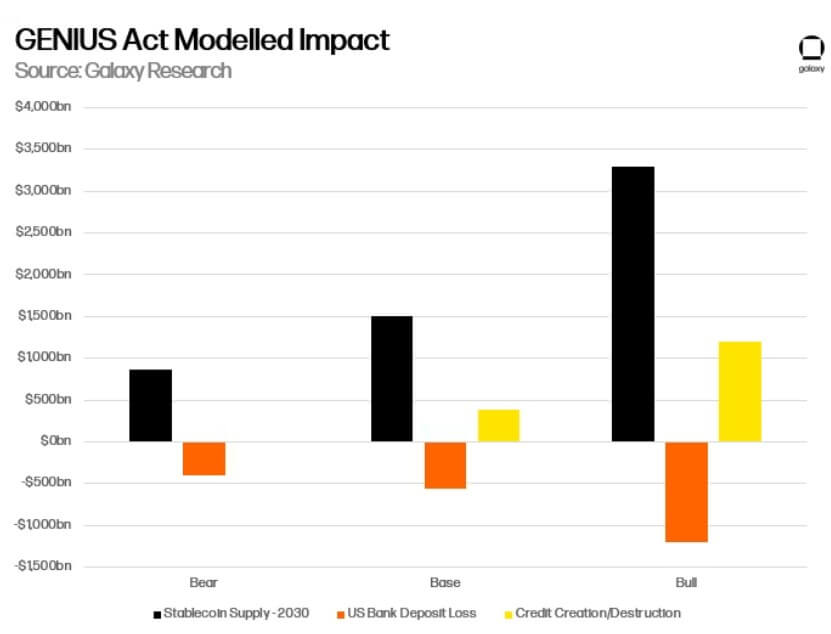
Galaxy estimated that 60% to 70% of stablecoin growth under the GENIUS Act framework could originate offshore. It also projected that imported deposits from foreign demand could exceed domestic deposit migration by roughly 2:1.
The firm said each newly minted stablecoin dollar could generate about 32 cents of net US credit, with total credit expansion reaching about $400 billion through 2030 in its base case and as much as $1.2 trillion in a stronger growth scenario.
GENIUS Act Impact on Stablecoin (Source: Galaxy Digital)
It also projected that stablecoin reserve demand could compress Treasury bill yields by 3 to 5 basis points, potentially lowering federal borrowing costs.
Meanwhile, Galaxy did not dismiss the pressure on banks. The report said some low-cost deposits would likely migrate, funding costs could rise at the margin, and net interest margins could compress in business lines sensitive to rate competition.
Still, the firm concluded that stablecoins could pressure banks that rely on cheap deposits, increase demand for US Treasury bills, import offshore dollar capital, and expand the reach of the US financial system.
Crypto allies accuse banks of protecting margins
Crypto advocacy groups have seized on the ABA’s push as evidence that banks are trying to block competition days before the committee vote on the CLARITY Act.
Coinbase-backed Stand With Crypto urged supporters to contact senators, saying banking lobbyists were trying to weaken stablecoin rewards language before the markup.
The group framed the dispute as a consumer-rights issue, arguing that users should be able to earn returns on their own digital assets rather than have that value captured by intermediaries.
Cody Carbone, CEO of The Digital Chamber, said banks had months to negotiate over the issue and were now trying to force changes late in the process. He described the ABA campaign as an attempt to shield incumbents from competition after earlier opportunities to engage had passed.
Sen. Bernie Moreno, an Ohio Republican on the Banking Committee and a supporter of crypto legislation, used sharper language about the bank’s opposition to CLARITY Act.
He accused the “banking cartel” of trying to preserve a system in which banks pay depositors little while earning profits from lending and securities portfolios.
Moreno wrote on X:
“During the Biden era, these same banks worked hand-in-glove with Sen. Warren and her allies to debank Americans, including President Trump’s own family. They shut down accounts of conservatives, patriots, and anyone who dared challenge the regime, all while regulators applied pressure under schemes like Operation Choke Point 2.0. It wasn’t about risk. It was about political control. Now that innovative stablecoins threaten to break their monopoly and give you actual financial freedom? They’re running to Congress again, screaming about ‘threats to economic growth and financial stability.’”
Moreno’s statement showed how the stablecoin rewards dispute has moved beyond technical drafting.
The fight now carries a broader political message about financial competition, consumer returns, and resentment toward large banking institutions.
That rhetoric could help crypto advocates rally support, especially among Republicans who view stablecoins as part of a broader agenda around financial innovation and dollar competitiveness.
However, it also risks hardening opposition from lawmakers who are already concerned that crypto firms are seeking bank-like privileges without equivalent oversight.
Markup will test whether the stablecoin compromise can hold
If the committee advances the CLARITY Act with the current language largely intact, crypto firms will claim momentum, and banks will likely shift their campaign to the full Senate.
If lawmakers tighten the rewards provisions, the banking industry will have succeeded in reopening one of the most contested parts of the bill at the final stage before markup.
Meanwhile, the vote will also test the broader coalition behind the CLARITY Act. Republicans have pushed digital-asset legislation as a priority, while some Democrats have remained open to a market-structure bill if it includes stronger consumer protections, ethics, and anti-money-laundering provisions.
The stablecoin fight complicates that effort because it cuts across several policy lines at once. It raises questions about bank funding, consumer yield, Treasury demand, offshore dollar usage, and the role of crypto firms in payments.
That gives senators several reasons to demand changes, but also makes the issue difficult to settle cleanly.
Russian bankers are now urging their government to soften upcoming crypto rules and admit more coins to the country’s market for digital assets.
Their call comes after lawmakers warned against the overly strict framework currently under review, suggesting regulation in line with global standards.
Russian banks push for liberal cryptocurrency law
The Association of Russian Banks (ARB) has come up with ideas on how to “liberalize” the pending bill “On Digital Currency and Digital Rights.”
The draft law is part of a legislative package meant to comprehensively regulate crypto operations in Russia which is under consideration in the State Duma.
It legalizes cryptocurrencies and platforms working with them but imposes restrictions and penalties threatening to cut off Russia from the global market.
The proposals have been sent to the Chairman of the Financial Markets Committee at the lower house of Russian parliament, Anatoly Aksakov, local media unveiled.
According to reports by RBC and Bits.media, the ARB lobbies for allowing transfers to non-custodial wallets abroad and whitelisting foreign crypto platforms.
Such transactions would be illegal under the current version of the law, which permits only sending coins to custodial wallets and via licensed domestic intermediaries.
The banks, which will be authorized to work with decentralized money, want to be able to exchange cryptocurrencies for Russian digital financial assets such as tokenized securities.
They also suggest regulating stablecoins pegged to fiat currencies or backed by other assets, which are not mentioned in the legislation right now.
Russian bankers are also pushing the country’s monetary authority to relax the standards for cryptocurrencies approved for trading in the country.
The bill admits only the largest coins by capitalization and liquidity to the Russian market, such as Bitcoin, Ethereum, and Solana, as reported by Cryptopolitan.
The ARB further proposes ditching a requirement for digital depositories to disclose information about clients and their crypto holdings.
It also insists on extending judicial protection to cover crypto assets, including those that have not been disclosed to Russia’s tax authority.
Amendments can be made until the second reading of the bill, which was filed in the Duma earlier in April but has yet to hit the floor of the chamber.
Lawmakers call for easing crypto regulations
Meanwhile, the draft law was recently reviewed by the parliamentary Committee for Protection of Competition, and its members were also unhappy with its “excessive rigidity.”
The Russian deputies called for easing the rules for members of the industry, warning they would otherwise lead to monopolization of the market.
“Excessively stringent regulation compared to global regulatory practices may not achieve the bill’s goals,” the legislators remarked in their conclusion.
One of them is to bring the sector out of the shadows, but many Russians may opt to remain under the radar if the framework is adopted as is. The members of the Duma wrote:
“Instead of creating an effective and sustainable digital currency market in the Russian Federation, this could trigger an outflow of retail investors, who will be forced to choose between foreign platforms with more lenient regulations or remain in the gray zone of the domestic market, unwilling to use monopolists’ services under unfavorable terms.”
The other stated goals include introducing requirements for entities processing crypto transactions, such as exchanges and custodians.
Increasing market transparency and developing standards for provided services and investor protection are among the announced priorities, too.
The committee emphasized it has no objections to the need to achieve all this, but made it clear it’s concerned about other aspects of the legislation.
For example, it criticized the strict licensing requirements for crypto companies, including regarding capital, cybersecurity, and corporate transparency.
These will banish small and medium-sized participants from the market, leaving only large players like banks, depositories, and other financial institutions.
Under the currently proposed rules, only the latter will be able to gain full access to cryptocurrency transactions, which would allow them to monopolize the market.
This level of “centralization often leads to the disappearance of innovative startups and creates the risk of high fees,” the lawmakers warned.
They also fear “reduced quality of services and a lack of incentives for the development of new technological solutions.”
The “Digital Currency” bill must be adopted by July 1, 2026. Other acts, introducing fines and penalties for breaking the law, will be enforced a year later.