
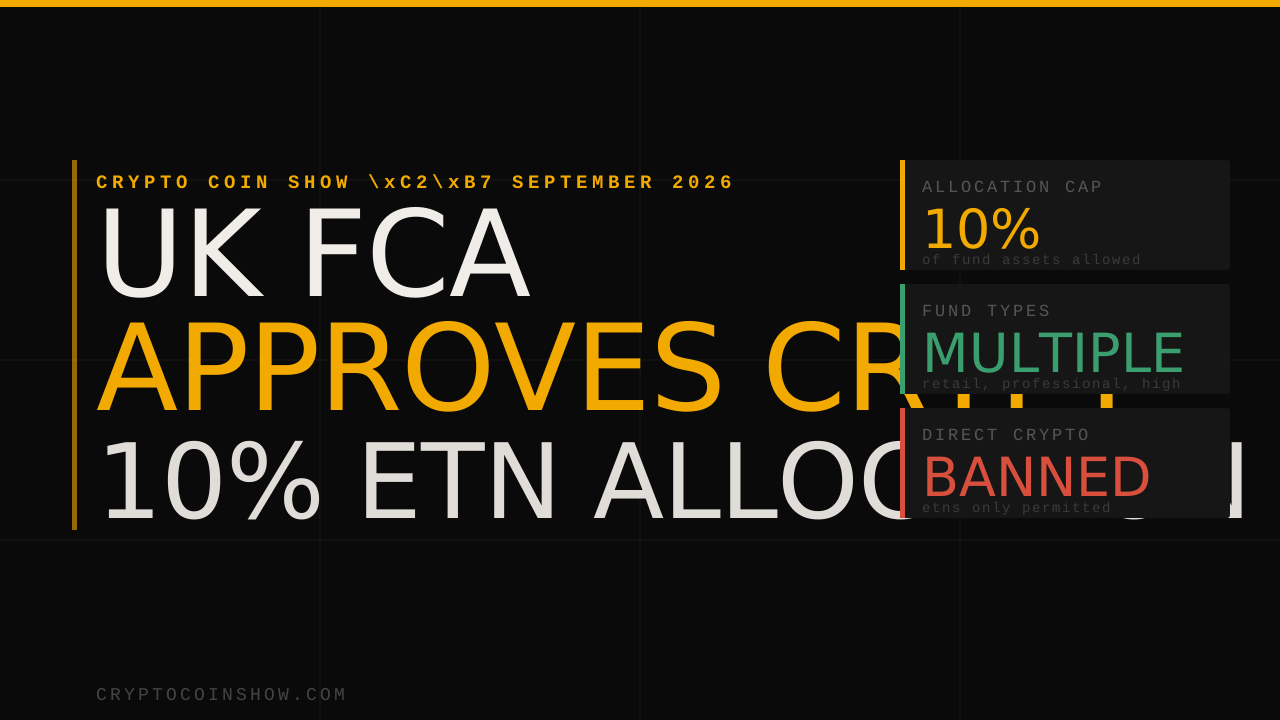
UK FCA proposes allowing investment funds hold up to 10% in crypto ETNs
The UK Financial Conduct Authority has proposed allowing regulated investment funds to allocate up to 10% of assets to cryptocurrency exchange-traded notes, marking the regulator’s most significant step yet toward integrating digital assets into mainstream institutional portfolios. The move addresses a widening gap between retail investor access to crypto ETNs and the restrictions that have prevented fund managers from building meaningful positions in the sector.
- FCA proposes 10% allocation cap for crypto ETNs within authorized investment funds
- Retail funds must justify ETN holdings align with stated objectives; professional and high-net-worth schemes face no cap
- Direct cryptocurrency ownership by funds remains prohibited; exposure limited to listed, exchange-traded products only
- 10% Maximum crypto ETN allocation cap for retail and UCITS investment funds
- July 13 Deadline for public consultation on FCA’s 52nd quarterly consultation paper
- 4 years Length of retail ban on crypto ETNs before FCA lifted restrictions in October 2025
The Financial Conduct Authority published the proposal in its 52nd quarterly consultation paper, with the public comment period closing on July 13. Under the framework, authorized portfolio managers could hold crypto exchange-traded notes provided the combined position does not exceed 10% of the fund’s total assets under management.
Fund managers would also bear responsibility for demonstrating that any such holdings align with the fund’s documented investment objective and risk profile, a requirement designed to prevent mission drift or unsuitable exposures for retail investors.
The 10% ceiling reflects a deliberate regulatory trade-off: permitting meaningful crypto exposure while preventing funds from crossing into “restricted mass market investment” classification, a status that would complicate their retail regulatory standing.
FCA sets different rules for retail funds versus professional schemes
The scope of the FCA’s proposal is deliberately stratified across the fund industry. Authorized UCITS funds and retail alternative investment funds would operate under the 10% cap, ensuring that products sold to mass-market investors carry defined limits on speculative exposure.
By contrast, investment schemes serving professional investors and individuals meeting high-net-worth criteria would face no allocation ceiling whatsoever, allowing their managers complete discretion over crypto ETN positioning.
Long-term asset funds and non-UCITS retail alternative investment funds are excluded entirely from the proposal and would remain prohibited from holding crypto ETNs under any circumstance.
This tiered approach reflects the FCA’s longstanding principle of calibrating rules to investor sophistication: retail products warrant tighter constraints, while professional-facing vehicles merit lighter-touch oversight.
Critically, the FCA has not altered its stance on direct cryptocurrency ownership by funds. Managers cannot hold Bitcoin, Ether, or other digital assets in native form.
Crypto exposure flows exclusively through listed, regulated exchange-traded notes, a structural requirement that preserves FCA oversight and leverages existing market infrastructure while keeping fund assets within established custody and trading frameworks.
Institutional crypto ETN market exploded after FCA lifted four-year ban
The current proposal arrives against the backdrop of a rapidly shifting regulatory landscape in the UK. In October 2025, the FCA terminated its longstanding ban on retail investors accessing crypto ETNs, ending a closure period that had lasted four years. That decision almost immediately triggered a wave of product launches from major financial institutions.
BlackRock, 21Shares, Bitwise, and WisdomTree all listed physically backed Bitcoin and Ether products on the London Stock Exchange in the months following the ban lift. These offerings gave retail investors direct access to spot-price exposure without requiring them to hold custody of digital assets themselves.
In April 2026, the FCA and HMRC extended that access further by allowing crypto ETNs to be held within Innovative Finance ISAs, tax-advantaged accounts previously closed to new crypto acquisitions under conventional stocks-and-shares ISA rules.
The asymmetry that the current proposal addresses became increasingly apparent: individual savers could now hold crypto ETNs in their personal portfolios and tax wrappers, yet the professional fund managers deployed to oversee collective investment schemes faced outright prohibition.
The proposal closes that gap by permitting funds to deploy a defined allocation into the same products their retail clients can access directly.
Fund managers must prove crypto holdings match investment mandate
Under the FCA proposal, the mechanics of permissible crypto ETN holdings come with a substantive governance requirement: fund managers must affirmatively demonstrate that any crypto exposure serves the fund’s stated investment objective and accords with its documented risk profile.
This is not a tick-box compliance exercise but rather a mandate that crypto allocation must be purposeful and defensible to regulators and clients alike.
Eligible products would include crypto ETNs listed on recognized investment exchanges in the UK as well as products traded on EU and global markets that meet the FCA’s existing criteria for cross-border eligibility.
This framework leverages the regulatory standing of listing venues rather than attempting to create separate FCA-administered registries, a pragmatic approach that reuses existing infrastructure.
The FCA explicitly stated it would revisit its prohibition on direct cryptocurrency ownership after assessing how its forthcoming crypto regulatory framework and client-asset protection rules affect fund structures.
That statement signals the regulator’s intent to continue calibrating the boundary between permitted indirect exposure via ETNs and outright asset holdings, with future adjustments contingent on how broader regulatory reforms develop.
The July 13 consultation deadline will determine whether the FCA proceeds with the 10% framework as proposed, modifies it in response to stakeholder feedback, or reconsiders specific segments of the fund industry to which it applies.
Industry response will focus on whether the 10% cap proves sufficient for meaningful strategic positioning and whether fund trustees and compliance teams will embrace crypto ETN allocations quickly once permitted.
The FCA has signaled it may revisit the direct ownership prohibition after assessing outcomes from its broader crypto regulatory framework and client-asset protection reforms, suggesting this proposal represents an interim milestone rather than the final regulatory settlement on institutional crypto access.
Professional Schemes Bypass Allocation Limits While Retail Funds Face Guardrails
The FCA’s framework creates a two-tier system in which professional investor schemes and high-net-worth portfolios face no prescribed allocation ceiling for crypto ETNs, while retail-focused funds remain bound by the 10% cap.
This differentiation mirrors existing regulatory practice for alternative assets like private equity and hedge funds, where institutional sophistication is assumed to reduce the need for protective position limits.
Professional schemes must still satisfy general suitability requirements, but the absence of a hard cap signals the regulator’s confidence in sophisticated investors’ ability to manage crypto volatility independently.
The divergence carries practical implications for fund structuring. A large institutional asset manager can now establish a dedicated professional crypto strategy with materially higher exposure, potentially 20%, 30%, or beyond, without triggering FCA intervention, provided risk disclosures remain accurate.
By contrast, a multi-asset retail fund seeking 15% crypto allocation would be forced to restructure into a professional vehicle or reduce the position to 10%. This has already begun reshaping product design at several London-listed asset managers preparing submissions ahead of the July 13 consultation deadline.
The two-tier approach may accelerate a bifurcation in UK fund distribution, where crypto-heavy strategies migrate toward professional classifications to escape the 10% ceiling, potentially narrowing retail access to crypto exposure through traditional fund structures and strengthening the case for a dedicated retail crypto ETF authorization, a topic the FCA has not yet formally opened for consultation.
“`