
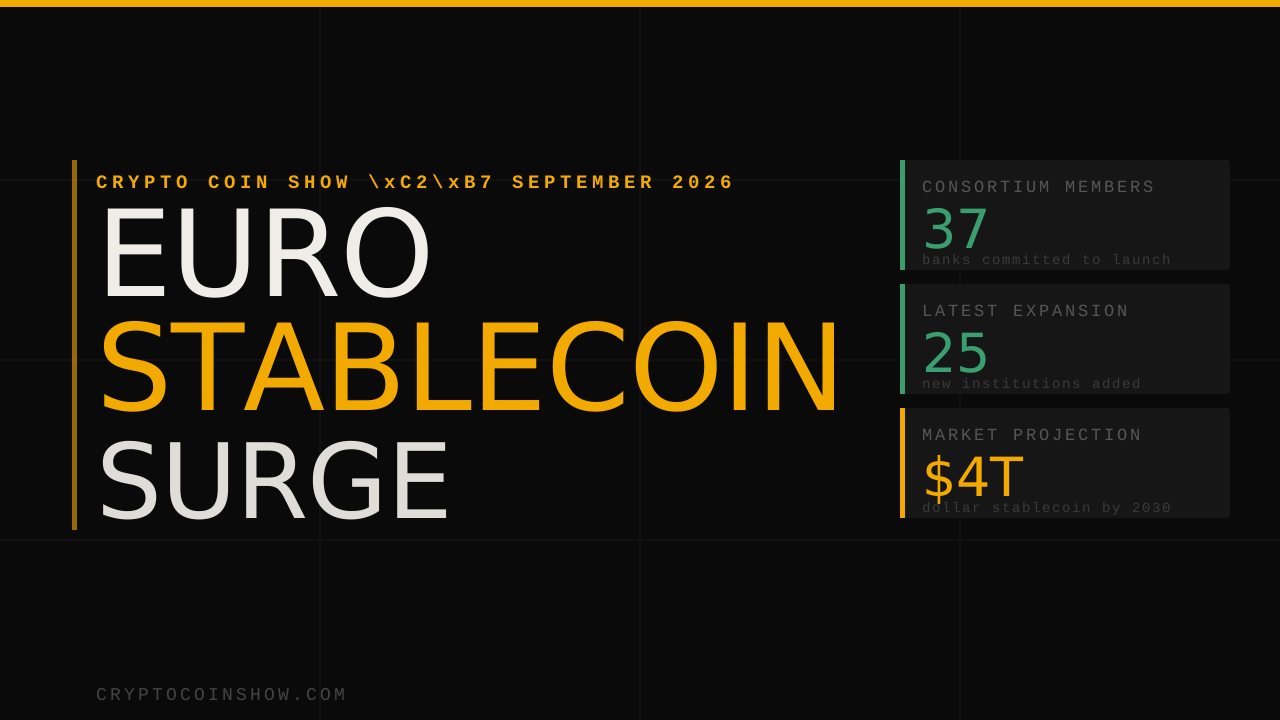
Euro stablecoin project Qivalis adds 25 new members
European banks have accelerated a major bid to create an institutional-grade euro stablecoin, with 37 financial institutions now committed to launch a regulated digital euro by mid-2026. For asset managers and trading firms dependent on dollar stablecoins, this represents the first credible path to euro-denominated on-chain settlement outside U.S. monetary control.
- Qivalis consortium grew from 12 to 37 member banks in two expansion waves, adding 25 institutions in latest announcement.
- Nine founding banks launched project in September 2025; ING, KBC, UniCredit, and Raiffeisen among original members from four nations.
- Target launch in second half of 2026 positions euro stablecoin to compete in dollar-dominated market projected at $4 trillion by 2030.
- 37 Major European banks now committed to Qivalis euro stablecoin project.
- H2 2026 Target launch window for regulated native euro on blockchain.
- $4T Projected global stablecoin market size by end of this decade.
The Qivalis consortium announced on Wednesday that 25 new financial institutions across the European Union have joined its effort to issue a euro-backed stablecoin, bringing total membership to 37 major banks spanning from Iceland and Sweden to Poland, Italy, and Greece.
The expansion represents a watershed moment for European institutional adoption of blockchain infrastructure: the project now encompasses systemically important lenders from every major eurozone economy, including the Netherlands’ ABN Amro and Rabobank, Spain’s five additional banks added this week, and earlier participants such as Italy’s UniCredit, Belgium’s KBC, and Austria’s Raiffeisen.
Qivalis intends to launch its regulated digital euro in the second half of 2026, positioning itself as a direct alternative to the dollar-denominated stablecoins that currently control the crypto settlement market.
Dutch and Spanish Banks Join Founding Members Spanning Four Nations
The consortium was formally established in September 2025 with nine founding members: ING, KBC, UniCredit, Raiffeisen, and five other major institutions representing the Netherlands, Belgium, Italy, and Austria. This foundational group was later joined by France’s BNP Paribas and Spain’s Banco Sabadell in May 2026, bringing the total to 12 before this week’s wave.
The current 25-member expansion signals a decisive shift in attitude among Europe’s largest retail and commercial banks toward blockchain infrastructure and regulated digital assets.
The participation of ABN Amro and Rabobank marks a turning point for the Netherlands, which now counts three systemically important banks in the consortium alongside ING. Both institutions are among the country’s “big three” retail and corporate lenders, controlling substantial deposit bases and payment flows.
Their entry, combined with the addition of five Spanish banks in a single week, indicates that Qivalis has moved beyond pilot-phase commitment into a critical mass that spans multiple deposit and payment ecosystems across the eurozone.
The potential of blockchain technology has consistently gone unrealized because banks did not support it. That is about to change.
Floris Lugt, Chief Financial Officer of Qivalis
Lugt’s statement reflects a material shift in how large European banks are approaching tokenized settlement infrastructure, moving from skepticism toward active participation in standards-setting.
Regulated Digital Euro Directly Addresses Dollar Stablecoin Dominance
The global stablecoin market is projected to reach $4 trillion by the end of this decade, according to Citigroup analysis cited by Qivalis. That market is currently dominated by dollar-pegged tokens such as USDT and USDC, which control the vast majority of on-chain trading volume and cross-border settlement activity.
For European institutional investors, asset managers, and trading firms, this dependency on dollar stablecoins creates both operational friction and indirect exposure to U.S. monetary and regulatory policy.
A euro stablecoin issued by a consortium of regulated EU banks would create the first institutional-grade alternative for euro-denominated settlement without requiring conversion to or from dollars.
This addresses a structural gap in the on-chain ecosystem: while bitcoin and ethereum are decentralized, most stablecoins are issued by single entities or small consortia without the backing of major banking infrastructure.
By contrast, Qivalis is explicitly designed as a “native, regulated euro in the on-chain financial system,” meaning its value maintenance, compliance, and custody would be anchored to the eurozone’s banking and regulatory framework.
For institutional crypto trading desks and asset managers, the availability of a bank-backed euro stablecoin would reduce settlement costs and counterparty risk compared to current workarounds that require intermediate dollar conversions or reliance on offshore platforms.
It also creates a direct channel for European institutions to access blockchain-based settlement without building their own infrastructure or partnering with non-EU entities.
Qivalis Aims for Mid-2026 Launch as Regulatory Clarity Hardens
The project’s stated launch window of H2 2026 provides an 18-month runway to complete technical development, regulatory pre-approval, and participant onboarding.
European financial regulators, particularly the European Central Bank and national supervisors, have begun to establish clearer expectations for stablecoin issuance under the Markets in Crypto Assets Regulation (MiCA), which entered into force in December 2023.
MiCA requires stablecoin issuers to maintain sufficient capital reserves, segregate customer assets, and submit to ECB oversight if their stablecoin is used across multiple EU member states.
Qivalis’ structure as a consortium of regulated banks positions it favorably under this regime, as each member institution is already subject to banking supervision and capital requirements under the Basel III and CRR frameworks.
CEO Jan-Oliver Sell framed the latest expansion as “a giant leap toward an open and compliant on-chain ecosystem for the euro,” signaling that Qivalis views regulatory alignment as a competitive advantage rather than a constraint.
The project’s transparency in announcing a specific launch window, rather than vague timelines, also suggests that technical and regulatory milestones are being met on schedule, or that the consortium believes it can close remaining gaps within the stated window.
The next material test for Qivalis comes in the second half of 2026, when the consortium must demonstrate a functioning, fully-tested stablecoin that meets both MiCA requirements and member banks’ internal risk and compliance standards.
The outcome will determine whether European institutions can establish a credible, independent settlement layer on blockchain infrastructure, or whether dollar stablecoins remain the default on-chain medium for eurozone asset managers and trading firms.
Regulatory approval from the ECB or national competent authorities for the stablecoin’s launch has not yet been publicly disclosed and remains the critical open question.
Regulatory Arbitrage and Dollar Dependency: Why European Banks Are Moving Now
The acceleration of Qivalis reflects a structural shift in how European institutional investors view blockchain settlement risk. Currently, euro-denominated transactions on major blockchains route through dollar stablecoins such as USDC and USDT, creating what regulators term “embedded currency risk”, exposure to U.S. monetary policy and sanctions frameworks without direct European oversight.
A regulated euro stablecoin issued by 37 eurozone banks eliminates that intermediary layer, allowing asset managers to settle trades in euros on-chain without converting to dollars and back. This matters acutely for pension funds, insurance companies, and central securities depositories operating under EU regulations that increasingly penalize off-balance-sheet dollar holdings.
The timing also reflects pressure from the European Central Bank’s regulatory roadmap. The ECB has signaled that it will not authorize a public digital euro until 2028 at earliest, leaving a two-year window where private institutional stablecoins operate with minimal competition from official channels.
Qivalis is designed to capture that window and establish network effects before central bank money arrives. By contrast, the U.S. Federal Reserve has shown no inclination to authorize private dollar stablecoins, meaning USDC and USDT operate in a regulatory gray zone that could tighten at any moment.
European banks are moving to lock in first-mover advantage in a market segment, private institutional settlement, that may become highly regulated within 36 months.
The ECB’s digital euro governance committee is scheduled to publish its final technical specifications in Q3 2026, the same quarter Qivalis targets for launch. If the central bank’s product offers comparable functionality at lower cost to issuers, Qivalis faces immediate displacement; if it does not, the consortium’s product could retain significant market share even after official digital euro deployment begins.