
Bermuda taps Stellar to widen government blockchain payments
Bermuda’s government is partnering with the Stellar Development Foundation to migrate national payment systems and financial services onto blockchain, targeting processing cost reductions from current rates as high as 10% per transaction. The move positions the Caribbean island as the first jurisdiction attempting a fully onchain national economy, with implications for how institutional investors evaluate blockchain adoption by sovereign governments and the viability of stablecoin infrastructure at the state level.
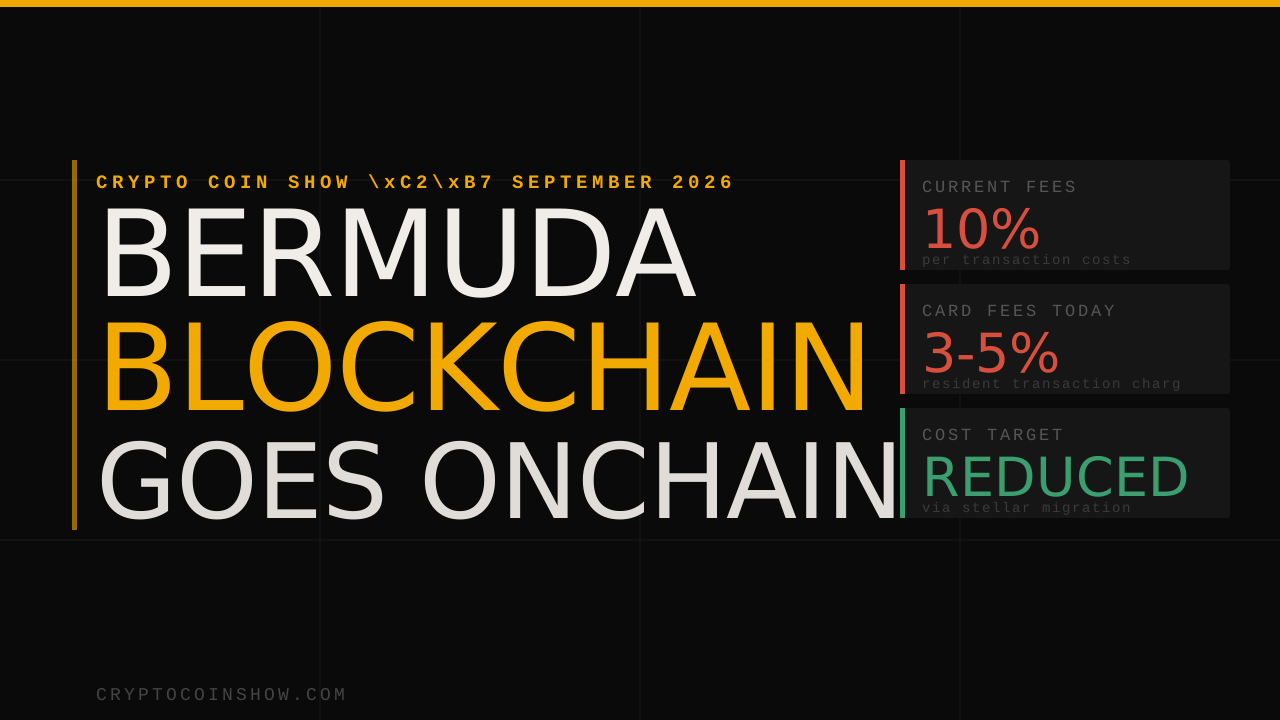
- Bermudian residents currently pay 3-5% in card fees per transaction, with effective processing costs reaching 10% in some categories that will migrate to Stellar network.
- Government agencies will pilot stablecoin-based payments, financial institutions will integrate tokenization tools, and residents can access digital wallets for wages, merchant payments, and government fees.
- Bermuda is the first jurisdiction publicly announcing a full national economy migration to blockchain, following January 2025 commitment at World Economic Forum; success or failure will shape institutional confidence in sovereign digital asset adoption.
- 10% Current maximum effective payment processing costs for some Bermuda merchant transaction categories.
- 3-5% Card fees per transaction that local merchants currently pay in Bermuda.
- January 2025 When Bermuda first announced plan to become world’s first fully onchain national economy.
Bermuda’s government and the Stellar Development Foundation announced today a formal partnership to move the island’s payment infrastructure, financial services, and government operations onto the Stellar blockchain network.
The announcement follows Bermuda’s January 2025 commitment at the World Economic Forum to become the world’s first fully onchain national economy, a pledge that initially positioned the island as an outlier among sovereigns.
The new partnership operationalizes that pledge by establishing a concrete technical pathway: residents will access digital wallets on Stellar to receive wages, pay local merchants, settle government fees, and hold digital assets, while government agencies will pilot stablecoin-based payments and financial institutions will integrate tokenization infrastructure.
The timing and scope signal institutional seriousness rather than regulatory experiment. Bermuda is moving beyond a sandbox or pilot program; the government is committing to systematic replacement of legacy payment rails with blockchain infrastructure across resident finances, merchant transactions, and government disbursement systems.
For institutional investors evaluating blockchain adoption by sovereigns, the announcement removes a key question: whether governments would actually follow through on blockchain integration rhetoric or defer to legacy systems. Bermuda is choosing to follow through.
Processing costs of up to 10% create economic necessity for onchain migration
The economic argument underpinning Bermuda’s migration is not ideological but fiscal. Local merchants currently incur card processing fees of 3% to 5% per transaction, but effective payment processing costs in certain merchant categories, including categories where residents spend regularly, reach as high as 10% annually.
That erosion of merchant revenue and resident purchasing power exceeds typical blockchain transaction costs by orders of magnitude and creates a measurable incentive for both merchants and residents to adopt digital assets and onchain settlement.
For institutional investors, this cost structure matters because it establishes a real economic floor for blockchain adoption.
Bermuda is not pursuing onchain payments because blockchain is trendy or because regulators want to experiment; Bermuda is pursuing onchain payments because the island’s isolation from global payment networks and reliance on legacy infrastructure creates genuine economic leakage. Premier E. David Burt framed the problem in institutional terms.
The lack of mobile money applications and reliance on legacy payments infrastructure has left Bermudians paying high payment processing fees and hindered additional economic growth opportunities.
The Hon. E. David Burt, JP, MP, Premier of Bermuda
That framing, payment infrastructure as an economic growth lever, not a fintech experiment, shifts how institutional investors should evaluate the Bermuda model.
Other small island economies and emerging markets with similar cost structures now face a benchmark: if Bermuda succeeds in reducing effective processing costs and retaining economic value onchain, peer jurisdictions will face pressure to adopt similar systems or risk permanent competitive disadvantage.
Stablecoin payments and real-time financial integration reshape settlement flow
The technical implementation reveals Bermuda’s intent to embed digital assets into every layer of economic activity.
Government agencies will pilot stablecoin-based payments for resident wages and social service disbursements; financial institutions will integrate tokenization tools to issue and manage digital versions of financial instruments; and residents will participate in mandatory digital literacy programs to ensure broad adoption and competency.
The combination moves beyond simple payment replacement and instead creates a closed-loop digital financial system where settlement, custody, and value transfer all occur onchain.
For institutional investors, the stablecoin component is critical. Bermuda is not betting solely on XLM volatility; the partnership explicitly includes stablecoin issuance and deployment for government payments. That approach reduces volatility risk for residents and merchants while maintaining the settlement and cost benefits of blockchain infrastructure.
The pilot phase allows Bermuda to test stablecoin demand, integration workflows, and regulatory risk before full deployment.
The integration of tokenization tools by financial institutions signals that Bermuda intends to move beyond simple payments into deeper financial market infrastructure. If securities, bonds, or other instruments are eventually tokenized on Stellar, the island creates a template for how sovereigns can modernize capital markets alongside consumer payments.
Stellar Development Foundation selection reflects commitment to finality and regulatory clarity
Bermuda’s choice of the Stellar Development Foundation and the XLM network, rather than Ethereum, Solana, or other major blockchains, reflects deliberate selection for specific technical properties and institutional maturity.
Stellar was built explicitly to connect global financial systems and offers faster finality, lower transaction costs, and a payments-first architecture compared to general-purpose blockchains. For a sovereign government implementing a national payment system, those properties reduce complexity and operational risk.
The partnership also benefits from prior coordination between Bermuda’s regulatory framework and Stellar’s operating model. Denelle Dixon, CEO and Executive Director of the Stellar Development Foundation, noted that Stellar was built to seamlessly connect global financial systems, signaling that the foundation views this deployment as a proof point for that mission.
For institutional investors, the selection of Stellar suggests that blockchain infrastructure choices are now driven by technical fit and regulatory compatibility rather than brand awareness or community size.
Bermuda’s existing work with other blockchain vendors, including recent completion of an “Embedded Supervision Solution” with Chainlink, Apex Group, Bluprynt, and Hacken, indicates the island is building a modular stack rather than betting everything on one blockchain platform.
That approach reduces platform risk and allows Bermuda to integrate emerging standards or tools without wholesale system replacement.
Sovereign blockchain adoption now extends beyond transparency pilots to core payment systems
Bermuda is not the first jurisdiction to explore blockchain for government services. The Philippines launched Integrity Chain, a blockchain transparency system for the Department of Public Works and Highways, after an estimated 130,000 residents protested on September 21, 2025, over corruption in flood-control projects.
Those protests highlighted chronic overpricing, substandard construction, and ghost projects that drained the nation’s flood-control budget, allocated at over $33 billion across 15 years, without commensurate infrastructure improvement. Integrity Chain addressed the accountability problem by creating an immutable record of project status and spending.
But Integrity Chain is a transparency and auditing tool, not a payment system redesign. Bermuda’s partnership with Stellar represents an institutional shift: sovereigns are now moving beyond using blockchain as a monitoring or accountability layer and instead are rearchitecting core economic systems, wages, merchant payments, government fees, directly on blockchain.
That escalation carries higher operational risk and higher institutional impact if executed successfully.
For institutional investors, the comparison matters because it signals that blockchain adoption by sovereigns is maturing from proof-of-concept (transparency, anti-corruption) to production-grade infrastructure (payment systems, settlement).
If Bermuda’s migration succeeds in reducing effective processing costs, broadening financial inclusion, and retaining economic value on the island, other sovereigns will accelerate similar projects. If the migration fails, due to technical issues, resident resistance, or integration complexity, institutional confidence in sovereign blockchain adoption will contract sharply.
Bermuda’s next milestone is the