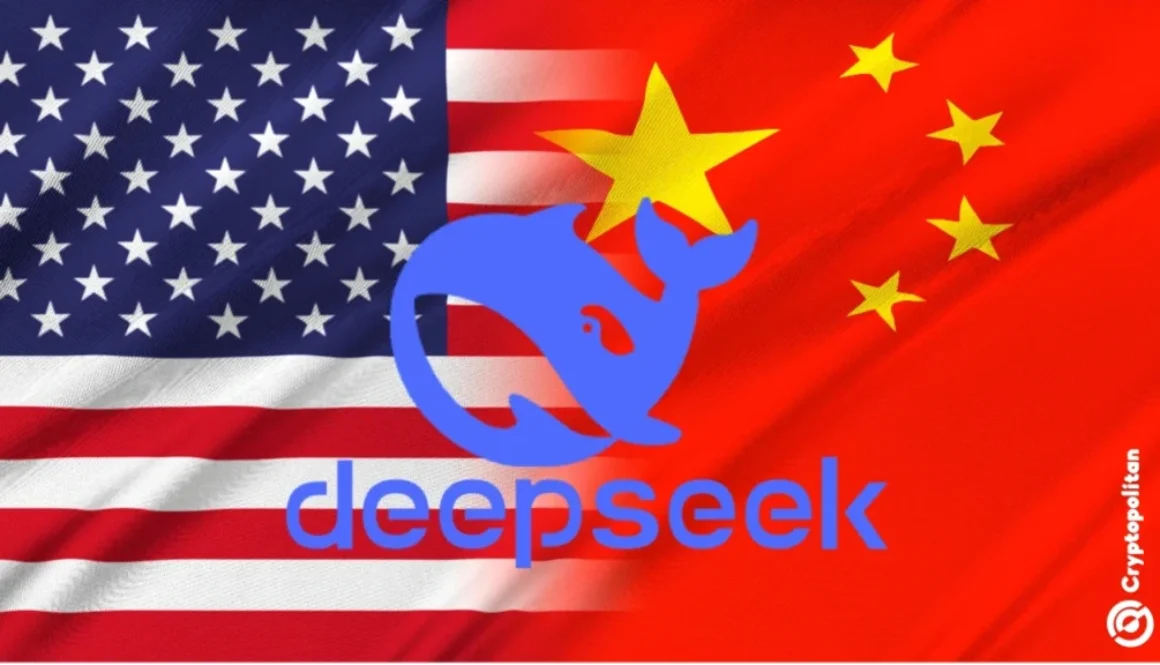
Chinese startup DeepSeek challenges Nvidia’s AI dominance as U.S.-China tech rivalry accelerates
DeepSeek’s Shanghai spotlight and Trump’s U.S. AI push signal an accelerating tech competition that will reshape AI chip demand, regulatory frameworks, and venture capital flows affecting crypto infrastructure plays. Institutional investors should watch how this rivalry reshapes energy markets, semiconductor access, and cross-border tech funding, three vectors that directly influence blockchain data infrastructure and AI-adjacent crypto tokens.
- DeepSeek’s low-cost, high-performance model challenged the assumption that AI requires billion-dollar Nvidia chip investments, shifting cost dynamics industry-wide.
- China targets $100 billion AI industry by 2030, with humanoid robots from UBTech, Unitree, and AgiBot priced under $10,000 aiming for mass production.
- Trump’s AI Action Plan eases regulations and boosts data center energy supply as major U.S. firms step back from Shanghai forum, leaving China to frame global AI governance.
- $2 billion New dollar-denominated VC funds Chinese firms are raising targeting global investors
- $100 billion China’s targeted AI industry size by 2030 versus current uncertain baseline
- Months Estimated gap between U.S. and China AI development, narrowed from wider semiconductor sector gaps
The World Artificial Intelligence Conference in Shanghai this week has become a proxy battleground for U.S.-China tech dominance, with DeepSeek, the Chinese startup that first captured attention at the event, symbolizing Beijing’s push to close an AI gap once measured in years. President Trump signed his AI Action Plan days before the summit, vowing federal support to keep America ahead; simultaneously, Chinese venture firms are raising over $2 billion in new funds to bankroll homegrown competitors. The timing matters to crypto institutional investors because the victor in this competition will set standards for data infrastructure, energy allocation to computing clusters, and export controls on AI chips, all factors that affect validator economics and blockchain-based data verification networks.
DeepSeek’s cost breakthrough reshapes global AI investment calculus
DeepSeek emerged earlier this year with a stripped-down AI model that delivered high performance without the billion-dollar infrastructure bill typically required. The startup’s founder, Liang Wenfeng, even won rare public praise from President Xi Jinping for the achievement, an unusual endorsement that signaled the company’s role as a flagship for Chinese innovation.
That breakthrough forced a reckoning: cutting-edge AI does not require the scale of Nvidia chip deployment and data center investment once assumed mandatory.
DeepSeek’s follow-up model, R2, remains unreleased as of this week, with observers citing technical delays and Liang’s perfectionist standards as reasons.
For institutional crypto investors, the implication is immediate. If China proves it can build competitive AI systems at a fraction of the cost, it reshapes venture funding flows away from U.S.-centric infrastructure plays toward Chinese-backed alternatives, including blockchain-based data verification layers that Chinese firms may prefer to American-controlled centralized services. Crypto data infrastructure projects like those solving verified data for AI gain urgency in a multipolar tech landscape.
Trump’s AI Action Plan tightens U.S. energy and regulatory advantage
Within days of the Shanghai forum opening, Trump signed sweeping executive orders designed to cement U.S. AI supremacy in what he framed as an existential race. The orders ease data center regulations and direct federal support to expand energy supply, two constraints that have slowed AI infrastructure buildout.
Nvidia CEO Jensen Huang attended Trump events marking the rollout, signaling alignment with U.S. semiconductor interests.
Unlike 2024, when Elon Musk and Tesla drew crowds at Shanghai with the Cybertruck and Optimus robot, major U.S. tech firms are absent from this year’s speaker lineup, ceding visibility to China’s own robotics and AI startups.
The regulatory contrast is stark. Trump’s orders loosen guardrails on AI development, while China’s national ambitions in AI remain tied to centralized state planning and chip supply constraints. For crypto institutions, this bifurcation means energy costs for proof-of-work validation and validator infrastructure will diverge by jurisdiction, U.S. data centers may gain cost efficiency, while Chinese builders must navigate tighter supply channels and state priorities.
Humanoid robots and VC capital signal manufacturing race entering production phase
Shanghai’s exhibition space will showcase humanoid robots from UBTech, Unitree, and AgiBot, with prices now dipping below $10,000 for some models, a dramatic cost reduction compared to earlier prototypes.
Morgan Stanley analysts expect hundreds to thousands of units to ship this year as Chinese firms target mass production and ecosystem dominance in a sector where U.S. competitors have not yet delivered commercial alternatives.
Beyond hardware, the summit serves as a dealmaking carnival. Chinese venture firms including Lightspeed China Partners and Monolith Management are raising more than $2 billion in new dollar-denominated funds targeting global investors hungry for exposure to China’s tech revival.
With 70,000 square meters of exhibition space, hundreds of startups will pitch live, ranging from delivery drones to smart devices.
China is using the high-level sessions to frame itself as a responsible global AI governance partner, a political play that could shape which jurisdictions regulate AI-adjacent crypto applications like on-chain AI agents and automated trading systems.
The CCS read. We see a strategic divergence: Trump’s deregulation and energy subsidy favors U.S. data center consolidation and Nvidia’s moat, while China’s cost innovations and state backing target market share in robotics and emerging AI verticals. For crypto holders, the winner determines whether energy-heavy proof-of-work networks migrate toward cheaper U.S. grids or whether Chinese state backing of AI infrastructure creates alternative consensus layers outside Western control. Validator returns and hardware economics hinge on this outcome.
Watch for DeepSeek R2’s release date and performance benchmarks against OpenAI’s latest model, the follow-up will signal whether China’s efficiency breakthrough was repeatable or a one-time engineering win. Simultaneously, monitor Trump administration data center permits and energy allocations announced by the Commerce or Energy departments in the next 60 days; any delays in U.S. infrastructure subsidy rollout would validate Chinese cost advantages and accelerate capital reallocation toward Asian AI builders. Institutional crypto investors should track Chinese VC fund closes tied to AI infrastructure plays, if dollar-denominated pools exceed $2 billion actually deployed rather than merely raised, it signals a structural pivot in tech capital geography.