SpaceX, Tesla to Spend $16.8B on Terafab Chip Factory in Texas
The move comes as Elon Musk’s companies look to secure chip capacity for AI, robotics and space-based data centers.
The crypto market slump wiped $112 million from Tesla’s pretax second-quarter results. The unrealized loss reduced earnings for common stockholders by $87 million after tax, or $0.02 per diluted share.
The carrying value of Tesla’s digital assets fell to $674 million at June 30, 2026, from $786 million at March 31, 2026, according to the company’s Q2 shareholder update.
Tesla’s March 31, 2026, filing reported that Bitcoin made up the majority of its digital assets, including 11,509 BTC acquired for $386 million.
The June 30 shareholder deck did not disclose a coin count or any digital-asset disposition, and Tesla’s investor-relations page listed no Q2 Form 10-Q when checked on July 23, 2026.
Under the Financial Accounting Standards Board’s crypto-asset standard, covered holdings are measured at fair value each reporting period, with changes recognized in net income. That makes the earnings effect symmetrical: rising prices can generate an unrealized gain, while falling prices can produce an unrealized loss before any sale.
Tesla’s preferred adjusted measure tells a different story. Its Q2 reconciliation added back the full $112 million digital-asset loss when calculating adjusted EBITDA of $3.273 billion.
The paper loss dragged down Tesla’s GAAP earnings but left adjusted EBITDA untouched. It also did not take cash out of the business.
The difference reshapes how Tesla’s earnings look on paper, not its broader balance-sheet exposure.
The $674 million digital-asset balance represented about 0.454% of Tesla’s $148.524 billion in total assets at quarter-end. Tesla is therefore not operating like a dedicated Bitcoin treasury company whose capital strategy centers on accumulating the asset, even though crypto volatility can still leave a visible mark on its reported profit.
The Q2 result also shows the reverse of Tesla’s fourth-quarter 2024 fair-value benefit. CryptoSlate reported that the accounting treatment contributed a $600 million lift to GAAP net income in that earlier quarter.
If crypto markets keep swinging, Tesla’s reported earnings will swing with them. If Tesla continues the same reconciliation treatment, those swings may again be excluded from adjusted EBITDA.
The next primary filing will be important for any updated Bitcoin unit count or transaction disclosure.
Until then, the change in carrying value establishes the accounting impact, not whether Tesla changed the size of its position.
The post Tesla books $112 million crypto paper loss as digital assets fall to $674 million appeared first on CryptoSlate.
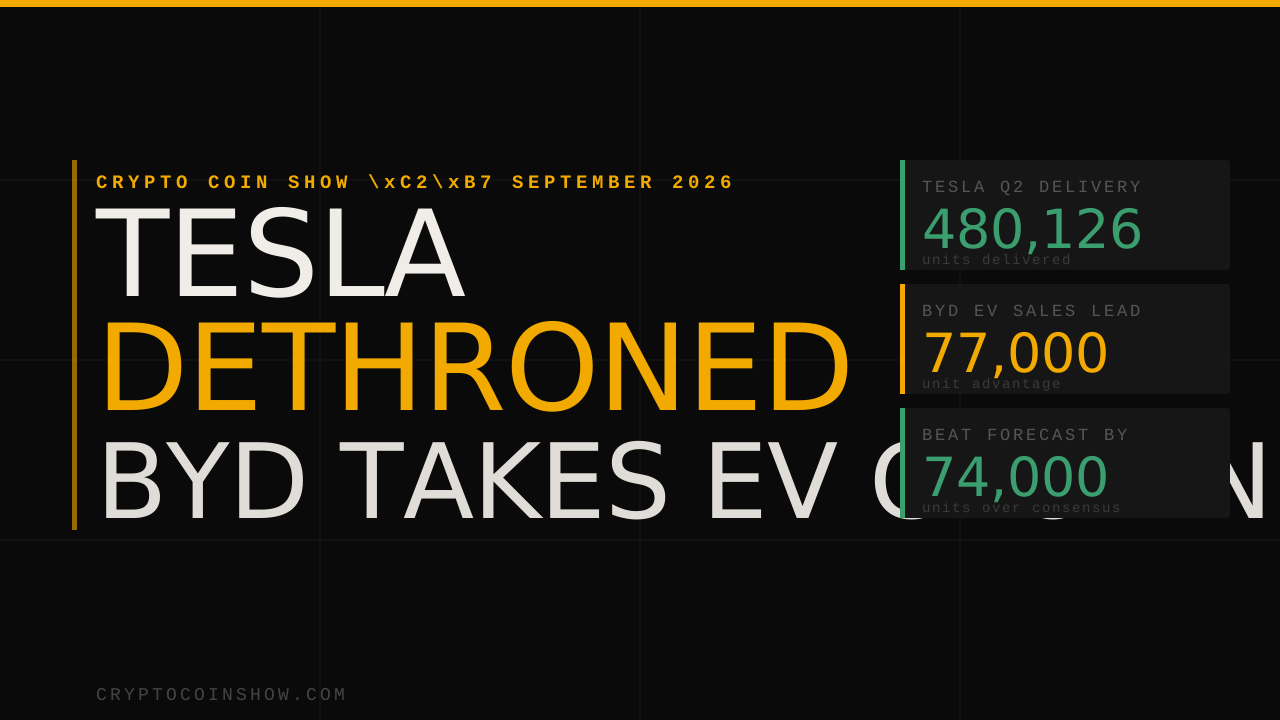
Tesla (NASDAQ: TSLA) surpassed Wall Street’s sales expectations and shipped 480,126 vehicles in the second quarter of 2026.
The EV company shipped 74,000 more units than expected but still failed to outsell BYD. That relative underperformance could be part of the reason the EV maker’s stock has failed to follow the positive news it delivered in its own report.
Tesla (NASDAQ: TSLA) delivered 480,126 vehicles in the second quarter of 2026, 25% higher than the same time last year, despite Wall Street predicting that Tesla would only deliver about 406,000 vehicles. The company beat the forecast by around 74,000 cars.
Tesla’s Model 3 and Model Y made up most of the sales, accounting for 467,762 deliveries. Other models, including the Cybertruck and the higher-end Model S and X, made up just 12,364 units.
The company only produced 451,758 vehicles during the quarter, meaning about 28,000 of the shipped cars were from its existing inventory.
In the first quarter of 2026, Tesla delivered 358,023 vehicles. These Q2 figures represent a 34% increase in just three months. Only three quarters in Tesla’s history have been bigger: Q3 2025 (497,099), Q4 2024 (495,570), and Q4 2023 (484,507).
Tesla registrations across Europe reached 28,610 in May, a nearly 108% increase in the number from the same month last year. Year-to-date registrations through May reached 118,068 vehicles, a 57% increase. Within the European Union alone, May registrations more than doubled, climbing 152%.
However, in the United States, sales dropped. The federal EV tax credit expired, which made electric cars more expensive for many buyers. Cox Automotive said Tesla’s domestic sales fell 20% because of this change.
Deutsche Bank analyst Edison Yu said Tesla’s international sales in both Europe and China helped a lot. The company’s growth in Europe happened due to the competitive deals buyers were offered. Some buyers disagree with CEO Elon Musk’s political views, but the pricing was good enough for them to look past the controversy.
Tesla also deployed 13.5 gigawatt-hours (GWh) of energy storage in Q2, representing a 53% increase from the 8.8 GWh in Q1 2026. This number missed the mark on analysts’ expectations of 13.8 GWh.
BYD retained its position as the world’s top electric car seller, reporting 557,090 fully electric vehicle sales for Q2 2026. BYD announced its numbers one day before Tesla released its results.
BYD’s lead over Tesla is roughly 77,000 vehicles. BYD’s quarterly volume dropped 8% year over year from a higher peak, but its overseas sales are growing fast. About 43% of BYD’s sales in Q2 came from outside China.
On July 2, 2026, BYD’s stock closed at 83.57 Chinese Yuan (CNY) on its Shenzhen listing (SHE: 002594), up 3.61%. Its Hong Kong-listed shares (HKEX: 1211) closed at 78.30 Hong Kong dollars (HKD).
Meanwhile, Tesla’s stock (NASDAQ: TSLA) traded around $391 on July 2, down nearly 8% on the day. Tesla’s Q2 earnings call on July 22 will reveal whether Tesla kept its profit margins or sacrificed them with aggressive pricing.
The smartest crypto minds already read our newsletter. Want in? Join them.
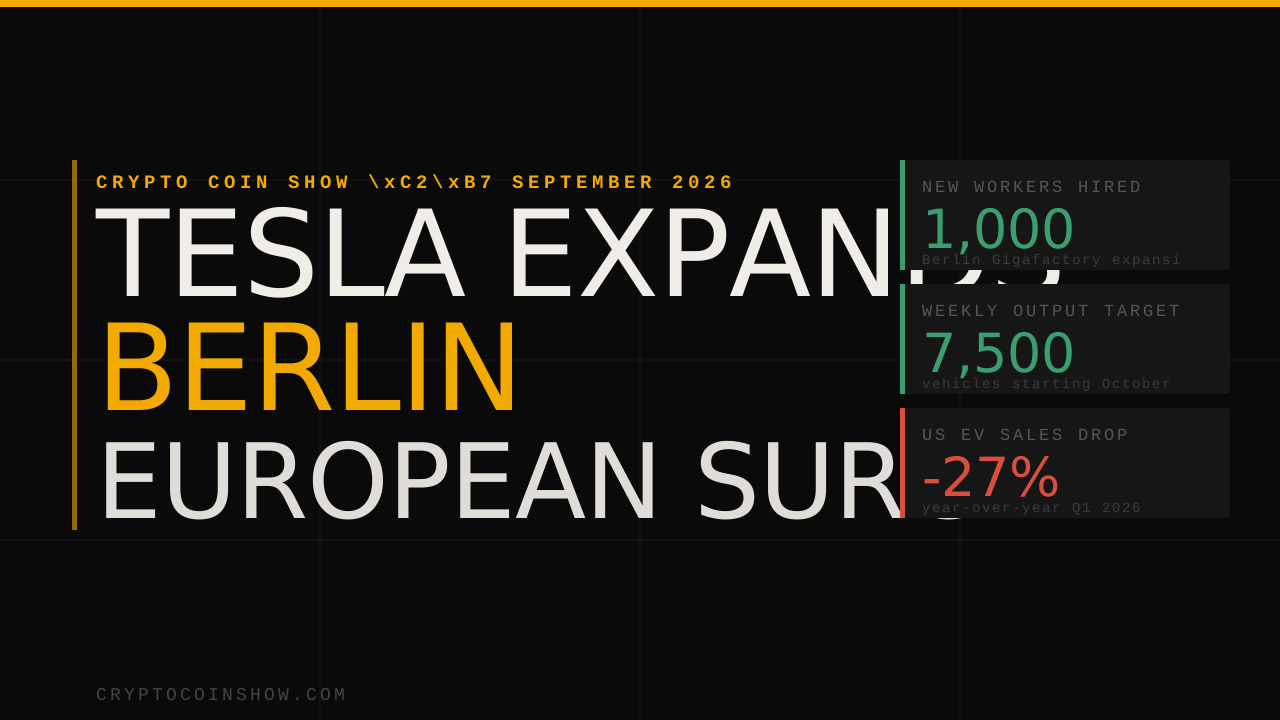
Tesla plans to increase weekly output at its Gigafactory Berlin by 20% to 7,500 vehicles starting in October. The company needs 1,000 additional employees at the Gruenheide facility east of the capital to get there.
This is the third workforce and capacity commitment Tesla has made at the German plant.
In April, the company said it would bring on 1,000 new staff and lift weekly production by about a fifth beginning in Q3, according to Reuters. A month later, Tesla disclosed plans to pour more money into battery cell manufacturing at the same location. Added together, the three rounds of investment will create 3,500 jobs across vehicle assembly and battery production, Tesla said.
The hiring follows a rough 2025 in which Tesla’s European sales slid and the Berlin factory built just over 200,000 vehicles, well short of its listed annual capacity of 375,000 units. In Q1 2026, the plant set an internal record of 61,000 vehicles built. Model Y registrations in Germany quadrupled year-over-year to 9,252 units in March, and France, Denmark, and Sweden posted registration gains above 46%.
Tesla moved 21,767 vehicles across the bloc in May, pushing its market share to 2.3% from 0.9% a year earlier, according to Cryptopolitan’s reporting on European registration data. Battery-electric cars accounted for a fifth of all new EU passenger registrations that month, up from 15.3% in the same period of 2025.
The Berlin expansion runs opposite to what’s happening in the US.
According to Cox Automotive’s Kelley Blue Book data, sales of electric vehicles in the United States dropped 27% year-over-year in the first quarter of 2026, to about 216,400 units. The main reason was that the $7,500 federal tax credit expired in Q3 of 2025, and demand for EVs has not yet returned.
Tesla’s domestic deliveries dropped by more than 8% in the quarter, though the company gained market share as competitors fell faster.
About 11,500 people work at the Gruenheide plant right now. There will be a line for making battery cells in the first half of 2027, which is another reason for Tesla’s management to hire people now.
Don’t just read crypto news. Understand it. Subscribe to our newsletter. It’s free.
As if things couldn’t get any worse for Tesla in Europe, traffic safety researchers now say they’ve caught the company cooking numbers they gave to regulators in order to get its “Full Self-Driving” system approved.
The discrepancy was spotted by Reuters, which claims that data Tesla gave to authorities in Sweden and the Netherlands grossly exaggerated the safety record of FSD in the United States.
Reuters reports that in a presentation meant for Swedish regulators, Tesla’s policy manager Ivan Komusanac claimed that Tesla’s FSD can travel over seven times farther between crashes than human drivers in the US. Using that claim as a jumping-off point, the presentation continued by claiming that Tesla’s FSD could have saved 32,000 lives and prevented 1.9 million injuries over an indeterminate period of time, the publication reports.
Independent researchers who saw the underlying data behind that claim say the numbers are wildly misleading, because they assume that every vehicle on the road would be replaced by a Tesla in FSD mode, semi trucks and motorcycles included.
While regulatory officials at the Netherlands’ governmental traffic agency RDW told Reuters they tested Tesla’s FSD mode independently, they didn’t explain what that entails, or what the numbers showed. RDW approved Tesla’s FSD mode for supervised deployment back in April, and the Netherlands agency has since notified European regulators of its plans to seek FSD approval throughout the European Union.)
As spokesperson for the European Transport Safety Council Dudley Curtis told Reuters, if Tesla wants to make outsized safety claims, it needs to “give the data to a university, have it independently verified by a qualified researcher, and then let’s talk.”
Tesla did not respond to Reuters‘ request for comment.
More on Tesla: Tesla Insiders Admit Self-Driving Is a Complete Disaster
The post Tesla Allegedly Showed Cooked Data to Get Full Self-Driving Approved appeared first on Futurism.
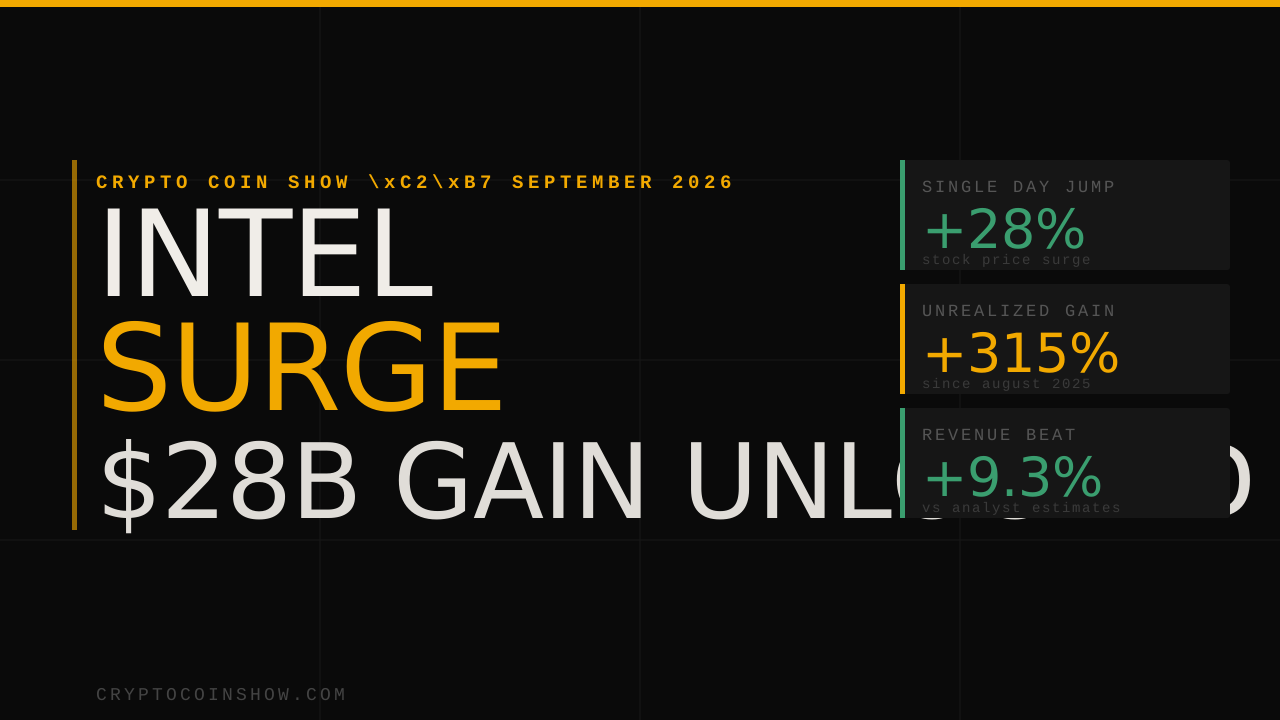
The Trump administration’s Intel (INTC) stake has grown into a $28 billion paper gain after Intel surged to a fresh all-time high.
Back on August 22, 2025, Cryptopolitan reported that the U.S. government had bought a 10% holding in Intel at $20.47 a share, a position worth about $8.9 billion at the time.
Now, after a huge run in the stock, that U.S. position is sitting on a gain of about 315%.
On Friday, Intel surged by 28% and traded as high as $85.22, setting a new record for the stock. The rally pushed Intel to its strongest one-day performance since October 29, 1987. It also lifted the stock’s gain for the year to about 120%.
Intel also climbed 22.6% in another reading that took it above the peak it reached during the dot-com era in 2000. Truly just… outstanding!
Yesterday, Cryptopolitan reported that Intel saw $13.58 billion in revenue for the quarter, beating the $12.42 billion that Wall Street expected. Earnings per share came in at $0.29, far above the $0.01 forecast.
Revenue was also up 7.2% from the $12.67 billion that Intel reported a year earlier. For the next quarter, Intel said it expects revenue between $13.8 billion and $14.8 billion in the second quarter. Analysts had been looking for about $13 billion.
And then of course, we’ve got the whole matter of Tesla and SpaceX picking Intel’s 14A process for the Terafab AI chip project. That gives Intel an outside customer for a future manufacturing node that the market is watching closely.
At the same time, Intel’s Data Center and AI business posted year-over-year growth. Those two things landed together. The foundry build-out is still expensive and still one of the biggest financial variables in the Intel story, but the new customer link gave traders another reason to bet on Intel in the near term.
For a long stretch, Intel looked like it was losing ground in the fight for AI hardware demand. Other chip companies got most of the attention, and Nvidia led much of that run. But perhaps that money is now flowing back into Intel in a serious way.
The rally did not stop with Intel. U.S. chip stocks surged to new highs on Friday after Intel’s stronger-than-expected forecast boosted confidence in the wider AI trade.
The Philadelphia Semiconductor Index rose 3.2% to a record and was on track for its 18th straight day of gains. The index is now up more than 47% this year.
That broader rise has been tied to the spending binge from major tech companies building more AI infrastructure. Chip names have been among the biggest winners from that wave of spending. The earnings outlook shows how wide the gap has become.
The semiconductor group is expected to post 109.2% earnings growth for the first quarter, based on LSEG data. The wider S&P 500 information technology sector is expected to grow earnings by 48.2%. Both numbers are strong, but the chip group is in a different league.
Other stocks joined the Friday jump. AMD climbed 13.7%. Arm gained 12%. Nvidia, now the most valuable company in the world, added 1.6%. Last year, a lot of the rally in chip names came from demand for Nvidia’s graphics chips, which are used to train large AI models on huge piles of data.
Earlier this year, many AI and other Big Tech stocks came under pressure. Investors started asking whether all the spending would really turn into better revenue, fatter margins, and stronger cash flow soon enough.
Even with that concern, valuations have cooled from earlier extremes. The S&P 500 tech index now trades at about 22 times forward 12-month earnings, down from about 31.8 last year. The Philadelphia Semiconductor Index was last around 26.6 times forward earnings, compared with about 20.7 times for the S&P 500.
The smartest crypto minds already read our newsletter. Want in? Join them.
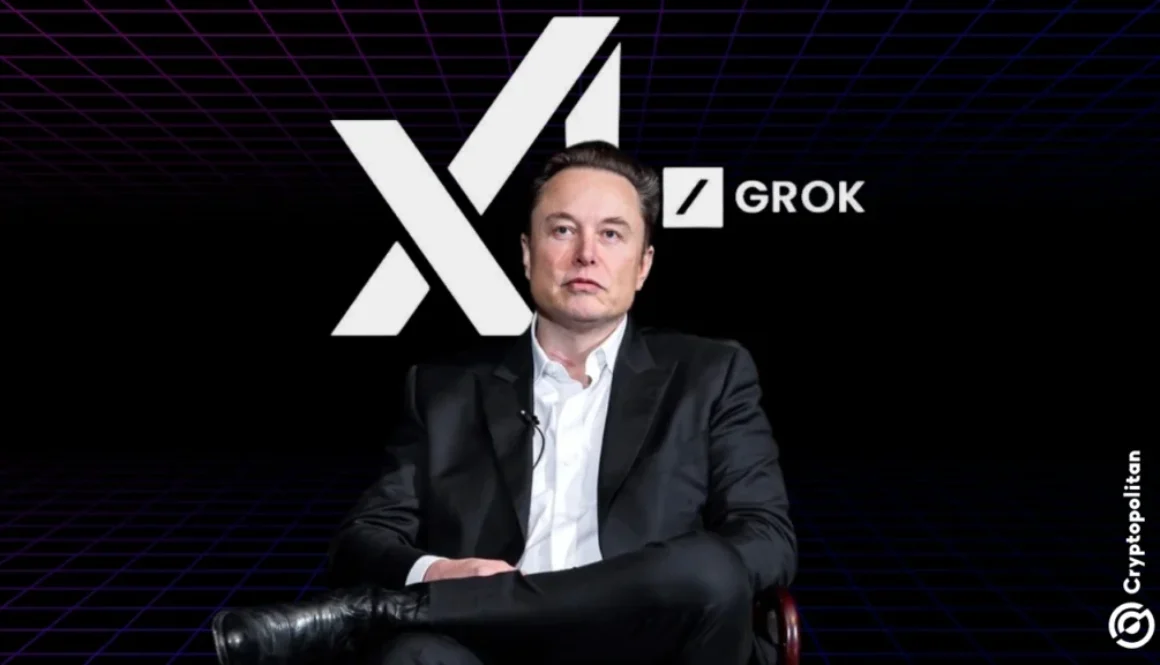
Elon Musk has signaled that he will not unilaterally decide whether Tesla Inc. should invest in his artificial intelligence startup, xAI. Instead, the decision will be left to Tesla’s shareholders.
“Shareholders are welcome to put forward any shareholder proposals they’d like,” Musk said on Wednesday during Tesla’s second-quarter earnings call. His remarks came in response to a query on whether the electric car maker could fund or have a stake in xAI.
Musk had recently posted support for such a purchase on his own social media platform, X. But he was definitive on the question during the earnings call, saying in response to a question, “It’s not up to me.”
Vaibhav Taneja, Tesla’s chief financial officer, also reflected on the matter and said that it was not the platform to talk about it, suggesting that the company’s executives would leave the decision to the formal processes of its shareholders.
Tesla’s next annual general meeting is set for Nov. 6, potentially allowing investors a chance to bring up and vote on the issue. Musk did not say whether the proposal would appear on that agenda meeting, but said a vote was inevitable.
xAI, which was established by Musk in 2023, has yet to make significant headway in the incredibly saturated AI field. Unlike competitors like OpenAI, Anthropic, and Google DeepMind, xAI hasn’t signed any big corporate customers or made itself broadly available to developers.
Its main product is a chatbot named Grok, which has generated excitement for its potential as a way to plug into X. Grok is meant to be more cutting and sarcastic than the average chatbot. Musk has claimed that it is more “honest” than ChatGPT.
xAI isn’t a one-off; it already has a partnership with Tesla, despite what made news today. The startup is a Tesla Energy business customer and buys Megapack utility-scale batteries. Tesla has big plans for Grok in its vehicles, where AI will offer services to drivers and passengers.
The momentum behind xAI is also supported by Musk’s other venture-backed companies. Bloomberg reported that SpaceX is committing about $2 billion to xAI in June. There are doubts whether Tesla, Musk’s most valuable and publicly traded company, would invest in the AI venture.
Musk has previously made the point that Tesla shareholders should get in on some of xAI’s likely expansion, since the two companies have some degree of technological overlap and shared leadership. “It’s a good idea for Tesla’s shareholders to have an exposure to AI,” Musk wrote on X earlier this year.
This wouldn’t be the first time Tesla shareholders have been asked to vote on a controversial Musk-led proposal. In 2016, Tesla shareholders signed off on a $2.6 billion deal to buy SolarCity, a solar energy company founded by Musk’s cousins that was floundering at the time. That arrangement drew lawsuits and criticism for potential conflicts of interest, but Musk defended it as a long-term strategic decision.
Now, with Musk managing several companies, including Tesla, SpaceX, xAI, X, and Neuralink, among others, concerns about overlap and fair governance are flaring anew. Critics say Tesla, a public company with a fiduciary duty to shareholders, should be prudent in backing other Musk ventures unless there is a clear benefit.
Jumping back to 2023, Musk conducted an impromptu poll on X to see if users thought Tesla should pursue the development of xAI. A majority said yes. Musk later said that the company’s board would consider the possibility. But there has been no formal response — until now.
Should Tesla shareholders formally propose an investment and the motion be included in the upcoming annual meeting agenda, the vote would be an opportunity for a new chapter in Tesla’s strategy and a tighter alliance with Musk’s ever-expanding AI aspirations.
Cryptopolitan Academy: Tired of market swings? Learn how DeFi can help you build steady passive income. Register Now