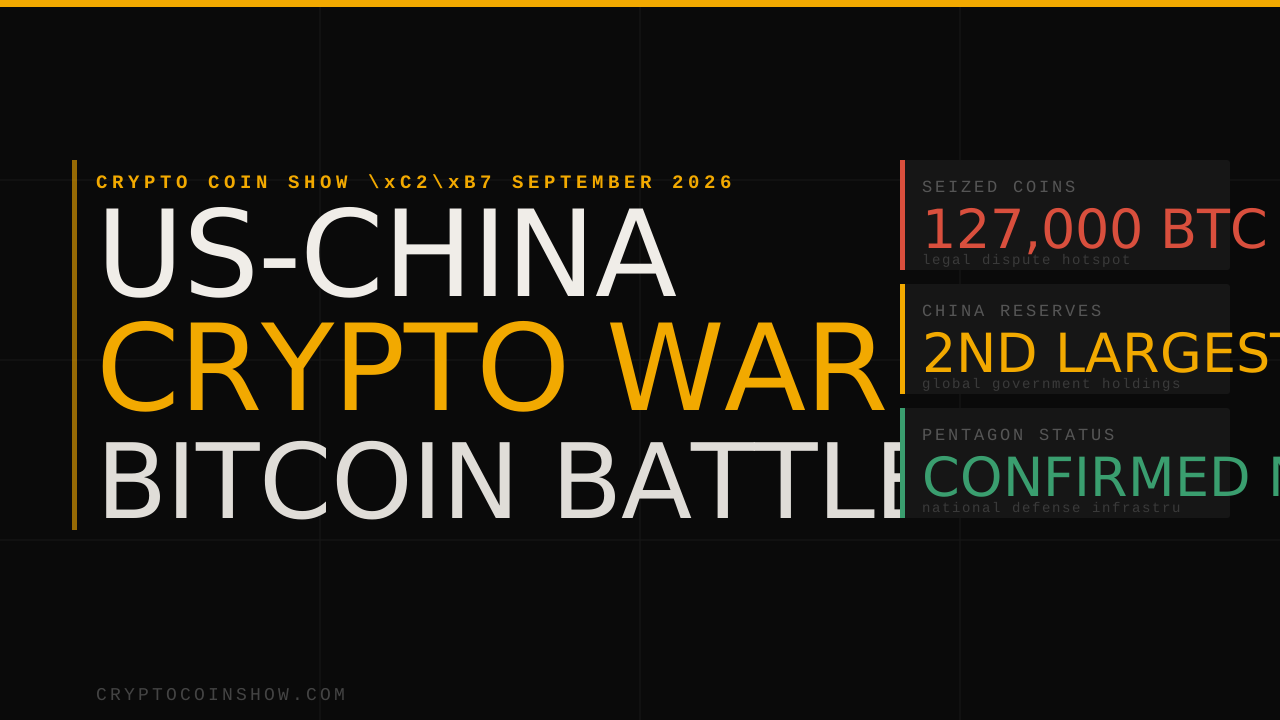
How the U.S.-China cold war went crypto
The Pentagon’s first public acknowledgment of running Bitcoin nodes and conducting operational security tests signals a fundamental shift in how the U.S. military views cryptocurrency, no longer as a fringe asset but as critical infrastructure for national defense. Simultaneously, China’s quiet accumulation of Bitcoin reserves while maintaining a domestic ban, combined with a high-stakes legal fight over 127,000 seized coins, reveals crypto has become a new arena for superpower competition over financial sovereignty and sanctions resistance.
- Admiral Samuel Paparo confirmed the Pentagon runs Bitcoin nodes and conducts operational tests to secure networks using the Bitcoin protocol.
- China holds the second-largest government Bitcoin stockpile globally, while the U.S. holds roughly 198,000 Bitcoin seized from accused fraudster Chen Zhi.
- A legal dispute between Washington and Beijing over 127,000 Bitcoin worth approximately $15 billion could determine control of over 321,000 total coins.
- 127,000 Bitcoin seized by U.S. DOJ, now disputed by China in court case.
- $15 billion Value of contested Bitcoin holdings at current market price.
- 321,000 Bitcoin China would control if it recovers seized assets from the U.S.
The U.S. military’s pivot toward treating Bitcoin as a strategic asset reflects a broader reorientation of how Washington perceives cryptocurrency in an era of geopolitical fragmentation. Admiral Samuel Paparo, Jr., who commands U.S. Indo-Pacific forces, told a Senate panel in recent testimony that Bitcoin extends beyond financial speculation into matters of national security.
His confirmation that the Pentagon operates its own Bitcoin node and runs operational tests on the protocol marked the first time the military publicly disclosed such activity, signaling a deliberate shift from dismissal to integration.
The timing is not coincidental.
Iran has begun accepting Bitcoin as payment for commercial shipping through the Strait of Hormuz, Taiwan is evaluating it as a contingency reserve asset in case of financial warfare by China, and Russia declared last week it will accept Bitcoin for international trade starting in July.
What was once dismissed as a speculative bubble confined to retail traders and darknet markets has become a tool of statecraft, a means for nations to circumvent sanctions, store value outside traditional banking channels, and project economic power across borders.
For institutional investors managing sovereign wealth or allocating to geopolitical hedges, this recategorization changes the risk-reward calculus fundamentally.
Pentagon Confirms Bitcoin Node Operations as Cybersecurity Doctrine
Admiral Paparo’s testimony bifurcated Bitcoin’s utility into two distinct categories: economic value and computer science application. His framing matters because it allows the military to justify Bitcoin deployment without endorsing cryptocurrency as an asset class.
The Pentagon’s interest centers on the protocol’s cryptographic foundations and distributed architecture, properties that make Bitcoin networks resilient against both cyber attack and centralized control.
The operational tests Paparo referenced signal that the Department of Defense is moving beyond theoretical study into practical implementation. Running a node means the Pentagon is participating in Bitcoin’s consensus mechanism, validating transactions, and maintaining a full copy of the blockchain ledger. This is not passive observation but active engagement with the network’s infrastructure.
For institutional investors accustomed to thinking of Bitcoin adoption as primarily retail or financial-sector driven, Pentagon participation represents validation at the highest level of U.S. strategic planning.
The implications extend to network security and resilience. A well-resourced military operator running nodes contributes computational redundancy and resistance to censorship.
It also positions the U.S. to better understand Bitcoin’s role in adversary operations, Iran’s use of Bitcoin for sanctions evasion, China’s accumulation strategy, and Russia’s pivot to accepting it for trade all become more intelligible if American military operators are embedded in the network itself.
China Holds Second-Largest Government Bitcoin Stockpile While Banning Domestic Use
China’s stance on Bitcoin represents a deliberate contradiction that institutional investors must parse carefully. In 2021, Beijing imposed a sweeping ban on all cryptocurrency activity within its borders, citing environmental concerns, fraud risks, and money laundering. The rhetoric was unambiguous: crypto was a threat to financial stability and Communist Party control.
Yet China simultaneously accumulated what is now the world’s second-largest government Bitcoin reserve, trailing only the United States.
The clearest window into Beijing’s actual intentions emerged in May 2025 when China’s International Monetary Institute, the Communist Party’s top financial think tank, translated and circulated a report by former White House economist Matthew Ferranti. Ferranti’s analysis argued that Bitcoin could serve central banks as a hedge against inflation, sanctions, and financial crises.
The institute attached a note to Communist Party policymakers explicitly stating that Bitcoin’s emergence as a reserve asset “deserves continued attention.” This is not casual acknowledgment; it is deliberate signaling to China’s highest economic officials that Bitcoin warrants strategic consideration.
The contradiction resolves when viewed through the lens of financial sovereignty. By banning Bitcoin domestically, China eliminates retail speculation, capital flight via crypto, and loss of monetary control.
Simultaneously, by accumulating Bitcoin at the state level, Beijing positions itself to use the asset in international settlements, reserve diversification, and sanctions resistance, leverage that only makes sense if Bitcoin’s role in global finance continues to expand.
For institutional investors, this suggests China is betting on Bitcoin’s continued appreciation and adoption despite publicly dismissing it as worthless.
U.S. and China Battle Over 127,000 Bitcoin in Unprecedented Legal Dispute
The highest-stakes confrontation between Washington and Beijing over Bitcoin revolves around 127,000 coins seized by the U.S. Department of Justice, currently worth approximately $15 billion. The coins were seized from Chen Zhi, a 38-year-old Chinese billionaire accused of orchestrating fraud operations across Southeast Asia that defrauded hundreds of American victims.
Before U.S. authorities could apprehend him, Chinese officials extracted Chen back to mainland China in January and filed their own charges against him under Chinese law.
What makes this case extraordinary is Beijing’s counterclaim: China accuses the United States of stealing the Bitcoin through a hack of Chen’s mining operation, LuBian, as far back as 2020, then falsifying the seizure as a law enforcement action. Because there is no extradition treaty between the U.S. and China, both nations claim jurisdiction.
If China succeeds in its legal challenge and recovers Chen’s holdings, it would control roughly 321,000 Bitcoin combined with its existing reserves, substantially outpacing the United States’ current holdings of approximately 198,000 Bitcoin.
Bitcoin is a reality. It is a valuable computer science tool as a power projection. And outside of the economic formulation of it, it has got really important computer science applications for cybersecurity.
Admiral Samuel Paparo, Jr., Commander of U.S. Indo-Pacific Forces
The dispute is not merely legal theater. If resolved in China’s favor, the geopolitical balance of Bitcoin reserves shifts decisively toward Beijing. This would be the first major international legal battle over cryptocurrency holdings between superpowers, and the precedent it sets will influence how courts and governments worldwide adjudicate competing claims to digital assets.
For institutional investors holding Bitcoin as a reserve asset or portfolio hedge, the outcome carries implications for regulatory risk and the enforceability of ownership in contested jurisdictions.
American Lawmakers Propose Domestic Hardware Mandate to Counter Chinese Mining Dominance
China’s control of Bitcoin mining hardware manufacturing has created a structural vulnerability that U.S. policymakers are now attempting to address. Approximately 97% of specialized Bitcoin mining chips are produced in China, yet these components are used in roughly 38% of global Bitcoin mining activity.
About 82% of global Bitcoin production relies on Chinese hardware, according to data cited by lawmakers pushing for domestic alternatives. This dependency means China maintains potential leverage over the American mining industry’s cost structure and supply chain resilience.
In response, Senators Bill Cassidy of Louisiana and Cynthia Lummis of Wyoming introduced legislation in March titled the “Mined in America” bill, which aims to reduce U.S. reliance on Chinese hardware and incentivize domestic Bitcoin mining infrastructure. The bill represents the first major legislative effort to treat Bitcoin mining as a matter of national industrial policy. Cassidy and Lummis are signaling that American Bitcoin mining capacity is now viewed as strategically equivalent to semiconductor manufacturing or