Bitcoin Volatility Returns After Fed Holds Interest Rates Steady
The Federal Reserve’s decision to hold interest rates steady at 3.50-3.75% amid unusual pre-meeting uncertainty has reignited bitcoin volatility, with the asset swinging $3,000 in 24 hours. Institutional investors face a critical signal point in incoming Fed Chair Kevin Warsh’s first press conference, which could clarify the central bank’s forward guidance and reset expectations for crypto risk assets.
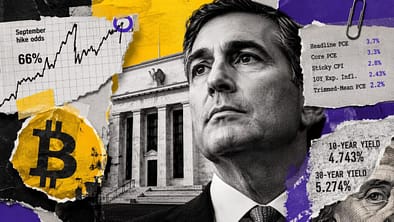
- Fed voted 9-3 to maintain rates at 3.50%-3.75%, with futures markets pricing 30%-38% probability of a hike beforehand
- Bitcoin fell $3,000 in de-risking ahead of the meeting, then rebounded to $64,500 before dipping below $63,800
- New Fed Chair Kevin Warsh’s imminent press conference is positioned as the key determinant of next policy direction and crypto volatility
- 9-3 Fed vote to hold rates, breaking 99% pre-meeting consensus pattern since pandemic
- 30%-38% Probability of rate hike priced into futures and prediction markets before decision
- $3,000 Bitcoin decline in 24 hours prior to Fed announcement and statement release
The Federal Reserve’s July meeting concluded with a 9-3 vote to maintain the federal funds rate target in the 3.50%-3.75% range, a decision that carried outsized significance for cryptocurrency markets already whipsawed by monetary policy uncertainty.
The central bank’s statement confirmed the committee would continue its policy of maintaining ample reserves in the banking system, supporting the Fed’s dual mandate of price stability and maximum employment.
Yet the path to this decision proved far messier than the post-pandemic norm: futures markets and prediction platforms had assigned a 30%-38% probability to a rate hike in the days before the meeting, marking a stark departure from the 99% pre-meeting consensus that had characterized every FOMC decision since March 2020.
For institutional crypto investors, the divergence matters because it signals either genuine dissent within the Fed’s leadership or genuine uncertainty about the inflation trajectory ahead. Bitcoin, the most volatility-sensitive asset class to real interest rate expectations, reflected this uncertainty viscerally.
In the 24 hours preceding the announcement, the asset shed $3,000 as large holders de-risked into cash and stablecoins ahead of a meeting outcome that appeared far from settled. This kind of pre-event liquidation typically signals that leveraged positions and passive indexers were unwinding hedges, a sign that institutional flow managers had priced in material downside risk.
Pre-Meeting Consensus Breakdown Signals Rare Fed Divisions
The 9-3 vote split marked the first significant public division on the Fed’s policy committee since the onset of the COVID-19 pandemic, when interest rate decisions had become nearly automatic.
From March 2020 through this July meeting, FOMC outcomes carried 99% agreement in the media’s pre-meeting prediction markets, a reflection of telegraphed policy and the central bank’s forward guidance framework.
The emergence of three dissenting votes, even on a hold decision, suggests either that inflation concerns remain elevated among some governors or that the path to future rate cuts is more contested than Chair Warsh’s predecessor had indicated.
This breakdown carries direct implications for crypto asset pricing. Bitcoin and other risk assets trade on real interest rate expectations, not nominal rates alone. A 9-3 split on a hold, even without a rate change, implies that future policy direction remains uncertain.
Some Fed governors appear hawkish enough to have voted for a hike; others may have wanted guidance signaling faster rate cuts ahead. This lack of clarity freezes institutional capital allocation, because portfolio managers cannot confidently price the probability of the next move or the timeline for any pivot toward easing.
The last time Fed voting produced this kind of visible dissent was in the early taper discussions of 2013, which preceded a sharp sell-off in risk assets.
Bitcoin’s $3,000 Pre-Announcement Liquidation Reflects Leveraged De-Risking
Bitcoin’s retreat from $64,500 to below $63,800 in the hours immediately before the Fed statement was not a gradual drift but an active liquidation. The $3,000 decline in a single 24-hour window prior to the meeting conclusion indicates that leveraged traders and passive index positions had been pared back by institutional risk managers operating under pre-determined volatility bands.
When a single asset class moves that sharply on anticipated binary event risk, it typically reflects forced selling from stop-loss orders and margin calls rather than fundamental repricing.
What followed the announcement was the expected volatility rebound: bitcoin pumped above $64,000 immediately after the hold decision was released, then fell again as traders awaited Warsh’s press conference remarks.
This pattern, sharp pre-event liquidation followed by relief-driven rebound followed by fresh uncertainty, is characteristic of institutional positioning ahead of central bank communication. Portfolio managers had likely set upper and lower bands for bitcoin holdings in anticipation of either outcome, with instructions to buy on a dovish hold and sell on a hawkish hold.
The magnitude of the move is notable in another sense: a $3,000 swing represents roughly 4.6% of bitcoin’s then-prevailing price, which is material but not catastrophic for an asset class that routinely experiences 10%-15% daily swings during genuine crisis events. This suggests that the de-risking was targeted and disciplined rather than panicked, consistent with institutional behavior.
Warsh’s First Press Conference as the Critical Next Signal
The July FOMC meeting culminated in a hold decision, but the real market-moving event has yet to occur: Fed Chair Kevin Warsh’s inaugural press conference in the role. Warsh, a former Goldman Sachs executive and Fed governor during the 2008 financial crisis and its aftermath, has signaled in past remarks that he favors data-driven policy and measured communication.
His first public statement as Chair will be scrutinized for any indication of whether the Fed plans to cut rates at the next meeting, hold for an extended period, or pivot back to tightening if inflation accelerates.
For cryptocurrency markets, the stakes are high because Warsh’s tone will either validate or invalidate the post-hold rebound. If he signals that rate cuts are likely within the next two to three meetings, bitcoin and other risk assets will likely consolidate gains and potentially push higher, as real interest rates would be expected to decline.
If he suggests the Fed will hold steady or hints at future hikes, the volatility that emerged after the announcement will likely intensify, with fresh liquidation possible.
Institutional investors in crypto are effectively trading Warsh’s communication style as much as the Fed’s policy stance itself.
The fact that futures markets had priced a 30%-38% probability of a hike ahead of the decision suggests that some significant expectations revision is possible if Warsh explicitly rules out tightening. A clear dovish signal, such as a statement that rate cuts are being seriously considered for later this year, would likely produce a sharp rally across risk assets.
Conversely, any language hinting at the three dissenting governors’ inflation concerns could trigger another round of de-risking similar to what occurred in the 24 hours before the announcement.
Institutional traders should monitor Warsh’s first press conference remarks for explicit guidance on the Fed’s rate path through year-end and any commentary on inflation trends that might explain the 9-3 vote split. A clear forward-looking statement on the next FOMC meeting’s likely outcome will be the key determinant of whether bitcoin settles into a new trading range or experiences fresh volatility. The lack of consensus on the Fed’s direction means that each official communication from Warsh will reset market expectations with outsized impact.