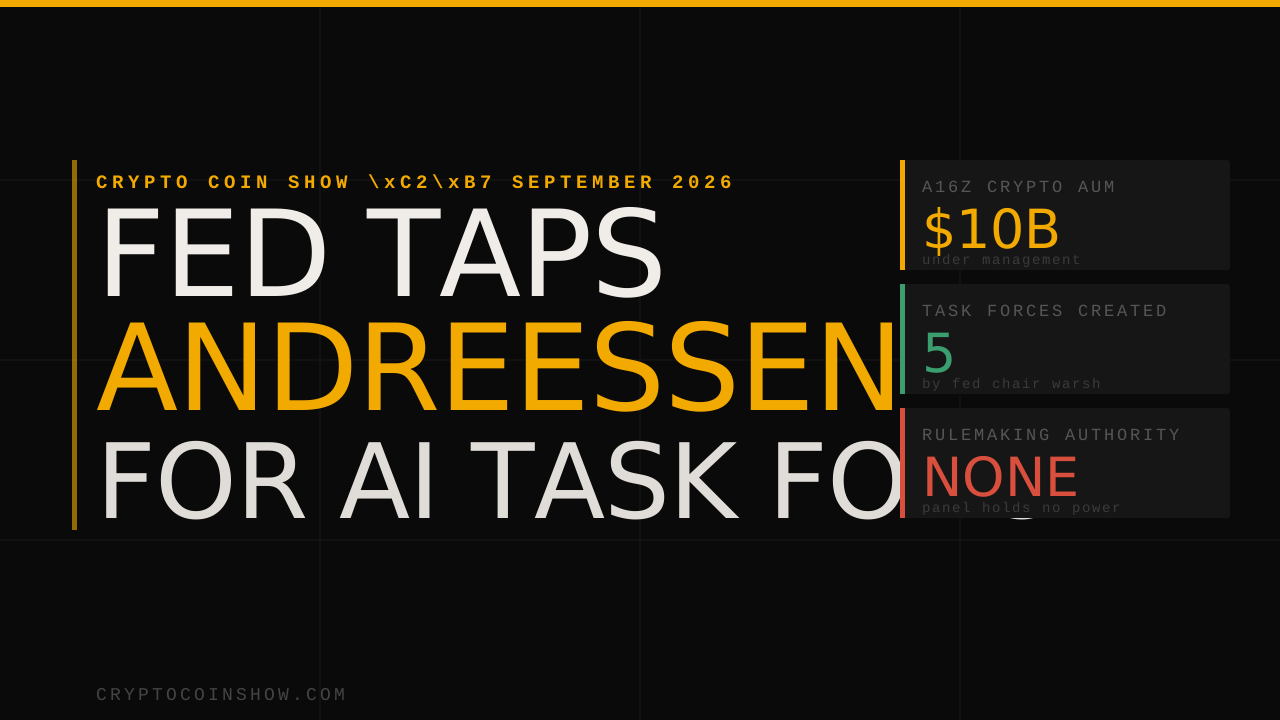
Fed names a16z’s Marc Andreessen to co-lead AI task force on jobs
Marc Andreessen’s appointment to lead a Federal Reserve task force on AI, productivity, and employment marks the first direct seat for a major crypto venture capitalist inside the Fed’s monetary policy deliberation process. While the panel holds no rulemaking authority, its conclusions on inflation and productivity could influence interest rate decisions that move billions in cryptocurrency assets.
- Marc Andreessen named co-lead of Fed’s Productivity and Jobs task force alongside Stanford economist Charles I. Jones and Microsoft executive Asha Sharma
- Panel is one of five new task forces created by Fed Chair Kevin Warsh to reshape how the central bank approaches monetary policy decisions
- a16z crypto division manages roughly $10 billion in dedicated digital asset capital, making Andreessen the most prominent crypto backer in Fed deliberations
- $10 billion Total dedicated crypto capital managed by a16z crypto division as of 2024
- 5 New Federal Reserve task forces created by Chair Kevin Warsh to challenge monetary policy processes
- July 9 Date of Andreessen’s appointment announcement by the Federal Reserve
Marc Andreessen, co-founder of venture capital giant Andreessen Horowitz, will co-lead a new Federal Reserve task force examining how artificial intelligence reshapes workplace productivity and employment.
The Federal Reserve announced the appointment on July 9, positioning Andreessen alongside Charles I. Jones, a Stanford economics professor currently on leave at AI company Anthropic, and Asha Sharma, Microsoft’s executive vice president and Xbox CEO. The Productivity and Jobs panel represents one of five new task forces created by Fed Chair Kevin Warsh to fundamentally restructure how the central bank approaches monetary policy deliberations, with the other groups focusing on Fed communications, balance sheet strategy, economic data quality, and inflation measurement methodology.
Andreessen Brings Crypto Credibility Into Fed’s Core Policy Process
Andreessen’s role inside a Federal Reserve working group carries symbolic and practical significance for the cryptocurrency industry, despite the panel holding no direct regulatory mandate over digital assets.
His appointment places one of America’s most vocal Bitcoin advocates and largest institutional crypto investors directly inside the central bank’s deliberative machinery at a moment when the Fed remains internally divided on how AI affects inflation and monetary policy.
Andreessen Horowitz’s crypto division manages roughly $10 billion in dedicated digital asset capital, raised largely through its fifth fund, which closed with $2.2 billion earlier this year.
The venture firm has positioned itself as the institutional bridge between Silicon Valley’s technology leadership and the blockchain sector, and Andreessen personally has maintained a consistent public position favoring Bitcoin and cryptocurrency adoption.
His appointment to shape how the Fed interprets technological change and productivity gains means crypto policy considerations now have a seat at the table where interest rate expectations are formed.
The panel operates with independence from direct Fed authority but will supply research and policy feedback to the Federal Open Market Committee, the body that sets U.S. interest rates.
This structure allows the task force to influence monetary thinking without holding formal voting or rulemaking power, a critical distinction for institutional investors assessing how much weight Andreessen’s presence will carry in actual rate decisions.
Fed Leadership Divided on Whether AI Cools or Stokes Inflation
The creation of this task force reflects genuine uncertainty inside the Federal Reserve about AI’s macroeconomic effects. Fed Governor Lisa Cook stated in a May 27 speech that she expects artificial intelligence to support stronger economic growth but warned that it carries material risk of higher inflation.
Former Fed Chair Jerome Powell said in March that data center construction was “probably pushing inflation up at the margin,” a statement that contrasts with the productivity-focused argument that AI should lower costs and inflation through efficiency gains.
This internal split matters directly to cryptocurrency investors because interest rate expectations drive Bitcoin and other risk assets. When the Fed raises rates, capital flows toward safer assets like cash and government bonds, creating headwinds for volatile speculative positions.
When rates remain low or decline, investors typically increase risk appetite, a dynamic that historically benefits Bitcoin and other cryptocurrencies during accommodative monetary cycles.
Andreessen’s participation in this deliberative process creates a mechanism through which crypto-friendly analysis of AI’s effects on productivity and labor markets could influence Fed thinking. If the task force concludes that AI substantially lifts productivity and reduces inflationary pressure, such findings could support arguments for lower rates or delayed rate increases.
Conversely, if the panel determines that AI-driven spending on chips, data centers, and power infrastructure stokes demand-side inflation, it would reinforce the case for tighter monetary policy.
Warsh’s Task Forces Expected to Deliver Findings by Fall 2024
Fed Chair Kevin Warsh has stated that these five task forces could begin work within weeks of their formal launch, with early findings expected by fall 2024. The timeline suggests that substantive policy recommendations could influence FOMC discussions before year-end, giving Andreessen’s panel a concrete opportunity to shape Fed thinking during a critical period for interest rate expectations.
The task force structure itself represents a shift in how the Fed approaches monetary policy formation. Rather than relying solely on internal staff economists and outside academic advisors through traditional channels, Warsh has created parallel working groups staffed by prominent figures from industry and academia, tasked with challenging the Fed’s conventional frameworks.
Andreessen’s appointment fits this model, bringing venture capital and technology sector perspective directly into conversations about productivity measurement and labor market dynamics.
Institutional cryptocurrency investors should monitor the Fed’s official release of the task force’s interim findings in fall 2024 and track any public statements from Andreessen or his co-leads that preview their conclusions on AI’s inflation effects.
The next concrete milestone is the delivery of early findings to the FOMC, which will signal whether the task force leans toward the productivity-deflation narrative or the spending-inflation narrative, and whether Andreessen’s influence moves Fed thinking in directions favorable to risk assets like Bitcoin.
Crypto Industry’s Regulatory Access Expands as Fed Shifts Leadership Philosophy
The appointment signals a strategic shift in how the Federal Reserve sources external expertise on emerging technologies and their macroeconomic effects.
Prior to Chair Warsh’s restructuring, the Fed’s monetary policy process relied heavily on academic economists and Wall Street strategists with limited exposure to digital asset markets or the venture capital perspective on technological disruption.
Andreessen’s inclusion breaks that pattern, granting the crypto industry a direct channel into discussions that shape interest rate guidance and inflation forecasting, two mechanisms that historically move Bitcoin and Ethereum valuations more than any single policy announcement.
The five-task-force model itself reflects Warsh’s stated goal of importing competitive tension into the Fed’s deliberative process, similar to how venture capital firms stress-test investment theses through partnership networks.
By separating productivity analysis from communications strategy and balance sheet policy, the Fed is creating internal constituencies that may challenge each other’s assumptions before consensus reaches the full policy committee.
Andreessen’s a16z crypto division, which manages approximately $10 billion in dedicated digital asset capital as of 2024, has invested in blockchain infrastructure companies whose valuations depend partly on favorable monetary policy conditions, a structural incentive that differs markedly from the asset-agnostic view traditional Fed advisers bring to the table.
The crypto community is now watching whether Andreessen uses the panel’s productivity mandate to argue that AI-driven deflation justifies lower interest rates than the Fed’s current 5.25-5.50% target range, or whether he frames automation’s employment disruption as requiring sustained higher rates to prevent wage-price spirals. His formal recommendations, expected in draft form by Q4 2024, will be the first Fed-affiliated analysis written by a senior figure with substantial personal stakes in cryptocurrency asset appreciation.