Ethereum Foundation cuts 20% of staff in big reorganization move
The Ethereum Foundation has cut 54 employees, 20% of its workforce, as part of a broad organizational restructuring aimed at tightening spending and refocusing resources on core protocol development. The move follows eight senior departures in six months and arrives as the foundation grapples with funding constraints that could force developer teams to seek alternative sources within years.
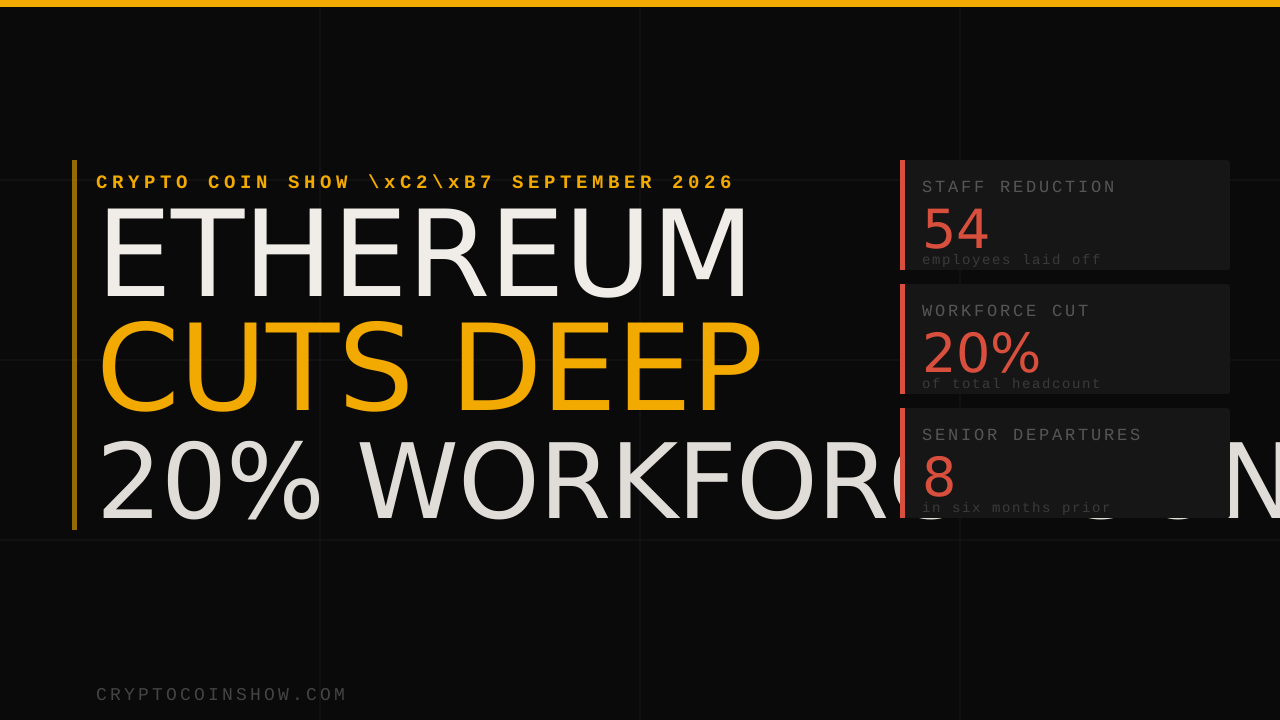
- Ethereum Foundation reduced staff by 54 employees, representing 20 percent of total workforce, on June 22, 2026
- Eight senior contributors, including co-executive director Hsiao-Wei Wang, departed before the layoffs over six-month period
- Foundation’s Client Incentives Program expired in April 2026 after four years; maintaining Ethereum client teams requires approximately $30 million annually
- 54 employees cut, representing roughly 20 percent workforce reduction
- $30M annual spending required to maintain Ethereum’s network of client teams
- 5% target baseline annual treasury spending by 2030, down from 15 percent
The Ethereum Foundation formally reduced headcount by 54 employees yesterday, marking the culmination of a restructuring cycle that began in June 2025 when the nonprofit adopted stricter financial governance and narrowed its operational mandate.
The cut represents a clean 20 percent reduction from the Foundation’s total workforce and reflects a deliberate pivot toward what leadership describes as financial discipline and concentrated resource allocation.
The Foundation simultaneously announced a new five-domain operating model, protocol, access, user, community, and institutional layers, intended to clarify accountability and eliminate redundancy across teams.
The layoff announcement arrived alongside a strategic shift in how the Foundation plans to manage its treasury.
Starting immediately, the organization intends to reduce annual spending from approximately 15 percent of total reserves to a 5 percent baseline by 2030, a policy the Foundation labeled “Subtraction.” This represents a substantial tightening of the cash burn rate that has funded Ethereum’s core development ecosystem for the past four years.
Eight senior researchers and engineers departed before formal restructuring took hold
The layoffs did not occur in isolation. Since January 2026, the Foundation has lost eight senior contributors, including both of its co-executive directors. Hsiao-Wei Wang, who had spent eight years on the Foundation’s research team, resigned on June 22 concurrent with the staff reduction announcement.
Her co-director Tomasz Stańczak departed four months earlier in February. Their departures left board member Bastian Aue as the sole executive leader managing daily operations.
The exodus also included Josh Stark, Trent Van Epps, Tim Beiko, Barnabé Monnot, Carl Beek, and Julian Ma, all figures with substantial tenure and institutional knowledge.
Former researcher Dankrad Feist publicly attributed the departures to internal management dysfunction rather than philosophical disagreements over Ethereum’s direction, a distinction that suggests structural rather than strategic problems.
Coinbase’s head of engineering, Yuga Cohler, characterized the situation as “dysfunction,” according to public reporting on the departures, signaling that observers outside the Foundation detected organizational stress.
The timing of these exits, preceding the formal layoffs by weeks to months, raised questions about whether early departures signaled awareness of coming restructuring among senior staff.
Client Incentives Program expiration forces Foundation to confront developer funding cliff
The restructuring cannot be separated from acute funding pressures now confronting Ethereum’s core development apparatus. The Foundation’s four-year Client Incentives Program, which provided direct funding to teams building and maintaining Ethereum’s client software, expired in April 2026.
That program had bankrolled the diverse set of client implementations, more than ten separate teams, required to keep the Ethereum network operating across multiple software implementations and preventing centralization.
Trent Van Epps, who served as core development coordinator until April 2026, publicly warned that maintaining this network of client teams requires approximately $30 million in annual funding. He further cautioned that without sustained support, developer funding could enter a critical shortage within three to nine months of April 2026.
That timeline places a potential funding crisis squarely within the second half of 2026 unless alternative capital sources materialize before year-end.
The Foundation’s pivot to “Subtraction”, its stated plan to reduce annual spending from 15 percent to 5 percent of treasury reserves by 2030, directly reflects this constraint. A move from 15 percent to 5 percent represents a two-thirds reduction in annual burn rate, a magnitude of cut that would necessarily shrink payroll and operating expenses substantially.
The 20 percent staff reduction announced yesterday aligns with this threshold but does not fully close the gap, suggesting additional cuts or business model changes may follow.
Five-layer reorganization shifts focus to protocol resilience and enterprise adoption
The new organizational structure signals a deliberate narrowing of the Foundation’s scope. The protocol layer will concentrate on core technical resilience, censorship resistance, network upgrade safety, and forward-looking research into post-quantum cryptography and Layer 1 privacy enhancements.
This represents the Foundation’s highest stated priority and the domain most directly dependent on sustained funding.
The access layer targets infrastructure for independent user interaction: enabling participants to read blockchain data and submit transactions without relying on intermediaries. The institutional layer, newly created by this reorganization, aims to accelerate adoption among enterprises, governments, and non-profits seeking to deploy Ethereum’s cryptographic tools.
The community and user layers handle operational and engagement functions. By separating management and general operations into distinct teams, the Foundation signaled an intent to reduce overhead and friction across domains.
The creation of a dedicated institutional layer reflects growing recognition that enterprise adoption now represents a material vector for Ethereum’s growth and treasury sustainability.
Protocol Guild and alternative funding models face immediate tests as Foundation withdraws
The Foundation’s funding retrenchment places immediate pressure on parallel funding mechanisms to fill gaps in client team support. Protocol Guild, an independent collective funding mechanism, and other decentralized approaches to developer compensation have emerged as potential supplements to direct foundation grants.
However, the scale of the shortfall, moving from $30 million annually to an unknown lower threshold, remains uncertain, and no single alternative mechanism has demonstrated capacity to replace institutional funding at equivalent scale.
The timing creates a concrete challenge for Ethereum’s technical governance. Without a clear funding successor, client teams face choices between reducing headcount themselves, pursuing commercial partnerships, or relying on alternative funding sources that may come with governance strings.
The Foundation’s restructuring essentially passes this problem downstream to teams that must now operate under tighter constraints.
Institutional investors tracking Ethereum’s development stability should monitor whether Protocol Guild and alternative funding mechanisms can sustain the client implementation diversity necessary for network security by end of 2026, and whether the Foundation announces concrete supplemental funding commitments to bridge the gap between the $30 million annual requirement and the reduced baseline spending the “Subtraction” policy implies.