Ethereum Foundation Cuts Another 40% But Solana Founder Calls It Bullish
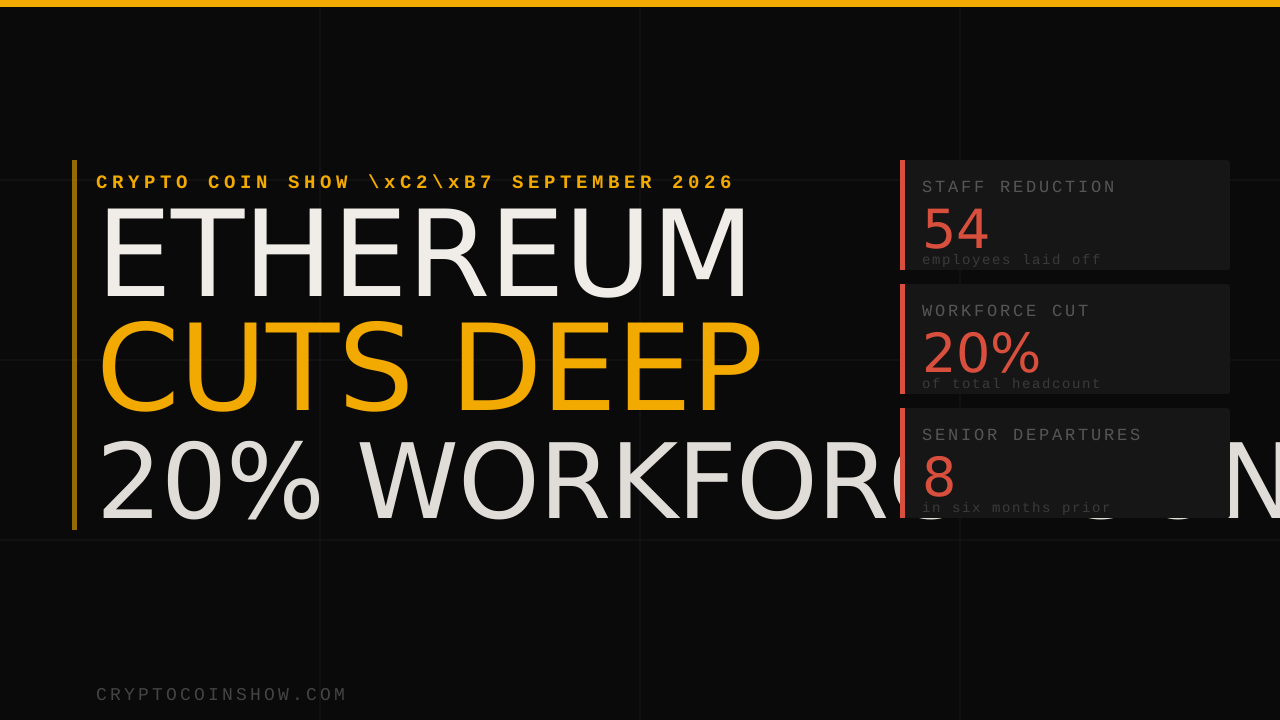
The Ethereum Foundation is cutting its budget by 40% and eliminating roughly 54 staff positions as it shifts toward a leaner, endowment-based model designed to extend its runway beyond 2030. For institutional investors, this restructuring signals a deliberate reprioritization of Ethereum’s protocol roadmap and a bet that private capital and ecosystem funding will fill development gaps the foundation can no longer cover alone.

- Ethereum Foundation cutting budget 40% and eliminating 54 roles, close to one-fifth of total staff
- Foundation adopting seven-cluster structure focused on protocol security, censorship resistance, and privacy priorities
- Solana co-founder Yakovenko argues leaner foundation will move faster; skeptics warn of $30 million annual funding gap
- 40% Ethereum Foundation budget reduction as part of endowment transition strategy
- 54 Staff roles being eliminated in reorganization affecting roughly one-fifth of workforce
- $30M Estimated annual funding gap for core development flagged by ecosystem observers
The Ethereum Foundation is executing a planned shift toward what co-founder Vitalik Buterin describes as a “long-term-oriented endowment-based organization,” cutting its annual budget by approximately 40% and reducing headcount by around 20%. The foundation confirmed it is eliminating 54 positions and reorganizing into a seven-cluster structure built around protocol security, censorship resistance, and privacy.
This is not a sudden retrenchment but rather the implementation of a treasury policy adopted in June 2025 that sets annual spending at 15% of holdings, with a 2.5-year cash buffer, mapping a glide path toward a 5% endowment baseline by approximately 2030.
The shift reflects a strategic decision to preserve capital and reduce dependence on ether sales, instead leaning on staking rewards and DeFi yield to fund operations.
Buterin Frames Cuts as Strategic Reprioritization, Not Efficiency Drive
Buterin explicitly rejected framing the reductions as a pure efficiency or cost-cutting exercise, instead naming concrete losses that accompany the transition. The foundation will scale back Devcon, wind down Privacy and Scaling Explorations, and reduce funding for projects beyond Ethereum’s core protocol.
Buterin tied the budget cuts to what he calls Ethereum’s Strawmap, the network’s third major iteration following the Merge, and signaled a higher bar for new protocol features once that roadmap concludes. He also projected that more of the protocol will shift from client redundancy to AI-assisted formal verification, potentially reducing the complexity and cost of future upgrades.
This year, the EF is decreasing its budget by roughly 40%, which entails some difficult decisions… the EF is transitioning into being a long-term-oriented endowment-based organization.
Vitalik Buterin, Ethereum co-founder
The cuts also signal a subtle shift in governance. Buterin acknowledged his diminishing influence on the foundation’s board, a point that underscores the organization’s move toward more distributed decision-making.
The foundation’s new structure, built around clusters focused on core protocol priorities rather than broader ecosystem development, suggests a narrower mandate than the organization has maintained in recent years.
Solana Co-Founder Argues Tight Constraints Will Accelerate Ethereum Progress
Solana co-founder Anatoly Yakovenko weighed in on the cuts with an unconventional take, arguing that budget constraints force focus and prioritization. He stated that a smaller, leaner Ethereum Foundation will be more decisive, move faster, and course-correct more rapidly, outcomes he described as bullish for Ethereum’s long-term prospects.
Yakovenko’s framing challenges the conventional view that foundation cuts signal weakness or reduced support for protocol development.
Not all observers share Yakovenko’s optimism. Former foundation contributor Trent Van Epps raised concerns about a roughly $30 million annual funding gap for core development work that the foundation can no longer absorb.
BitMine chairman Tom Lee dismissed the funding gap concerns, betting instead that private backers and staking infrastructure operators will step in to support core development. That transition is already underway: days before the budget cuts were announced, five former foundation researchers launched Ethlabs, an independent nonprofit backed by Lee and Ethereum co-founder Joe Lubin.
The organization is structured to push institutional adoption and is supported by a coalition spanning DeFi builders, core developers, Layer 2 founders, cypherpunks, investors, institutions, and researchers across the Ethereum ecosystem.
Private Capital and Ecosystem Infrastructure Fill the Foundation’s Receding Role
The emergence of Ethlabs and other independent funding mechanisms reveals the ecosystem’s response to the foundation’s planned contraction.
Rather than a single, foundation-led funding model, Ethereum’s development is shifting toward a distributed funding architecture where multiple entities, Layer 2 protocols, DeFi platforms, institutional backers, and researcher-led nonprofits, share responsibility for protocol advancement.
This model mirrors how Bitcoin development has operated for years, where no single entity controls the roadmap or holds a large discretionary budget.
For institutional investors, this shift presents both opportunity and risk. On one hand, a more focused foundation with narrower priorities may accelerate consensus on core protocol upgrades and reduce the likelihood of fragmentation.
On the other hand, the absence of a centralized funding source could slow development on non-consensus priorities or leave critical infrastructure underinvested if private capital dries up during market downturns.
The success of the transition hinges on whether ecosystem funding actually materializes at the scale needed and whether decentralized decision-making can coordinate as effectively as a well-resourced foundation.
The foundation’s June 2025 treasury policy, which targets a 5% annual spend by 2030, locks in a multi-year glide path that limits flexibility if Ethereum faces urgent technical challenges or competitive pressure.
The key test will come in 2026 and 2027, when the foundation begins operating under the reduced budget and the ecosystem’s ability to self-fund core development becomes clear.
Institutional investors should monitor whether Ethlabs and similar initiatives attract sufficient capital to close the $30 million funding gap that Van Epps identified, and whether the foundation’s shift to a leaner seven-cluster structure meaningfully accelerates protocol upgrades or creates coordination problems among its seven new teams.
Endowment Model Precedent in Crypto: How Ethereum’s Approach Compares to Peer Foundations
The Ethereum Foundation’s pivot to an endowment structure mirrors practices established by older charitable and research institutions, but enters territory largely uncharted in crypto governance.
The Polkadot Treasury, by contrast, operates as a decentralized spending mechanism funded by network inflation and governed by token holders, while the Solana Foundation maintains a more traditional grant-dispersal model funded through periodic token releases and ecosystem partners.
Ethereum’s 15% annual spending rule, designed to exhaust roughly 93% of holdings over the presumed lifetime of the protocol, creates a mathematically defined depletion timeline that differs markedly from perpetual endowment structures, which typically aim for zero drawdown and rely on yield to cover costs.
For institutional stakeholders, the endowment model reduces the risk of foundation insolvency or forced token sales during bear markets, a volatility vector that has historically triggered regulatory scrutiny and market concern.
The Ethereum Foundation held approximately $1.1 billion in assets at the time of the June 2025 policy adoption, meaning a 15% annual spend translates to roughly $165 million per year, a figure that exceeds the stated $30 million funding gap flagged by core developers.
However, this calculation assumes stable ether valuations; a 50% decline in ETH price would compress annual available capital to $82.5 million, forcing either spending reductions or accelerated drawdown of the endowment reserve.
The foundation’s decision to adopt a fixed percentage spend rule rather than a variable model tied to network revenue or validator rewards leaves it exposed to denominator risk if ether enters a prolonged bear cycle. Institutional investors are monitoring whether the foundation will hold to the 15% target through a significant market downturn or adjust the policy before the anticipated 2026-2027 budget cycle, when the first post-restructuring financial statements will become public.
Original reporting: beincrypto.com