Ethereum Foundation Cuts Put Long-Term Solvency Back In Focus
The Ethereum Foundation’s restructuring toward lower annual spending and a tighter operational mandate signals a fundamental shift in how the ecosystem’s primary coordination body manages its treasury and long-term solvency. For institutional investors, the move raises a critical question: whether leaner operations strengthen Ethereum’s protocol development and roadmap execution, or whether cost-cutting creates near-term uncertainty around research funding and client development at a moment when the network is competing for institutional adoption.

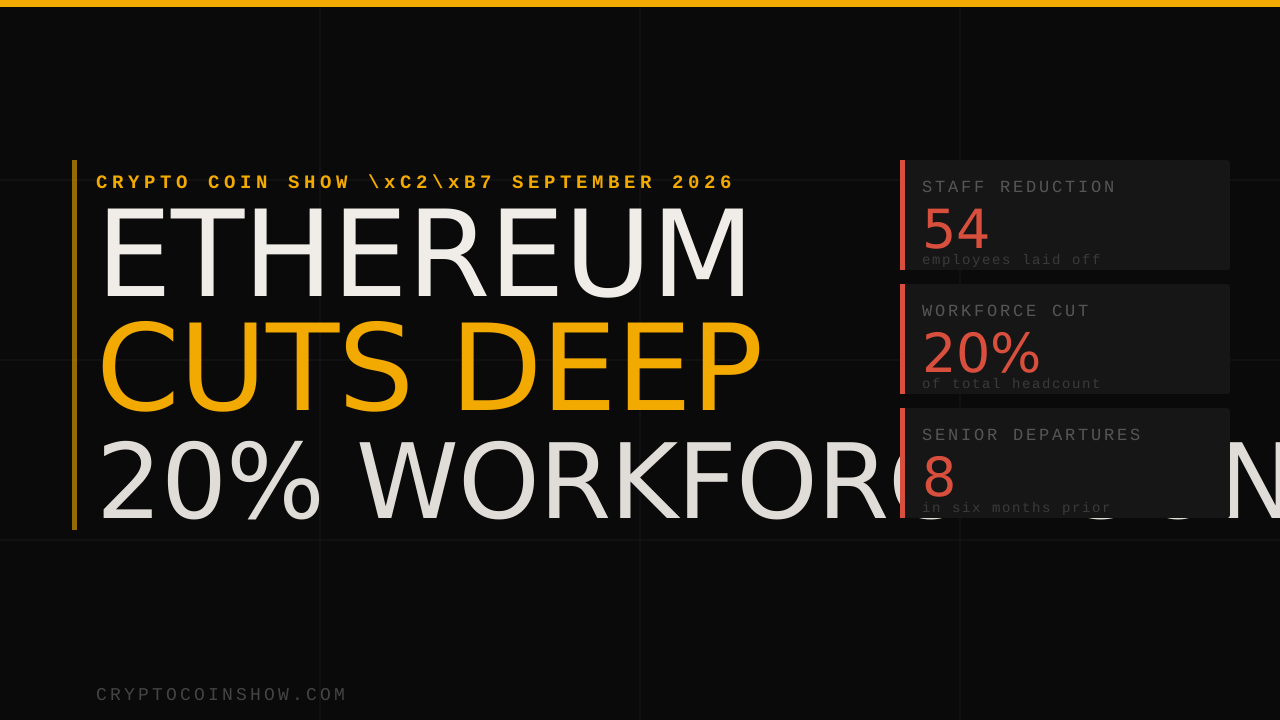
- Ethereum Foundation announced reorganization centered on lower annual spending, tighter mandate, and clearer internal work clusters.
- EF leadership is attempting to transition from cycle-driven spending model toward endowment-style long-term treasury management approach.
- Cost reduction strategy lands as Ethereum faces competing demands for protocol upgrades, institutional integration, and ecosystem public-goods funding.
- Reorganization Ethereum Foundation shifts toward lower spending and tighter operational mandate structure
- Endowment Model EF moves from cycle-driven spending toward long-term sustainable treasury approach
- Mandate Clarity Foundation narrows focus to core coordination work amid competing ecosystem demands
The Ethereum Foundation has announced a significant internal reorganization aimed at reducing long-term operating costs and restructuring how it manages its treasury and protocol coordination responsibilities. The move centers on lower annual spending, a clearer and narrower institutional mandate, and reorganized internal work clusters designed to improve efficiency.
The shift matters because the Foundation operates as one of Ethereum’s most important coordination bodies for protocol research, client development, grant programs, and public-goods funding, yet it is deliberately structured not to control the network itself, a distinction that sits at the heart of Ethereum’s decentralization story.
For institutional crypto investors and traders, the reorganization signals both opportunity and risk. A leaner Foundation with lower burn could prove more durable during extended periods of market weakness, extended bear cycles, or rising grant demand.
But it also raises questions about whether reduced spending will constrain the pace of protocol development, research output, or ecosystem support at a critical moment when Ethereum is competing against other Layer 1 networks for institutional capital and wallet adoption.
Ethereum Foundation Moves From Annual Spending Cycles Toward Endowment Model
The Foundation’s leadership has signaled a deliberate move away from year-to-year spending cycles toward a more structured endowment approach designed to sustain operations over decades rather than quarters. This shift reflects a maturation in how the organization thinks about treasury management.
Rather than allocating budget based on near-term market conditions or annual grant cycles, the Foundation is attempting to model long-term sustainability independently of ETH price movements or bear market severity.
The practical implication is significant. An endowment model typically means lower annual burn, more conservative capital allocation, and a willingness to defer spending in favor of capital preservation. For Ethereum, this could reduce the risk that the Foundation becomes underfunded during prolonged downturns or that grant programs face sudden cuts.
Conversely, it may also mean tighter near-term funding for research teams, client development, or experimental protocol work that does not fit a narrower mandate.
The trade-off reflects a philosophical choice: prioritize organizational longevity and treasury durability, or maximize near-term research and development output.
Tighter Mandate Reduces Internal Sprawl But Narrows Ecosystem Support
At the center of the reorganization is a clearer, more bounded mandate for what the Foundation will fund and coordinate. Ethereum’s roadmap has historically been broad and ambitious, spanning protocol upgrades, privacy infrastructure, wallet access, user experience, institutional integration, staking economics, and Layer 2 scaling.
By necessity, this creates competition for Foundation resources and attention.
A tighter mandate means the Foundation will be more selective about which workstreams it funds directly or coordinates through grants. This could eliminate redundancy and force sharper prioritization. It may also push more ecosystem work toward independent client teams, research groups, and Layer 2 projects that operate outside the Foundation’s direct control.
From a decentralization perspective, distributing responsibility away from the Foundation could strengthen Ethereum’s resilience by reducing single points of coordination failure.
However, a narrower mandate also creates risk. If core protocol development, consensus research, or client team funding falls outside the new boundaries, those workstreams may slow or fragment. Ethereum’s institutional adoption story depends partly on confidence that core protocol work, security audits, upgrade coordination, client diversity, remains well-resourced and coordinated.
A retreat by the Foundation from certain areas of public-goods work could be read by institutional investors as reducing the quality or pace of Ethereum’s technical roadmap execution.
Reorganization Tests Whether Lean Operations Improve or Constrain Protocol Development
The practical outcome of the Foundation’s reorganization will depend entirely on execution. There is no inherent reason that lower spending must slow protocol work, better prioritization and clearer mandates can improve efficiency. Research teams focused on narrower, more clearly defined problems may produce better work faster than teams operating across broader, less bounded projects.
But institutional investors will need visibility into which specific research programs, upgrade initiatives, or grant tracks are affected by the restructuring. If client team funding is reduced, for example, the effect on consensus diversity and network security could be material.
If privacy research is deprioritized, that signals a shift in what the Foundation views as core to Ethereum’s long-term value proposition.
The Foundation has framed the reorganization as a move toward maturity and durability, but the credibility of that frame depends on demonstrating that Ethereum’s roadmap, particularly around scaling, security, and institutional adoption, continues to advance at competitive pace.
Ethereum’s strength has historically derived from decentralization and the principle that no single organization controls the protocol or ecosystem. The Foundation’s role is to fund and coordinate work that markets and individual teams might underfund, research with long time horizons, public-goods that lack direct revenue models, and protocol-level work that benefits the entire network.
By moving toward an endowment model and tighter mandate, the Foundation is attempting to become more sustainable and focused. The risk is that it becomes less ambitious at precisely the moment when competing Layer 1 networks are accelerating their own roadmaps and when institutional adoption requires confidence in rapid, well-coordinated protocol development.
The key question for institutional investors is whether the Foundation will publish detailed guidance on which research programs, client teams, and ecosystem initiatives remain funded versus deprioritized under the new structure. Without that clarity, the reorganization could trigger uncertainty about Ethereum’s technical roadmap execution and protocol development pace relative to competing chains.
Original reporting: newsbtc.com