Wall Street giant Goldman Sachs has made a notable shift in its crypto-related exchange-traded (ETF) fund positions, according to a recent filing submitted to the US Securities and Exchange Commission (SEC).
The update shows the firm exiting XRP- and Solana (SOL)-linked ETF exposure, while also trimming its Ethereum (ETH) ETF holdings. At the same time, the filing shows it opened a new position tied to one of the largest decentralized exchanges (DEXs).
Goldman Sachs Exits XRP And Solana ETFs
The story starts with Goldman’s XRP ETF exposure going into the end of Q4 2025. At that point, the bank held nearly $154 million worth of XRP-related ETFs from issuers including Bitwise, Franklin Templeton, Grayscale, and 21Shares.
Those holdings made Goldman Sachs one of the largest institutional holders of XRP ETF products at the time. The latest SEC disclosure, however, shows that its XRP ETF positions were removed entirely, reflecting a full exit during the first quarter.
A similar change appears with Solana-linked products. Goldman Sachs had previously disclosed that it held exposure across multiple Solana investment products, including the Grayscale Solana Trust ETF, the Bitwise Solana Staking ETF, and the Fidelity Solana Fund.
However, just like XRP, those Solana-related ETF positions also disappeared in Goldman’s Q1 filing. In other words, Goldman fully exited both XRP- and Solana-linked ETF holdings by the first quarter of 2026, with no remaining trace of those positions in the updated portfolio disclosure.
Even with these exits, Goldman Sachs did not leave the crypto ETF space entirely. The firm still held roughly $700 million in Bitcoin ETFs. Still, its posture toward Ethereum was more cautious: Goldman cut its Ethereum ETF exposure by about 70%, bringing the total down to approximately $114 million.
New Bet On Hyperliquid
What makes the change more interesting is that Goldman Sachs appears to be redeploying at least some of that capital into other parts of the crypto market.
Alongside the ETF reductions and exits, the bank opened a new position tied to Hyperliquid (HYPE). According to the filing, Goldman acquired roughly 654,630 shares of Hyperliquid Strategies (PURR), valued at about $3.3 million.
Beyond Hyperliquid, Goldman Sachs’ trading activity also shows a new wave of exposure across several crypto-linked equities. The bank increased positions in Circle (CRCL), Galaxy (GLXY), and Coinbase (COIN) shares.
At the time of writing, Hyperliquid’s native token, HYPE, was trading at around $45. It has been one of the best-performing tokens over the past month, with gains of 10% in the last two weeks alone.
Featured image created with OpenArt, chart from TradingView.com

Institutional appetite for XRP is accelerating across multiple fronts, yet the digital asset’s price continues to struggle amid broad market consolidation.
CryptoSlate data show XRP has fallen more than 5% over the past 24 hours to $1.40, extending a pullback that contrasts with improving activity across several market indicators.
The decline has left traders weighing whether the latest accumulation signals can overcome short-term selling pressure after XRP briefly pushed above $1.54 for the first time in two months.
The disconnect is evident across three areas: ETF flows, exchange withdrawals, and XRP Ledger (XRPL) activity. Together, they point to rising interest in the asset, even as spot-market momentum remains fragile.
XRP ETFs post strongest weekly inflow this year
US-listed XRP exchange-traded funds (ETF) recorded their strongest week of inflows this year, adding another institutional support line beneath the token’s market structure.
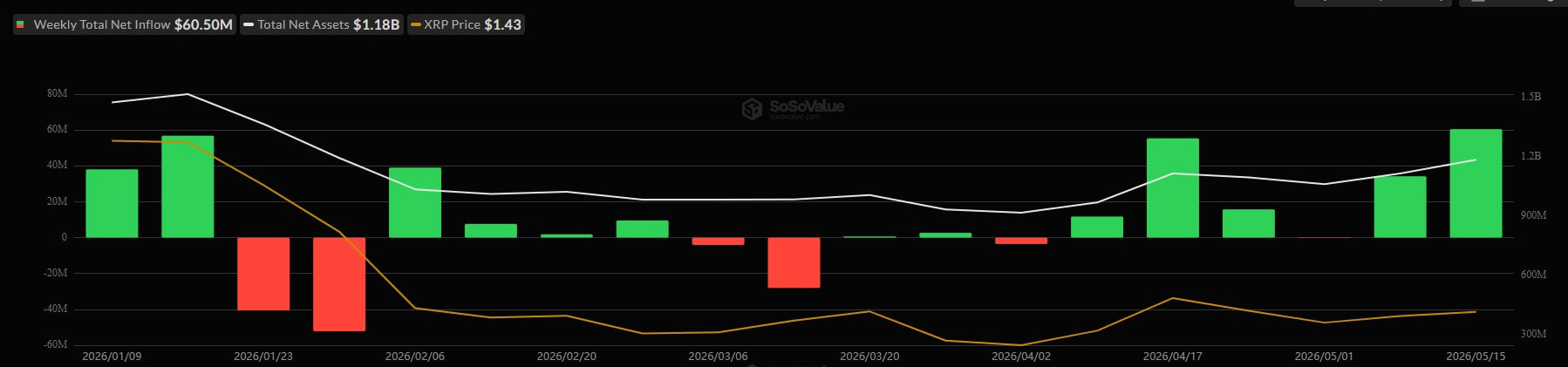
SoSoValue data show the four XRP funds attracted $60 million in net inflows this week, the highest weekly total of 2026. The last stronger reading came in the final week of last year, when the products pulled in $64 million.
XRP ETFs Weekly Inflow in 2026 (Source: SoSo Value)
The latest inflow streak began with $25.8 million on Monday, the largest single-day intake in more than four months. The funds then added $5 million on Tuesday, saw no flows on Wednesday, took in $18 million on Thursday, and closed the week with another $10 million on Friday.
The fresh demand lifted cumulative inflows into XRP funds to $1.39 billion, while total net assets stood at $1.18 billion.
That flow profile suggests institutional buyers are still allocating to XRP despite the token’s weak daily performance. It also shows that ETF demand has not yet been enough to reverse pressure in the spot market.
Binance withdrawals point to reduced exchange supply
Beyond Wall Street products, large-scale crypto investors are actively moving their assets into private custody, adding another bullish signal to the market.
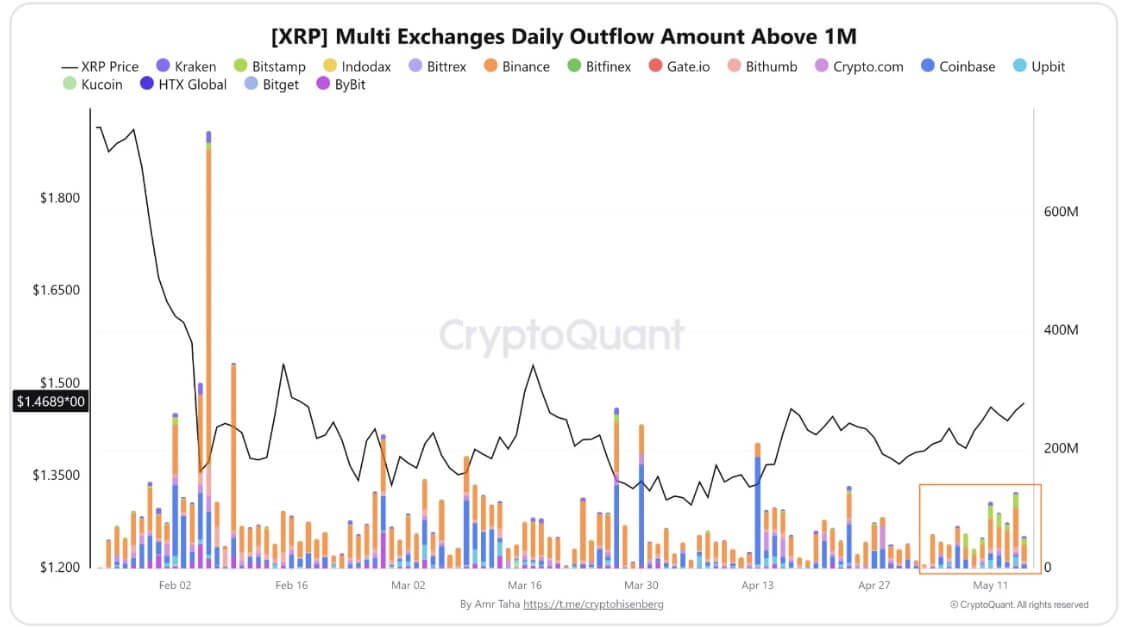
CryptoQuant data show that roughly 403 million XRP have been withdrawn from Binance since May 3 via transfers of more than 1 million XRP. The threshold filters out smaller retail activity and captures movements more commonly associated with whales, funds or high-net-worth holders.
XRP Exchange Outflows (Source: CryptoQuant)
The withdrawals have occurred on an almost daily basis, making the pattern more sustained than the isolated spikes recorded earlier this year.
In late March and mid-April, large XRP outflows were concentrated mainly on Coinbase, especially around March 27, March 30, and April 13, when XRP traded near $1.34.
That earlier behavior suggested large holders were moving coins away from exchanges during periods of price weakness.
The latest pattern has shifted to Binance, with withdrawals continuing as XRP attempted to recover toward $1.47 this week.
Typically, exchange outflows are often viewed as a sign that investors are moving assets into private custody or longer-term storage. That can reduce the amount of XRP immediately available for sale on trading platforms.
However, the effect is not automatic, but persistent withdrawals can tighten exchange-side liquidity if the trend continues.
XRPL activity reaches a two-month high
Parallel to these accumulation signals, the XRP Ledger (XRPL) is experiencing a resurgence in utility.
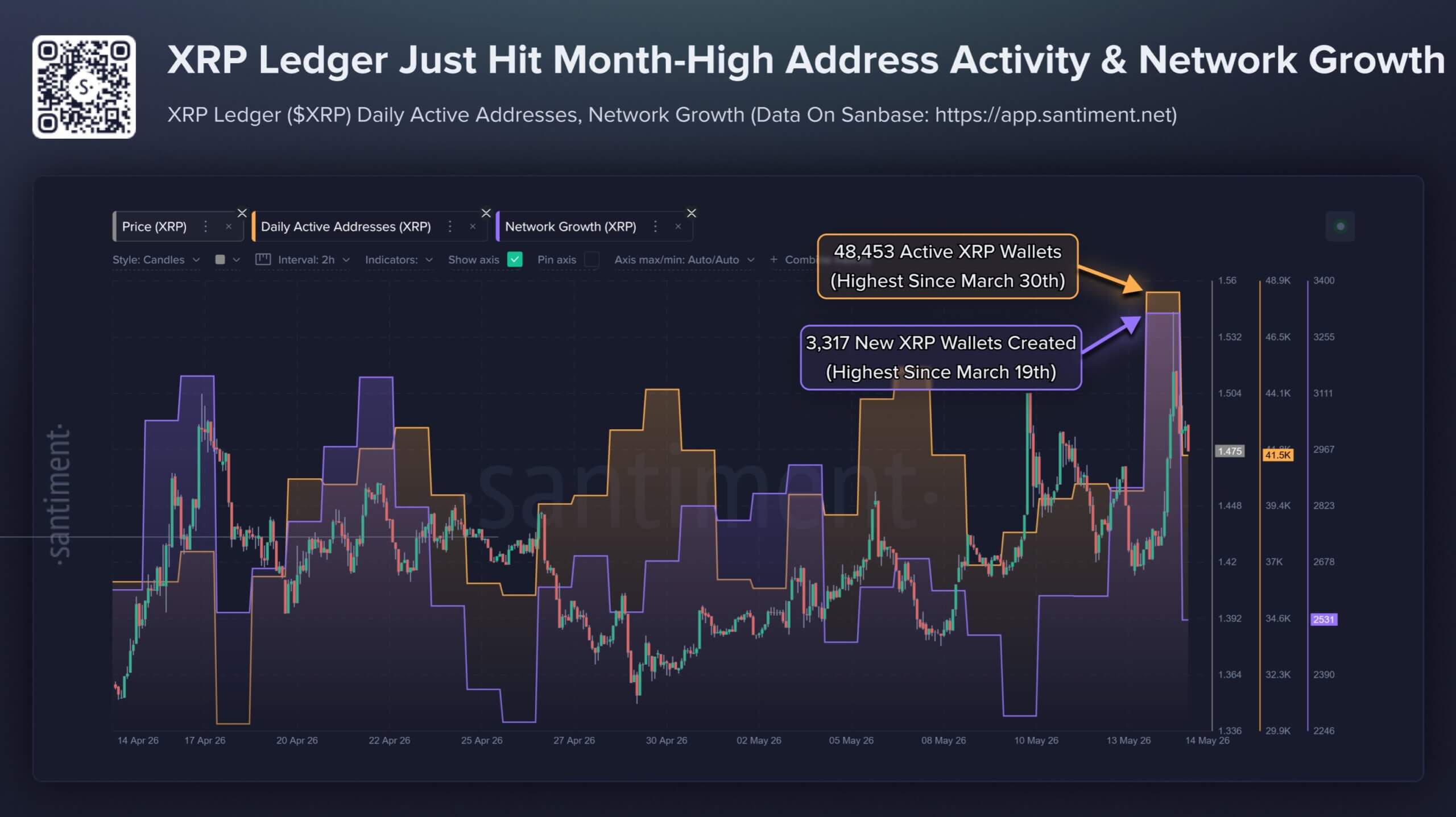
Santiment data show XRPL recently recorded its highest level of on-chain activity since late March after XRP climbed above $1.54. Active addresses reached 48,453 over a 24-hour period, the highest level since March 30.
XRPL Network Activity (Source: Santiment)
Network growth also accelerated, with 3,317 new addresses created. That marked the strongest pace of new wallet creation since March 19.
While some of the on-chain spikes can be attributed to retail traders chasing the brief price bump, sustained transactional activity and address growth provide a fundamental baseline for network valuation.
Bolstering these fundamentals is a growing wave of traditional finance integration. Just last week, Ripple announced a partnership with JPMorgan, Mastercard, and Ondo Finance to pilot cross-border transactions using tokenized US Treasuries on the blockchain network.
XRP now has to prove the signals can survive the pullback
Considering the above, the near-term setup leaves XRP in a difficult position as its improving flows and network activity have not translated into a sustained breakout.
That makes the next phase dependent on whether the current signals persist. Traders will be watching whether XRP ETFs continue to attract inflows, whether Binance withdrawals remain steady, and whether XRPL activity holds up after the initial price-driven burst.
A sustained improvement across those indicators could give bulls a stronger case that XRP’s latest correction is occurring amid firmer demand.
However, a slowdown in flows, exchange withdrawals, or network activity would weaken that setup and leave the token more exposed to further consolidation.
Bitwise CEO Hunter Horsley wants AI-displaced tech workers to consider crypto. He argues that the industry’s messy problems create the kind of opportunity ambitious engineers should chase.
The pitch arrived inside a broader Silicon Valley conversation about AI-driven job anxiety. Investors and founders are describing a workforce reshaped by automation, widening wealth divides, and questions about future careers.
Horsley Frames Crypto as the Pre-Mainstream OpenAI Bet
Horsley told tech employees their pragmatism is what crypto needs. He pointed to problems around financial freedom, access, and cutting out middle men. He compared the move to joining OpenAI before mainstream adoption was clear.
The Bitwise executive also acknowledged the industry has scams, messy projects, and shallow headlines. He argued those flaws are the opportunity for engineers willing to build.
Crypto roles offer competitive pay across engineering, protocol design, and product talent.
Big tech is moving on from needing you, and will be celebrating laying off talent. Fine. But crypto needs you. We need talented, professional, pragmatic people,” Horsley explained.
It aligns with a recent BeInCrypto report, which highlighted how TradFi giants were offering crypto talent stability and prestige as crypto firms cut staff. This is after JPMorgan, BlackRock, and Citi posted crypto roles recently, with base salaries reaching $300,000.
Banks are also demanding hybrid talent fluent in blockchain and TradFi compliance.
Wall Street’s Crypto Hiring Boom Comes as Layoffs Rock the Industry
“It’s really about domain overlap,” Bloomberg reported, citing Paul Przybylski, JPMorgan Asset Management’s global head of product for digital and tokenized assets.
Justin Sun Echoes the Career Reset
Menlo Ventures partner Deedy Das described San Francisco as frenetic. Roughly 10,000 employees at Anthropic, OpenAI, xAI, and Nvidia have reached wealth above $20 million in five years. Meanwhile, AI-driven layoffs reshape the rest of the workforce.
The vibes in SF feel pretty frenetic right now. The divide in outcomes is the worst I’ve ever seen.
Over the last 5yrs, a group of ~10k people – employees at Anthropic, OpenAI, xAI, Nvidia, Meta TBD, founders – have hit retirement wealth of well above $20M (back of the envelope…
BlackRock Investment Institute warned investors that company-level AI capex now drives the entire macro market backdrop. The asset manager said its first 2026 theme, micro is macro, captures the shift.
The note from strategists Jean Boivin and Wei Li lands as Big Tech capital spending tracks roughly $725 billion this year. That figure is up about 10% from estimates made before first-quarter earnings. Capex on this scale rivals traditional macro drivers.
AI Capex Now Rivals Traditional Macro Forces
The micro-is-macro thesis argues that capex from a few firms shapes growth, earnings, and yields. That spending now rivals central bank policy as a market driver.
BlackRock estimates AI infrastructure investment could reach $5 trillion to $8 trillion this decade. The Magnificent Seven recently tracked roughly 57% quarterly earnings growth. AI is now the dominant force behind US equity gains.
The firm believes AI could be the first innovation in 150 years strong enough to lift US growth above 2%. It stresses that the outcome remains uncertain.
AI investment is pressing ahead. At the same time, inflation pressures are proving more persistent than many expected — even before the Middle East conflict. Higher energy prices may pile on to that underlying pressure.
Inflation and the Strait of Hormuz raise the stakes
Sticky price pressures were already elevated before the Strait of Hormuz closure added fresh energy risks. BlackRock now sees about three rate hikes priced into Europe, with the U.S. on hold.
The firm stays overweight US and emerging-market equities. It cautions that long-term Treasuries no longer offer the portfolio ballast they once did. Higher yields, paired with sticky inflation, could begin to pressure valuations if disruptions persist.
Bitcoin gets caught in the macro crosswind
The crypto market reflects the same forces. Bitcoin (BTC) trades near $80,646, roughly 36% below its October 2025 record of $126,080. Ethereum (ETH) sits around $2,260, more than 50% off its August 2025 peak.
Capital that once flowed to risk assets is being diverted to AI capex and energy security, raising competition for funding. BlackRock argues that genuine diversification now requires private markets and hedge funds rather than traditional cross-asset spreads.
Rising leverage, weaker traditional hedges, and a few mega forces driving everything leave little room for passive positioning. Whether AI capex sustains its growth premium or starts to crowd out other assets is now the key question. The answer may set the tone for risk markets through the second half of 2026.
Asset manager Bitwise is set to launch an exchange-traded fund tracking Hyperliquid’s native HYPE token.
The ETF will start trading on May 15 under the ticker BHYP on the New York Stock Exchange (NYSE).
Capitalizing on Hyperliquid’s Growth and Dominance
Bitwise said that BHYP is the first HYPE ETF to use an in-house staking infrastructure, with the firm adding that the fund was designed to give investors a convenient and low-cost way to participate in Hyperliquid’s growth. Reacting to the development, Galaxy’s head of DeFi, Marc Antonio, wrote, “Damn Matt Hougan and Bitwise are cooking.”
DeFi Llama data shows that Hyperliquid makes up about 60% of global on-chain perpetual DEX open interest, with the network being capable of processing up to 200,000 orders per second while maintaining a strong reliability track record. Bitwise believes that because of this, the platform is on the road to becoming one of the biggest beneficiaries as capital markets continue moving on-chain.
Matt Hougan, Chief Investment Officer at Bitwise, said the chain proved its relevance during a period of geopolitical tensions earlier this year, when traditional markets were closed, and traders turned to it for price discovery.
“Hyperliquid has emerged as one of the most compelling investment opportunities in crypto today,” said Hougan.
Additionally, Hype has risen to become the tenth largest crypto asset in the world since launching two years ago, with a market cap of over $11 billion.
“Hyperliquid’s token is explicitly designed so that rising trading activity on the Hyperliquid platform directly benefits token holders. This has translated into historically strong returns,” he added.
Bitwise Shares Fees
The fund’s prospectus shows that BHYP carries a 0.34% sponsor fee, which Bitwise plans to waive for the first month on the first $500 million in assets. The company also clarified that the product hasn’t been registered as an investment firm, meaning it doesn’t have the same protections as ETFs and mutual funds.
Earlier in the week, 21Shares launched a similar product tracking HYPE dubbed THYP, which pulled about $1.8 million in trading volume on its first day, a feat described by analyst James Seyffart as “nothing too crazy.”
It has since racked up $7.42 million in cumulative net inflow, with data from SoSoValue showing that yesterday’s flow alone came in at nearly $5 million.
Grove has launched a liquidity facility called Basin that offers up to $1 billion in daily stablecoin payouts for investors.
Basin’s big pitch is that investors can now redeem their tokenized real-world assets and receive coins immediately from Basin rather than wait the two to three business days it would take an off-chain platform to complete the transaction.
What is the ‘settlement gap’ in tokenized finance?
Tokenized real-world assets (RWAs) like treasury funds are supposed to run on modern technology. They trade on blockchains and promise speed, theoretically.
The issue was that when an institutional investor wanted to cash out of a tokenized fund like BlackRock’s BUIDL, the process still had to rely on traditional finance methods, which often takes two to three business days to be settled. In the crypto world, which operates 24/7, this delay creates inefficiency and risk.
The tokenized U.S. Treasury sector has grown over 130% in the past year, currently sitting at over $15.20 billion. Major players include Circle’s USYC ($2.91B), BlackRock’s BUIDL ($2.58B), and Franklin Templeton’s BENJI ($2.05B). But growth has been limited by the settlement gap between on-chain assets and off-chain cash-out times.
Grove Labs, a subsidiary of Steakhouse Financial, launched Basin, a programmable credit facility, as a solution to this issue. Now, when an eligible investor redeems shares, Basin gives them stablecoins immediately. Grove then waits for the traditional settlement to finish and gets repaid days later.
How does Basin affect BlackRock and Janus Henderson?
There has been an immediate impact of this new liquidity on BlackRock’s USD Institutional Digital Liquidity Fund (BUIDL, $2.58B) and Janus Henderson Anemoy Treasury Fund (JTRSY, $1.24B).
Previously, selling these tokens meant waiting for the fund administrator to process the request, but now, through partners like Securitize (for BlackRock) and Centrifuge (for Janus Henderson), investors hit “redeem” and receive stablecoins instantly.
Anchorage Digital, Galaxy Digital, and FalconX have signed on as institutional access partners to connect their clients directly to the Basin liquidity network.
BlackRock’s global head of digital assets, Robbie Mitchnick, stated that fixing this “settlement friction” is necessary to make funds usable for institutions. Nick Cherney of Janus Henderson called the move “an absolutely essential component” for realizing the full benefits of blockchain.
Cryptopolitan recently reported that BlackRock filed with the SEC to launch two new tokenized funds: a tokenized version of the existing BlackRock Select Treasury Based Liquidity Fund (BSTBL) and a new vehicle called the BlackRock Daily Reinvestment Stablecoin Reserve Vehicle (BRSRV).
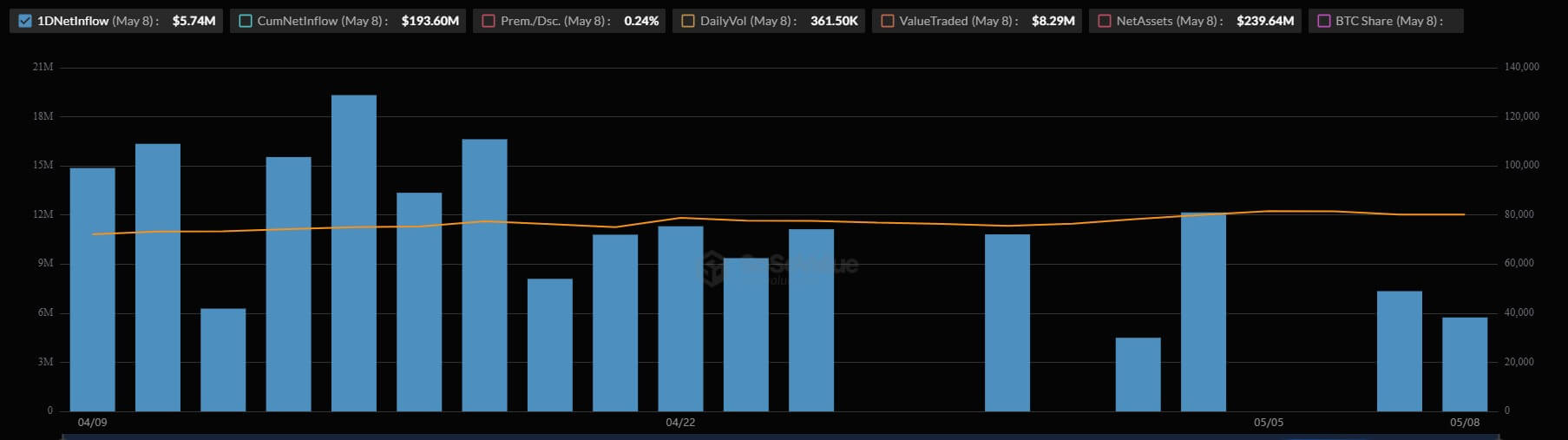
The Morgan Stanley Bitcoin Trust completed its first month of trading without a single day of net outflows, providing an early test case for how a Wall Street bank’s brand, pricing, and distribution network can alter the competitive landscape of the digital-asset market.
The product, trading under the ticker MSBT, launched on April 8 and has since attracted about $193 million in net inflows, while managing over $240 million in assets.
Data from SoSoValue shows the fund’s inaugural month included 17 days of positive inflows and five days of flat flows, with zero daily redemptions recorded.
Morgan Stanley Bitcoin ETF First Month Flows (Source: SoSo Value)
That streak stands out amid a period of localized volatility for rival US spot Bitcoin funds. For context, the broader Bitcoin ETF category bled $422 million in combined outflows during the last two trading sessions, while MSBT successfully absorbed an additional $13 million in fresh capital.
This divergence gives Morgan Stanley a flow record that fund sponsors typically take quarters to build.
Currently, MSBT holds about 2,620 Bitcoin, ranking it 32nd among Bitcoin-holding crypto ETFs and exchanges, according to Bitcoin Treasuries data.
While it trails the largest spot funds in raw size, its resilience during market drawdowns indicates that institutional clients are treating the fund as a long-term allocation.
How Morgan Stanley’s MSBT achieved a flawless first trading month
To understand why this capital is proving so sticky, market observers are looking directly at the issuer’s pedigree, as Morgan Stanley’s primary advantage in a turbulent market is familiarity.
While crypto-native firms and dedicated asset managers pioneered the US spot Bitcoin ETF market, the bank offers investors a distinctly different entry point: a regulated financial institution with an established wealth-management and advisory base.
The bank leaned into this distinction at launch. Amy Oldenburg, Morgan Stanley’s head of digital asset strategy, noted that digital assets are increasingly intersecting with traditional markets. She emphasized the firm’s focus on helping clients navigate this shift through financial structures they already trust.
However, brand familiarity and trust are only half the equation as the firm is also weaponizing its cost structure to capture market share.
The fund charges a 0.14% sponsor fee, which the bank positioned at launch as the lowest among all spot Bitcoin ETPs. It deliberately undercuts the Grayscale Bitcoin Mini Trust at 0.15%, Bitwise at 0.20%, and BlackRock’s industry-leading iShares Bitcoin Trust at 0.25%.
While the margin appears small in percentage terms, fees become a critical battleground as Bitcoin ETFs transition from novel launch products into standard portfolio allocation tools.
For fiduciaries, advisers, and institutions, a lower expense ratio heavily influences model-portfolio decisions when multiple products track the identical underlying asset and offer similar execution and custody standards.
This aggressive pricing strategy gives Morgan Stanley a highly effective pitch as its internal wealth-management channel expands access. The firm employs roughly 16,000 financial advisers overseeing $9.3 trillion in client assets.
Even a fractional allocation shift through this vast network could exponentially increase MSBT’s asset base over the coming quarters. Yet, this internal, advisor-led growth is just one pillar of a much wider, multi-front rollout.
Bitcoin ETFs register longest weekly inflow streak this year
Meanwhile, MSBT’s first month also benefited from a broader recovery in demand for US spot Bitcoin funds.
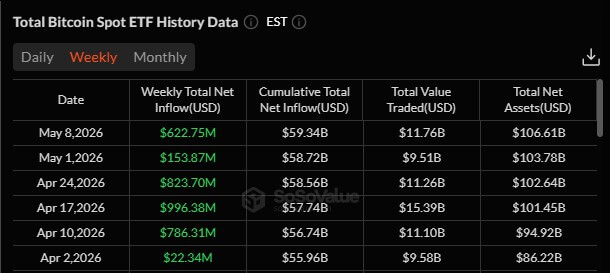
SoSoValue data show the US Bitcoin ETFs have drawn more than $3 billion across six straight weeks of net inflows through May 8, the longest run of weekly gains since last summer.
US Bitcoin ETFs Weekly Inflow Since April 2 (Source: SoSo Value)
Macroeconomic research platform Ecoinometrics noted that this steady improvement in ETF inflows suggests real, long-term capital is returning to the digital asset market, rather than a temporary rebound driven by short-term positioning or leverage.
For MSBT, the wider market recovery provides useful context. Morgan Stanley did not launch into a weak ETF market, but its lack of daily redemptions still sets it apart in a category where capital has continued to move unevenly across issuers.
That puts a 1,150% increase as a 2031 target inside a market that is still trying to prove it can hold the $80,000 area.
CryptoSlate’sBitcoin page shows BTC near $80,200 on May 9, with a market capitalization near $1.61 trillion and an all-time high of $126,198 set on Oct. 6, 2025.
A move to $200,000, another price target being batted around lately, would require Bitcoin to rise roughly 2.5 times from that level. A move to $1 million would require roughly 12.5 times.
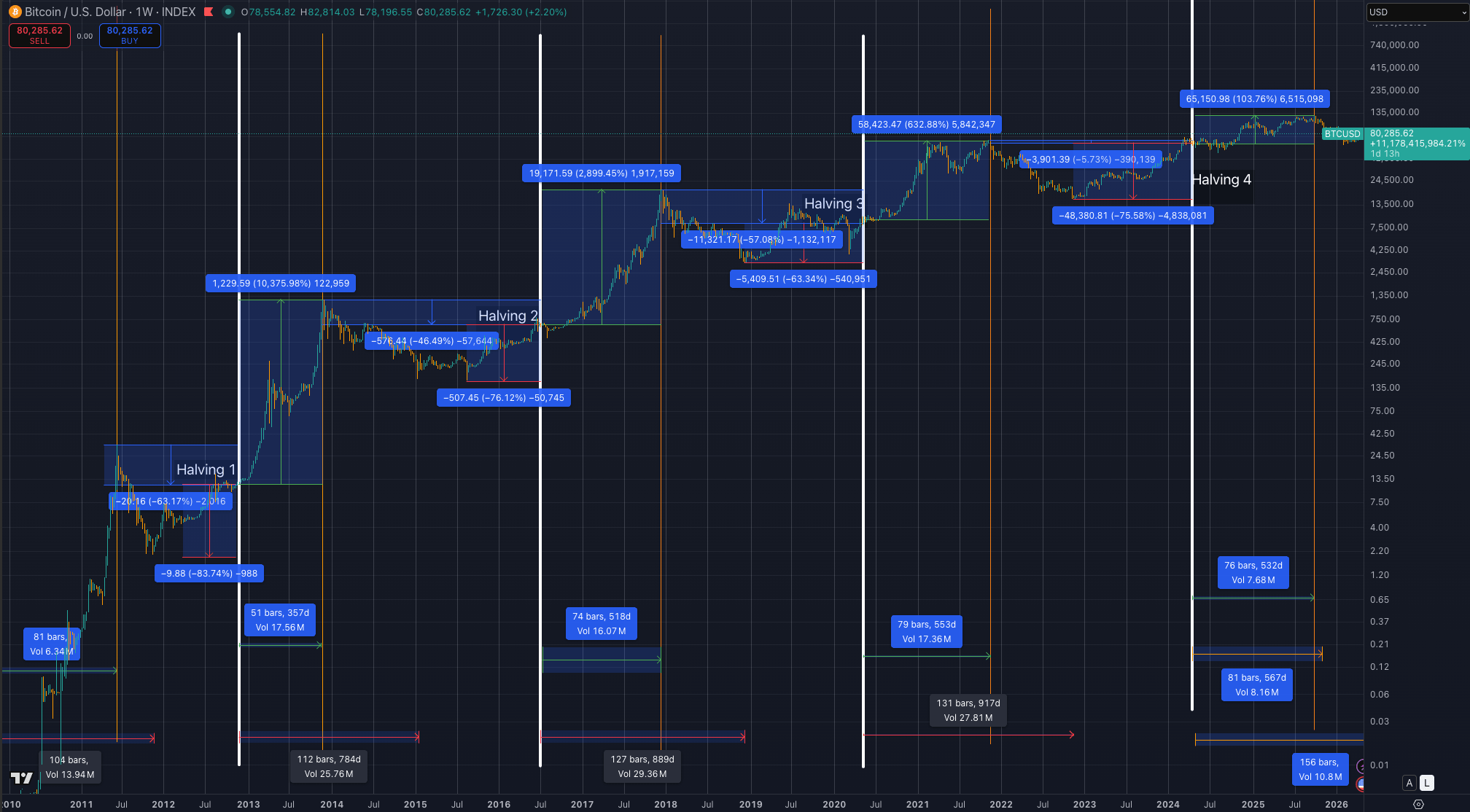
Bitcoin has produced larger percentage moves before, but the current forecast cycle now rests on a market question: whether the latest institutional demand is strong enough to absorb coins being sold into the rebound.
Bitcoin price chart showing projected Bitcoin cycle highs and pullbacks across multiple halving periods.
Why seven-figure math is back
The VanEck call lands alongside other seven-figure frameworks. Bitwise CIO Matt Hougan laid out a formal $1 million model in March, arguing that Bitcoin can reach seven figures by gaining share as the store-of-value market expands.
In his model, the market grows to about $121 trillion over 10 years, and Bitcoin reaches $1 million if it captures about 17% of the total.
That is a different time horizon from Sigel’s reported five-year view, but the logic overlaps. Both depend less on a single trading catalyst and more on Bitcoin becoming a larger part of how institutions, advisers, sovereign entities, and younger investors think about long-term savings outside the fiat banking system.
VanEck’s own research desk had already published a longer-range version of that argument. In a 2024 Bitcoin 2050 scenario, the firm modeled a possible $2.9 million Bitcoin price by 2050 if BTC becomes a meaningful medium of exchange and reserve asset.
That report used assumptions around trade settlement, reserve holdings, and Bitcoin scaling infrastructure. The newly reported call is more immediate, but it comes from the same broad research posture: Bitcoin as a macro asset whose valuation depends on adoption beyond crypto-native buyers.
If the thesis is only a trading call, the next resistance level carries most of the weight. If the thesis is that adoption math, ETF flows, portfolio allocation, sovereign reserve behavior, and the size of the global store-of-value market carry more weight than a single weekly candle.
The near-term price frame is less clean. Fundstrat’s Tom Lee’s $200,000 to $250,000 Bitcoin range for 2026 should also be part of the conversation.
Prior CryptoSlate coverage had already placed Lee’s $200,000 forecast among a wide 2026 target set that also included more conservative and more aggressive institutional calls.
Arthur Hayes, the Maelstrom CIO and BitMEX co-founder, is cited as aiming for a shorter-term $125,000 target tied to liquidity and war-driven spending.
Together, those calls make Bitcoin look like it is re-entering a target-heavy phase. Hayes’ framework is macro-liquidity and event-driven. Lee’s is a 2026 market-cycle view.
Bitwise’s model is a store-of-value share calculation. VanEck’s reported call compresses a seven-figure outcome into roughly half a decade.
That difference should keep us grounded. A cluster of bullish forecasts can shift sentiment, but the market structure still has to carry the price there. The Fear and & Greed Index still sits firmly in the ‘fear’ category.
Recent CryptoSlate coverage framed Bitcoin’s rebound above $80,000 as a live test between seller supply and ETF demand. Long-term holders have been taking profits into strength, while spot Bitcoin ETF buyers have helped absorb supply.
That standoff is why the $90,000 area keeps appearing as the next upside test.
The bullish version is straightforward. If ETF demand continues to absorb coins from older holders, the low-$80,000 range could become a base rather than a ceiling. From there, a move toward $90,000 would provide the market with evidence that institutional access is doing real price-discovery work, rather than merely softening a rebound.
That would still leave $200,000 as a stretch target. It would, however, make six-figure 2026 targets easier to discuss without treating them as detached from traded demand.
A market that can hold $80,000, push through $90,000, and do it on broad spot demand would look more compatible with the Fundstrat-style bull case than a market that keeps rejecting the same supply zone.
The failure case is just as important. If ETF demand fades while long-term holders continue selling into rallies, the $1 million conversation becomes a long-horizon adoption argument rather than an explanation for the current price.
In that case, the five-year and 10-year targets can remain intellectually coherent while the 2026 market still struggles to escape its range.
That tension separates price targets from the evidence that would make them relevant now. Bitcoin can leave the $1 million debate unresolved for now. It needs to show whether the buyers who arrived through ETFs and institutional channels are still willing to absorb supply near levels that recently acted as resistance.
The practical threshold is therefore smaller than the largest target on the board. A clean $90,000 push would not validate seven-figure math, but it would show that the market can handle seller pressure while fresh capital still reaches spot Bitcoin products.
What would change the market signal next
Bitcoin needs to hold the low-$80,000 area and then attack $90,000 with enough spot demand to make the move look durable.
ETF flow data, long-term holder distribution, and any fresh confirmation of the VanEck comments will carry more weight than another round number from an executive or strategist.
The seven-figure targets are moving the debate away from whether Bitcoin can regain its 2025 high and toward whether the asset can claim a larger share of global savings. That is a much larger argument than a technical breakout, but it still needs the current market to cooperate.
For now, the credible takeaway is that institutional researchers are again willing to publish or defend seven-figure math while the market tests whether ETF-era demand can turn $80,000 from a stress point into a launch point.
It may be the beginning of the end for the global legions of C-drama fans.
iQIYI, the Chinese streaming service known for its massive library of Asian films and TV shows, is anticipating that AI will create the majority of its content in just five years, Bloomberg reports.
In an interview at iQIYI’s annual content showcase, CEO Gong Yu presented a sweeping AI vision so divorced from the company’s roots as a Netflix-style service that it has shades of Mark Zuckerberg’s aborted pivot to building an entire “Metaverse.” Per Bloomberg‘s paraphrasing of Yu’s remarks, the Beijing-based streamer plans to convert its website and video app into a “social media destination that hosts mainly AI-generated content” — content it hopes will be made using its own model.
On Monday, the service launched its Nadou Pro suite, an all-in-one AI toolkit designed to handle every aspect of filmmaking, from screenwriting to storyboards and video generation. The company says Nadou Pro has already been used to make films during internal testing, but that’s not the extent of its vision. iQIYI is also planning to release an AI-generated film this summer, one it hopes will be a genuine box office success rather than an overlooked experiment.
A version of the facelifted iQIYI app was unveiled on Monday. Striking when the iron is hot, executives hope to capture the mass appeal of OpenAI’s video generator app Sora, which unexpectedly shut down last month.
“It’s once in a decade,” Gong said of the opportunity to an audience of producers and directors at the content showcase, per Bloomberg. “We have to take the tide as it comes.”
In the meantime, iQIYI will release 16 Nadou-produced films on the platform — the opening salvo before its anticipated onslaught of AI content. iIQIYI will even pay filmmakers that use its AI tool an additional 20 percent cut of advertising and membership fees, Gong said.
iQIYI’s expansive AI vision comes amid a swell of unrest in Hollywood over how the tech could disrupt the industry, sparked by the impressive capabilities of the latest video generating models like Google’s Veo 3 and ByteDance’s Seedance 2.0. Some insiders say AI is already pervasive in the industry and others fatalistically claim that an AI takeover is inevitable, though many examples of movie-like AI footage have turned out to be misleadingly presented. There’re also nagging questions about the economic feasibility of AI video generation. Sora, OpenAI’s app that iQIYI is hoping to eat the lunch of, was reportedly losing over $1 million per day before being shut down.
It also comes during a less-than-outstanding year at the Chinese box office, with the runaway success of “Ne Zha 2,” which released on the first day of the Chinese New Year holiday in 2025, proving a tough act to follow. Domestic sales during this year’s Chinese New Year week plunged by nearly 40 percent, with one report suggesting it was the lowest figure since 2018. iQiyi’s own revenue is estimated to have fallen by 13 percent in the first quarter of this year, Bloomberg reported.
Defiance ETFs has filed a preliminary prospectus with the SEC for the Defiance US AI Resilience ETF. The passively managed fund is designed to hold companies least likely to be disrupted by artificial intelligence (AI).
The filing, submitted on Thursday, marks Defiance’s latest thematic bet. Rather than chasing AI upside, this fund takes the opposite approach by targeting old-economy businesses that AI is unlikely to replace.
What the AI Resilience ETF Holds
The ETF will track the VettaFi US AI Resilience Index. The index selects roughly 50 US large-cap companies from VettaFi’s broader equity universe. It focuses on what the industry has labeled “HALO” firms, short for Heavy Asset, Low Obsolescence.
These are businesses with inelastic demand, long-life physical infrastructure, and revenue profiles insulated from labor automation.
Under normal conditions, the fund will invest at least 80% of net assets in companies that meet these AI-resilience criteria. It may use either full replication or representative sampling to track the index.
The HALO Thesis Behind the Fund
The ETF arrives as Wall Street’s appetite for HALO stocks continues to grow. Goldman Sachs introduced the framework in early 2026.
The firm found that capital-intensive companies relying on physical assets have outperformed capital-light, digital-first peers by about 35% since the start of 2025.
The reasoning is straightforward. Transmission grids, pipelines, industrial capacity, and transport infrastructure are costly to replicate and sit outside the reach of generative AI.
Software companies, by contrast, face growing displacement risk as AI systems automate more of their functions.
Defiance, which manages over $8 billion in assets, already operates thematic funds covering quantum computing, AI power infrastructure, and drone automation.
Its Quantum Computing ETF (QTUM) recently passed $4 billion in AUM with a 5-star Morningstar rating. The AI Resilience ETF extends that lineup into contrarian territory.
Congratulations to @Defiance_ETFs on their Quantum Computing #ETF – $QTUM – Surpassing $4 Billion in Assets and Earning a 5-Star @MorningstarInc Rating!@MarketVector is proud to be the administrator of $QTUM‘s benchmark, the #BlueStar Machine Learning and Quantum Computing…
The prospectus is still preliminary. The ticker has not been assigned, and management fees are listed as placeholders. The fund will trade on Nasdaq once the filing becomes effective, which typically takes about 75 days.
Principal risks highlighted in the filing include interest-rate sensitivity for capital-intensive holdings and sector concentration in staples and industrials.
Penserra Capital Management will handle day-to-day portfolio management through a sub-advisory arrangement.
The actual portfolio managers are Dustin Lewellyn, Ernesto Tong, and Christine Johanson, all from Penserra.
The filing is available on SEC EDGAR under ETF Series Solutions. With AI hype dominating markets in 2026, Defiance is betting that investors will also pay for protection against the other side of that trade.