In an August 12 memo, Matt Hougan, chief investment officer at asset manager Bitwise, said most crypto tokens other than Bitcoin are undervalued.
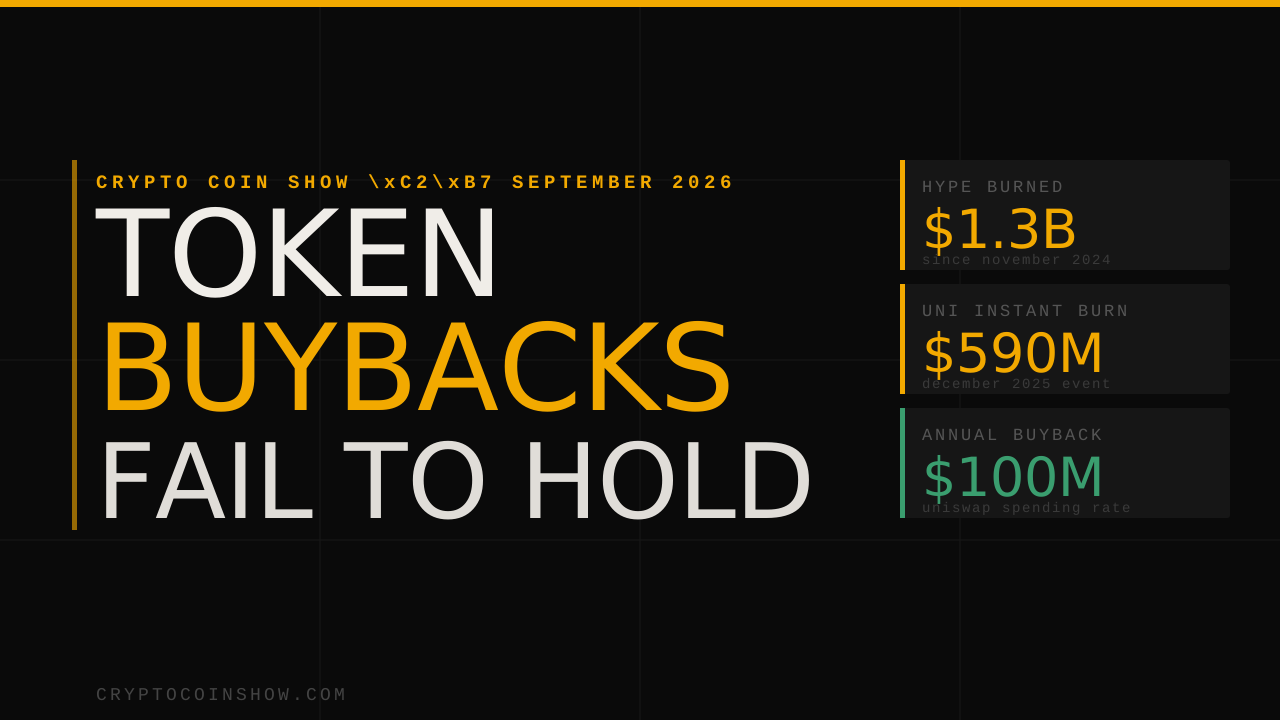
Investors are not aware of how much revenue protocols now pay back to holders. The clearest example is Hyperliquid retiring $1.3 billion of its HYPE token, he said. If the trend continues, the market “could see valuations double or more,” Hougan added.
Hougan says tokens now trade on revenue
For years, the main criticism of crypto was that networks could scale significantly, yet tokens captured little value.
Hougan said, “That era is over,” in the memo titled “Crypto’s Revenue Revolution.” He believes tokens are beginning to trade on the same yardstick as equities and bonds, which is revenue.
Hougan explicitly tied his valuation claim to his belief that the link between protocol revenue and token price is strengthening. Bitwise said the memo represents a snapshot assessment and is not investment advice.
Hyperliquid generated over $800 million in revenue in the last year. The DEX sends about 99% of its fees to buy HYPE on the open market and burn it, according to the Bitwise memo.
Since the token went live in November 2024, those purchases take $1.3 billion of HYPE out of supply permanently.
Hougan said HYPE is up about 800% since launch, at a time when Bitcoin has lost about a third of its value. He credits part of the HYPE’s run to buyers predicting that rising volume would feed straight into the burn.
HYPE changed hands at $57.77, up 2.8% over seven days and 11.1% over the past 30 days, according to CoinGecko data.
Uniswap and Aave copy Hyperliquid’s model
Uniswap’s December 2025 vote on “UNIfication” switched on protocol fees for the first time, instantly burning 100 million UNI, or about $590 million. It now generates about $100 million a year, and it spends all of that on buybacks.
Aave plans to burn about $30 million of AAVE per year, close to a fifth of its revenue. It has implemented an automated program called Aavenomics 3.0.
Pump.fun, doing $328 million in annual revenue, had burned $370 million of PUMP by April 2026. Lighter, a newer perpetuals venue, bought back about 6% of its LIT supply on $67 million of revenue.
“Revenue fever” has reached base-layer chains, Hougan said. Solana’s community has proposed SGP-0003 to increase its fee burn up to 14 times.
Aptos hiked gas fees tenfold this year. Activity on Aptos almost tripled, and annual token burns soared from ~90,000 to about 1.9 million.
A January Cryptopolitan report found that shrinking supply has not reliably lifted prices and that many tokens with regular buybacks still underperformed the market and failed to hold a floor.
Even Hyperliquid broke its initial “up only” pattern. Pump.fun, at one point, had repurchased more than 18% of its supply while the token sat near its lows.
Hougan stated that a token buyback is not like a stock buyback since there’s no contractual right to profits or assets. Governance can always rewrite or change the economics.
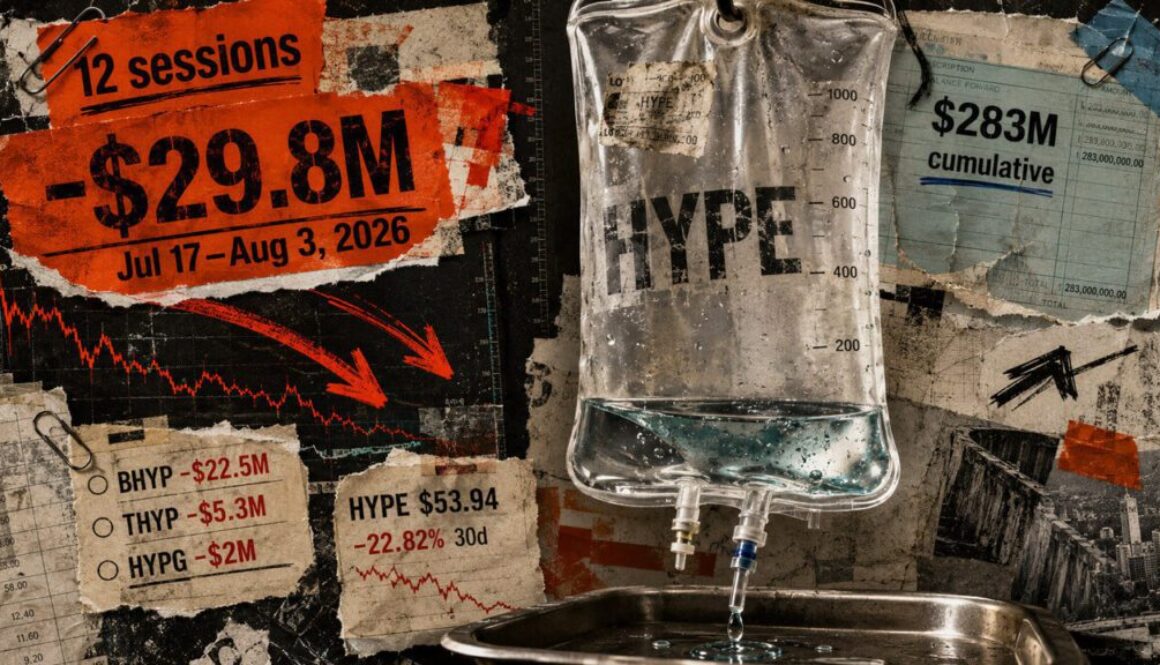
Hyperliquid’s HYPE ETFs went 12 trading sessions without a single inflow from July 17 through Aug. 3, 2026, recording $29.8 million in reported net outflows. The drought counted nine negative sessions and three flat ones.
According to Farside Investors, BHYP absorbed $22.5 million of the outflows, far more than THYP’s $5.3 million and HYPG’s $2 million. Farside’s Aug. 3, 2026 entry added a $1 million HYPG outflow; BHYP and THYP were flat.
Earlier inflows across the HYPE ETFs left a deep cushion. Farside’s table through Aug. 3, 2026 showed about $283 million of cumulative reported flows across the category, with $106.3 million for BHYP, $50 million for THYP and $126.9 million for HYPG.
The token was sliding at the same time. After CryptoSlate’s Aug. 3, 2026 market refresh, HYPE traded at $53.94, down 4.53% over seven days and 22.82% over 30 days. HYPE ETFs can see their asset values move with the token separately from share creations and redemptions.
Dated issuer figures show how AUM can drift away from cumulative flows. Bitwise listed $92.36 million of BHYP AUM and 3.03 million shares on Aug. 2, 2026, with 70% of assets staked. 21Shares listed $50.95 million of THYP AUM and 1.67 million shares on July 31, 2026. Its prospectus describes an intended 30% to 70% staking range. Grayscale listed $109.35 million of HYPG AUM, 5.67 million shares and 94.31% of assets staked on Aug. 3, 2026. Prices, staking rewards, fees and distributions keep those balances moving.
Daily flow tables track dollars while investor identity and motive stay hidden. Farside’s page omits end-investor identities and a full methodology. The THYP and HYPG prospectuses add another moving part. Authorized participants create and redeem shares to keep market prices near net asset value, activity that can shape daily flows.
The HYPE ETFs’ flow story has moved from early accumulation to a live durability test. The next print will show whether the drought is breaking or digging in.
XRP funds led altcoin inflows in July, extending a four-month streak that increasingly separates them from most rival products.
The US-listed funds attracted $27.29 million during the month, nearly twice Solana’s $14.62 million intake, according to SoSoValue data. Chainlink followed with $4.54 million, while Hedera products added $3 million.
Bitcoin and Ethereum remained the dominant crypto fund categories, attracting $172 million and $365 million, respectively. Among products tracking assets outside the two market leaders, however, XRP finished July comfortably ahead.
XRP builds the steadiest demand as Solana and Hyperliquid gain ground
XRP funds have become the altcoin ETF market’s most consistent source of new capital, ranking first or second in monthly inflows since April and avoiding a single monthly outflow over that period.
Indeed, XRP funds attracted $81.59 million in April, $131.94 million in May, $59.46 million in June and $27.29 million in July. The four-month run has added more than $300 million and lifted cumulative inflows to roughly $1.5 billion, the largest total among altcoin products.
This run also gives XRP the longest active monthly inflow streak across the crypto funds tracked by SoSoValue this year.
However, that lead is becoming more competitive. Solana funds have accumulated about $1.15 billion since launch and returned to second place in July after a modest June outflow. Their scale suggests investor demand is beginning to extend beyond XRP rather than concentrating in a single altcoin.
Hyperliquid has emerged even faster. Its funds attracted about $293 million across May and June, briefly surpassing XRP in both months before recording its first outflow in July. The reversal slowed that momentum but did not erase one of the strongest launches in the market.
Together, XRP, Solana, and Hyperliquid are forming a distinct group beneath Bitcoin and Ethereum.
XRP stands out for the durability of its inflows, while Solana and Hyperliquid show that investors are also building meaningful exposure to a small number of emerging alternatives.
Crypto ETF product shelf is expanding faster than demand
Strong demand for XRP, Solana, and Hyperliquid contrasts with weak, sporadic flows across the rest of the altcoin fund market.
Several products spent most or all of July without attracting fresh capital. Avalanche and Polkadot recorded no monthly flows, while BNB has not registered a net inflow since June 11.
Their cumulative totals remain modest, ranging from about $1.45 million for BNB and $1.94 million for Polkadot to roughly $24 million for Avalanche.
A zero-flow day does not mean investors stopped trading the funds. It means creations and redemptions produced no net addition of capital. But the frequency of those days still reveals a market where new listings are expanding faster than the pool of committed buyers.
For context, Litecoin and Dogecoin each recorded flows on just two days during July, with withdrawals largely offsetting the limited money that entered. Dogecoin finished the month with about $526,000 of net outflows, while Litecoin was effectively flat.
Hedera stood out within that group, attracting $3 million across four positive sessions and lifting cumulative inflows to about $105 million.
Even so, the concentration of its monthly demand into only a few days shows how sporadic allocations remain outside the leading products.
The emerging structure is therefore becoming more selective. Bitcoin and Ethereum dominate the market, XRP and Solana have established a credible second tier, and Hyperliquid has shown that newer products can break through quickly.
Beneath them, a growing long tail of altcoin funds is struggling to convert regulatory access into sustained investment demand.
Most leading cryptocurrencies have headed south over the past 24 hours, yet Hyperliquid’s HYPE is among the few to defy the latest red wave.
While it has risen by a mere 1.5%, one analyst assumed it might be gearing up for a staggering 40% pump in the near future.
The Necessary Condition
Currently, HYPE trades at around $54.70, placing it above the lower boundary of an important channel depicted by Ali Martinez. He suggested that if the asset holds the $53 level, a move up to $75 is possible. Also speaking on the matter was Altcoin Sherpa, who claimed that HYPE’s current level is “a good spot for a bounce.”
“Expecting huge tradfi trading volumes to come over the next few days too, which helps,” the analyst added.
Some on-chain signals also suggest that the asset may post additional gains in the short term. CoinGlass’s data shows that exchange outflows have dominated over inflows in the last several days, meaning that investors have transferred their holdings from centralized platforms to self-custody solutions. This is considered a bullish factor since it reduces the immediate selling pressure.
HYPE Exchange Netflow, Source: CoinGlass
The Bearish Case
The number of pessimists, though, seems even more well-represented. X user Cut recently doubted HYPE’s potential, reminding of its inability to break its all-time high and wondering if its price would make a substantial decline. Ryker joined the discussion, projecting a plunge to $32 “soon.”
Cryptorphic also gave their two cents, arguing that HYPE is showing weakness after losing its long-term trendline and its price has broken below the key ascending support. They believe that if the $57-$58 range turns into resistance, the breakdown could confirm further downside, envisioning a possible crash under $30.
Meanwhile, the whales’ activity reinforces the pessimists’ outlook. Lookonchain disclosed that large investors keep selling HYPE, revealing the case of a market participant who purchased over one million tokens at an average price of $18 17 months ago and unstaked and deposited the stash into FalconX and Coinbase, perhaps with the intention to cash out.
The waning institutional interest adds more weight to the bearish perspective. Spot HYPE ETFs, which attracted substantial capital in June, have not appealed to pension funds, hedge funds, and other conservative investors during most days of July, with outflows significantly dwarfing inflows.
The Transparent Prop Firm | CryptoCoinShow Exclusive
PROPR ◆ ONCHAIN PROP TRADING$1M REVENUE IN 60 DAYS5,000+ ACTIVE TRADERS300+ AI AGENTS LIVE80% PROFIT SPLITHYPERLIQUID INFRASTRUCTUREPOLYMARKET INTEGRATION IMMINENTMMT.GG PARTNERSHIP LIVEALGO PASS RATE: 15% VS HUMAN 13.5%PROPR ◆ ONCHAIN PROP TRADING$1M REVENUE IN 60 DAYS5,000+ ACTIVE TRADERS300+ AI AGENTS LIVE80% PROFIT SPLITHYPERLIQUID INFRASTRUCTUREPOLYMARKET INTEGRATION IMMINENTMMT.GG PARTNERSHIP LIVEALGO PASS RATE: 15% VS HUMAN 13.5%
CryptoCoinShow
Exclusive Feature
July 2026 · Blockchain Interviews
Deep Dive · Prop Trading · DeFi Infrastructure
The Prop Firm That Shows Its Work
While every other prop trading firm hides its books, changes the rules when you start winning, and denies payouts it can’t afford — Propr built the whole thing onchain, in public, for anyone to audit in real time. Louis Régis, former Credit Suisse quant and Rothschild crypto desk head, explains why that’s the only model that survives.
By Ashton Addison · CryptoCoinShow Blockchain Interviews · Exclusive
▶ WATCH THE FULL INTERVIEW
$1M+Revenue · 60 Days
5,000+Active Traders
300+AI Agents Live
80%Profit Split
Onchain Verified · Transparency Dashboard Live
Prop trading is a quiet $10 billion industry in traditional finance. Hundreds of thousands of retail traders pay entry fees for the chance to trade a firm’s capital — keeping a cut of the profits if they succeed, absorbing nothing if they fail. The firms collect the fees, manage the risk, and pocket the spread. It’s a clean business model. It’s also almost entirely absent from crypto.
Louis Régis wants to know why — and he thinks he’s found the answer. “The breakthrough is liquidity,” he says. “For retail traders, it’s now very close to on par with traditional venues. You can trade the Nasdaq and S&P on Hyperliquid, and the spread and execution quality will be similar to TradFi. That’s the building block Propr is built upon. The constraint that killed earlier attempts — dYdX, GMX — was simply that the liquidity wasn’t there.”
Régis is not a crypto-native. He spent years as a quantitative analyst at Credit Suisse, then ran the crypto desk at Rothschild & Co before leaving to build Propr. He now codes the platform live on Twitch every day. Two and a half months after launch: $1 million in revenue, over 5,000 active traders, and more than 300 AI agents already trading with real funded capital.
Propr — Platform Snapshot · July 2026
Revenue (since launch)$1,000,000+
Active Traders5,000+
AI Agents Live300+
Max Funded Capital$300,000
Profit Split (trader)80%
Human Pass Rate13.5%
Algo Pass Rate15.0%
Execution VenuesHyperliquid + Lighter
InfrastructureOnchain · Fully Auditable
Upcoming IntegrationsPolymarket · MMT.gg
01 — The ProblemThe Black Box Business Model
To understand why Propr exists, you have to understand what the rest of the prop trading industry is doing wrong. The mechanics are straightforward: a firm charges a trader a fee — typically between $500 and $1,000 — for the right to attempt a funded challenge. Pass the challenge, get access to real capital. Make profits, keep a share. Sounds fair. The problem, Régis explains, is what happens when you actually start winning.
“If a firm is denying payouts, it’s about the economics of the firm. If they have rules that are too loose and don’t practice good risk management, it’s not good for them. This will still occur onchain — we already see it in quite a lot of onchain counterparts.”
Louis Régis, Founder — Propr
When a trader becomes consistently profitable, a traditional prop firm faces a problem: they now owe that person real money. If the firm has been internalizing trades — acting as the counterparty rather than hedging — a winning trader is a direct loss. The response, documented across the industry, is quiet rule-tightening: consistency requirements that materialize mid-campaign, payout delays, account flags. The rules weren’t changed officially. They were just applied differently.
Régis’s solution is deceptively simple: put the economics onchain so anyone can see them. “A very simple metric is the payout-to-revenue ratio,” he says. “If you have more payouts than revenue, it’s not sustainable in the medium term. That’s something you can now verify on onchain platforms. On Propr, you can audit that the firm is profitable and see the margin we have deployed to all traders — in real time. No other firm has this level of transparency.”
02 — The InfrastructureWhy Hyperliquid — and Why Lighter Is Coming
The choice of Hyperliquid as Propr’s primary infrastructure wasn’t sentimental. “It’s all a function of liquidity,” Régis says. “Hyperliquid is actually very expensive as a trader. But the spread and depth is so much greater than other venues that it makes sense.” When you’re running a book with large open interest, execution quality matters more than fee minimization. A firm that needs to enter or exit a position quickly can’t afford slippage. Fees are secondary.
But Propr already hedges across both Hyperliquid and Lighter — and Régis is candid about where each wins. On a $1 million position, Lighter’s spread-only model (no fees) costs roughly $400 in execution versus $700 on Hyperliquid. For retail traders doing high-frequency intraday work, that gap matters. For larger wallets trading with more capital, Hyperliquid’s depth is worth the premium.
“We don’t really care about the end venue. We go wherever the execution is best. The only thing that matters to us is: on a 1 million to 10 million order, what’s my slippage on any given asset?”
Louis Régis, Founder — Propr
The longer view is aggregation. Régis sees the perpetuals DEX landscape evolving the same way spot DEX aggregators like LlamaSwap did — routing volume to wherever execution is most efficient rather than locking into a single venue. “We’ll value perp DEXes based solely on execution quality, just like we view AMMs today,” he says. “I think that’s coming very soon.”
03 — The ExpansionPolymarket and the Prediction Market Thesis
Propr’s tagline is “get funded, trade anything.” Anything tradable onchain, Régis wants to offer prop trading infrastructure for. The next frontier: Polymarket. At the time of filming, Propr was days away from launching on the prediction market platform — a move that required building entirely new risk management frameworks from scratch.
“Risk management for Polymarket is actually a lot harder than for Hyperliquid,” Régis says. “It’s a fundamentally different structure.” Prediction markets resolve on events, not prices. The question of how and when to resolve a market — and who has the authority to challenge that resolution — is one Polymarket itself is still working through. Propr’s position: mirror Polymarket’s resolutions exactly, without taking a position. “If the market doesn’t resolve a trade, we don’t have the authority to say the market is wrong.”
04 — The SignalAI Agents Are Beating Human Traders
The most unexpected development at Propr isn’t the revenue or the trader numbers. It’s the bots. Over 300 AI agents are currently trading with funded capital on the platform — and they’re outperforming humans on the metric that matters most: the challenge pass rate.
Human Traders
Emotional decision-making under pressure
Stop-losses moved on impulse
Inconsistent rule adherence
Struggle with risk-first discipline
Reactive to market noise
AI Agents / Algos
Zero emotional interference
Strict stop-loss enforcement
Consistent rule execution
Risk-reward filtering built-in
Only takes trades that meet criteria
13.5%Human Pass Rate
15.0%Algo Pass Rate
“The number one trader on our platform is a bot — not a human,” Régis says. The economics make sense for algo builders: for $500, you can get exposure to $100,000 in capital. No developer wants to deploy an algorithm on $100,000 of their own money to test it. Prop funding provides implied leverage that makes the math work at every scale.
The agent builders coming to Propr aren’t all quants. Claude and Gemini have democratized programming to the point where retail traders with a back-tested edge can now automate it without a software background. Propr sees three distinct customer types: amateur traders bootstrapping their first algos with LLMs; sophisticated quantitative players; and small market makers using the firm’s infrastructure to deploy strategies. Platform integrations — like Nick.ai, where anyone can build a bot — are adding a fourth channel that Régis expects to dominate within a year.
“We have pretty strong conviction that AI agent traders will be the far majority of our users in the next six months to a year.”
Louis Régis, Founder — Propr
05 — The Platform PlayMMT.gg and the Funding Layer Thesis
Propr’s most significant announcement at time of publication: a full integration with MMT.gg, one of the largest order-flow tools in crypto. The implication is architectural. For the first time, traders using an existing platform they already know can access prop-funded capital without visiting Propr’s interface at all.
Régis draws the analogy to Hyperliquid’s own distribution expansion — embedded now inside Phantom, MetaMask, and dozens of other interfaces. “Think of the same happening for prop funding,” he says. “Propr will be the main supplier of this equity. You embed the capital layer the same way you embed the execution layer.”
If the thesis holds, Propr isn’t just a prop trading firm. It’s infrastructure — a funded capital primitive that any trading terminal, agent platform, or prediction market can plug into. The transparency dashboard at propr.xyz/transparency is already the clearest demonstration of what that looks like in practice: real-time hedging activity, daily P&L, affiliate payout ratios, and organic versus referral traffic breakdowns — all public, all verifiable, all the time.
“See how much money we make — and if we lose on a given day, you see how much we lose,” Régis says. “No one else is doing this to the extent we are.”
The Hyperliquid price prediction anticipates a high of $79.77 by the end of 2026.
In 2029, it will range between $187.03 and $213.01, with an average price of $198.99.
In 2032, it will range between $318.95 and $346.16, with an average price of $333.12.
Hyperliquid is a leading decentralized exchange (DEX). It has its own Layer 1 blockchain, and HYPE is its native token, which is used for staking, governance, and payments within the ecosystem.
One of the key features of Hyperliquid, along with its high-speed platform, is that it offers crypto perpetual futures for trading by its users without the need to own the asset. The platform supports a number of cryptocurrencies, including but not limited to BTC, ETH, SUI, AVAX, and SOL, to name a few.
Technically, the Hyperliquid blockchain is based on two protocols, namely HyperEVM and HyperBFT; combined, they help provide high-speed trading and Ethereum-based smart contracts with reliability to support the Hyperliquid ecosystem.
The Hyperliquid platform revolves around community participation, as token holders have voting rights to govern and influence developments taking place on the platform.
On November 29, 2024, Hyperliquid conducted an airdrop of its native token, HYPE, but unlike other players, it was selective in allocating the airdrop to only 94,000 users with an average value of $45,000 to $50,000, making it one of the most worthy airdrops in crypto history.
Let’s take a deep dive into what the future holds for the HYPE token in Cryptopolitan’s Hyperliquid price prediction for 2026 and beyond.
Overview
Cryptocurrency
Hyperliquid
Token
HYPE
Price
$60.99 (+3.58%)
Market Cap
$15.46B
Trading Volume
$253.2M
Circulating Supply
252.88M HYPE
All-time High
$76.70 (Jun 16, 2026)
All-time Low
$3.2 (Nov 29, 2024)
24-hour High
$61.33
24-hour Low
$58.39
Hyperliquid Price Prediction: Technical Analysis
Metric
Value
Price Prediction
$47.72 (-21.54%)
Price Volatility (30-day variation)
4.69%
50-Day SMA
$65.43
200-Day SMA
$43.49
Market Sentiment
Neutral
Fear & Greed Index
28 (Fear)
Green Days
14/30 (47%)
Hyperliquid Price Analysis
TL;DR Breakdown:
Hyperliquid price analysis indicates an upward trend at $60.99.
Cryptocurrency has gained 3.58% of its value.
HYPE token faces strong resistance around the $66 range.
On July 19, 2026, Hyperliquid price analysis revealed a bullish trend, as the altcoin is now trading at $60.99 after dipping to a low of $58 yesterday. From an overall view, the altcoin gained a significant 3.58% in its value over the last 24 hours. This recovery creates relatively favorable circumstances for buyers, as the altcoin was previously following a downward trajectory. However, market conditions appear risky, as the token may start to correct again by the next trading session.
HYPE/USDT 1-day chart analysis
The one-day price chart of Hyperliquid Coin shows a bullish trend in the market. The cryptocurrency’s value has increased to $60.99 during the day, as traders continue to buy more. At the same time, a new green candlestick on the price chart signifies the presence of bullish elements, as the price has started to increase. Buyers are leading the price action at the moment because buying interest is present at the current price level.
The distance between the Bollinger Bands defines the intensity of volatility. This distance is wide, leading to high volatility levels, as the bands are diverging. Moreover, the upper limit of the Bollinger Bands indicator, indicating resistance, has shifted to $73. Conversely, its lower limit, indicating support, has moved to $58.
The Relative Strength Index (RSI) indicator is trending in the neutral region. The indicator’s score has increased to 42 today. This condition is reflected by an upward-pointing RSI curve. If buying activities continue to intensify, the indicator’s reading can increase further into the neutral range.
HYPE/USDT 4-hour chart analysis
The four-hour price analysis of Hyperliquid also indicates positive sentiment in the market on an hourly basis. The HYPE/USD price has increased to $61.01 over the past few hours as buying interest persists. The low volatility on the 4-hour chart also suggests a lower probability of an imminent reversal or further price appreciation.
The Bollinger Bands are covering comparatively less area, resulting in low volatility levels. This condition typically signifies less market unpredictability. Technically, the upper Bollinger Band has shifted to $65, indicating a resistance level. Conversely, the lower Bollinger Band has moved to $56, indicating a strong zone of support.
The RSI indicator has been moving down in the central neutral region during the last 4 hours, as its value has decreased to 42 for now. Overall, selling activity remained high during the last four hours of the day, which has resulted in an increase in the indicator’s score.
Hyperliquid Technical Indicators: Levels and Action
Daily simple moving average (SMA)
Period
Value ($)
Action
SMA 3
60.19
BUY
SMA 5
62.57
SELL
SMA 10
64.52
SELL
SMA 21
66.03
SELL
SMA 50
65.43
SELL
SMA 100
55.62
BUY
SMA 200
43.49
BUY
Daily exponential moving average (EMA)
Period
Value ($)
Action
EMA 3
60.90
BUY
EMA 5
61.96
SELL
EMA 10
63.72
SELL
EMA 21
64.92
SELL
EMA 50
62.98
SELL
EMA 100
57.00
BUY
EMA 200
49.68
BUY
What to expect from Hyperliquid price analysis?
Hyperliquid price analysis gives a bullish prediction regarding ongoing market events. The coin’s value increased to $60.99 in the past 24 hours, after it touched the $58 level. According to an overall analysis, the currency gained 3.58% in its value today. Technical indicators give neutral signals, but the price charts showcase a bullish market scenario at the time of writing.
Why is Hyperliquid up?
The cryptocurrency market is showing positive trends, and HYPE is receiving the same sentiment. It is encouraging that HYPE marked a new ATH a few days ago, on June 16, 2026. From a broader perspective, the HYPE price increased to $60.99, gaining 3.58% in its total value today. The token is still trending in its higher price envelope.
Is Hyperliquid a Good Investment?
HYPE has growing utility, and its Ethereum compatibility helps it steal a share of the DeFi industry. BitMEX co-founder and influencer Arthur Hayes is one of the most prominent mega-bulls and a primary financial backer of Hyperliquid. Through his family office/fund, Maelstrom, Hayes has made HYPE his largest liquid altcoin position.
Arthur Hayes utilizes a revenue-based price prediction tool to analyze how the protocol captures volume from traditional markets, such as its recent $1.7 billion daily peak in oil perpetuals. He maintains that Hyperliquid’s HYPE token is fundamentally de-risked by a robust mechanism that directs 97% of protocol fees toward token buybacks.
Hayes wrote and published a detailed investment thesis titled “Valhalla,” where he revealed that Maelstrom was aggressively selling off other holdings (like ENA, PENDLE, and ETHFI) to increase its exposure to Hyperliquid. In his predictions, Hayes argued to set a very public price target of $150 for HYPE by August 2026. This proves that in his predictions for the HYPE token, Arthur Hayes is extremely bullish. While the technical analysis can change from bullish to bearish with new regulatory developments, price predictions paint a different picture. However, this is not investment advice, and a risk analysis is recommended.
Will Hyperliquid reach $70?
The current price action does justify predicting a $70 target. In the cryptocurrency market, things change rapidly, but if the token maintains its price levels, a rally can be initiated. It can be expected that HYPE will reach above $70 by any time in 2026, once again, as it did a few days ago.
Can Hyperliquid Coin reach $100?
According to Hyperliquid price prediction, HYPE price might surpass $100 in 2027. The highest price HYPE could attain that year is expected to be above $123.17.
Will Hyperliquid reach $500?
According to crypto analysts’ price predictions, Hyperliquid may not reach this level in the next five years. Considering the current market cap of the token, it seems like far target.
Will Hyperliquid reach $1000?
Per the Cryptopolitan’s HYPE price prediction, Hyperliquid is unlikely to reach $1000 before 2032.
How high can Hyperliquid go?
The highest expected price for Hyperliquid is $346.16, which it will achieve in 2032.
Does Hyperliquid have a good long-term future?
Hyperliquid is trading higher than its December 2025 price levels, making it an ideal time for buyers to enter the market. Hyperliquid is now offering Brent and WTI futures. The oil trades are available through the HIP-3 framework on the XYZ exchange, as traders bet high on oil as it smashed through $100 for the first time in years. It is important to remember that XYZ:CL, representing WTI oil, entered the top 5 of the most traded futures in its first week. Given its current price and a favorable future valuation of $346.16 by the end of 2032, the asset appears to be a worthwhile investment.
Recent News/Opinions on Hyperliquid
Cryptopolitan reported that Hyperliquid is now available on TradingView, offering users around the world direct access to on-chain, decentralized perpetual futures in crypto, equities, commodities, and foreign exchange.
According to a report by Cryptopolitan, Multicoin Capital (Multicoin) published a full valuation for HYPE, indicating the protocol’s annual revenues will reach approximately $8 billion by 2028, resulting in a price target of $319, over five times its current trading value of around $67.
Hyperliquid Price Prediction July 2026
This month, Hyperliquid is expected to reach a high of $76.59, with an average price of $65.18 and a minimum trading price of $51.82.
Hyperliquid Price Prediction
Minimum price
Average price
Maximum price
Hyperliquid price prediction July 2026
$51.82
$65.18
$76.59
Hyperliquid Price Prediction 2026
The price of HYPE is predicted to reach a minimum value of $19.31 in 2026. Traders can anticipate a maximum value of $79.77 and an average trading price of $66.53 throughout this year.
HYPE Price Prediction
Minimum price
Average price
Maximum price
Hyperliquid price prediction 2026
$19.31
$66.53
$79.77
Hyperliquid Price Predictions 2027 – 2032
Year
Potential Low ($)
Potential Average ($)
Potential High ($)
2027
96.51
109.89
123.17
2028
142.02
154.97
167.74
2029
187.03
198.99
213.01
2030
231.04
243.84
257.14
2031
274.89
287.97
302.10
2032
318.95
333.12
346.16
Hyperliquid (HYPE) price prediction 2027
The year 2027 will experience more bullish momentum. According to the Hyperliquid price prediction, it will range between $96.51 and $123.17, with an average trading price of $109.89.
Hyperliquid crypto price prediction 2028
The Hyperliquid price prediction climbs even higher into 2028. According to the projections, the price of HYPE will range between $142.02 and $167.74, with an average of $154.97.
Hyperliquid coin price prediction 2029
According to our Hyperliquid (HYPE) price prediction for 2029, we expect a maximum price of $213.01, a minimum price of $187.03, and an average price of $198.99.
Hyperliquid price prediction 2030
As per the HYPE price prediction for 2030, it will reach a maximum price of $257.14 and a minimum price of $231.04, with an average price of $243.84.
Hyperliquid price prediction 2031
The Hyperliquid forecast for 2031 suggests a price range of $274.89 to $302.10 and an expected average trading price of $287.97. This long-term prediction also hinges on HYPE’s rising global recognition and adoption.
Hyperliquid prediction 2032
The Hyperliquid price forecast for 2032 is a high of $346.16. According to the HYPE coin price prediction, it will reach a minimum price of $318.95 and average at $333.12.
While the short-term sentiment keeps flickering, we anticipate Hyperliquid will trade higher in the coming years. The coin will achieve a high of $79.77 before the end of 2026. In 2027, it will range between $96.51 and $123.17, with an average of $109.89. However, you should note that HYPE is still quite volatile. Negative market sentiment, such as market crashes, could derail the predictions.
The native token of Hyperliquid, called HYPE, was launched on November 29, 2024, through an airdrop targeted at a limited number of only 94,000 users.
This was one of the most lucrative airdrops, with an average allocation of value of $45,000 to $50,000.
Hyperliquid kept away from venture capitalists, who usually get most of the tokens in usual airdrops; rather, 76% of the supply was slated for user-centric initiatives.
Usually, tokens dump after airdrops until the market momentum picks up, but Hyperliquid’s approach helped garner trust, and the token jumped from $4 to $35 from November 2024 to December 22, 2024.
Hyperliquid’s market cap improved during this period, reaching above $8 billion, showing significant growth, as it received super positive market sentiment.
In late December and early January 2025, the HYPE token corrected down to $20.24, shedding significant value as per crypto market data.
Price stabilized through February as it traded in a range of $19.92 to $27.42 before taking a dive at the end of February, when the broader trend turned bearish again.
HYPE stumbled to $12.34 by mid-March, and it touched a low of $10.21 on April 7, 2025, which significantly decreased the market capitalization.
The token saw nothing but improvement in the remainder of the month of April, and its price surged to $18.57 by the end of the month.
On June 16, 2025, HYPE reached a high price of $45.57. A month later, on July 14, it marked another all-time high of $49.75, and on August 27, it discovered the $50.99 level with changing market dynamics.
On September 18, HYPE achieved its ATH at $59.30, and in October, it corrected to $50. At the start of December, the HYPE token price fell to the $31 range.
At the start of 2026, the HYPE token was trending near $25, and in March, it increased to the $33 rang.
At the start of April, Hype was trading near the $36 range, and in May, it jumped above $70, with the broader crypto market turning into bullish mode. However, the token corrected to the $57 range in June.
Hype maintained a higher price range near $70 in July, despite the broader crypto market being bearish.
Crypto trader Axel Bitblaze has laid out a fresh market thesis built on a video from analyst Taiki Maeda, arguing that assets like Hyperliquid (HYPE), Lighter (LIT), and Zcash (ZEC) are already trading like winners of the next cycle while most investors are waiting for a fourth-quarter bottom.
He says that markets tend to move before the crowd agrees a bottom has formed, so the better window to position could be mid-to-late Q3 and not whenever things look safe.
The Case for HYPE, LIT, and ZEC
On July 15, Maeda shared a video on his X account in which he said that crypto was bottoming and that he would be longing HYPE, LIT, and ZEC.
His take was expanded on by Bitblaze in a July 16 post, who noted that Hyperliquid has bought back about 3.4% of the circulating HYPE supply this year, allowing the token to perform well even as sector mainstays such as Bitcoin (BTC) struggled.
“If BTC volatility causes another $HYPE dip without changing its fundamentals… that could be an accumulation opportunity,” wrote the analyst.
Lighter’s LIT token was presented as a higher-risk alternative, with Bitblaze crediting its reported partnership with Robinhood for giving the decentralized perpetual exchange access to a much wider audience. He also noted that buybacks have removed more than 6% of LIT’s circulating supply, helping to push it to an all-time high on the second-to-last day of 2025, when many altcoins were losing ground.
Meanwhile, ZEC carries the most caution. In his market update video, Maeda said he sold the privacy coin after the discovery of a vulnerability in its Orchard shielded pool that could have allowed bad actors to create unlimited amounts of fake ZEC, triggering a 60% collapse. He did, however, buy most of the ZEC back after reassessing the project’s outlook, with the Ironwood upgrade set for July 28 expected to introduce stronger quantum resistance and use formal verification to reduce the risk of hidden bugs.
That update, according to Bitblaze, could help push up the asset’s price. Recall that last week, Zcash founder Zooko Wilcox said that they were close to producing a mathematical proof that Ironwood’s new shielded pools have no undetectable counterfeiting bugs, taking ZEC’s price past $500.
The token is trading at about 0.8% of Bitcoin’s market cap, and per Maeda’s model, it could go anywhere between $650 and $700 if that ratio climbs back to 1%.
Traders Urged Not to Wait for Bitcoin
Bitblaze said that crypto has been in a bear market since the euphoria experienced in mid-2025 when ETH was closing in on $5,000. Now, people are waiting for the bottom, which, according to him, has been penciled in for Q4 2026.
But he believes the market has a tendency to “front-run what everyone expects,” meaning it is better for traders to start positioning themselves between August and September “before the recovery becomes obvious.”
“Don’t wait for Bitcoin and the entire market to look perfect,” the analyst advised. “The next winner usually starts separating from the market before everyone accepts that the bottom is forming.”
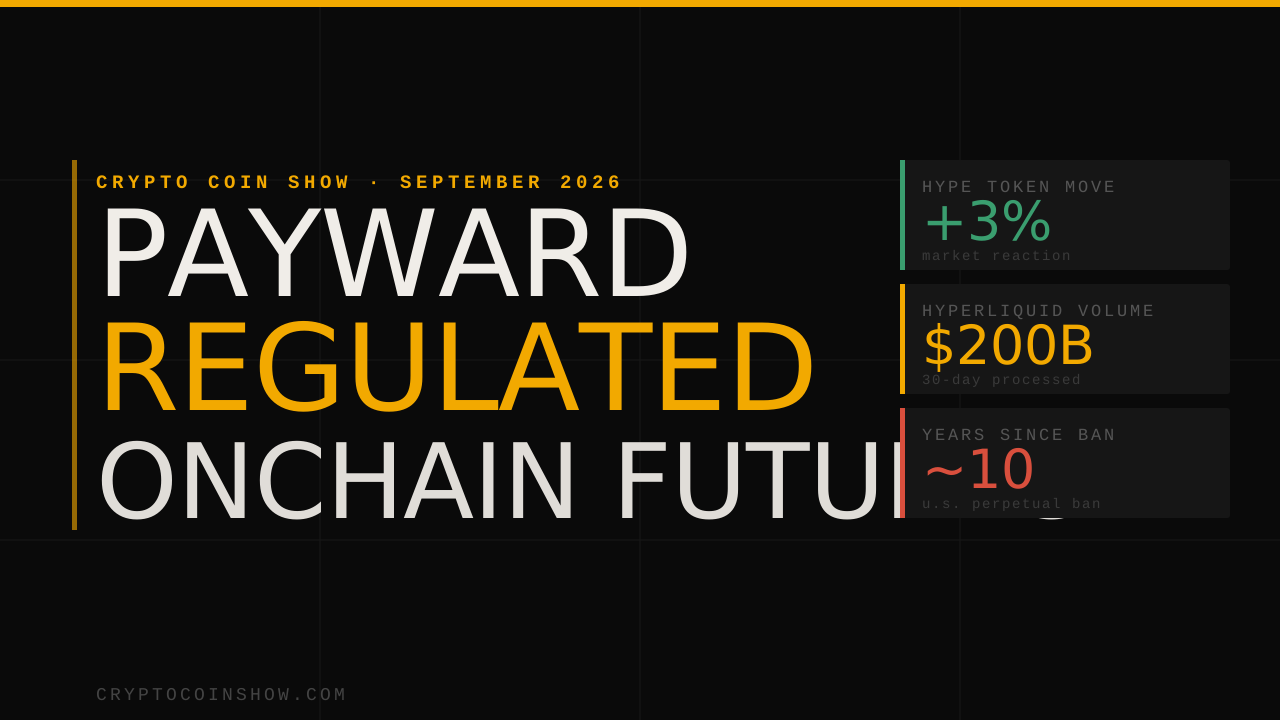
The SEC’s Crypto Task Force held a direct meeting with representatives from the Hyperliquid Policy Center, trade.xyz (XYZ Ltd.), and Sullivan & Cromwell LLP to discuss regulatory approaches for crypto assets and decentralized perpetual markets.
According to the official meeting memorandum issued by the Task Force, participants reviewed the Hyperliquid protocol’s technology and market infrastructure. The session was requested in a formal letter signed by Sullivan & Cromwell partner Natasha Vasan on behalf of the group.
Hyperliquid Execs Meet SEC Regulators for Clear Onchain Trading Rules
According to the official meeting memorandum issued by the Task Force, participants reviewed the Hyperliquid protocol’s technology and market infrastructure.
The session was requested in a formal letter signed by Sullivan & Cromwell partner Natasha Vasan on behalf of the group.
Key attendees included Hyperliquid Policy Center CEO Jake Chervinsky, Hyperliquid founder Jeff Yan, and product lead Collins Belton from XYZ Ltd., the primary HIP-3 deployer powering 24/7 perpetual contracts on the platform.
The Hyperliquid Policy Center launched in February 2026 as an independent 501(c)(4) organization focused on building a compliant path for Americans to access onchain derivatives. Today’s meeting marks one of its most visible engagements with the SEC since inception.
This comes as Hyperliquid has established itself as a major force in decentralized perpetuals trading. The talks reflect growing regulator interest in understanding high-performance onchain markets that operate continuously, including weekends.
$HYPE responded positively to the news, trading near $65 with intraday gains as investors priced in potential regulatory tailwinds for the ecosystem.
With the Crypto Task Force actively soliciting industry input, this meeting could influence future guidance on decentralized trading infrastructure. Further public comments or follow-up sessions are expected in the coming months as regulators work toward practical frameworks.
The discussion underscores a maturing phase in U.S. crypto policy, one where leading builders are moving from offshore innovation to direct dialogue with Washington.
Blockchain research firm L2BEAT published a comparative analysis of perpetual futures exchanges Hyperliquid and Lighter on July 2. In its findings, the research firm discovered that none of the platforms fully protects traders through verifiable math alone.
The report matters to anyone trading leveraged crypto derivatives on venues that market themselves as decentralized alternatives to the likes of Binance or Bybit.
Are perpetual DEXs delivering on all their promises?
Perpetual DEXs claim to offer custody over user collateral, and execution can be verified independently, according to L2BEAT’s research. The firm evaluated Hyperliquid and Lighter across property rights, order fairness, and position fairness.
Lighter operates as an Ethereum layer-2, posting validity proofs to a chain it does not control.
Hyperliquid, on the other hand, runs its own layer-1, where 28 validators handle both trade execution and settlement. The Hyperliquid Foundation directly controls half the staked tokens, with additional stake routed through a delegation program.
Should Lighter stop working, users are not necessarily left in limbo, as they can generate an account proof against the latest state root on Ethereum and withdraw funds independently.
If the same thing happened to Hyperliquid, L2BEAT reports that there is no permissionless exit path because the platform’s Arbitrum bridge relies on permissioned validator subsets (two groups of four validators each).
Do the validity proofs on Lighter and Hyperliquid have limits?
Lighter runs on zero-knowledge proofs, which means that operators cannot steal idle funds, fabricate USDC balances, or match orders at prices worse than the user’s limit. Similar standards on Hyperliquid are up to validator consensus.
However, L2BEAT’s analysis shows Lighter’s proofs are not evidence of full protection. The research firm discovered that oracle signatures used for mark prices are not verified on-chain or within the proof circuit.
On both platforms, order flow protections are absent. Neither venue prevents the operator from seeing, reordering, front-running, or censoring submitted orders, L2BEAT stated.
Lighter’s proofs guarantee that once an order enters the system, it cannot be altered in price or size. But the operator can insert its own orders ahead of users to become the best quote on the book.
What precedent did the JELLY incident set?
In March 2025, Hyperliquid had to carry out an operator intervention during the JELLY incident. It all started after three coordinated accounts opened opposing positions in the low-liquidity JELLY token. One of the accounts took a $4.1 million short while the other two went long for a combined $4.05 million.
As spot purchases pushed JELLY’s price up, the short position was liquidated and passed to Hyperliquid’s automated market-making vault (HLP), which could not absorb it.
Hyperliquid’s validators voted to delist JELLY and force-settled all positions at $0.0095, which is a fraction of the $0.50 price on decentralized spot markets at the time.
While that action saved the HLP vault from an estimated $13 million loss, it overrode the exchange’s own matching engine. The Hyper Foundation pledged to compensate affected users.
Based on L2BEAT’s analysis, Hyperliquid’s validator acts in ways that are similar to a traditional exchange operator, as they have the power to change trade outcomes through governance.
Lighter’s current contract setup also permits such action through upgradeable contracts with no time delay.
The trust ceiling
The core finding is that both platforms currently require trust in their operators for critical functions. Lighter’s advantage is in its L2 architecture, which could eventually reach Stage 2 decentralization by removing upgrade control, at which point Ethereum’s validator set would enforce the rules.
Hyperliquid’s L1 design means it does not have a similar path to Lighter’s.
The L2BEAT report has brought to the fore the depth of how decentralized these platforms are in terms of protection, and users using them should know the full extent of what is covered and areas where the lines blur between their chosen platforms and centralized exchanges.
Three altcoins are trading within striking distance of their record highs as the weekend begins. Rain (RAIN), Hyperliquid (HYPE), and ADI each sit close enough that one strong push could deliver a fresh all-time high (ATH).
Each token tells a slightly different story. RAIN is retesting its peak after a shallow dip, while HYPE and ADI recover from deeper corrections. The setups vary in strength, and the technical levels below explain why.
Rain (RAIN) Sits Less Than 3% From Its Record
Rain Protocol (RAIN) is the closest of the three to a breakout. The token trades near $0.0144, about 2.4% below its all-time high of $0.0148 set on May 27.
The recent correction was shallow. Price held the 0.786 reversed Fibonacci level and bottomed near $0.0125 before turning higher. RAI is now pressing directly into prior resistance.
A clean break opens the 1.272 Fibonacci extension near $0.0173 as the first target. The 1.618 extension near $0.020 marks the second. On the downside, the 0.618 reversed Fib level near $0.012 should act as support.
Fundamentals add weight to the setup. Rain recently entered the top three prediction markets by value locked, helped by fresh liquidity ahead of the 2026 FIFA World Cup. That demand could fuel the final move toward records.
Hyperliquid (HYPE) Holds Above $63 in Price Discovery
Hyperliquid (HYPE) remains in price discovery despite a pullback. The token trades near $66.70, roughly 13% under its record high of $76.70 printed on June 16.
So far, the dip has held above the 0.236 Fib retracement near $63.66. A standard continuation correction would target the 0.382 level near $55.40, which lines up closely with the previous all-time high around $59.40. That confluence forms strong support.
A deeper flush could reach the golden pocket near $42, where an ascending trendline also sits. Buyers would likely defend that zone.
Momentum has cooled slightly, with volume easing and the RSI slipping back toward neutral. Even so, the broader trend stays bullish, and continued institutional demand for spot Hyperliquid products keeps the path toward $77 open.
ADI Shows the Strongest Momentum of the Three
ADI looks the most explosive of the group. The token trades near $3.96, about 13% below its all-time high of $4.55 from April 3, yet its recovery stands out.
Price corrected into the 0.618 golden pocket near $3.65 and held firmly. Since then, volume has expanded steadily, a sign that buyers are stepping back in with conviction.
One hurdle remains. The 0.382 retracement near $4.00 is acting as resistance, and ADI needs a daily close above it to clear the way back to records. The RSI has turned higher without reaching overbought territory, leaving room to run.
The token also carries real catalysts. ADI Chain recently launched its mainnet as an institutional network for stablecoins, and its Predictstreet platform was named an official prediction market partner of the 2026 FIFA World Cup.