
Grove launches Basin for BlackRock and Janus Henderson tokenized funds instant stablecoin redemptions
Grove Labs has deployed a $1 billion daily liquidity facility that eliminates the two-to-three-day settlement delay plaguing tokenized fund redemptions, immediately enabling institutional investors in BlackRock’s BUIDL and Janus Henderson’s JTRSY to receive stablecoins on-chain without waiting for traditional finance workflows. The move addresses a critical friction point that has constrained adoption of the $15.2 billion tokenized Treasury sector despite 130% year-over-year growth.
- Grove’s Basin facility enables instant stablecoin payouts for tokenized fund redemptions, versus two-to-three business day delays from traditional settlement processes.
- BlackRock’s BUIDL ($2.58B) and Janus Henderson’s JTRSY ($1.24B) are the initial beneficiaries, with Securitize and Centrifuge as integration partners.
- The tokenized Treasury market has grown 130% year-over-year to $15.2 billion, but settlement friction has constrained further institutional capital deployment.
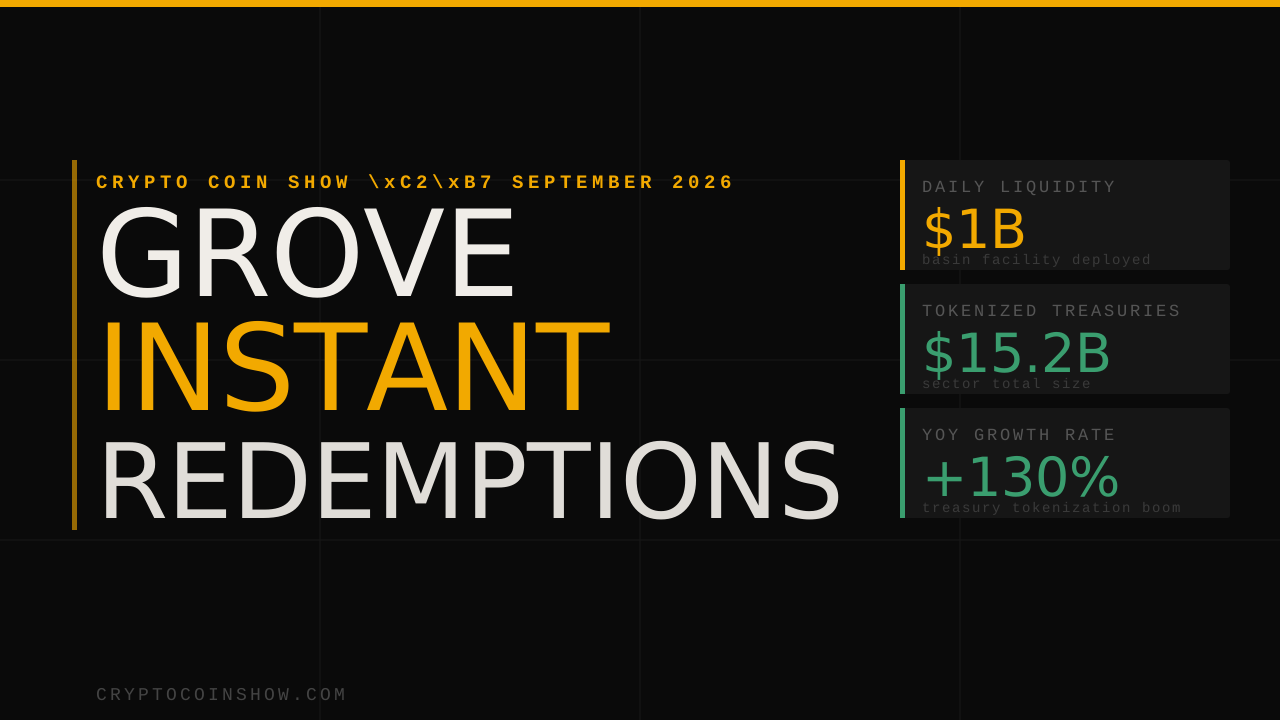
- $1B Daily stablecoin redemption capacity from Basin liquidity facility
- $15.2B Current tokenized Treasury sector size versus $6.6 billion one year prior
- 2-3 days Traditional settlement time eliminated by immediate on-chain payout model
Grove Labs, a subsidiary of Steakhouse Financial, has launched Basin, a programmable credit facility designed to solve one of the most persistent inefficiencies in institutional tokenized finance: the gap between on-chain redemption requests and off-chain cash settlement. When an investor redeems shares in a tokenized fund, Basin supplies stablecoins directly to the investor’s wallet in real time.
Grove then assumes the settlement risk, waiting for the fund administrator to complete the traditional banking transfer and repaying the facility days later. The arrangement transfers the operational friction from the investor to a party better positioned to bear it.
The timing reflects institutional tokenized finance reaching a maturity inflection point where basic operational mechanics have become competitive differentiators. Tokenized real-world assets, particularly U.S. Treasury funds, were supposed to deliver blockchain’s core promises: speed, 24/7 availability, and direct settlement.
Instead, they inherited the slowest layer of traditional finance, the backend cash settlement, while gaining none of the speed benefits that justify the technological migration in the first place. This contradiction has become an explicit constraint on institutional capital allocation.
BlackRock and Janus Henderson Activate Instant Redemptions on $3.82 Billion in AUM
BlackRock’s USD Institutional Digital Liquidity Fund (BUIDL) and Janus Henderson’s Anemoy Treasury Fund (JTRSY) are the immediate beneficiaries of the Basin deployment. BUIDL, which holds $2.58 billion in assets under management, integrates Basin through Securitize, the infrastructure provider that also manages fund operations. JTRSY, with $1.24 billion in AUM, connects through Centrifuge.
Both arrangements became live upon Basin’s launch, meaning institutional investors can now execute redemptions and receive stablecoins without entering a queue or waiting for a fund administrator’s business-day processing cycle.
Three major digital asset platforms have committed to connecting their institutional client bases directly to Basin’s liquidity network: Anchorage Digital, Galaxy Digital, and FalconX. This architecture matters because it creates multiple on-ramps for institutional capital and reduces friction in the end-user experience.
An investor with an existing relationship at any of these three platforms can trigger a redemption and receive stablecoins without navigating separate infrastructure or custody arrangements. The design mirrors how traditional prime brokers and market makers operate, layering institutional connectivity on top of blockchain settlement.
BlackRock’s Robbie Mitchnick, global head of digital assets, stated that fixing this “settlement friction” is necessary to make funds usable for institutions.
The language reflects a threshold problem: without instant settlement, tokenized funds remain slower than their traditional mutual fund counterparts, undermining the entire value proposition of blockchain-based vehicles to allocators comparing use cases.
Janus Henderson’s Nick Cherney characterized the development as “an absolutely essential component” for realizing the full benefits of blockchain, a statement that signals institutional consensus that the technology layer alone is insufficient, operational completeness is now table stakes.
Tokenized Treasury Market Triples in Size Amid Redemption Bottleneck
The deployment of Basin follows explosive growth in the tokenized Treasury sector, which has expanded 130 percent in the past twelve months to reach $15.2 billion in total assets. The three largest vehicles are Circle’s USYC ($2.91B), BlackRock’s BUIDL ($2.58B), and Franklin Templeton’s BENJI ($2.05B).
Combined, these three funds represent approximately $7.5 billion, or roughly half of the sector, illustrating the concentration of capital around established asset managers with existing institutional distribution channels.
Despite this growth, the settlement gap has become a documented constraint on further expansion. Institutional investors conducting due diligence on tokenized funds are asking explicit questions about redemption timelines.
A fund that requires two-to-three-day settlement for a cash-out operation cannot claim a technological advantage over traditional alternatives, even if the fund itself trades and operates on-chain.
This comparison has begun to affect capital deployment decisions, particularly among allocators who are operationally sensitive to cash flow timing, pension funds, insurance companies, and corporate treasurers whose cash management procedures depend on predictable settlement cycles.
The Basin solution directly addresses this competitive disadvantage. By guaranteeing immediate stablecoin settlement, tokenized fund sponsors can now claim operational parity or superiority to traditional vehicles while preserving the on-chain trading and transparency benefits that motivated the initial migration to blockchain.
This removes a material objection from the institutional sales process and lowers the adoption barrier for funds that have already built blockchain infrastructure but remain constrained by backward-compatible settlement mechanics.
BlackRock Files to Launch Two Additional Tokenized Vehicles as Basin Goes Live
The deployment of Basin coincides with BlackRock’s filing with the U.S. Securities and Exchange Commission to launch two new tokenized fund vehicles: a tokenized version of the existing BlackRock Select Treasury Based Liquidity Fund (BSTBL) and a new fund called the BlackRock Daily Reinvestment Stablecoin Reserve Vehicle (BRSRV).
The timing suggests that BlackRock is accelerating its tokenized asset strategy based on improved operational conditions, removing the settlement friction creates additional rationale for launching new vehicles and migrating assets that may have remained in traditional structures under higher redemption friction.
The BRSRV fund name specifically references daily reinvestment mechanics, a feature that likely depends on efficient settlement to function smoothly. A vehicle structured around daily reinvestment requires fast, predictable cash-in and cash-out flows.
Without instant settlement, daily reinvestment funds either operate on delayed cycles (reducing their appeal) or require sophisticated treasury management to bridge the gap between on-chain activity and off-chain settlement. Basin eliminates this constraint at the engineering level, making daily reinvestment mechanics feasible without operational complexity.
The two new filings represent BlackRock’s confidence in the institutional market’s readiness to adopt tokenized vehicles at scale. Filing to launch additional vehicles immediately after Basin’s launch signals that asset managers see the operational constraints as effectively resolved.
Whether the SEC approves these filings in the near term remains an open regulatory question, but the volume and pace of applications suggest that both asset managers and regulators are moving in alignment on how tokenized funds should function operationally.
The settlement gap fix may prove to be the operational prerequisite that regulators were implicitly waiting to see implemented before approving new vehicle launches at scale.
The next critical milestone is the SEC’s approval or denial of BlackRock’s two pending fund applications. The agency has shown willingness to approve tokenized Treasury vehicles, having greenlit BUIDL in 2024, but the pace of new approvals will indicate whether Basin’s settlement solution has satisfied regulatory confidence in operational robustness. Simultaneously, watch whether other tokenized fund sponsors (Franklin Templeton, Circle, Janus Henderson) announce integration with Basin or launch competing settlement facilities, as the market structure around instant redemptions is likely to become a competitive battleground within the next six to twelve months as AUM in tokenized assets continues