Malaysian authorities have revoked the business license of Network School, a technology community founded by former Coinbase CTO Balaji Srinivasan.
The decision followed scrutiny over alleged links to Israeli participants. However, local officials said they cancelled the license over business and premises violations.
The Iskandar Puteri City Council ordered NS0 Malaysia Sdn Bhd to stop all operations at Forest City from July 22. Officials said the company operated from two premises. One site did not have the required business license.
Meanwhile, inspectors found that the company carried out activities beyond those approved under its existing license. Authorities also found problems with its advertising signboard.
Network School is not shutting down; that’s fake news.
We received two notices. The first tells us to change the text of a sign. The second says that our coworking site, which was created by joining two adjacent units, evidently has a valid license on the left hand side but not…
The case began after pro-Palestinian activists raised concerns about possible Israeli participation at Network School.
Online posts alleged that Israeli entrepreneurs had entered Malaysia using passports issued by other countries. The claims also raised questions about the school’s admission process and its interest in Israel, politics and military technology.
However, Malaysian immigration officials later inspected 266 foreign residents from 40 countries.
They said everyone checked had valid travel documents. Authorities did not publicly confirm that any participant had entered Malaysia illegally as an Israeli national.
Malaysia does not recognise Israel and generally does not allow entry using Israeli passports. However, Israeli dual nationals may enter using valid passports from other countries if they meet Malaysian immigration rules.
Prime Minister Anwar Ibrahim said authorities would expel any Israeli national found breaking local laws.
Breaking News: The state of Johor has shut down @balajis‘ Network School.
The only remaining Network School entity will be in Singapore, where it is incorporated.
Congratulations, Singapore now you can have Balaji, the Network State, and the Network School. https://t.co/cKR15y2kws
Network School opened in Forest City, Johor, in 2024.
Despite its name, Malaysia’s Higher Education Ministry said it was not a registered university or private education provider. Officials described it as a residential and co-working community for technology founders, investors and startup workers.
The project became known for promoting Srinivasan’s “network state” idea. The concept involves online communities building physical settlements and developing their own economic and governance systems.
The school offered accommodation, meals, workspaces, startup programmes and fitness activities. It attracted people from the crypto, technology and investment sectors.
I am pleased to announce that a memorandum of understanding has been signed between the Republic of Kazakhstan and Network School. Our new campus will become a haven for global techno-optimism, with expedited visas, streamlined redomiciliation, and active recruitment of talent. pic.twitter.com/R20i8UAYoc
Srinivasan denied the claims about Israeli links before the license was cancelled.
He said anonymous social media accounts had spread false allegations. He also warned that the investigation could damage Malaysia’s reputation among international technology investors.
According to Srinivasan, Network School had invested more than 100 million Malaysian ringgit in Forest City. He said the company had planned a further 500 million ringgit expansion.
The company placed those plans on hold during the investigation.
Srinivasan joined Coinbase in 2018 after the crypto exchange acquired Earn.com, where he served as chief executive.
Coinbase appointed him as its first CTO. His role focused on technology strategy, crypto advocacy and recruitment. He left the company in May 2019.
Malaysia and Israel’s Diplomatic Roadblocks
Malaysia has a long-standing policy of refusing formal diplomatic relations with Israel and strongly supporting Palestinian statehood. Israeli passport holders are generally barred from entering without special permission, and Malaysian passports have historically excluded travel to Israel.
Malaysia warns any Israelis found in the country will be immediately deported —— Malaysian Prime Minister Anwar Ibrahim said on Wednesday that authorities are investigating allegations that an Israeli national may have been involved in the activities of a private residential… pic.twitter.com/PyL28Ye5b4
In 2024, 22 Malaysian civil-society organisations urged the government to block a consortium’s proposed privatisation of Malaysia Airports because one consortium member, Global Infrastructure Partners, was being acquired by BlackRock.
Campaigners alleged that BlackRock had significant Israeli connections and investments.
The government did not cancel the airport transaction solely on that basis. Global Infrastructure Partners later said BlackRock would not participate in the deal.
MVMT Labs, Inc., the original developer of the Movement blockchain, filed for Chapter 11 bankruptcy in Delaware on July 15, 2026. Days later, the Movement (MOVE) token slid to an all-time low of $0.0104.
Move Industries, the separate company that took over ecosystem development in 2025, says the case does not touch its operations. MOVE trades near $0.0108, down 94% over the past year.
Movement (MOVE) Price Performance. Source: BeInCrypto
Inside the MVMT Labs Bankruptcy Filing
Court records show a voluntary Subchapter V petition, a streamlined Chapter 11 track for small businesses. Case 26-11113 sits before Judge Thomas M. Horan in the District of Delaware.
The petition lists assets between $100,001 and $1 million against liabilities of $1 million to $10 million. Creditors number between 200 and 999.
The estate is a fraction of the project’s former scale. MOVE peaked at $1.45 in December 2024 before a disputed market making deal dumped 66 million tokens on launch day and crushed the price.
The remaining team rebranded to Move Industries in May 2025 under CEO Torab Torabi. It pivoted toward stablecoin payments for emerging markets this June. On July 21, Torabi rejected talk of a project collapse.
You may have seen the news about the Chapter 11 filing by MVMT Labs, Inc. on July 15th.
Two things worth saying clearly:
1 – MVMT Labs, Inc. is a separate legal entity, and Move Industries is not part of that filing.
Markets have yet to reward that confidence. MOVE holds a $45 million market cap at rank 473, and its price action this week will show whether traders buy the separation.
The court expects a restructuring plan by October 13, 2026, which may reveal what remains inside the bankrupt entity.
Humanoid, a London-based builder of wheeled industrial robots, has raised $152 million in a Series A funding round. The two-year-old company is now valued at $1.35 billion.
Forbes has labeled Humanoid Europe’s first robotics unicorn and the funding round lands just as investors begin to pour money into “physical AI.”
Who is buying Humanoid stocks?
Humanoid has announced that it raised $152 million in a Series A funding round led by Prime Movers Lab. The company says the raise pushes its total funding to $270 million. Following the round, the company is now valued at $1.35 billion.
Humanoid told reporters that it expects beta robots to be operational at customer sites in the fourth quarter of 2026, spread across the manufacturing, logistics, and retail industries. To achieve this goal, Bosch will act as contract manufacturer, handling parts sourcing and production.
Schaeffler, a German industrial supplier, has signed a separate agreement covering the planned rollout of thousands of robots inside its factories. Humanoid also lists SAP (ETR: SAP), NVIDIA (NASDAQ: NVDA), and Siemens (ETR: SIE) among its Fortune 500 partners.
The founder and CEO of Humanoid, Artem Sokolov, said in a statement that the funding provides the company with the resources to move even faster and to turn humanoid robots from “breakthrough technology into everyday industrial tools.”
Zia Huque, a general partner at Prime Movers Lab, said he expects the humanoid field to “consolidate around a handful of category leaders across the U.S., Europe, and China,” and stated that Humanoid would be one of them.
The Hurun Research Institute counted 80 unicorns in the UK as of July 1, worth a combined £242.4 billion and ranking the country third globally behind the United States and China and Humanoid is now one of those companies.
China minted 67 unicorns in the first half of 2026, according to Cryptopolitan’s previous reporting. Notably, the AI and robotics industries accounted for more than half of those unicorns.
What will Humanoid do with the money from its funding round?
Humanoid’s newly raised funds will be used for several key projects, like developing its next-generation robot platform. The company also plans to start mass manufacturing its wheeled robots and intends to expand its AI software, specifically its proprietary AI system called KinetIQ.
KinetIQ is the part of Humanoid’s technology that lets the company’s robots understand and carry out physical tasks, essentially the brain. The system is designed to coordinate entire fleets of robots, even if the robots have different bodies and jobs.
Humanoid says it has also secured 34,000 robot pre-orders worth $2.4 billion and completed nine proof-of-concept projects with its wheeled robot, the HMND 01.
Humanoid is pitching its wheeled robots as an answer to labor shortages in factories and warehouses, where employers want steadier output and less employee turnover.
Don’t just read crypto news. Understand it. Subscribe to our newsletter. It’s free.
Bitcoin (BTC) continues to trade in a consolidation phase, a little above the $60,000 level. The market is approaching 165 days of testing that crucial price zone despite a rally above $80,000 in May that ultimately failed to sustain momentum, according to analyst Darkfost.
The analyst pointed to a lack of fresh liquidity entering the crypto market as one of the main reasons behind Bitcoin’s inability to establish a stronger uptrend.
Stablecoin Drain
Fresh demand has struggled to materialize for both Bitcoin and the broader crypto market, the analysis said. Exchange stablecoin reserves have reflected that trend since the beginning of the year, which essentially shows a near-continuous decline as outflows consistently outpaced inflows.
Over the past 30 days, Binance recorded approximately $1.55 billion in stablecoin outflows – a significant reduction in reserves over a relatively short period. Bybit also saw a further $786 million leave its stablecoin reserves during the same timeframe. In total, the two exchanges recorded nearly $2.3 billion in stablecoin outflows over the past month.
Darkfost explained that the falling reserves indicate that incoming liquidity and investor demand are continuing to contract. The analyst added that market participants appear to be withdrawing stablecoins from exchanges rather than deploying them into crypto assets, while some may be exiting the market entirely.
According to the analysis, such a “pessimistic” market positioning continues to limit the liquidity available to Bitcoin, which then ends up preventing the asset from making a meaningful breakout above its long-running consolidation range around the $60,000 level.
Accumulation Opportunity
Some market analysts, such as Doctor Profit, believe that the ongoing market conditions present a gradual accumulation opportunity. The analyst recently said that investors waiting for Bitcoin’s traditional four-year cycle bottom could end up missing the market’s next move.
Meanwhile, market trader Daan Crypto Trades said the crypto asset is on track to close another weekly candle above its 200-week moving average (200MA), a level often watched as an important long-term support indicator. However, the trader said a stronger move higher is still needed to retrace the previous decline and reclaim the 200-week exponential moving average (200EMA). Until that happens, Bitcoin is expected to remain stuck in its “choppy” trading range around the current level.
With the cryptocurrency exchange scheduled to report data on July 30, traders on prediction market platforms are wagering that Coinbase’s trading volume in the second quarter fell significantly below projections.
Part of the reason the bets are getting attention is that the platforms that handle them have expanded significantly in the last 12 months.
In April 2026, the total trade volume on Kalshi and Polymarket reached $24 billion, almost five times more than it had been less than a year before.
Traders on Kalshi believe that Coinbase’s trading activity was impacted by the roughly 12% drop in Bitcoin’s price during the second quarter.
It is anticipated that the exchange will announce a third consecutive quarterly decline in volume.
There is a good chance that the total would fall below $200 billion, which would be the lowest amount the corporation has reported since the third quarter of 2024.
The prices of Kalshi’s contracts spell out just how cautious sentiment has become. Traders put a 41% probability on Coinbase’s quarterly volume clearing $160 billion.
According to FactSet, the likelihood of it exceeding $170 billion is merely 25%, which is already below Wall Street’s consensus forecast of $168.5 billion.
However, there is a 99% chance that volume will remain above $150 billion, so bettors are not pricing in a complete collapse. Kalshi determines how these contracts settle using information from the investing research site Fiscal.ai.
The stock of Coinbase hasn’t fared any better. Since Bitcoin peaked in October 2025, shares have dropped more than 55%.
This decline is consistent with the general pressure that has built up throughout the cryptocurrency markets during that time.
World Cup drives a surge in new users
The growing use of prediction markets to price in financial results is happening alongside a sharp growth period for both of the industry’s leading platforms.
According to CBS Sports, their best picks for prediction markets 2026 include Kalshi at number one, while Polymarket at number two, with DraftKings and FanDuel Predicts following after.
Both have added large numbers of users in recent months, helped in part by high-profile events that brought them in front of audiences who had never used prediction markets before.
The amount traded in a single contract on which nation will win the title exceeded $1.2 billion, setting a record for any one market on the platform.
The total amount spent on Kalshi during the World Cup was $12 billion. In addition to promoting Luka Modric, José Mourinho, Lionel Messi, Timothée Chalamet, and J Balvin, the platform partnered with OpenAI to show current contract odds within ChatGPT.
The strategy, according to Tarek Mansour, CEO and co-founder of Kalshi, is “where the news is at.”
Now that the World Cup is over, the platform’s problem is how to retain those new users when nothing of a similar magnitude is scheduled.
Political volume and the regulatory divide
In the world of political betting, Polymarket is still in the lead.
The site generates about $507 million in weekly political bets, accounting for an estimated 93% of all political prediction market transactions.
In contrast, Kalshi registers a weekly political volume of roughly $16.8 million. Politics accounts for 32% of Polymarket’s total activity, but only 4% of Kalshi’s.
Within Polymarket, the business is divided between two very different operations.
Its offshore platform generated $9 billion in volume during April 2026. The US-regulated version of the platform brought in $1.3 billion in the same period.
For traders who wish to use prediction markets to hedge positions around outcomes from established firms like Coinbase, that separation has significant ramifications.
The CFTC is currently looking investigating Polymarket for potential insider trading in contracts related to geopolitical events.
Institutional traders have a legally valid way to take positions on company earnings and volume expectations in real time thanks to Kalshi, a local, licensed business.
The outcome could also serve as another test of whether prediction markets are becoming a reliable barometer for corporate earnings expectations.
Don’t just read crypto news. Understand it. Subscribe to our newsletter. It’s free.
Even as the AI bubble becomes a mainstream talking point on Wall Street, tech companies continue to peddle the fantasy that AI is poised to become an almost magical money-maker. Case in point, OpenAI wants you to believe that by 2030, it’ll be raking in $100 billion a year just from ads alone — even though it’s currently struggling to reach just $1 billion.
That massive gulf was observed in a new analysis from marketing consulting firm Emarketer, first flagged by AdWeek, which found OpenAI is on pace to undershoot its own five-year ad revenue projections by a whopping 90 percent. In fact, Emarketer’s take is even more devastating than that: it estimates that the entire addressable market for chatbot advertising — the maximum amount of money up for grabs overall — at $5.4 billion.
That figure isn’t just bad news for OpenAI, but for every giant tech company, all of which are jockeying for a piece of the AI ad pie. In 2026, Emarketer projects that the combination of OpenAI, Microsoft, Google, and Amazon will bring in under $1 billion in ad revenue. For context, OpenAI had projected that its AI ad revenue alone would hit $2.5 billion by the end of this year.
It all adds up to a difficult question for investors. If the top AI companies — which have burned over $1.6 trillion building AI so far — can’t even hit OpenAI’s meager projection for 2026, what hope do they have of hitting their projections four years from now?
To hit that number, AdWeek observes, OpenAI needs three miracles to happen all at once. First, advertisers have to abandon decades worth of infrastructure built around search engines and social media and put all their advertising budgets into chatbots. Once that happens, OpenAI has to out-muscle previous ad-sales giants like Google and Meta, while the entire AI-ad market balloons from just a six-figure stream in 2026 to a raging, 12-figure river by 2030.
Basically, OpenAI will have to make a lot of history to justify these numbers. And whether it can do so is no small matter: according to OpenAI’s own forecasts, advertising is supposed to make up 36 percent of the company’s total revenue by 2030. If the AI lab can’t make the math work, the company’s five-year financial story falls apart, and with it, a major bullet point justifying one of the largest financial bubbles the world has ever seen.
The Chinese robotics market had a blast in the first half of the year, with sales topping the rest of the world.
Data released by the Ministry of Industry and Information Technology on Monday says Chinese quadruped robots accounted for nearly 70% of global sales in H1 2026. China has also now built 400 humanoid robot models, accounting for more than half of the global market.
Most of the supply chain ran through Zhejiang, according to Global Times. The province shipped more than 1 billion yuan ($147 million) worth of robots in the first half. Its intelligent bionic robot exports accounted for about 60% of China’s total exports during the period.
“China has already taken the lead,” says industry expert
China witnessed massive growth across different sectors in the first half of the year, including artificial intelligence, semiconductors, new energy, and biomedicine, as reported by Cryptopolitan.
The boom added 67 new unicorns to the Chinese market, the second-best half-year growth in China since 2021, when 76 unicorns were created.
Led by DeepSeek, the growth was mostly concentrated on AI and robotics, which together accounted for more than 53% of the unicorns.
The H1 performance puts a firm floor under China’s claim to lead the robotics sector.
During the World AI Conference in China last week, the chief scientist at the Shanghai-based National and Local Co-Built Humanoid Robotics Innovation Center, Jiang Lei, asserted, “China has already taken the lead in several core areas of embodied intelligence, particularly manufacturing, datasets, and training environments.”
China on track to produce 100,000 humanoid robots in 2026
In terms of manufacturing, speakers at the conference believe China is on track to produce more than 100,000 humanoid robots this year.
Last year, China made only about 20,000 units. However, it’s already surpassed 40,000 in the first half, according to recent reports.
The output figures align with how Wall Street has been revising its expectations for the year.
Morgan Stanley has raised its forecast for Chinese humanoid shipments twice this year. In June, the bank raised its 2026 forecast to 50,000 units, up from an initial estimate of 14,000 at the start of the year and a spring revision of 28,000.
The Wall Street bank expects China’s humanoid robot market to reach $2 billion in 2026 and up to $15 billion by 2030.
Don’t just read crypto news. Understand it. Subscribe to our newsletter. It’s free.
A real German rail timetable has now been processed with a quantum system, giving the industry a test using railway data rather than a classroom example.
IQM Quantum Computers (Nasdaq: IQMX) cooperated with Deutsche Bahn in running 190 train paths in five cities. This scheduling problem offered 98,500 combinations, making the task impossible to check manually.
The researchers combined high-performance computing with quantum Computing for the remaining portion of the job. Results were published in a white paper by IQM. This research investigated whether present-day technology can generate a practical railway schedule before fault-tolerant technology becomes available.
Researchers divide the railway schedule into smaller Quantum jobs
IQM employed the use of a Quantum Approximate Optimization Algorithm, referred to as QAOA, in phases. The Classical part handled the entire railway problem. While the quantum processor solved specific subproblems within its reach, the results were fed back into the overall scheduling system.
The model is also useful in other industries where similar optimization problems exist. They are faced in transport, energy, manufacturing, and distribution, where firms have to choose from various options.
Three conclusions were drawn from the trials. First, the model was able to generate valid schedules with existing computer hardware. There was no need for any future computer processor or fault-tolerant computer. This way, organizations can experiment with Hybrid quantum optimization without waiting for new technology.
Second, the processing performance increased as the processor managed more data. There was a statistically significant relationship observed by the researchers between the task assigned to the quantum chip and the quality of the result. Increased capabilities of the processors would allow the current software architecture to produce better schedules without modifications.
Third, IQM ran the full chain on its own computer. The process began with the scheduling question and ended with a usable final result. No major stage remained limited to simulation.
As reported by Dr. Inés de Vega, IQM’s chief scientist, “the collaboration demonstrates that quantum computers are already powerful enough to solve such industrial-scale optimization challenges.” As per her statement regarding the collaboration with Deutsche Bahn, she said, “this partnership offers us an exemplary roadmap on how quantum computing provides value today and scales naturally through improved hardware.”
Manfred Rieck, Deutsche Bahn’s head of quantum technology, said, “Quantum computing is not going away. By tackling a real-world problem in a hybrid HPC and quantum computing environment, we have taken another step toward quantum advantage.”
IBM connects major Quantum spending with a volatile stock story
The rail test covered a fixed plan where the main conditions were already known. Daily operations can change within minutes because of delays, blocked tracks, equipment faults, or other disruptions. Researchers said the same hybrid setup may later help with faster decisions as quantum hardware improves.
The report arrives while International Business Machines (NYSE: IBM) draws investor attention through its own quantum plans. IBM climbed above its earlier record from April 2013, when shares traded near $215 to $216. Since the September 2024 breakout, the price has mostly stayed between about $200 and $325 to $335.
IBM reached $324.90 on November 25, 2025, then hit $332.46 on June 3, 2026. Quantum announcements helped fuel both runs. On June 3, IBM said it would spend $10 billion over five years and aim to deliver its first fault-tolerant quantum computer by 2029.
That followed a May 21, 2026 announcement from the U.S. Department of Commerce. The agency said IBM would receive a $1 billion grant to create Anderon, a separate business expected to become the first pure-play quantum foundry in the United States.
IBM shares have also fallen sharply after the excitement fades. The stock has risen when the wider quantum group rallies on fresh news, then dropped when those stories lose attention.
Management has sent mixed messages on artificial intelligence. During the April 2026 earnings call, IBM did not update its AI order book after giving that figure during the previous three calls, even though the earlier numbers showed growth.
IBM will report second-quarter 2026 results after trading ends on Wednesday, July 22. Analysts lowered expectations after a negative pre-announcement the week before. That warning sent the stock down about 25% during the trading day.
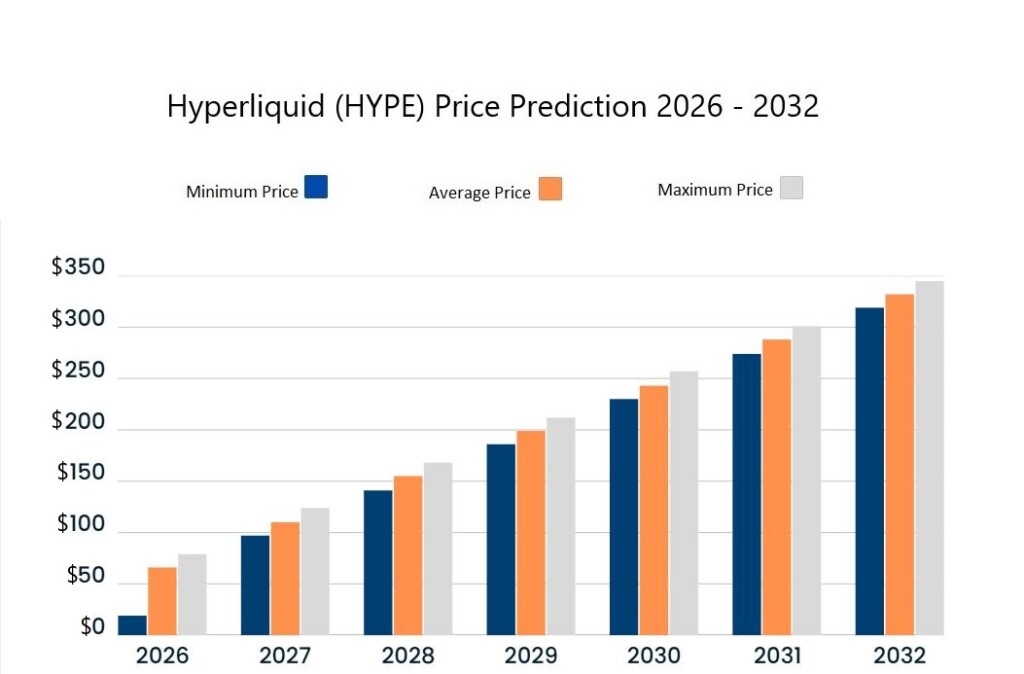
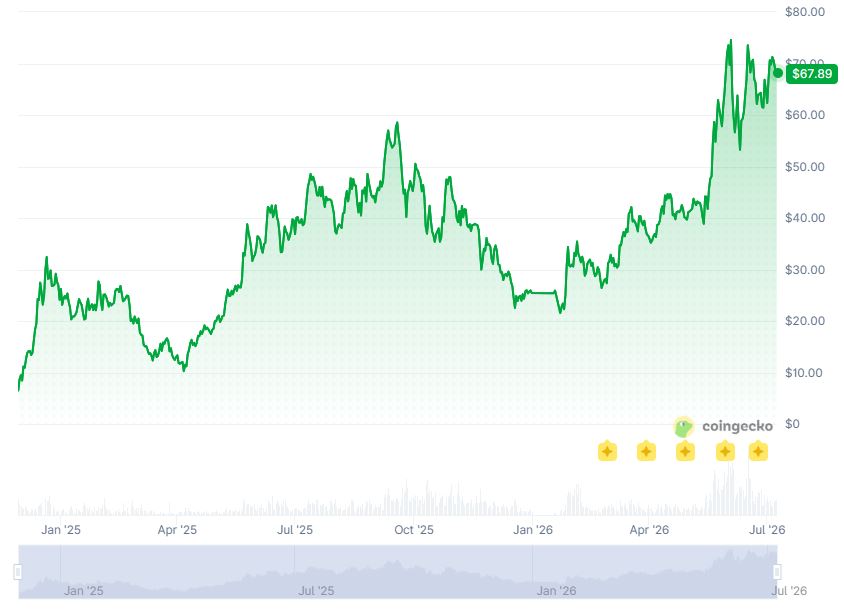
The Hyperliquid price prediction anticipates a high of $79.77 by the end of 2026.
In 2029, it will range between $187.03 and $213.01, with an average price of $198.99.
In 2032, it will range between $318.95 and $346.16, with an average price of $333.12.
Hyperliquid is a leading decentralized exchange (DEX). It has its own Layer 1 blockchain, and HYPE is its native token, which is used for staking, governance, and payments within the ecosystem.
One of the key features of Hyperliquid, along with its high-speed platform, is that it offers crypto perpetual futures for trading by its users without the need to own the asset. The platform supports a number of cryptocurrencies, including but not limited to BTC, ETH, SUI, AVAX, and SOL, to name a few.
Technically, the Hyperliquid blockchain is based on two protocols, namely HyperEVM and HyperBFT; combined, they help provide high-speed trading and Ethereum-based smart contracts with reliability to support the Hyperliquid ecosystem.
The Hyperliquid platform revolves around community participation, as token holders have voting rights to govern and influence developments taking place on the platform.
On November 29, 2024, Hyperliquid conducted an airdrop of its native token, HYPE, but unlike other players, it was selective in allocating the airdrop to only 94,000 users with an average value of $45,000 to $50,000, making it one of the most worthy airdrops in crypto history.
Let’s take a deep dive into what the future holds for the HYPE token in Cryptopolitan’s Hyperliquid price prediction for 2026 and beyond.
Overview
Cryptocurrency
Hyperliquid
Token
HYPE
Price
$60.99 (+3.58%)
Market Cap
$15.46B
Trading Volume
$253.2M
Circulating Supply
252.88M HYPE
All-time High
$76.70 (Jun 16, 2026)
All-time Low
$3.2 (Nov 29, 2024)
24-hour High
$61.33
24-hour Low
$58.39
Hyperliquid Price Prediction: Technical Analysis
Metric
Value
Price Prediction
$47.72 (-21.54%)
Price Volatility (30-day variation)
4.69%
50-Day SMA
$65.43
200-Day SMA
$43.49
Market Sentiment
Neutral
Fear & Greed Index
28 (Fear)
Green Days
14/30 (47%)
Hyperliquid Price Analysis
TL;DR Breakdown:
Hyperliquid price analysis indicates an upward trend at $60.99.
Cryptocurrency has gained 3.58% of its value.
HYPE token faces strong resistance around the $66 range.
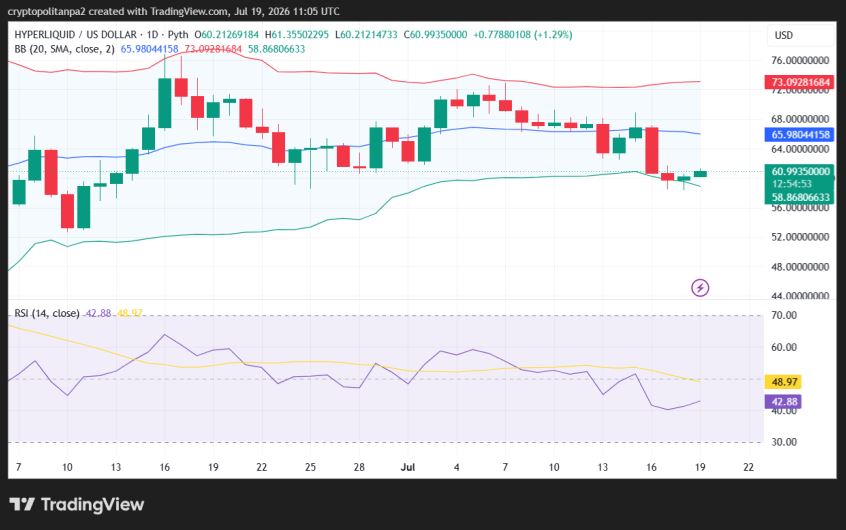
On July 19, 2026, Hyperliquid price analysis revealed a bullish trend, as the altcoin is now trading at $60.99 after dipping to a low of $58 yesterday. From an overall view, the altcoin gained a significant 3.58% in its value over the last 24 hours. This recovery creates relatively favorable circumstances for buyers, as the altcoin was previously following a downward trajectory. However, market conditions appear risky, as the token may start to correct again by the next trading session.
HYPE/USDT 1-day chart analysis
The one-day price chart of Hyperliquid Coin shows a bullish trend in the market. The cryptocurrency’s value has increased to $60.99 during the day, as traders continue to buy more. At the same time, a new green candlestick on the price chart signifies the presence of bullish elements, as the price has started to increase. Buyers are leading the price action at the moment because buying interest is present at the current price level.
The distance between the Bollinger Bands defines the intensity of volatility. This distance is wide, leading to high volatility levels, as the bands are diverging. Moreover, the upper limit of the Bollinger Bands indicator, indicating resistance, has shifted to $73. Conversely, its lower limit, indicating support, has moved to $58.
The Relative Strength Index (RSI) indicator is trending in the neutral region. The indicator’s score has increased to 42 today. This condition is reflected by an upward-pointing RSI curve. If buying activities continue to intensify, the indicator’s reading can increase further into the neutral range.
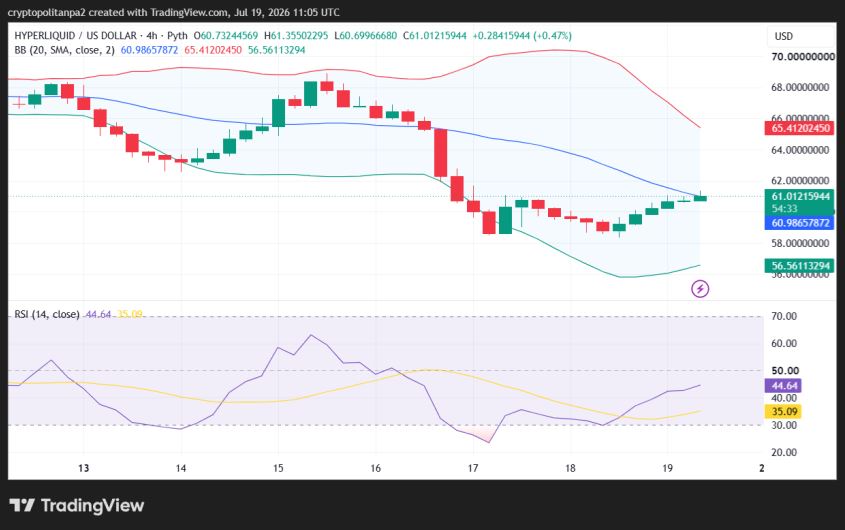
HYPE/USDT 4-hour chart analysis
The four-hour price analysis of Hyperliquid also indicates positive sentiment in the market on an hourly basis. The HYPE/USD price has increased to $61.01 over the past few hours as buying interest persists. The low volatility on the 4-hour chart also suggests a lower probability of an imminent reversal or further price appreciation.
The Bollinger Bands are covering comparatively less area, resulting in low volatility levels. This condition typically signifies less market unpredictability. Technically, the upper Bollinger Band has shifted to $65, indicating a resistance level. Conversely, the lower Bollinger Band has moved to $56, indicating a strong zone of support.
The RSI indicator has been moving down in the central neutral region during the last 4 hours, as its value has decreased to 42 for now. Overall, selling activity remained high during the last four hours of the day, which has resulted in an increase in the indicator’s score.
Hyperliquid Technical Indicators: Levels and Action
Daily simple moving average (SMA)
Period
Value ($)
Action
SMA 3
60.19
BUY
SMA 5
62.57
SELL
SMA 10
64.52
SELL
SMA 21
66.03
SELL
SMA 50
65.43
SELL
SMA 100
55.62
BUY
SMA 200
43.49
BUY
Daily exponential moving average (EMA)
Period
Value ($)
Action
EMA 3
60.90
BUY
EMA 5
61.96
SELL
EMA 10
63.72
SELL
EMA 21
64.92
SELL
EMA 50
62.98
SELL
EMA 100
57.00
BUY
EMA 200
49.68
BUY
What to expect from Hyperliquid price analysis?
Hyperliquid price analysis gives a bullish prediction regarding ongoing market events. The coin’s value increased to $60.99 in the past 24 hours, after it touched the $58 level. According to an overall analysis, the currency gained 3.58% in its value today. Technical indicators give neutral signals, but the price charts showcase a bullish market scenario at the time of writing.
Why is Hyperliquid up?
The cryptocurrency market is showing positive trends, and HYPE is receiving the same sentiment. It is encouraging that HYPE marked a new ATH a few days ago, on June 16, 2026. From a broader perspective, the HYPE price increased to $60.99, gaining 3.58% in its total value today. The token is still trending in its higher price envelope.
Is Hyperliquid a Good Investment?
HYPE has growing utility, and its Ethereum compatibility helps it steal a share of the DeFi industry. BitMEX co-founder and influencer Arthur Hayes is one of the most prominent mega-bulls and a primary financial backer of Hyperliquid. Through his family office/fund, Maelstrom, Hayes has made HYPE his largest liquid altcoin position.
Arthur Hayes utilizes a revenue-based price prediction tool to analyze how the protocol captures volume from traditional markets, such as its recent $1.7 billion daily peak in oil perpetuals. He maintains that Hyperliquid’s HYPE token is fundamentally de-risked by a robust mechanism that directs 97% of protocol fees toward token buybacks.
Hayes wrote and published a detailed investment thesis titled “Valhalla,” where he revealed that Maelstrom was aggressively selling off other holdings (like ENA, PENDLE, and ETHFI) to increase its exposure to Hyperliquid. In his predictions, Hayes argued to set a very public price target of $150 for HYPE by August 2026. This proves that in his predictions for the HYPE token, Arthur Hayes is extremely bullish. While the technical analysis can change from bullish to bearish with new regulatory developments, price predictions paint a different picture. However, this is not investment advice, and a risk analysis is recommended.
Will Hyperliquid reach $70?
The current price action does justify predicting a $70 target. In the cryptocurrency market, things change rapidly, but if the token maintains its price levels, a rally can be initiated. It can be expected that HYPE will reach above $70 by any time in 2026, once again, as it did a few days ago.
Can Hyperliquid Coin reach $100?
According to Hyperliquid price prediction, HYPE price might surpass $100 in 2027. The highest price HYPE could attain that year is expected to be above $123.17.
Will Hyperliquid reach $500?
According to crypto analysts’ price predictions, Hyperliquid may not reach this level in the next five years. Considering the current market cap of the token, it seems like far target.
Will Hyperliquid reach $1000?
Per the Cryptopolitan’s HYPE price prediction, Hyperliquid is unlikely to reach $1000 before 2032.
How high can Hyperliquid go?
The highest expected price for Hyperliquid is $346.16, which it will achieve in 2032.
Does Hyperliquid have a good long-term future?
Hyperliquid is trading higher than its December 2025 price levels, making it an ideal time for buyers to enter the market. Hyperliquid is now offering Brent and WTI futures. The oil trades are available through the HIP-3 framework on the XYZ exchange, as traders bet high on oil as it smashed through $100 for the first time in years. It is important to remember that XYZ:CL, representing WTI oil, entered the top 5 of the most traded futures in its first week. Given its current price and a favorable future valuation of $346.16 by the end of 2032, the asset appears to be a worthwhile investment.
Recent News/Opinions on Hyperliquid
Cryptopolitan reported that Hyperliquid is now available on TradingView, offering users around the world direct access to on-chain, decentralized perpetual futures in crypto, equities, commodities, and foreign exchange.
According to a report by Cryptopolitan, Multicoin Capital (Multicoin) published a full valuation for HYPE, indicating the protocol’s annual revenues will reach approximately $8 billion by 2028, resulting in a price target of $319, over five times its current trading value of around $67.
Hyperliquid Price Prediction July 2026
This month, Hyperliquid is expected to reach a high of $76.59, with an average price of $65.18 and a minimum trading price of $51.82.
Hyperliquid Price Prediction
Minimum price
Average price
Maximum price
Hyperliquid price prediction July 2026
$51.82
$65.18
$76.59
Hyperliquid Price Prediction 2026
The price of HYPE is predicted to reach a minimum value of $19.31 in 2026. Traders can anticipate a maximum value of $79.77 and an average trading price of $66.53 throughout this year.
HYPE Price Prediction
Minimum price
Average price
Maximum price
Hyperliquid price prediction 2026
$19.31
$66.53
$79.77
Hyperliquid Price Predictions 2027 – 2032
Year
Potential Low ($)
Potential Average ($)
Potential High ($)
2027
96.51
109.89
123.17
2028
142.02
154.97
167.74
2029
187.03
198.99
213.01
2030
231.04
243.84
257.14
2031
274.89
287.97
302.10
2032
318.95
333.12
346.16
Hyperliquid (HYPE) price prediction 2027
The year 2027 will experience more bullish momentum. According to the Hyperliquid price prediction, it will range between $96.51 and $123.17, with an average trading price of $109.89.
Hyperliquid crypto price prediction 2028
The Hyperliquid price prediction climbs even higher into 2028. According to the projections, the price of HYPE will range between $142.02 and $167.74, with an average of $154.97.
Hyperliquid coin price prediction 2029
According to our Hyperliquid (HYPE) price prediction for 2029, we expect a maximum price of $213.01, a minimum price of $187.03, and an average price of $198.99.
Hyperliquid price prediction 2030
As per the HYPE price prediction for 2030, it will reach a maximum price of $257.14 and a minimum price of $231.04, with an average price of $243.84.
Hyperliquid price prediction 2031
The Hyperliquid forecast for 2031 suggests a price range of $274.89 to $302.10 and an expected average trading price of $287.97. This long-term prediction also hinges on HYPE’s rising global recognition and adoption.
Hyperliquid prediction 2032
The Hyperliquid price forecast for 2032 is a high of $346.16. According to the HYPE coin price prediction, it will reach a minimum price of $318.95 and average at $333.12.
While the short-term sentiment keeps flickering, we anticipate Hyperliquid will trade higher in the coming years. The coin will achieve a high of $79.77 before the end of 2026. In 2027, it will range between $96.51 and $123.17, with an average of $109.89. However, you should note that HYPE is still quite volatile. Negative market sentiment, such as market crashes, could derail the predictions.
The native token of Hyperliquid, called HYPE, was launched on November 29, 2024, through an airdrop targeted at a limited number of only 94,000 users.
This was one of the most lucrative airdrops, with an average allocation of value of $45,000 to $50,000.
Hyperliquid kept away from venture capitalists, who usually get most of the tokens in usual airdrops; rather, 76% of the supply was slated for user-centric initiatives.
Usually, tokens dump after airdrops until the market momentum picks up, but Hyperliquid’s approach helped garner trust, and the token jumped from $4 to $35 from November 2024 to December 22, 2024.
Hyperliquid’s market cap improved during this period, reaching above $8 billion, showing significant growth, as it received super positive market sentiment.
In late December and early January 2025, the HYPE token corrected down to $20.24, shedding significant value as per crypto market data.
Price stabilized through February as it traded in a range of $19.92 to $27.42 before taking a dive at the end of February, when the broader trend turned bearish again.
HYPE stumbled to $12.34 by mid-March, and it touched a low of $10.21 on April 7, 2025, which significantly decreased the market capitalization.
The token saw nothing but improvement in the remainder of the month of April, and its price surged to $18.57 by the end of the month.
On June 16, 2025, HYPE reached a high price of $45.57. A month later, on July 14, it marked another all-time high of $49.75, and on August 27, it discovered the $50.99 level with changing market dynamics.
On September 18, HYPE achieved its ATH at $59.30, and in October, it corrected to $50. At the start of December, the HYPE token price fell to the $31 range.
At the start of 2026, the HYPE token was trending near $25, and in March, it increased to the $33 rang.
At the start of April, Hype was trading near the $36 range, and in May, it jumped above $70, with the broader crypto market turning into bullish mode. However, the token corrected to the $57 range in June.
Hype maintained a higher price range near $70 in July, despite the broader crypto market being bearish.
Daddy Tate (DADDY), the Solana meme coin built on Andrew Tate’s brand, fell 24% on Sunday. The trigger was the arrest of Andrew and Tristan Tate in Miami, where US Marshals detained them on a UK extradition request.
UK prosecutors also added 38 new charges against the brothers. That lifts their combined total to 59. Once again, the token moved in lockstep with its namesake’s legal troubles.
Tate Brothers Face 59 UK Charges After Miami Arrest
Bedfordshire Police, the UK force leading the case, said in a statement that officers detained the brothers on Saturday. The Crown Prosecution Service (CPS) approved the new counts after reviewing fresh evidence. The number of alleged victims rose from three to seven.
Two brothers have been detained by officers in the United States of America, following an investigation by our major crime unit into sexual offences.
Andrew Tate, 39, and Tristan Tate, 38, were arrested in Miami yesterday (Saturday).
Andrew Tate, 39, now faces 42 charges. The new ones include seven rape counts, three trafficking counts, three assault counts, and 19 charges tied to indecent images of a child and extreme pornography. Tristan Tate, 38, faces 17 charges after six new counts, including two of rape.
The alleged offenses date from July 2010 to August 2017. Prosecutors want the brothers extradited on all 59 counts. Both deny every allegation.
They already face a separate trafficking trial in Romania dating back to a 2023 indictment. Markets have seen this movie before, as celebrity meme coins tend to swing hard on courtroom news.
DADDY Token Slides Toward Its February Low
BeInCrypto data shows DADDY near $0.0112, down 24% in a day and 22% on the week. Its market value slipped to about $6.7 million, according to DADDY price data.
The market is also thin. Only about $429,000 traded over the day, so even modest selling moves the price fast. DADDY now sits 96% below its June 2024 peak of $0.2886, and not far above its record low of $0.0045 set on February 6.
DADDY Market Cap and 24-Hour Trading Volume. Source: Coingecko
The pain started earlier this month. Andrew Tate sold his TATE airdrop for about $23,000 despite a public pledge to hold. Meanwhile, analysts have long warned about the risks of celebrity tokens, which run on hype alone.
The next move now hangs on the extradition hearings. For DADDY holders, the chart matters less than the courtroom.