Goldman Sachs claims China-led EV surge could cut oil demand by 2027
Goldman Sachs projects that accelerating electric vehicle adoption, driven by China and higher fuel costs from Middle East disruptions, could slash global oil demand by up to 320,000 barrels per day by end-2027. For institutional investors, this signals a structural shift in energy markets with direct implications for oil price trajectories, refinery valuations, and the timing of peak oil demand across Asia.
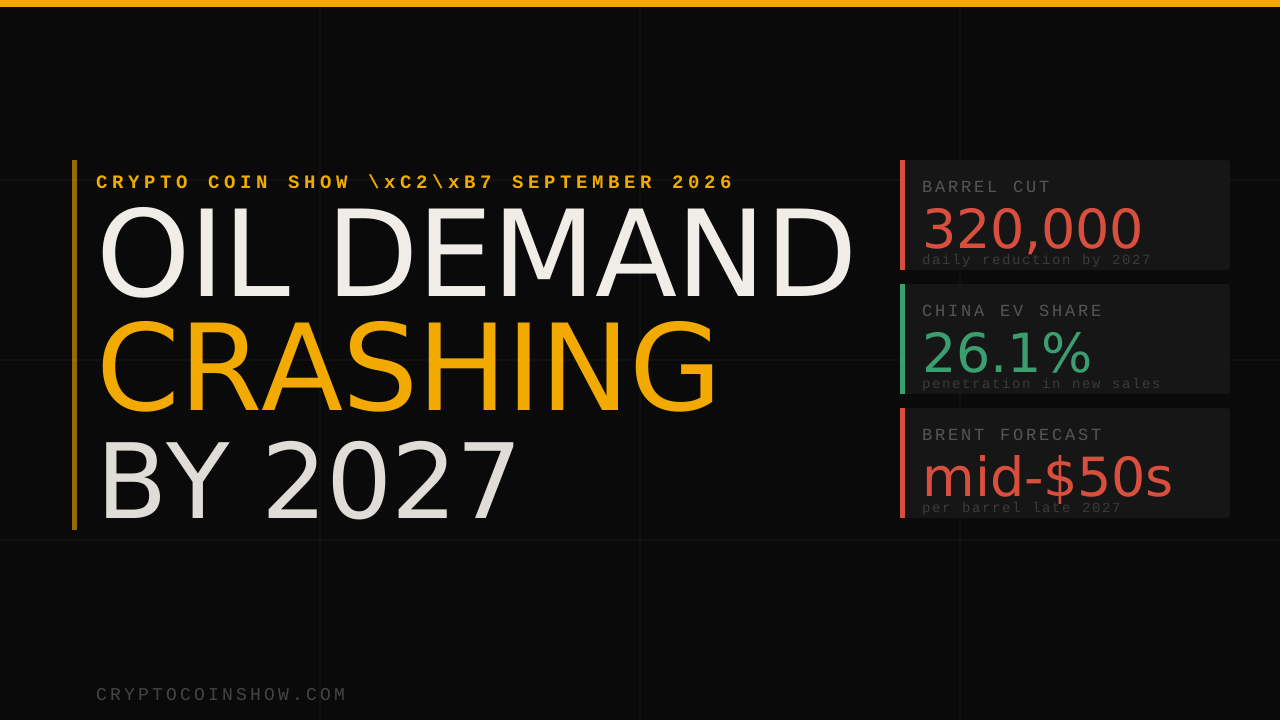
- Goldman Sachs models oil demand falling 320,000 barrels daily by December 2027 under its “Persistent Acceleration” scenario
- China accounts for over 60% of recent global EV market share gains, with 26.1% EV penetration in new car sales by May 2026
- Bank predicts Brent crude could fall to mid-$50s per barrel by late 2027 if China demand weakness materializes as modeled
- 320,000 barrels per day oil demand reduction forecast by end of 2027
- 26.1% global EV share of new passenger car sales recorded in May 2026
- 60% of recent EV market share gains attributed to China’s rapid adoption
Goldman Sachs has published research projecting that electric vehicle adoption, concentrated in China and amplified by regional geopolitical supply shocks, will reduce global oil demand by as much as 320,000 barrels per day by the end of 2027.
The investment bank laid out two scenarios in a research note published June 21: a “Persistent Acceleration” case where EV adoption continues at the pace recorded between February and May 2026, yielding the full 320,000 barrel-per-day reduction, and a more conservative “Temporary Acceleration” scenario where adoption rates hold flat, producing a 130,000 barrel-per-day decline over the same period.
Both pathways point to a material structural compression in oil consumption within 18 months, a timeframe that institutional investors typically use to reassess commodity price targets and energy sector allocations.
China’s EV Dominance Now Accounts for Majority of Global Demand Shift
China is driving the bulk of the global EV transition, capturing more than 60% of the recent increase in worldwide EV market share despite representing only a fraction of total global vehicle sales.
The country’s penetration rate has climbed consistently since February 2026, reflecting both subsidized EV pricing, charging infrastructure investment, and reduced gasoline demand as consumers trade internal combustion for battery-electric powertrains.
This concentration matters because China’s refinery sector and energy policy directly influence regional crude consumption patterns and, by extension, global price discovery through Asian marker crude benchmarks.
The EV acceleration extends well beyond passenger automobiles. Two- and three-wheeled electric vehicles, which dominate transport in China, India, and Vietnam, displace approximately one-third to one-half the fuel consumption of a passenger car EV each.
This multiplier effect significantly amplifies oil demand destruction in markets where motorized two-wheelers represent the primary form of individual transport, a category covering hundreds of millions of users across South and Southeast Asia.
Goldman Sachs analysts factored this into their modeling, recognizing that EV adoption metrics cannot be measured solely through passenger car sales without underestimating total fuel displacement.
Twelve of the world’s 15 largest EV markets recorded rising adoption rates between February and May 2026, indicating that the shift is not confined to China alone but reflects a broad regional trend across Asia and portions of Europe.
Higher Fuel Costs Tied to Hormuz Disruptions Accelerate EV Switching
Goldman Sachs ties the rapid EV adoption surge directly to elevated crude oil and refined product prices stemming from geopolitical disruptions near the Strait of Hormuz and broader Middle East tensions. Elevated gasoline costs create a stronger economic case for switching to electric vehicles, compressing the payback period on EV purchase premiums and shifting consumer preference at the margin.
This price-elasticity dynamic proved particularly pronounced in China, where retail gasoline sales fell more than 20% year-over-year in April 2026, a decline that the bank attributes to both lower refinery throughput and higher EV charging volumes.
Separate Goldman Sachs research published earlier in June found that actual oil demand destruction from higher prices exceeded market expectations. Western Europe recorded an average 8% annual decline in retail automotive fuel volumes in April 2026, suggesting that price-driven demand destruction is not isolated to Asia but reflects a global consumer response to energy cost inflation.
The bank concluded that retail-use oil consumption may have contracted more sharply in response to fuel price spikes than prior models anticipated, effectively pulling forward the timing of peak oil demand in key consumption regions by several quarters.
Elevated fuel prices linked to Hormuz supply disruptions likely pushed consumers more toward electric vehicles, a dynamic particularly of weight in China where gasoline demand has weakened as the volume of EVs charging recorded a climb.
Goldman Sachs analyst Alexandra Paulus
This acceleration in demand destruction sets the stage for Goldman Sachs’ more aggressive oil price forecasts. The bank currently predicts Brent crude will average $90 per barrel in the fourth quarter of 2026, but sees the potential for a roughly $10-per-barrel decline if China’s demand weakness materializes in line with its modeling assumptions.
Goldman Sachs Targets Mid-$50s Brent Price if EV Demand Collapse Materializes
Under the “Persistent Acceleration” scenario, Goldman Sachs now projects Brent crude could slide into the mid-$50s per barrel by late 2027, a decline of approximately $35-$40 per barrel from the bank’s Q4 2026 base case. This represents a material downside risk to oil price assumptions embedded in most institutional energy and infrastructure portfolios.
For refineries, integrated oil majors, and upstream producers, such a price trajectory would compress margins, defer production economics on high-cost projects, and force capital allocation resets across the upstream sector.
The bank’s modeling hinges on whether China’s EV adoption acceleration persists at the pace recorded in the February-to-May window or moderates to a steady-state level. The distinction between these scenarios represents roughly a 190,000 barrel-per-day difference in global oil demand by end-2027, a spread large enough to account for the entire OPEC+ production cut commitment implemented in 2024.
This uncertainty creates a bifurcated risk framework: institutional investors holding long oil positions face genuine downside if China’s EV transition reinforces the “Persistent Acceleration” path, while those positioned defensively in equities and bonds may benefit from lower energy costs flowing through to inflation metrics and monetary policy expectations.
The timing is critical: Goldman Sachs anchors its forecast to observable data from February through May 2026, meaning only a 12-to-18 month window remains before market participants can definitively assess whether the bank’s aggressive demand destruction scenario is tracking to reality.
Institutional investors should monitor quarterly EV sales data for China, India, and Southeast Asia through the remainder of 2026 and into early 2027, alongside monthly retail gasoline sales figures and refinery throughput reports, to gauge whether Goldman Sachs’ demand destruction thesis is on track. If Chinese gasoline sales continue declining at or above the 20% year-over-year pace recorded in April, and if EV adoption rates hold above the February-May trend line, the mid-$50s Brent scenario moves from tail risk to base case, a shift that would trigger significant repricing across integrated energy equities, pipeline MLPs, and crude derivatives markets.