China moves to electric taxis to ease Hormuz oil scarcity issues
China’s crude oil imports collapsed 41.3% in June compared to year-ago levels, marking the weakest month since October 2016, as electric taxis absorb transportation demand that would normally drive petrol consumption. For institutional investors tracking energy markets and commodity exposure, this signals a structural shift in Chinese oil demand that may prove more durable than typical cyclical fluctuations tied to geopolitical disruption.
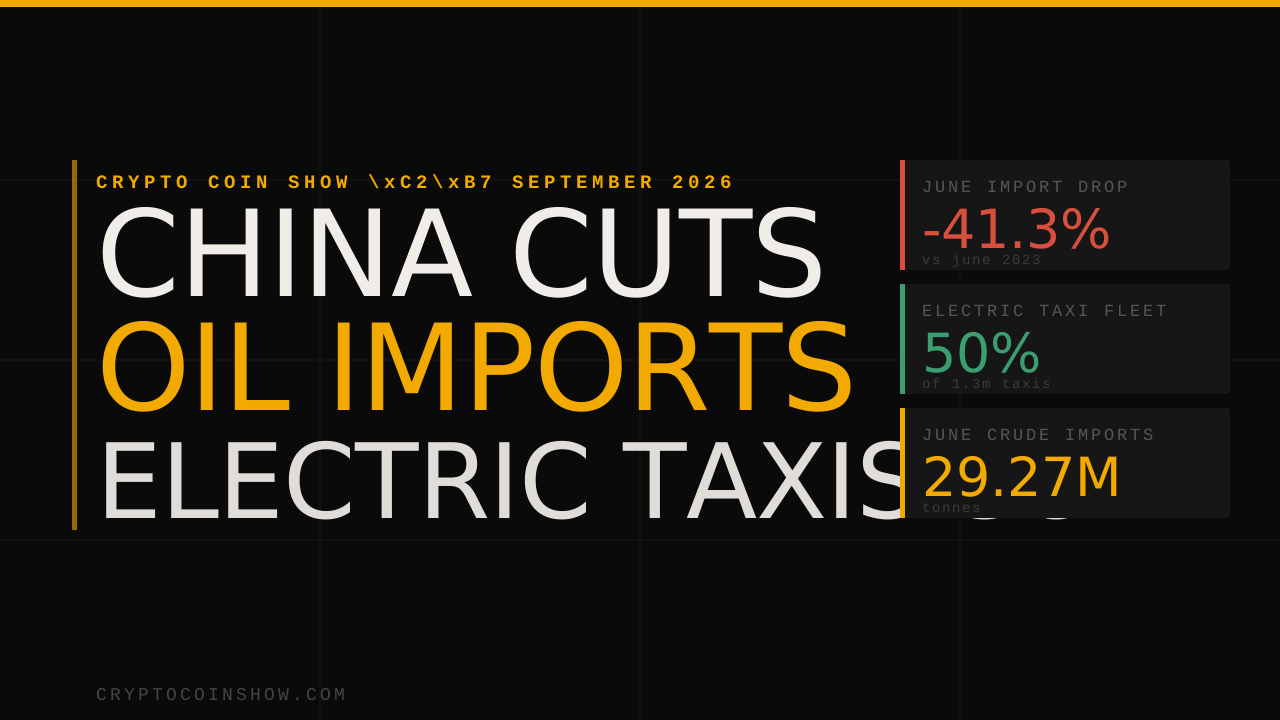
- China imported 29.27 million tonnes of crude in June, down 41.3% versus June 2023, the weakest month since October 2016.
- Roughly 50% of China’s 1.3 million taxis now run on batteries or hybrids, with electric vehicles handling 75% of total mileage booked through Didi’s platform.
- J.P. Morgan forecasts Chinese petrol demand will fall 150,000 barrels per day in 2024 and another 50,000 barrels per day by 2027 due to vehicle electrification.
- 41.3% China’s crude import decline in June versus prior year same month
- 50% Share of China’s 1.3 million taxi fleet now battery or hybrid powered
- 150,000 bpd J.P. Morgan’s forecast of Chinese petrol demand loss this year alone
China’s crude imports fell to 29.27 million tonnes in June, a 41.3% decline from June 2023, marking the weakest month since October 2016, according to customs data released July 14. The collapse occurs five months into a geopolitical crisis that began in late February and has threatened the Strait of Hormuz, which normally carries 45% to 50% of all seaborne Chinese crude oil.
Refiners have responded by cutting crude distillation unit utilization to 57.72%, close to a decade-low, signaling both constrained supply and deliberate demand management rather than panic buying.
Yet the headline import figure masks a more consequential story for energy markets: Chinese transportation demand has not disappeared, it has shifted decisively to electricity.
Didi’s 8 Million Electric Fleet Absorbs the Oil Demand Cliff
China’s cab-hailing giant Didi added 2 million hybrid and electric vehicles to its platform in the past year, bringing its total non-petrol fleet to 8 million cars. Battery-powered vehicles now account for 75% of all mileage booked through Didi’s application, according to platform data.
This electrification wave extends beyond rideshare: the Ministry of Transport estimates that approximately 50% of China’s entire 1.3 million taxi fleet has already switched to battery or hybrid power, with major cities moving toward complete electrification.
The timing matters. This vehicle transition began before the Hormuz crisis, driven by commercial calculus rather than government mandate or emergency response. Rising petrol prices combined with a surge of cheap electric vehicles and new drivers competing for fares, pushing ride-hailing prices down 10% to 15% over six months, created a structural incentive for fleet owners to retire petrol cars.
Owners of conventional vehicles began parking them in favor of booking rides instead, according to transportation analysts.
The demand signal remains robust despite this substitution. Riders took 3.05 billion taxi and ride-hailing trips in May alone, a 6% increase on the prior year. This surge occurred even as China consumed 10% less petrol and 14% less diesel in May than in the same month a year earlier, despite road freight increasing 2% and May Day holiday travel hitting record levels.
The arithmetic reveals that transportation activity and oil consumption have decoupled.
J.P. Morgan Links Behavioral Shift to Structural Oil Demand Loss
J.P. Morgan analyst Natasha Kaneva framed this transition as something more durable than temporary supply disruption. In a July 2 note, Kaneva stated the bank expects Chinese petrol demand to fall 150,000 barrels per day this year and an additional 50,000 barrels per day by 2027.
The conflict may have accelerated behavioral changes that were already underway, leaving China structurally less dependent on oil than the market has historically assumed.
Natasha Kaneva, J.P. Morgan analyst
This framing carries implications for long-term crude pricing and emerging-market energy demand forecasts. Most oil market models have treated Chinese imports as a relatively stable variable within demand elasticity bands, with supply shocks producing temporary price spikes before demand recovered.
Kaneva’s assessment suggests instead that the Hormuz crisis has crystallized an electrification trend that will create a persistent reduction in Chinese oil requirements, not a demand destruction that reverses when supply normalizes.
The data supports this reading. Columbia University’s Center on Global Energy Policy documented that the Strait of Hormuz carries between 45% and 50% of all Chinese seaborne crude, making it the single largest chokepoint for Chinese energy security. Yet even as Hormuz tensions intensified through May and June, Chinese petrol demand fell faster than analysts had historically modeled.
Electric vehicle adoption in ride-hailing, a sector that accounts for millions of daily trips, has effectively decoupled a large portion of Chinese urban mobility from crude oil.
Refiners Cut Production as Markets Price in Persistent Demand Loss
Chinese refineries have responded to weaker import demand by operating crude distillation units at 57.72% utilization, a level that approaches the lowest point in a decade. This production cutback signals that refiners themselves expect the oil demand reduction to persist beyond short-term supply relief.
If demand destruction were temporary, refiners would typically maintain higher utilization rates to capture future demand when supply constraints ease.
Instead, the market is pricing in a structural floor to Chinese oil demand. Reduced Chinese buying helped cap crude prices even as Brent crude spiked above $79 per barrel following news of a U.S.-Iran ceasefire breakdown. Without Chinese demand support at historical levels, supply-side shocks that would previously have triggered significant price rallies are producing more muted reactions.
The question facing institutional energy investors is whether Chinese crude demand has entered a new, lower equilibrium or whether the Hormuz crisis and electric taxi adoption represent a temporary overlay on demand that will partially recover.
J.P. Morgan’s forecast of 150,000 barrels per day demand loss in 2024 alone suggests the bank models this as largely irreversible, at least over the medium term. That assumption hinges on whether electric vehicle adoption in ride-hailing continues accelerating and whether the commercial model for petrol-based taxi fleets remains uncompetitive once the Hormuz supply crisis resolves.
Watch for the next revision to Chinese crude demand forecasts from major investment banks and OPEC+ supply meetings over the second half of 2024; if multiple institutions begin systematically lowering full-year Chinese oil demand estimates below 10 million barrels per day, it would confirm that the market views electric taxi adoption as a durable shift rather than a crisis-driven anomaly. Didi’s next fleet electrification disclosure and any policy announcement from China’s Ministry of Transport regarding mandatory battery standards for new taxis will also signal whether this transition is accelerating or stabilizing.