United States of Iran: Trump’s Delusion or Strategy? Bitcoin Doesn’t Care
President Trump’s social media claim that the Strait of Hormuz is now U.S. territory has no bearing on actual shipping flows or geopolitical control, but it exposes a deeper tension between political messaging and real supply disruption that matters enormously to institutional crypto investors watching Fed policy. Bitcoin’s indifference to the Hormuz announcement reveals that macro rate expectations, not headline risk, currently drive institutional crypto positioning.

- Only six commodity vessels crossed the Strait of Hormuz on Monday versus 140 daily pre-war, according to Kpler data cited by Reuters.
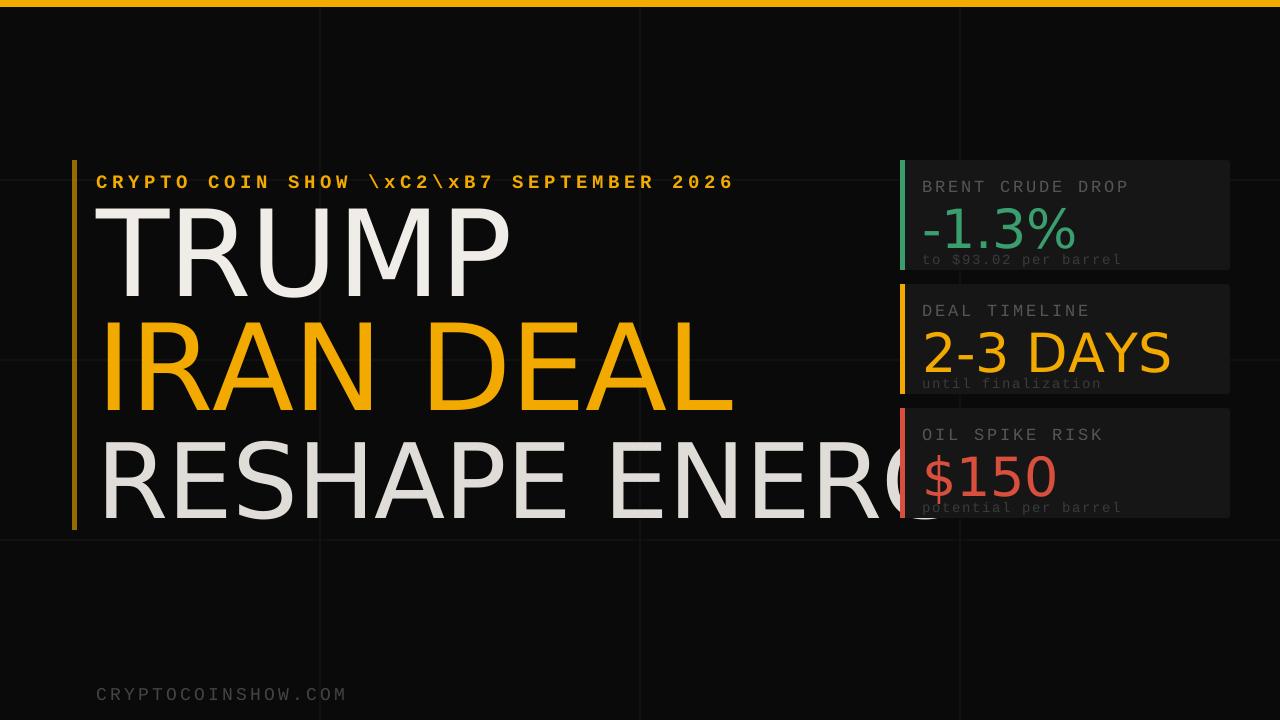
- Brent crude oil has jumped nearly 15 percent in August despite Trump’s claim that Hormuz is open for all ships.
- Bitcoin trades near $64,700, roughly flat month-over-month, while oil surged and U.S. Treasury yields climbed in the same period.
- 6 Commodity vessels crossing Hormuz Monday versus historical 140-ship daily average
- 15% Brent crude price increase in August amid disputed strait control claims
- $64,700 Bitcoin price level, unchanged one month despite regional oil supply crisis
President Donald Trump posted an image to social media on August 18, 2026, depicting the Strait of Hormuz as a new U.S. territory, potentially the 51st state. The White House framed the claim as establishing American control over one of the world’s most critical maritime chokepoints, through which roughly one-third of global seaborne oil and liquefied natural gas passes.
No sovereign transfer has occurred; Hormuz remains an international strait between Iran and Oman under established maritime law. Yet the announcement signals either theatrical political messaging or a calculated attempt to convert military positioning into negotiating leverage amid ongoing regional tensions.
For institutional investors, the claim matters only insofar as it reflects the actual state of shipping traffic and energy supply, and the data tells a sharply different story from Trump’s public statement.
Only Six Tankers Crossed Hormuz on Monday, Not the Flow Trump Claims
Kpler vessel tracking data, cited by Reuters, shows that just six commodity vessels transited the Strait of Hormuz on a single day last week. Before the outbreak of regional conflict, nearly 140 ships crossed the strait daily.
The six vessels that did pass included no very large crude carriers (VLCCs) or liquefied natural gas (LNG) carriers, the high-capacity ships that carry the majority of energy cargo to Asia, Europe, and beyond.
This near-total collapse in traffic exposes the gap between Trump’s sovereignty claim and shipping reality: declaring the strait “open for all ships” carries no weight when owners and operators refuse to route vessels through an active geopolitical flashpoint.
The economic consequences are already visible in commodity markets. Brent crude has surged nearly 15 percent in August alone, a sharp move that reflects genuine supply fear rather than speculative positioning. Global oil and liquefied gas markets are pricing in the reality that Hormuz transit remains functionally impaired, regardless of any U.S. presidential announcement.
LNG availability has contracted sharply, forcing buyers in South Asia and Europe to either pay premium prices on spot markets or negotiate emergency cargoes from alternative suppliers at inflated terms.
Supply-side inflation from sustained Hormuz disruption now poses a structural headwind to the Federal Reserve’s rate-setting calculus. Elevated oil prices feed into headline and core inflation metrics, constraining the Fed’s ability to cut interest rates even as growth slows. For institutional crypto investors, this dynamic matters more than the geopolitical theater itself.
Bangladesh, Pakistan, India Face Acute Energy Shortages From Delayed Cargoes
South and Southeast Asian economies dependent on Gulf LNG imports are facing critical supply shortages. Bangladesh has implemented mandatory gas rationing and power-saving measures as LNG availability has dried up.
Pakistan, which relies heavily on both crude oil and liquefied gas transiting Hormuz, faces similar pressures; any extended disruption will force it to either ration power or divert hard currency to emergency spot purchases at multiples of contracted prices.
India, one of the world’s largest LNG importers, is experiencing disruptions to dozens of Qatari cargo shipments originally routed through the strait.
European energy markets present an additional vulnerability. Germany and the broader European Union are heading into winter with unusually weak storage levels and elevated baseline gas prices. A continuation of Hormuz transit delays into the colder months could trigger rationing scenarios not seen since the 2022 energy crisis.
The geopolitical risk is real; Trump’s social media claim to ownership does not change it.
Bitcoin Unmoved by Hormuz Crisis, Focused on Federal Reserve Rate Expectations
Bitcoin trades near $64,700 per coin, a level almost identical to where it stood one month prior at roughly $63,900. During that intervening period, Brent crude surged nearly 15 percent, discussions around Hormuz control broke down, and U.S. Treasury yields climbed.
Bitcoin’s indifference to these developments reflects a clear institutional priority: macroeconomic policy, particularly Federal Reserve rate decisions, matters far more to crypto pricing than geopolitical supply shocks.
The modest upward movement in Bitcoin price over the past week stemmed from two domestic policy signals. Positive inflows into U.S. spot Bitcoin exchange-traded funds resumed after a period of outflows, signaling institutional rebalancing.
Simultaneously, market participants became increasingly confident that the Federal Reserve would not raise interest rates at its next meeting, reducing the near-term pressure on risk assets and reducing capital costs for leveraged crypto positions.
This focus on Fed action rather than regional geopolitics reveals an institutional consensus: while energy price spikes matter to equity valuations and credit spreads, the crypto market’s price discovery mechanism tracks monetary policy rather than commodity supply.
Elevated oil and gas prices do constrain Fed easing capacity, persistent inflation from Hormuz disruption leaves little room for rate cuts, but that transmission mechanism operates through Fed policy, not directly through the price of oil itself. Bitcoin is pricing in a long-duration, high-rate environment where the Fed cannot cut materially despite economic headwinds.
A sudden resolution to Hormuz tensions would allow faster Fed easing, which would support crypto risk assets. Conversely, further deterioration would keep rates higher for longer, offsetting any crypto volatility gains from headline geopolitical risk.
Citigroup Launches Native Bitcoin Custody Ahead of Institutional Adoption Surge
Major Wall Street custodians are moving to standardize crypto holdings for institutional portfolios even as geopolitical and macro risks dominate headlines. Citigroup announced that it will launch native Bitcoin custody later in 2026, integrated into its new Custody+ platform that combines traditional assets and digital currencies under unified management.
The service includes 24/7 tokenized deposits, real-time asset servicing, and instant settlement, capabilities designed to reduce friction for asset owners managing both traditional and crypto positions.
The Citigroup custody announcement arrives at a critical moment for institutional crypto adoption. Mainstream custodians and prime brokers have spent three years building infrastructure to handle Bitcoin and Ethereum alongside stocks and bonds.
Custody+ represents the logical conclusion of that process: one integrated interface, one counterparty relationship, and one regulatory framework spanning equities, bonds, foreign exchange, and digital assets. For institutions allocating to crypto, this eliminates operational complexity and reduces vendor fragmentation, a key barrier to larger allocations.
The timing matters in a Hormuz-disrupted, Fed-constrained environment. Institutional investors facing higher-for-longer rate conditions may be rotating portions of fixed-income and equity allocations toward digital assets as a hedge against currency devaluation and negative real yields. Seamless custody integration removes an excuse to delay those moves.
The Citigroup rollout will likely accelerate similar launches from JPMorgan, Bank of New York Mellon, and other megabanks already operating crypto custody services.
The next focal point for institutional crypto investors is the Federal Reserve’s September interest rate decision and the accompanying economic projections. If elevated oil prices and Hormuz supply disruption push Fed officials to signal a slower pace of rate cuts than markets currently price, Bitcoin and other risk assets may face pressure even as geopolitical headlines intensify. Conversely, if the Fed signals faster easing despite inflation concerns, the Citigroup custody launch and similar
Original reporting: beincrypto.com