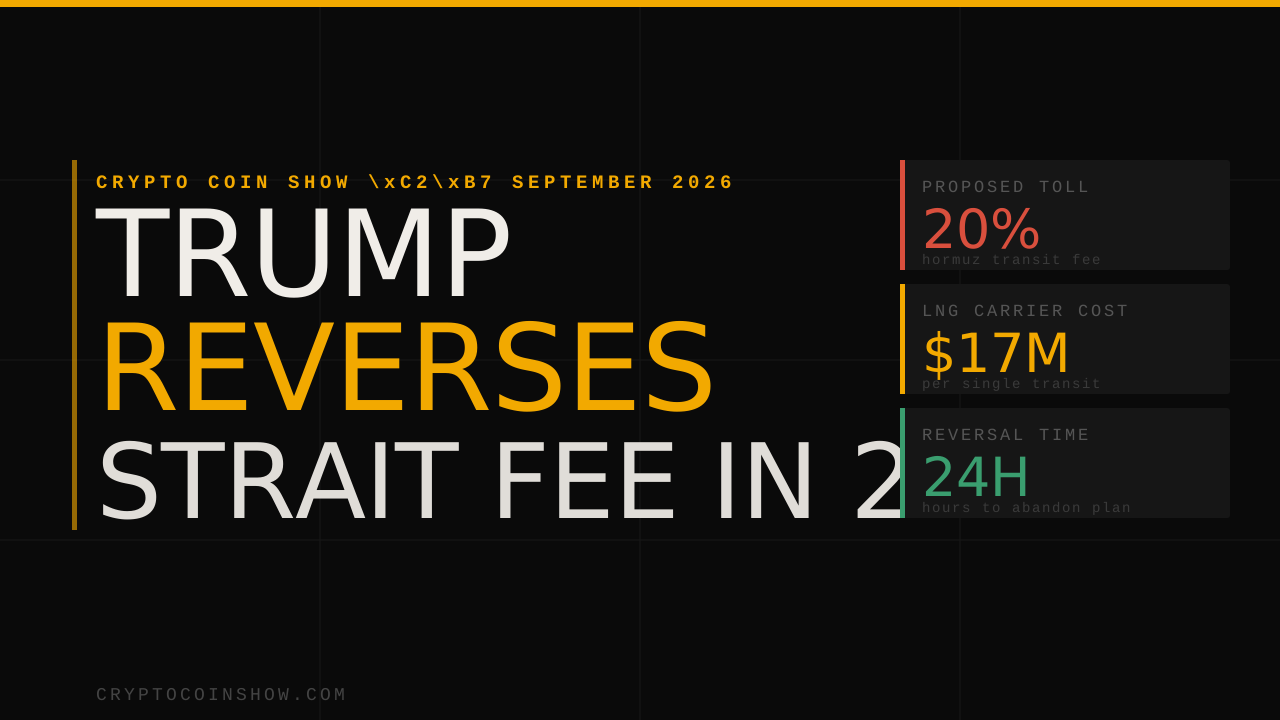
Trump scrapped a proposed 20% Strait of Hormuz transit fee within 24 hours
President Trump abandoned a proposed 20% transit fee through the Strait of Hormuz within 24 hours of announcing it, citing offers of “massive” investment deals from Gulf states as an alternative. The reversal followed immediate pushback from maritime industry bodies, international law experts, and members of Trump’s own cabinet who argued the toll had no legal basis under international maritime law.
- Trump proposed then scrapped a 20% fee on vessels transiting the Strait of Hormuz in less than 24 hours
- A fully loaded liquefied natural gas carrier would have paid approximately $17 million per transit under the plan
- The International Maritime Organization and State Department both opposed the fee as violating international maritime law
- 20% Proposed transit fee on Strait of Hormuz shipping, now replaced with investment deals
- $17 million Estimated per-transit cost for a loaded LNG carrier under the toll structure
- 24 hours Time between Trump’s announcement and reversal of the controversial shipping fee
President Donald Trump announced and then rapidly reversed a sweeping proposal to impose a 20% fee on commercial vessels transiting the Strait of Hormuz, one of the world’s most critical chokepoints for energy trade.
The announcement, made via Truth Social on Tuesday, sparked immediate condemnation from maritime regulators, industry bodies, and international law experts who declared the proposal violated established international conventions.
Within hours, Trump pivoted to claiming Gulf nations had offered substantial investment commitments to the United States in lieu of the transit tax, though he provided no details on which countries, signed agreements, or implementation timelines.
The proposal’s sudden collapse reveals deeper tensions within the Trump administration and signals the difficulty of imposing unilateral trade mechanisms on chokepoints that handle roughly one-third of global seaborne traded oil.
For institutional investors with exposure to shipping, energy, and emerging market assets, the episode underscores both the administration’s willingness to test the boundaries of international maritime law and the speed at which such policies can face reversal when institutional and diplomatic resistance materializes.
LNG carriers would have faced $17 million per-voyage charges under the toll structure
Industry analysts quickly quantified the economic impact of the proposed toll. According to Lloyd’s List, a fully loaded liquefied natural gas carrier would have faced approximately $17 million in charges per transit through the Strait.
For oil tankers, the burden would have been similarly substantial: a vessel carrying 2 million barrels of crude at $60 per barrel prices would have incurred a $24 million charge per trip, while the same cargo at $80 per barrel would have generated $16 in additional cost per barrel.
These figures translate to material supply-chain friction across energy markets. The Strait handles roughly 21 million barrels of oil per day, accounting for approximately one-third of seaborne traded petroleum.
A 20% toll would have restructured shipping economics across Asia, Europe, and North America, likely forcing refiners and traders to either absorb costs, renegotiate long-term contracts, or shift sourcing patterns. Insurance and freight forwarding firms flagged that the fee would have been passed downstream to consumers, raising gasoline, diesel, and heating oil prices across importing economies.
The proposal gained no public support from any commercial shipping operator or energy trader.
International Maritime Organization and State Department both rejected the fee as illegal under treaty law
The International Maritime Organization, the UN body responsible for maritime safety and law, issued a formal statement opposing the toll within hours of Trump’s announcement.
The IMO stated it was “firmly against charging fees for passage through straits used for international navigation” and that “there is no legal basis through which to introduce mandatory tolls simply to transit through a strait.” This position reflects the United Nations Convention on the Law of the Sea, which grants vessels of all nations the right of transit passage through international straits, explicitly prohibiting tolls on such passage.
Within the Trump administration itself, opposition had already crystallized. Secretary of State Marco Rubio stated last month that charging fees on straits used for international navigation would violate international law.
His position aligned with the consensus view among maritime law scholars, who noted that the Strait of Hormuz qualifies as an international strait under UNCLOS, meaning the U.S. government, or any nation, lacks legal standing to unilaterally impose transit fees.
Petras Katinas, a research fellow in climate, energy, and defense at RUSI Europe, warned that such a policy would establish a dangerous precedent, enabling other nations to impose tolls on their own strategic waterways and fragmenting the rules-based maritime system that underpins global trade.
Richard Meade, editor of Lloyd’s List, was explicit about the legal vulnerability: “There is no legal basis for charging vessels to exercise their right of transit passage through an international strait,” he stated, adding that the source of the demand, whether Washington or Tehran, was “largely beside the point.” The universality of that legal principle reflected broad consensus that the proposal, if implemented, would have invited immediate challenge in international arbitration and potentially triggered retaliatory trade measures from affected nations.
Trump cites unnamed Gulf investment pledges but provides no signed agreements or timelines
In reversing the policy, Trump stated that conversations with Middle Eastern leaders had convinced him to pursue “Trade and Investment Deals” instead of the transit tax. He wrote on Truth Social that Gulf states would be making “massive” investments into the United States.
When pressed by reporters, Trump said several foreign leaders had called requesting a different approach, claiming they wanted to invest “billions of dollars” in America rather than pay the toll.
However, Trump neither named any countries, announced any finalized agreements, nor provided implementation timelines. No Gulf government had publicly confirmed any investment commitment as of Tuesday evening.
The absence of concrete detail, specific nation names, dollar amounts, deal structures, or signing ceremonies, left open questions about whether the pivot represented genuine investment pledges or served primarily as a face-saving exit from a legally indefensible policy.
For institutional investors evaluating the credibility of Trump administration statements on trade policy, the lack of specificity presented a challenge to assessing the sustainability of the reversal.
No Gulf governments had publicly responded to Trump’s claims by end of business Tuesday.
Reversal signals limits on unilateral tariff authority, even in strategically sensitive waterways
The swift collapse of the Strait of Hormuz fee proposal reveals the structural constraints on U.S. authority to unilaterally reshape maritime commerce, even in regions where American military presence is substantial. The Strait is nominally adjacent to Iran and Oman, neither of which controls it; international law vests no single nation with toll authority.
Trump’s administration tested whether claims of national security or reimbursement for naval protection could override UNCLOS protections, but encountered immediate resistance from maritime law bodies, allies, trading partners, and members of his own cabinet.
The episode also illustrates how quickly commercial and diplomatic constituencies can mobilize opposition to policies perceived as economically disruptive. Industry groups, the IMO, and allied governments moved within hours to publicly signal opposition.
The administration’s receptiveness to that pressure, and its rapid reversal, suggests that while Trump may pursue aggressive trade policies, proposals targeting core international legal frameworks face higher barriers to implementation than tariffs on specific goods or countries.
Institutional investors should monitor whether any of the claimed Gulf investment deals materialize with specific announcements in coming weeks, and whether the administration attempts different approaches to extracting payments from maritime commerce or energy trade corridors. The absence of named countries or timelines on investment pledges remains the concrete follow-up point: if no deals are announced within 30-60 days, the reversal will have been purely tactical rather than strategic, suggesting the administration retreated without securing compensatory commitments.