
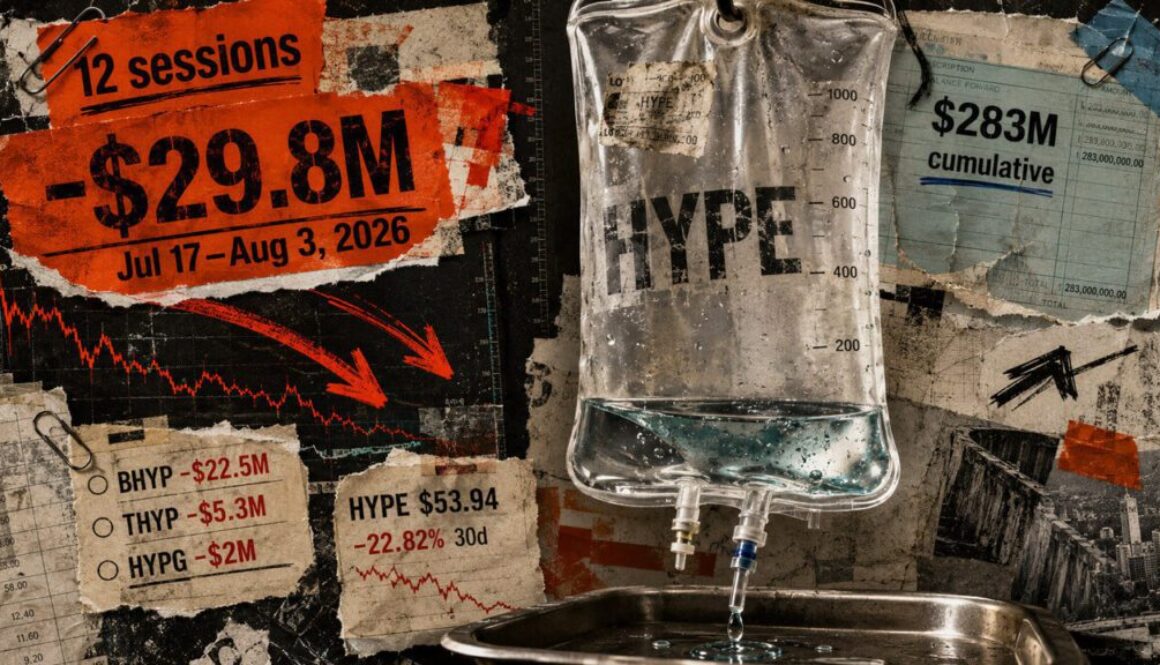
Investors haven’t added a single dime to HYPE ETFs in 12 days as a $30 million exodus begins
Hyperliquid’s HYPE ETF complex has recorded $29.8 million in net outflows over 12 consecutive trading days, signaling a potential reversal in institutional appetite for the alternative exchange’s native token after a strong May-June launch. The exodus matters to institutional investors because it suggests that initial allocation to HYPE products may have been tactical positioning rather than structural commitment, raising questions about whether altcoin ETFs can sustain inflows once initial momentum fades.
- HYPE ETFs posted zero inflows across 12 trading sessions from July 17 through August 3, 2026, with $29.8 million in net outflows recorded during that period
- Bitwise’s BHYP absorbed $22.5 million of the total outflows, more than double the $5.3 million departure from 21Shares’ THYP and the $2 million exit from Grayscale’s HYPG
- The outflow period coincided with a 22.82% one-month decline in HYPE token price to $53.94 as of August 3, suggesting institutional redemptions may track token weakness rather than lead it
- $29.8M Net outflows across HYPE ETF complex over 12 trading days through August 3
- $283M Cumulative reported flows across all HYPE ETF products through August 3, 2026
- 22.82% One-month price decline in HYPE token through August 3 versus June baseline
Hyperliquid’s three spot ETF products tracking the HYPE token have entered a decisive inflection point less than three months after their May 2026 launch generated momentum among institutional investors.
The 12-day dry spell spanning mid-July through early August represents the first sustained period without investor inflows since the products began trading, breaking a streak that had accumulated approximately $283 million in cumulative reported flows.
Yet this apparent retreat obscures deeper structural questions about whether the initial capital deployment reflected genuine institutional conviction or opportunistic positioning ahead of token unlock events and validator risk that remain largely untested in live market conditions.
Bitwise’s BHYP captures outsized share of $29.8 million institutional retreat
Bitwise’s BHYP, the largest of the three HYPE ETF vehicles by reported outflows, accounted for $22.5 million of the $29.8 million total redemption activity over the 12-session period, a proportion suggesting that institutional capital concentrated in the flagship product may be exiting more aggressively than holders of alternative structures.
By August 2, 2026, Bitwise reported $92.36 million in BHYP assets under management and 3.03 million shares outstanding, with 70% of holdings staked to generate protocol rewards. The remaining outflow burden fell on 21Shares’ THYP, which saw $5.3 million depart, and Grayscale’s HYPG, which recorded $2 million in net redemptions.
The disparity in outflow distribution reflects both the absolute size advantage Bitwise holds in the category and potentially different investor bases or redemption thresholds across the three fund structures.
The outflow pattern also coincides with a period in which HYPE token itself declined 22.82% over 30 days to close August 3 at $53.94, suggesting that institutional redemptions may be following rather than anticipating token weakness. This reactive posture contrasts sharply with the early positioning visible in June 2026, when the products drew $161 million in their first month of trading.
Token price weakness and staking complexity compound the flow reversal
HYPE’s 4.53% weekly decline through August 3 coincided directly with the most intense redemption pressure, a timing pattern that complicates interpretation of investor motivation.
Institutional buyers who committed capital in late May or June faced competing pressures: realized losses on the underlying token versus the optionality embedded in staking yields that Grayscale’s HYPG, holding 94.31% of assets staked as of August 3, had begun accruing.
The gap between HYPG’s high staking ratio and BHYP’s 70% allocation suggests that different risk-return calculations may be driving divergent capital retention across the ETF wrappers.
Grayscale’s prospectus specifies a 30% to 70% staking range, implying that its managers retain discretion to rebalance positioning in response to rewards, risk premiums, or redemption pressure. That flexibility may have insulated HYPG from the heaviest outflows despite its $109.35 million AUM, the largest of the three products as of August 3.
By contrast, Bitwise’s more aggressive 70% staking commitment at BHYP may constrain redemption efficiency during volatile token periods, potentially triggering secondary market discounts that accelerate investor exits.
$161 million May launch momentum faces sustainability test as unlocks and validator risks loom
The severity of the 12-day inflow drought becomes apparent only when measured against the rapid capital accumulation that preceded it.
HYPE ETFs drew $161 million in their first month through mid-June 2026, establishing what appeared to be a durable institutional allocation alongside concurrent outflows from Bitcoin and Ethereum ETFs that suggested intentional diversification into alternative exchange tokens.
That narrative collapsed by late July, when nearly $27 million had already redeemed before the August 3 data point pushed total 12-day outflows to $29.8 million.
Institutional investors face unresolved liquidity and structural risks that have not yet encountered real stress-test conditions.
Hyperliquid’s $1 billion treasury facility was designed to underpin market liquidity and validator confidence, but prospectus filings openly acknowledge risks around token unlocks, validator economics, and exchange operational resilience that remain theoretical until markets actually test them.
The outflow pattern suggests that early institutional buyers may have treated HYPE allocation as a tactical position sized for launch volatility rather than a structural holding warranting multi-year commitment.
The critical question facing institutional investors is whether the August 3 outflows represent capitulation at a trough or merely the opening stage of a longer redemption cycle.
Authorized participants continue to shape daily flow data through share creation and redemption activity designed to maintain net asset value alignment, meaning the published flow figures obscure the true investor redemption rate.
Watch for whether HYPE token price stabilizes above $55 in the week following August 3, and whether Grayscale’s high staking ratio ($109.35 million AUM) begins to lag redemptions as trapped staking yields become less attractive than exiting to cash, a divergence that would signal institutional conviction has genuinely shifted from accumulation to reduction.
Validator Economics and Token Unlock Risk Loom Over HYPE Institutional Thesis
The timing of HYPE ETF outflows coincides with approaching validator unlock schedules and unresolved questions about Hyperliquid’s economic sustainability at scale. Institutional investors face opacity around when large token holders can liquidate positions, a dynamic that historically triggers volatility in Layer 1 and exchange tokens once lock-up periods expire.
The absence of published validator earnings data comparable to Solana’s validator APY disclosures (currently 4-6% range) leaves institutional allocators unable to benchmark whether Hyperliquid’s fee-sharing model justifies long-term infrastructure investment.
Bitwise’s BHYP product, which absorbed $22.5 million of the outflows, had positioned itself as the institutional-grade entry point through its $0 fee structure, a pricing war tactic that typically signals confidence in asset class scale but that may indicate the manager underestimated redemption risk.
Comparable Layer 1 ETF products including Solana’s SOL ETF complex and Avalanche products have historically seen outflow cycles of 5-8% of peak cumulative flows when validator or tokenomics uncertainty surfaced, suggesting HYPE’s current 10.5% outflow rate ($29.8M against $283M peak flows) sits at the higher end of historical precedent.
Institutional investors will face a clarity checkpoint in Q4 2026 when Hyperliquid releases formal validator APY benchmarks and unlock schedules; until those metrics enter public documentation, the ETF complex risks further outflows from risk-averse allocators who cannot reconcile HYPE’s valuation against comparable DeFi infrastructure tokens trading at lower revenue multiples.