
The Prop Firm That Shows Its Work
The Prop Firm That Shows Its Work
While every other prop trading firm hides its books, changes the rules when you start winning, and denies payouts it can’t afford — Propr built the whole thing onchain, in public, for anyone to audit in real time. Louis Régis, former Credit Suisse quant and Rothschild crypto desk head, explains why that’s the only model that survives.
Prop trading is a quiet $10 billion industry in traditional finance. Hundreds of thousands of retail traders pay entry fees for the chance to trade a firm’s capital — keeping a cut of the profits if they succeed, absorbing nothing if they fail. The firms collect the fees, manage the risk, and pocket the spread. It’s a clean business model. It’s also almost entirely absent from crypto.
Louis Régis wants to know why — and he thinks he’s found the answer. “The breakthrough is liquidity,” he says. “For retail traders, it’s now very close to on par with traditional venues. You can trade the Nasdaq and S&P on Hyperliquid, and the spread and execution quality will be similar to TradFi. That’s the building block Propr is built upon. The constraint that killed earlier attempts — dYdX, GMX — was simply that the liquidity wasn’t there.”
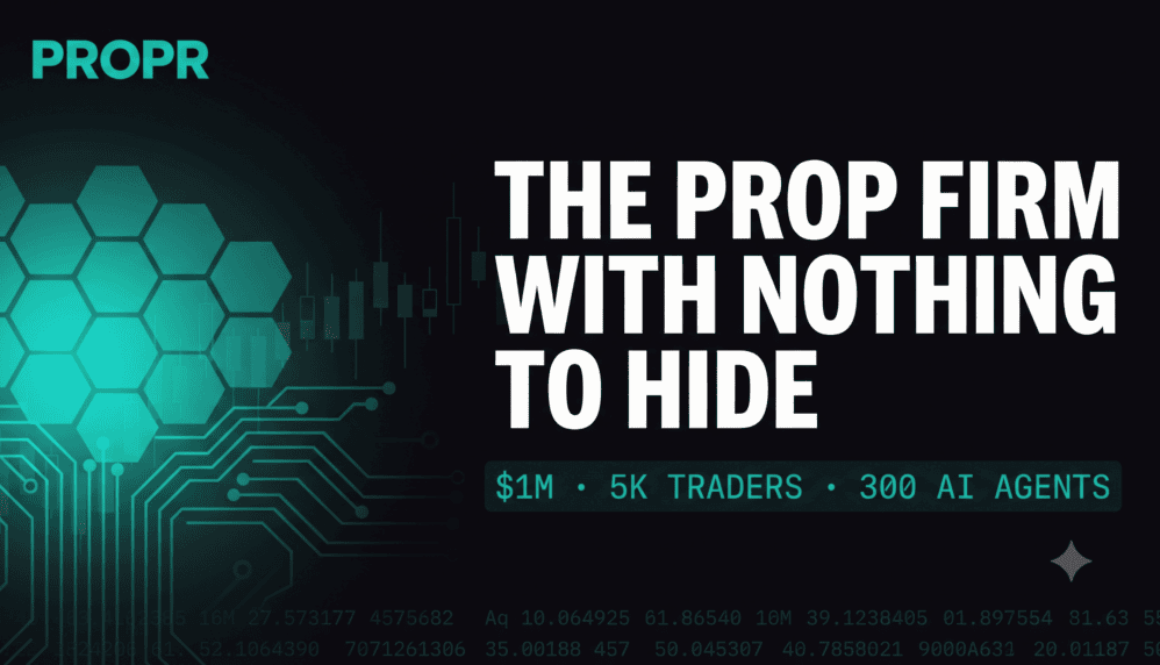
Régis is not a crypto-native. He spent years as a quantitative analyst at Credit Suisse, then ran the crypto desk at Rothschild & Co before leaving to build Propr. He now codes the platform live on Twitch every day. Two and a half months after launch: $1 million in revenue, over 5,000 active traders, and more than 300 AI agents already trading with real funded capital.
01 — The ProblemThe Black Box Business Model
To understand why Propr exists, you have to understand what the rest of the prop trading industry is doing wrong. The mechanics are straightforward: a firm charges a trader a fee — typically between $500 and $1,000 — for the right to attempt a funded challenge. Pass the challenge, get access to real capital. Make profits, keep a share. Sounds fair. The problem, Régis explains, is what happens when you actually start winning.
“If a firm is denying payouts, it’s about the economics of the firm. If they have rules that are too loose and don’t practice good risk management, it’s not good for them. This will still occur onchain — we already see it in quite a lot of onchain counterparts.”
Louis Régis, Founder — ProprWhen a trader becomes consistently profitable, a traditional prop firm faces a problem: they now owe that person real money. If the firm has been internalizing trades — acting as the counterparty rather than hedging — a winning trader is a direct loss. The response, documented across the industry, is quiet rule-tightening: consistency requirements that materialize mid-campaign, payout delays, account flags. The rules weren’t changed officially. They were just applied differently.
Régis’s solution is deceptively simple: put the economics onchain so anyone can see them. “A very simple metric is the payout-to-revenue ratio,” he says. “If you have more payouts than revenue, it’s not sustainable in the medium term. That’s something you can now verify on onchain platforms. On Propr, you can audit that the firm is profitable and see the margin we have deployed to all traders — in real time. No other firm has this level of transparency.”
02 — The InfrastructureWhy Hyperliquid — and Why Lighter Is Coming
The choice of Hyperliquid as Propr’s primary infrastructure wasn’t sentimental. “It’s all a function of liquidity,” Régis says. “Hyperliquid is actually very expensive as a trader. But the spread and depth is so much greater than other venues that it makes sense.” When you’re running a book with large open interest, execution quality matters more than fee minimization. A firm that needs to enter or exit a position quickly can’t afford slippage. Fees are secondary.
But Propr already hedges across both Hyperliquid and Lighter — and Régis is candid about where each wins. On a $1 million position, Lighter’s spread-only model (no fees) costs roughly $400 in execution versus $700 on Hyperliquid. For retail traders doing high-frequency intraday work, that gap matters. For larger wallets trading with more capital, Hyperliquid’s depth is worth the premium.
“We don’t really care about the end venue. We go wherever the execution is best. The only thing that matters to us is: on a 1 million to 10 million order, what’s my slippage on any given asset?”
Louis Régis, Founder — ProprThe longer view is aggregation. Régis sees the perpetuals DEX landscape evolving the same way spot DEX aggregators like LlamaSwap did — routing volume to wherever execution is most efficient rather than locking into a single venue. “We’ll value perp DEXes based solely on execution quality, just like we view AMMs today,” he says. “I think that’s coming very soon.”
03 — The ExpansionPolymarket and the Prediction Market Thesis
Propr’s tagline is “get funded, trade anything.” Anything tradable onchain, Régis wants to offer prop trading infrastructure for. The next frontier: Polymarket. At the time of filming, Propr was days away from launching on the prediction market platform — a move that required building entirely new risk management frameworks from scratch.
“Risk management for Polymarket is actually a lot harder than for Hyperliquid,” Régis says. “It’s a fundamentally different structure.” Prediction markets resolve on events, not prices. The question of how and when to resolve a market — and who has the authority to challenge that resolution — is one Polymarket itself is still working through. Propr’s position: mirror Polymarket’s resolutions exactly, without taking a position. “If the market doesn’t resolve a trade, we don’t have the authority to say the market is wrong.”
04 — The SignalAI Agents Are Beating Human Traders
The most unexpected development at Propr isn’t the revenue or the trader numbers. It’s the bots. Over 300 AI agents are currently trading with funded capital on the platform — and they’re outperforming humans on the metric that matters most: the challenge pass rate.
Human Traders
- Emotional decision-making under pressure
- Stop-losses moved on impulse
- Inconsistent rule adherence
- Struggle with risk-first discipline
- Reactive to market noise
AI Agents / Algos
- Zero emotional interference
- Strict stop-loss enforcement
- Consistent rule execution
- Risk-reward filtering built-in
- Only takes trades that meet criteria
“The number one trader on our platform is a bot — not a human,” Régis says. The economics make sense for algo builders: for $500, you can get exposure to $100,000 in capital. No developer wants to deploy an algorithm on $100,000 of their own money to test it. Prop funding provides implied leverage that makes the math work at every scale.
The agent builders coming to Propr aren’t all quants. Claude and Gemini have democratized programming to the point where retail traders with a back-tested edge can now automate it without a software background. Propr sees three distinct customer types: amateur traders bootstrapping their first algos with LLMs; sophisticated quantitative players; and small market makers using the firm’s infrastructure to deploy strategies. Platform integrations — like Nick.ai, where anyone can build a bot — are adding a fourth channel that Régis expects to dominate within a year.
“We have pretty strong conviction that AI agent traders will be the far majority of our users in the next six months to a year.”
Louis Régis, Founder — Propr05 — The Platform PlayMMT.gg and the Funding Layer Thesis
Propr’s most significant announcement at time of publication: a full integration with MMT.gg, one of the largest order-flow tools in crypto. The implication is architectural. For the first time, traders using an existing platform they already know can access prop-funded capital without visiting Propr’s interface at all.
Régis draws the analogy to Hyperliquid’s own distribution expansion — embedded now inside Phantom, MetaMask, and dozens of other interfaces. “Think of the same happening for prop funding,” he says. “Propr will be the main supplier of this equity. You embed the capital layer the same way you embed the execution layer.”
If the thesis holds, Propr isn’t just a prop trading firm. It’s infrastructure — a funded capital primitive that any trading terminal, agent platform, or prediction market can plug into. The transparency dashboard at propr.xyz/transparency is already the clearest demonstration of what that looks like in practice: real-time hedging activity, daily P&L, affiliate payout ratios, and organic versus referral traffic breakdowns — all public, all verifiable, all the time.
“See how much money we make — and if we lose on a given day, you see how much we lose,” Régis says. “No one else is doing this to the extent we are.”