
The brutal $346M math behind Galaxy’s high-stakes race to build CoreWeave’s Texas AI mega-center
Galaxy Digital is financing a $3.507 billion AI data-center build in Texas with debt carrying a 9.875% coupon, roughly $346 million in annual cash interest, that begins flowing to creditors in 2027 while principal repayment waits until construction ends. For institutional investors, the structure reveals both the capital intensity of competing in AI infrastructure and the execution risk now embedded in one of crypto’s largest firms outside pure trading or custody.
- Galaxy subsidiary priced $3.507 billion in senior secured notes at 9.875% coupon on July 23, closing July 28.
- Annual cash interest of $346.3 million begins February 1, 2027, while principal amortization defers until project completion.
- CoreWeave committed 260 MW of critical IT load for Phase II with deliveries expected in first half of 2027.
- $3.507B Total debt financing for CoreWeave Texas data-center phases versus prior Bitcoin-mining sector deals
- 9.875% Annual coupon rate on Galaxy’s senior secured notes, reflecting current credit risk premium
- 400 MW Target utility capacity across eight data halls, representing scale of AI infrastructure buildout
Galaxy Digital’s financing for CoreWeave’s Helios campus in Texas marks a structural watershed for crypto-native capital allocation: interest payments begin immediately upon note issuance in 2027, but the company will not repay principal until the data center is built and operational.
The $346.3 million annual interest bill, paid semiannually starting February 1, 2027, represents a fixed cash drain on Galaxy regardless of CoreWeave’s progress or performance. The 9.875% coupon reflects the credit risk and duration that creditors are pricing into a construction project that may not generate revenue for two to three years after initial completion.
The deal structure splits cash flows into two distinct phases. Interest accrues and pays in cash on a fixed schedule. Principal amortizes at 4 percent of the original $3.507 billion annually, roughly $140.28 million per year, but only after the Helios campus reaches operational status.
That deferred repayment schedule places Galaxy’s construction timeline at the center of its debt service obligations. The senior secured notes mature August 1, 2031, giving Galaxy approximately five years from issuance to repay the full balance.
Creditors hold first-priority claims on nearly all project assets and Galaxy’s equity stake in the issuer, but the liens do not extend to Galaxy Digital’s broader corporate assets.
CoreWeave’s 260 MW commitment anchors Phase II revenue but leaves delivery timing as the critical variable
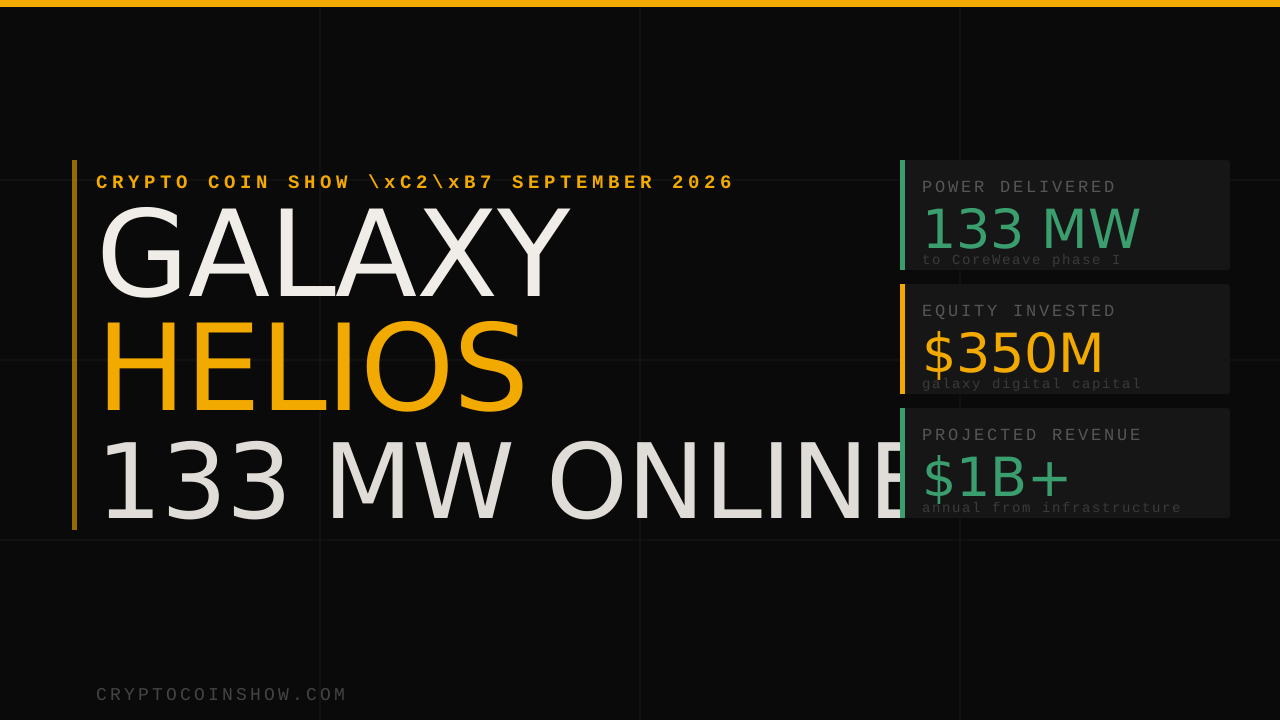
CoreWeave committed to approximately 260 MW of critical IT load for Phase II of the Helios campus in April 2025, with terms substantially similar to its previously announced 15-year, 133 MW Phase I agreement. That cumulative 393 MW of committed load, spread across two phases, gives the project a defined customer base and revenue runway.
Galaxy reported on July 6 that Phase I had been completed on schedule, positioning Phase II deliveries to begin in the first half of 2027. The timing alignment matters because CoreWeave’s rental payments begin flowing only when Galaxy delivers colocation capacity.
The data center is designed for 400 megawatts of utility capacity and 260 MW of critical IT capacity across eight data halls at the Helios campus. Galaxy’s previous AI infrastructure deals, particularly the Phase I agreement, establish a template: long-term leases with predictable revenue but operational execution risk.
The spread between utility power available (400 MW) and committed critical IT load (260 MW) suggests either additional capacity for future customer commitments or built-in redundancy and cooling overhead typical of hyperscale data centers.
Institutional investors tracking Galaxy’s debt coverage ratios should note that CoreWeave revenue does not flow until Phase II capacity is delivered. The company must service $346 million in annual interest starting in less than a year while still completing construction.
That timing compression raises the stakes on Galaxy’s project execution and CoreWeave’s ability to occupy and deploy hardware in the first half of 2027 as planned.
9.875% coupon reflects data-center leverage and competitive pressure in AI infrastructure financing
The coupon on Galaxy’s notes sits materially higher than U.S. Treasury yields and even investment-grade corporate debt, pricing in both the leverage of a construction-phase project and the capital intensity of competing in AI infrastructure. For comparison, Galaxy’s previous corporate-level debt and traditional infrastructure financing typically trade at lower yields.
The 9.875% rate reflects creditor concern that construction delays, CoreWeave’s inability to secure additional customers, or shifts in AI workload demand could compress project economics.
The note structure itself, with interest paid in cash upfront and principal deferred, transfers construction risk partially back to Galaxy. Creditors are effectively saying: we will collect cash interest regardless of progress, but we are pushing principal repayment downstream until you prove the asset generates revenue.
Galaxy must therefore fund operating expenses, debt service, and working capital from existing revenue sources, debt refinancing, or additional equity, all while building a $3.5 billion facility.
The senior secured status means creditors rank ahead of equity holders but take a second lien to whatever collateral CoreWeave (or other future customers) provides under their lease agreements.
First Phase I completion in July opens window for Phase II delivery but creates execution dependency
Galaxy’s announcement on July 6 that Phase I had been completed on schedule represents the first major operational proof point. Phase I’s on-time delivery suggests the contractor, supply chain, and power infrastructure can meet timelines.
However, Phase II carries additional complexity: it adds a second building with four new data halls and must scale power infrastructure from 133 MW to 260 MW of critical load. The first half of 2027 delivery target means Phase II must advance through final build-out, testing, and CoreWeave customer hardware deployment over the next 18 months.
If Phase II slips even moderately, into late 2027 or 2028, Galaxy’s interest payments continue but CoreWeave revenue remains minimal. Each quarter of delay compresses the window between project completion and the 2031 maturity date, reducing time for the company to service debt from operations.
CoreWeave’s own capital constraints and customer readiness introduce a second variable: the company may own the right to deploy capacity, but its ability to monetize it depends on customer hardware availability and integration timelines.
Institutional credit investors should track Galaxy’s quarterly construction progress reports and any CoreWeave disclosures about Phase II customer commitments or delays. The August 1, 2031 maturity date is now a hard constraint; Galaxy cannot simply extend or refinance at maturity if the project has not generated expected cash flow by then.
Galaxy’s next material test arrives in the first half of 2027, when CoreWeave Phase II deliveries are scheduled to begin and the first principal amortization payments ($140.28 million) fall due on an unknown timeline after project completion. Watch for Galaxy’s Q4 2026 and Q1 2027 earnings calls for any revision to the Phase II delivery schedule, announcements of additional CoreWeave capacity commitments, or disclosure of refinancing discussions with creditors. The company must also navigate rising competition: CleanSpark and Hut 8 have already secured multibillion-dollar AI data-center lease commitments, and CoreWeave itself has announced $20 billion in total funding, suggesting the customer is pursuing multiple build partners. Galaxy’s ability to deliver Phase II on time and retain CoreWeave’s full 260 MW commitment will determine whether the 9.875% coupon represents fair compensation or an early warning signal.