
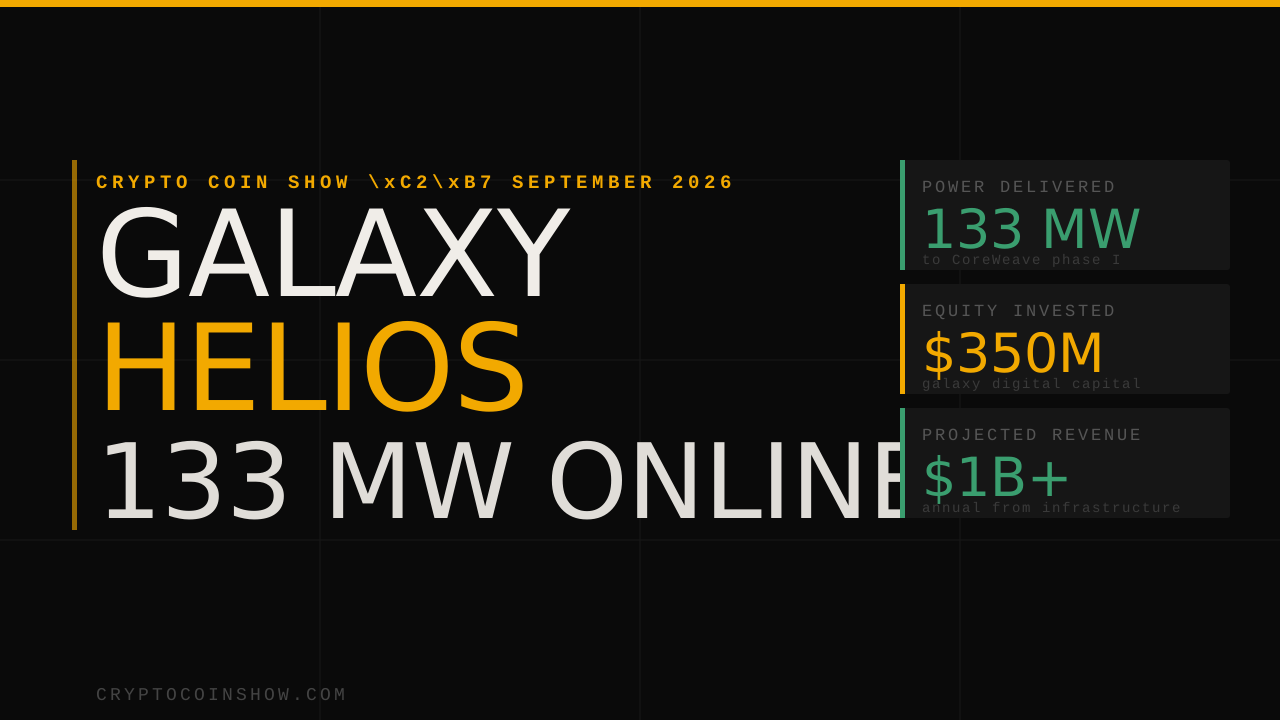
Galaxy Digital completes Phase I of Helios AI data center, delivers 133 MW of power to CoreWeave
Galaxy Digital has completed Phase I of its Helios AI data center in West Texas, delivering 133 megawatts of compute capacity to CoreWeave under a 15-year lease, a watershed moment for the company’s transition from cryptocurrency mining to infrastructure-as-a-service for artificial intelligence. The project stayed on budget and timeline, positioning Galaxy to generate over $1 billion in average annual revenue while reducing its earnings volatility to crypto market swings.
- Phase I power becomes operational at Helios, supplying 133 MW to CoreWeave with billing starting Q2 2026
- Galaxy invested $350 million in equity and secured $1.4 billion debt financing at 80% loan-to-cost ratio
- Phase II construction underway in greenfield stage; data hall deliveries expected mid-2027 with full campus reaching 526 MW
- 133 MW of critical IT capacity delivered to CoreWeave under fifteen-year lease agreement
- $1.4B debt facility closed to finance remaining construction costs beyond equity commitment
- 526 MW total CoreWeave allocation across all three phases once complete through 2027
Galaxy Digital has crossed a critical threshold in its strategic pivot from cryptocurrency mining operations to institutional AI infrastructure provision.
The company announced that Phase I power at its Helios data center campus in West Texas is now fully operational, making available 133 megawatts of compute capacity to CoreWeave, a leading provider of cloud infrastructure for generative AI workloads. Under the terms of a 15-year lease agreement, CoreWeave will begin billing Galaxy for the power in the second quarter of 2026.
This completion marks the physical culmination of a transformation that began in 2022, when Galaxy acquired the site, originally a top-tier 180-megawatt Bitcoin mining facility, for $65 million, then systematically repurposed it for AI infrastructure rather than cryptocurrency operations.
The scope of Galaxy’s capital commitment underscores the company’s conviction in the long-term profitability of the shift. The company deployed $350 million of its own equity into Phase I, with the remainder of construction costs financed through a $1.4 billion debt facility structured at an 80% loan-to-cost ratio.
Reaching financial close on that debt facility, combined with meeting the project’s timeline and budget targets, represents a significant validation of both Galaxy’s operational execution and the underlying demand for high-density power infrastructure tailored to AI workloads.
The Helios campus, which spans more than 2,200 acres, sits on approved power capacity of 1.63 gigawatts with a path to expand to 3.6 gigawatts.
The project’s full completion will dwarf today’s initial deployment.
Galaxy Executive Projects Over $1 Billion in Annual Revenue From CoreWeave Deal
Mike Novogratz, Galaxy’s founder and CEO, framed the Phase I completion as confirmation that the company can execute at hyperscale in infrastructure development, a capability required to win long-term contracts with institutional AI platforms.
In recent commentary, Novogratz emphasized that demand for high-density, AI-ready power represents a structural economic shift rather than a temporary cycle. He further noted that Galaxy now operates as an approximately even mix of data infrastructure revenue and digital asset holdings, reducing the company’s dependence on cryptocurrency market sentiment to drive earnings.
The demand for high-density, AI-ready power is not a cycle; it is a structural shift, and Galaxy is built to meet it.
Mike Novogratz, Founder and CEO, Galaxy Digital
Galaxy expects the full Helios-CoreWeave relationship to generate more than $1 billion in average annual revenue once all three phases reach completion. That figure carries significant weight for a company that reported a $216 million net loss in the first quarter of 2025, driven substantially by declines in cryptocurrency prices.
By diversifying revenue into long-term, contracted AI infrastructure leases, Galaxy aims to decouple its financial performance from the volatility of digital asset markets and establish a stable, recurring revenue base comparable to traditional data center operators.
Phase II Greenfield Construction Targets Mid-2027 Data Hall Deliveries
With Phase I now operational, Galaxy’s engineering and construction teams have shifted focus to Phase II, which remains in greenfield stage with structural work currently underway. The company expects to begin delivering data halls in that phase by mid-2027.
Once Phase II and Phase III are complete, CoreWeave will control 526 megawatts of critical IT load across the entire Helios campus, exhausting the site’s 800 megawatts of approved gross power allocation.
That sequential buildout reflects both the engineering and financial reality of hyperscale data center development: phasing construction, power delivery, and lease activation allows Galaxy to stage capital deployment and CoreWeave to activate capacity as its customer demand warrants.
The timeline carries weight for institutional investors monitoring Galaxy’s ability to convert capital expenditure into revenue generation. Each phase of completion reduces execution risk and validates the assumptions embedded in the original pro forma financial models.
Phase II’s mid-2027 data hall delivery date, if met, would continue a pattern of on-time, on-budget execution that began with Phase I, a track record increasingly important as institutional infrastructure investors scrutinize management teams’ ability to deliver large, complex projects under inflationary construction cost environments and volatile interest rate conditions.
The campus’s total approved power footprint of 1.63 gigawatts allows for staged expansion without additional regulatory hurdles.
Galaxy Introduces Institutional OTC Prediction Markets as Alternative Revenue Stream
Alongside the Helios announcement, Galaxy expanded its institutional client offerings by launching an over-the-counter prediction markets service operated through its Global Markets trading desk. The service targets hedge funds, family offices, and other institutional investors seeking to trade prediction markets at scale while maintaining enhanced privacy protections.
The offering focuses exclusively on non-sports prediction markets listed on platforms including Kalshi and Polymarket, covering categories ranging from political outcomes to economic data releases.
The move extends Galaxy’s institutional client relationships beyond infrastructure into markets and volatility trading.
This addition reflects Galaxy’s broader strategy to monetize multiple revenue lines across its digital assets and infrastructure divisions. While the prediction markets service generates smaller dollar volumes compared to the data center leasing arrangements, it reinforces Galaxy’s positioning as an infrastructure and market access provider to institutional crypto and derivatives traders.
For institutional investors evaluating Galaxy’s earnings diversification, the expanded client offerings signal management’s intent to deepen relationships across multiple product categories rather than rely solely on the Helios-CoreWeave transaction to drive revenue stability.
Galaxy’s next critical milestone arrives in Q2 2026, when Phase I billing to CoreWeave commences and the company begins recognizing recurring infrastructure revenue at scale. Investors will watch whether Phase II data hall deliveries begin on schedule in mid-2027, as any delays would signal execution challenges and compress the timeline to profitability; simultaneously, CoreWeave’s actual consumption of the 133 MW delivered in Phase I will indicate real demand dynamics versus contracted capacity, providing the first empirical test of Galaxy’s thesis that AI infrastructure represents a durable, non-cyclical revenue source.
