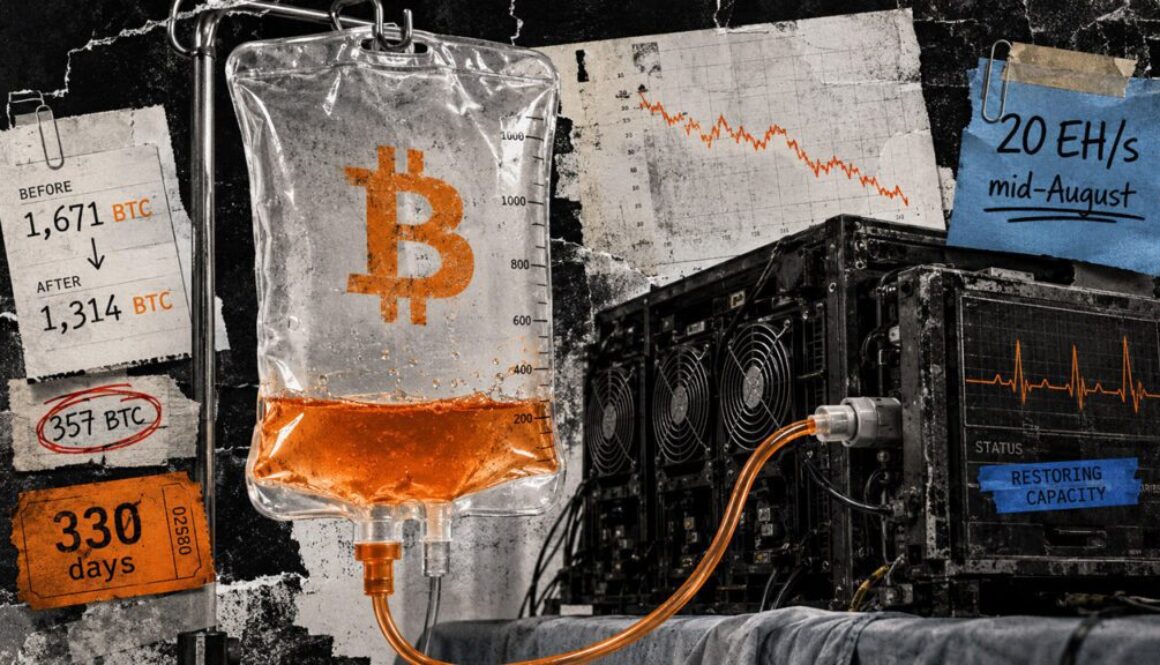
Bitcoin miner and cloud-mining provider BitFuFu said advance payments for 330 days of future hashrate were the primary reason its reported Bitcoin holdings fell by 357 BTC in July. At the same time, production and managed hashrate declined, leaving a clear operational checkpoint: whether the platform reaches approximately 20 EH/s by mid-August.
The company’s SEC-filed July operating update put holdings at 1,314 BTC on July 31, down from 1,671 BTC a month earlier. The reported balance excludes Bitcoin produced for cloud-mining customers. Total production fell to 112 BTC from 125 BTC, while average daily output slipped to 3.6 BTC from 4.2 BTC.
Total managed hashrate declined to 14.2 EH/s from 15.3 EH/s. Third-party suppliers and hosting customers contributed 10.6 EH/s, down from 11.8 EH/s, while self-owned hashrate rose to 3.6 EH/s from 3.5 EH/s.
Management expects capacity secured in June and July to restore total managed hashrate to about 20 EH/s by mid-August. From the July-end level, that guidance implies a 5.8 EH/s, or roughly 41%, increase if the base otherwise remains unchanged.
A separate June operating update disclosed 5.3 EH/s from suppliers for 270 days beginning in August. That block nearly matches the gap between 14.2 EH/s and 20 EH/s, but the July filing calls its 330-day capacity additional and does not disclose the new block’s EH/s contribution. The two updates therefore cannot be combined into a precise commissioning schedule.
The capacity purchase still lacks a price tag
The July filing does not disclose how much Bitcoin or money BitFuFu committed, identify the supplier, or provide pricing, energy costs, uptime requirements, or cancellation protections. It also does not provide a complete bridge between self-mining additions, sales or transfers, client receipts and advance payments. The 357 BTC decline therefore cannot safely be treated as either an open-market sale or the exact price of the capacity arrangement.
Those missing economics matter because BitFuFu said in its April update that it had declined to renew some third-party contracts when they would pressure margins. At the time, management said it would not pursue hashrate growth at the expense of unit economics. The July disclosure is not detailed enough to test the new purchase against that earlier standard.
A separate portion of the reserve remains encumbered. The July balance included an aggregate 44 BTC pledged for loans and miner-procurement payables, compared with 54 BTC in June, but the reason for the 10 BTC change and the current allocation are undisclosed. BitFuFu’s 2025 annual report describes historical collateral arrangements, but those year-end balances and terms cannot be mapped onto the July figure.
Reaching about 20 EH/s by mid-August would show that the planned capacity arrived on management’s timetable. It would not, by itself, establish that production has recovered, that the purchase meets BitFuFu’s earlier unit-economics standard or that further reserve use will not be required. Those questions depend on contract details and subsequent operating and treasury disclosures.
A US-based crypto mining venture raised about $22 million from more than 380 investors, then spent just 13 cents of every dollar on its purported mining operation, the SEC alleges.
The regulator filed partially settled charges on July 20 against Zan Shaikh and Bright Vision Distribution LLC, doing business as Mining Automatic. According to the SEC complaint, the defendants promised guaranteed monthly returns between approximately June 2023 and May 2025 even though the purported mining operation was not set up to generate those levels of returns.
The SEC alleges Shaikh and Mining Automatic took in at least $20 million more than they repaid to investors. It said investor money was used largely for marketing to solicit new investors, along with Shaikh’s personal expenses and unrelated business expenses.
Shaikh and Mining Automatic agreed to proposed permanent injunctions, subject to court approval. Shaikh also agreed to an officer-and-director bar and a conduct-based injunction. If the court approves the consent judgments, disgorgement, prejudgment interest, and civil penalties would be decided later on an SEC motion. Any investor distribution or recovery remains unannounced and uncertain.
A separate FBI victim-information page says the bureau’s Boston Division is seeking potential victims connected to Shaikh, Bright Vision Distribution, YT Automatic and Mining Automatic.
The questionnaire also names RankOne Ecommerce and Replic8 among companies affiliated with Shaikh and associates, without defining each relationship, and says investors were primarily targeted from 2022 through 2025.
The FBI’s outreach casts a wider net than the SEC’s case, which covers more than 380 investors allegedly promised guaranteed returns from around June 2023 to May 2025. More victims may now come forward, but the FBI has not updated the total or suggested anyone will get their money back.
The FBI says submissions are voluntary, may aid the investigation and may lead agents to request more information. It says victims may be eligible for services, restitution and rights under federal or state law. Submitting the form remains an information-gathering step, with formal claim status left unspecified.
The next formal step is court review of the proposed judgments. If they are approved, the SEC can move for the court to set monetary relief, while the amount investors might ultimately recover remains unknown.
TeraWulf (NASDAQ: WULF) shares jumped 17% on Monday after the former Bitcoin miner announced it had signed a 20-year lease with Anthropic.
The company expects to bring in roughly $19 billion from the deal. This deal hands one of the most closely watched AI-infrastructure players a marquee tenant and two decades of contracted revenue.
WULF traded around $24.14 by late Monday morning, up from Friday’s close of $21.18, with an intraday range of $23.38 to $25.15, according to Google Finance. The move continues an upward trend that has seen WULF grow more than 117% since the start of the year.
The deal means Anthropic will occupy a purpose-built AI campus at TerraWulf’s Justified Data site in Hawesville, Kentucky, near Louisville. The build-out is in different stages: with the first services slated for H2 of 2027, while the full 401 megawatts of critical IT capacity will go live in early 2028. That’s enough power to run large-scale AI training workloads.
Anthropic is the brain behind the Claude family of AI models. For TeraWulf to lock in a customer of that magnitude for two decades, it means the company’s pivot is not just speculative but has the potential to build a strong revenue base.
Effectively, the lease is betting on Anthropic being a key player in the field of AI two decades from now, as Contellation Research noted.
Two deals on the same day
TeraWulf paired the lease with an exit. The company agreed to sell its 50.1% stake in an AI data center joint venture in Abernathy, Texas, to an investor group led by Fluidstack, its partner in the project.
While TeraWulf did not disclose terms, the company claimed it had earned a premium on the ~$450 million it sunk into the venture. The next step is to redeploy that capital into sites fully owned and controlled by TeraWulf.
“Collectively, the transactions enhance TeraWulf’s long-term revenue visibility, strengthen its financial position, and further align the Company’s capital with infrastructure platforms where it maintains direct ownership, customer relationships, and operational control,” the company said in its announcement.
From Bitcoin mining to AI data centers
The company started as a Bitcoin mining business, with facilities in New York and Pennsylvania. In Q1 of 2026, TeraWulf generated $21 million in revenue from its high-performance computing hosting and passed the ~$13 million mark from its mining operations, for the first time ever.
That transition to AI data centers has not come cheap. In Q1, TeraWulf posted $427.63 million in losses. Q1 ended with TeraWulf having about $3.1 billion in cash and roughly the same amount in long-term debt.
TeraWulf is not the only company making a pivot. Plenty of mining companies are leasing power and ready-built space to AI firms, as this provides a stable income stream compared to the volatility of Bitcoin mining.
Demand for data centers is sky high: the International Energy Agency projects data center electricity use will nearly double to about 945 terawatt-hours by 2030, with AI the main driver.
Constellation Research believes there is a greater subtext to the deal, with Neoclouds and smaller providers moving quickly ahead of Meta’s cloud-computing launch, and TeraWulf sits among the companies most exposed to that shift.
Kentucky has become a key part of TerraWulf’s plans. The company already has hundreds of megawatts of grid-connected capacity in the Hawesville area and has a separate 285-acre site in Kentucky that can support more than a gigawatt.
What to watch next is delivery. The first phase of the Anthropic campus is more than a year out, and the $19 billion figure depends on capacity coming online through 2028 and a tenant that stays the course.
Don’t just read crypto news. Understand it. Subscribe to our newsletter. It’s free.
Bitcoin miner Riot Platforms (RIOT) has moved another 500 Bitcoin (BTC) to custody firm NYDIG, worth roughly $39 million, the latest move in a treasury strategy now funding its push beyond mining.
On-chain monitors spotted the deposit, which fits a familiar pattern. Riot has sold far more Bitcoin than it mines, converting its reserves into cash for a costly pivot into AI data centers.
A Familiar Pattern for Riot
Blockchain monitor Onchain Lens flagged the 500 BTC deposit on June 30. It mirrored a similar transfer that analytics firm Arkham tracked in early April. Such moves to custodians often precede sales.
The scale of the selling is striking. Riot disclosed selling 3,778 Bitcoin for $289.5 million last quarter, while mining just 1,473 coins. The first-quarter Bitcoin sell-off far outpaced production, draining the treasury.
Those sales cut holdings to about 15,680 BTC as of this writing, down 18% from a year earlier.
Riot Platforms Among Top Public Firms Holding BTC. Source: Bitcoin Treasuries
Other miners offloading Bitcoin have leaned on the same playbook. Rival MARA Holdings sold about $1.1 billion in Bitcoin this year, while Core Scientific began monetizing most of its coins.
Thinner margins since the 2024 halving have squeezed pure mining.
The Riot Bitcoin Sale Funds an AI Bet
The clearest link between the selling and the pivot came in January. Riot funded a $96 million land purchase at its Rockdale site in Texas entirely by selling about 1,080 Bitcoin.
That land now anchors a data center business. Anchor tenant AMD signed a 10-year lease worth about $311 million, then doubled its commitment to 50 megawatts last quarter. The segment brought in $33.2 million of revenue, its first contribution.
— Riot Platforms, Inc. (@RiotPlatforms) June 30, 2026
The economists explain the urgency. Once equipment depreciation is accounted for, Riot spent $96,283 to mine each Bitcoin last quarter, more than a Bitcoin was worth. It reported a net loss of about $500 million.
What the Sale Streak Signals
CEO Jason Les has cast the shift as a turning point rather than a retreat.
“The first quarter of 2026 marks a definitive inflection point for Riot, as we officially transitioned into an active, revenue-generating data center operator,” the miner’s CEO, Jason Les, said.
Riot abandoned its long-standing hold-only policy in 2025 and now sells routinely. Still, the company has staked its future on tenants like AMD rather than on Bitcoin alone.
With Bitcoin trading near $58,700, Riot can still raise large sums from a shrinking treasury. The race for AI infrastructure has rewarded that bet, with miner stocks climbing even as mining margins fade.
The Oman Ministry of Transport, Communications and Information Technology has launched a state-backed bitcoin mining pool OmanHash.om, that every licensed miner in the country must now use in their mining operations.
According to Oman’s newly set up regulatory framework, OmanHash.om is now the only mining pool for licensed operators in the Sultanate.
Mining pool operation and capacity
Digital energy and infrastructure company, Enegix Global, developed the technology platform and liquidity backend for the mining pool. Frontier Technologies LLC, an Omani blockchain firm based in Muscat, will manage all local operations.
OmanHash.om uses a Full Pay-Per-Share (FPPS) payout model, where miners receive payouts based on shares submitted regardless of whether a block is found by the pool, and with the pool operator collecting a fee.
The country has announced that the initial target for the new mining pool is approximately 10 exahashes per second (EH/s) of computing power. Oman controls almost 3% of the entire bitcoin network hashrate worldwide, which is equal to about 30 EH/s, according to Q2 2026 data from Hashrate Index.
The Omani Sultanate has invested heavily in bitcoin mining infrastructure since 2022. More than $700 million has gone into mining and data center projects in the Salalah Free Zone, including two major facilities that launched in 2022 and 2023.
The Kazakhstan precedent amid Oman’s investment
Enegix had previously built and currently operates btcpool.kz in Kazakhstan, launched in October 2023 after the country passed a digital assets law requiring licensed miners to operate through government-accredited pools and report revenue directly to tax authorities. Oman has now become the second country with this sovereign mining pool model.
“This is our second sovereign mandate, and it validates the model we have been building since Kazakhstan,” said Olzhas Amirov, chief business development officer of Enegix Global, according to TheEnergyMag. “Clear licensing frameworks help miners operate legally, avoid excessive taxation, and establish transparent communication with authorities.”
With OmanHash.om added, Enegix says its combined pool operations across 21pool.io, btcpool.kz, and OmanHash.om reach approximately 25 EH/s. Yersaiyn Nurtoleuov, Enegix’s chief product officer, said: “Our target is 30 EH/s, and we are actively building the infrastructure and partnerships to get there.”
Hut 8 is pushing even further into AI infrastructure than most other Bitcoin miners are. Its latest disclosures show a company using power access, data center leases, project debt, and BTC-backed liquidity to build the financing stack for that move.
The company’s latest disclosures put numbers around that transition. Hut 8 reported $16.8 billion in triple-net, take-or-pay contracted lease revenue across two hyperscale AI campuses, then separately refinanced a $200 million Bitcoin-backed credit facility with FalconX.
The new facility cut the fixed rate to 7.0% from 9.0% and unencumbered roughly 3,300 BTC from the prior collateral package.
Taken together, the disclosures show a miner identity changing into something closer to an infrastructure landlord. Hut 8 is turning megawatts, lease commitments, project debt, and Bitcoin holdings into the machinery for a business that depends less on mining alone.
The result is a case study with more substance than a generic AI pivot. Hut 8 is showing a funded path into data center infrastructure, though the model still needs operating proof. The test is whether contracted AI cash flows arrive on schedule and become durable enough that Bitcoin collateral becomes a bridge instead of a recurring source of balance-sheet dependence.
The lease base turns power into finance
The strongest number in Hut 8’s first-quarter disclosure sits outside the Q1 income statement: $16.8 billion of contracted lease revenue across River Bend and Beacon Point, covering 597 MW of AI data center capacity.
Hut 8 generated $71 million of revenue in the first quarter, including $66 million from Compute, and posted a $253 million net loss that included $295 million of primarily unrealized digital-asset losses.
The $16.8 billion figure represents long-term contracted lease value that Hut 8 is presenting as the foundation for a different kind of business.
The pieces are specific. Hut 8’s Beacon Point lease added 352 MW of IT capacity and $9.8 billion of base-term value. Its earlier River Bend lease added 245 MW and $7 billion of base-term value, with Google providing a financial backstop for the base lease term.
Hut 8 is commercializing scarce power and data center capacity under long-term lease structures. The appeal comes from contracts and power access rather than a token, a cloud slogan, or a vague compute promise.
Triple-net and take-or-pay terms are designed to make those cash flows more financeable because the tenant obligation is less tied to day-to-day mining economics.
Hut 8’s disclosures line up across four moving parts:
Model component
Hut 8 evidence
Reader impact
Risk still live
Power and sites
597 MW of contracted AI data center capacity across two campuses
Turns miner infrastructure into leaseable digital infrastructure
Delivery, interconnection, construction, and tenant concentration
Contracted demand
$16.8 billion in base-term contracted lease revenue
Creates a financing story beyond hashprice exposure
Lease value depends on execution over long timelines
Project finance
$3.25 billion River Bend notes, non-recourse to Hut 8
Reduces the need to fund all growth from equity or BTC sales
Large projects still carry cost, schedule, and market risks
Bitcoin balance sheet
$200 million FalconX BTC-backed facility and 3,300 BTC unencumbered
Gives liquidity without immediately selling coins
Collateral value still moves with BTC
Hut 8’s AI transition has more to it than most, but each component still carries a different kind of risk.
The leases reduce some revenue uncertainty. The bond financing reduces some parent-level funding pressure. The Bitcoin facility improves liquidity. Still, all three leave Hut 8 with the task of building, delivering, and operating infrastructure for customers whose requirements differ from Bitcoin mining.
Bitcoin becomes bridge capital
The FalconX refinancing is the clearest sign that Bitcoin is becoming part of the financing machinery rather than only the asset being mined.
The full Hut 8 release distributed through Nasdaq described the facility as a 364-day Bitcoin-backed loan with limited recourse to pledged BTC, a no-rehypothecation covenant, fixed loan-to-value thresholds, and no loan-to-value ratchet triggered by declines in Bitcoin’s price.
Those terms blunt part of the obvious criticism. The deal improves the terms of a miner’s coin-backed borrowing instead of worsening them to chase a new market.
Hut 8 lowered its fixed cost of debt by 200 basis points and increased Bitcoin held outside collateral covenants. The release valued the newly unencumbered coins at roughly $260 million as of May 1, 2026, giving Hut 8 more balance-sheet room without selling the asset.
That makes the facility a better tool, but not a risk-free one.
Hut 8’s own balance sheet shows why the distinction is important. Its 10-Q said the company held about 16,332 BTC as of March 31, 2026, including about 9,311 BTC held by Hut 8 and about 7,021 BTC held by American Bitcoin.
The aggregate fair value was about $1.11 billion, based on approximately $68,222 per BTC. The same filing tied the first-quarter digital-asset loss to Bitcoin’s decline during the period.
Today, Bitcoin trades near $75,782 on CryptoSlate’s price page, down 2.1% over 24 hours and roughly 40% below its October 2025 all-time high. The market-price channel is the relevant risk.
Bitcoin can provide liquidity without a sale, but the borrowing value, covenant comfort, and refinancing backdrop still depend on the asset’s market behavior.
That is why the AI landlord strategy cannot be separated from the Bitcoin treasury strategy. If AI leases produce reliable cash flows, BTC collateral can be transitional capital. If delivery slips, financing markets tighten, or Bitcoin weakens at the wrong time, the same collateral can keep the pivot tied to the volatility it was meant to escape.
The miner label is becoming less useful
Earlier coverage of miners’ AI pivot showed the broader identity split facing the sector. Miners are moving toward AI and high-performance computing because power access, cooling infrastructure, land, interconnection work, and industrial operations can be worth more under contracted dollar revenue than under compressed mining margins.
Hut 8 fits that broader sector shift. Public miners built businesses around converting power into BTC, and AI data center demand is now giving some of them a second possible use for the same physical footprint.
The difference is that AI customers do not buy the same thing the Bitcoin network buys. Mining can tolerate interruption when economics or grid conditions change. AI tenants want uptime, delivery certainty, dense power, cooling, network architecture, and creditworthy execution.
A miner with megawatts still has to become a hyperscale landlord. It has to turn a power position into infrastructure that lenders and tenants will treat as dependable.
Hut 8’s disclosures show both sides of that transition. The company describes itself as an energy infrastructure platform integrating power, digital infrastructure, and compute. It also still reports digital-asset losses, BTC holdings, and exposure to mining economics.
Some Compute revenue and BTC holdings are held by American Bitcoin, a consolidated subsidiary, making Hut 8’s strategy less straightforward than a clean exit from mining.
That complexity is part of the shift. The market is watching whether miners can stop being pure BTC proxies without losing the balance-sheet optionality that made their treasuries valuable in the first place.
The strongest argument in Hut 8’s favor is that the AI pivot uses more than Bitcoin-backed debt. The company said it closed $3.25 billion of fully amortizing 16.5-year investment-grade senior secured notes to finance River Bend.
Hut 8 described the financing as non-dilutive and non-recourse to Hut 8, with loan-to-cost increasing to about 95%.
That weakens the crutch argument. If project-level debt funds the campus and long-term leases support the debt, then Bitcoin collateral is one part of the structure rather than the whole. It is a liquidity tool alongside project finance and contracted revenue.
The caution is that the financial structure still has to become operationally sound. River Bend is still advancing toward delivery, Beacon Point still has to be built out, and the company still has to convert an 8,375 MW development pipeline into real contracted capacity.
Hut 8 also warned investors about risks tied to data center construction, financing, power expansion, permitting, supply chains, technical challenges, and market conditions.
Hut 8 is showing that miners can finance a route into AI infrastructure when they have scarce power, credible tenants, project-finance access, and a Bitcoin balance sheet lenders will underwrite. It has yet to show that the route is self-sustaining.
The next test is whether AI infrastructure cash flows become strong enough to push Bitcoin collateral into the background. If they do, Hut 8’s BTC-backed financing will look like bridge capital for a miner that successfully monetized its power footprint.
If they fail to do so, the pivot will remain tethered to the same balance-sheet asset that made the strategy possible in the first place.
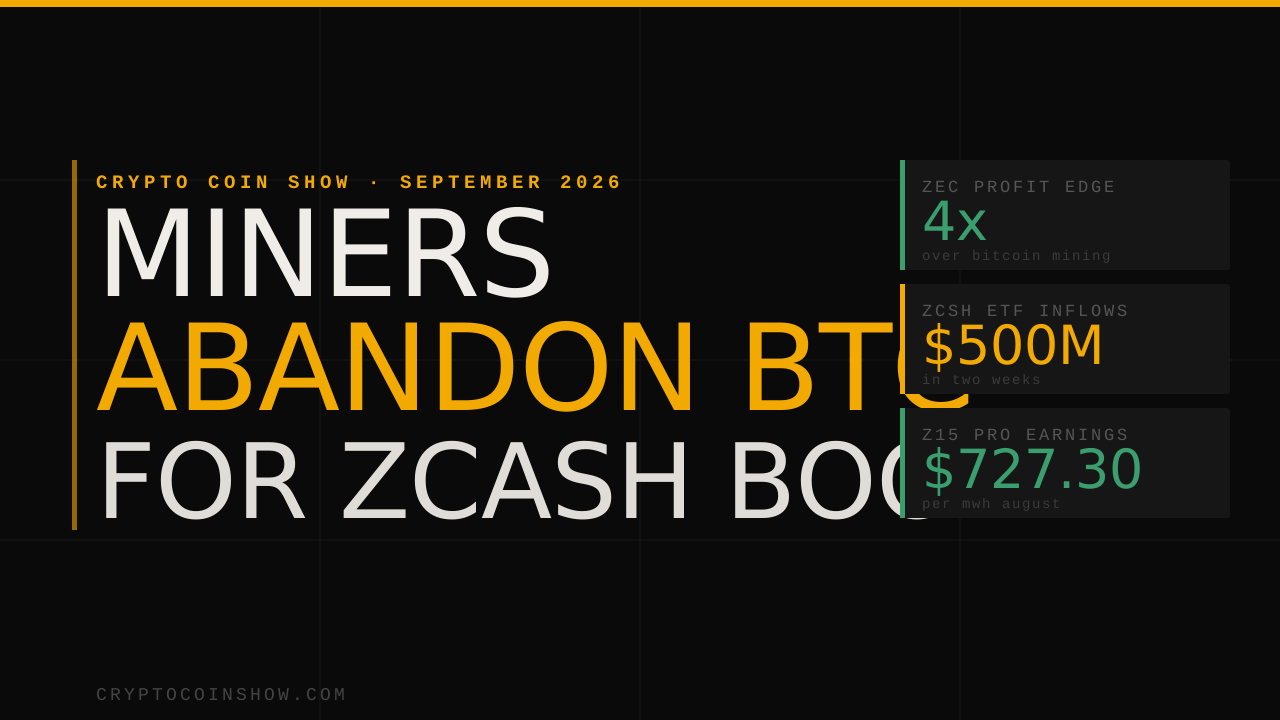
Is Bitcoin Mining Still Profitable in 2026? Here’s the Honest Answer | Crypto Coin Show
Bitcoin Mining · Economics
Is Bitcoin Mining Still Profitable in 2026?
The honest answer depends on who you are, what you’re running, and what you’re paying for power. Here’s how to actually work it out.
By Ashton AddisonApril 2026Crypto Coin Show
~$0.045
Break-even power cost / kWh
~50%
Mining revenue is energy cost
−45%
Hashprice vs. pre-halving peak
+3%
NiceHash premium over FPPS
Let’s skip the optimism and give you the real answer: Bitcoin mining in 2026 is profitable for some people and a money-losing grind for others — and the gap between those two outcomes comes down to a handful of variables most guides don’t bother to explain clearly.
The 2024 halving cut the block subsidy from 6.25 BTC to 3.125 BTC. Bitcoin’s price hasn’t compensated fully. Network difficulty has kept climbing. The miners who were marginal at $90,000 are now operating at a loss or have shut down entirely. Those with access to sub-$0.04/kWh power and modern hardware are still making money. Everyone else is somewhere in between, doing math that changes every time the price ticks up or down.
This article is for the people doing that math — or thinking about starting.
THE THREE NUMBERS THAT DECIDE EVERYTHING
Bitcoin mining profitability isn’t mysterious. It collapses to three inputs: your hashrate (how much compute you have), your power cost (what you pay per kilowatt-hour), and the hashprice (the current market rate for that compute). Get these right and the rest is arithmetic.
The problem is that two of those three numbers move constantly. Hashprice shifts daily with Bitcoin’s spot price, network difficulty, and transaction fee volume. Power costs are fixed for operators with contracts but highly variable for anyone paying retail electricity rates. Your hashrate is the only number you fully control — and even that degrades as better hardware hits the market.
Hashprice: the number most people ignore
Most conversations about mining profitability focus on Bitcoin’s price. That’s the wrong frame. What actually determines your revenue is hashprice — the dollar value earned per unit of hashrate per day, typically measured in $/TH/day. Hashprice is a function of Bitcoin’s price, yes, but also of total network hashrate and current transaction fees.
You can have Bitcoin at $80,000 and a lower hashprice than you had at $60,000 if the network has grown significantly more competitive in the interim. This is exactly what happened in the months following the 2024 halving: price held, but difficulty kept rising, compressing hashprice to levels that made many operations uneconomical.
“A lot of market participants were on the edge of profitability already in the $90,000 range. So a lot of those operations are shut down or operating at minimum scale.”
— Filip Primec, Director of NiceHash AG
WHO IS ACTUALLY PROFITABLE RIGHT NOW
The honest breakdown in 2026 looks like this. There are four distinct categories of miners, and they are having very different experiences.
✓ Profitable
Large-scale industrial operators
Long-term power contracts at $0.02–0.04/kWh, latest-gen ASICs, and treasury strategies that hedge against price volatility. These operations are still making money — but margins are thinner than 2021–2023.
✓ Profitable
Stranded or subsidized energy users
Operators co-located with cheap renewable generation — hydro, flared gas, solar — who effectively pay near-zero marginal cost for power. Their break-even is almost anywhere above $0.
~ Marginal
Mid-tier home and small farm miners
Running S19 Pro or S21 hardware on $0.06–0.10/kWh power. Profitable when Bitcoin is above ~$75,000. Currently break-even or slightly negative. Holding on for higher prices.
✗ Losing Money
Retail electricity miners
Anyone paying $0.12+/kWh — typical residential rates in the US, Europe, or Australia. At current hashprice levels, the electricity bill exceeds Bitcoin earned on almost any consumer hardware.
The dividing line runs almost entirely through power cost. Hardware matters — a newer S21 or M60 consumes less power per terahash than an S17 — but power cost has the steeper slope. Shaving $0.02/kWh off your electricity rate does more for profitability than upgrading hardware in most scenarios.
THE HALVING’S REAL EFFECT
Every four years, the Bitcoin protocol cuts the block subsidy in half. The logic behind this is foundational to Bitcoin’s design: predictable, disinflationary issuance toward a fixed 21 million supply cap. The economic effect on miners is more complicated than the headline number suggests.
The 2024 halving took block rewards from 6.25 BTC to 3.125 BTC. If nothing else changed, that would be a 50% revenue cut overnight. In practice, two things were supposed to compensate: a rising Bitcoin price (driven by post-halving supply shock and new ETF demand) and rising transaction fee revenue (driven by Ordinals, Runes, and overall on-chain activity).
The price rose — but not enough to fully compensate, and not before a significant period of margin compression. Transaction fees spiked during the halving week itself and then normalized. Network hashrate continued climbing through 2024 and into 2025, driven by machines ordered during the bull market that came online after the cut. The net result: hashprice spent most of 2025 well below pre-halving levels.
The Halving Math
At $80,000 BTC and current difficulty: a miner running 100 TH/s of modern hardware earns roughly $8–12/day in BTC before electricity costs. Running at 3,000W, that’s $7.20/day at $0.10/kWh — leaving $0.80–$4.80 gross margin before hardware amortization. At $0.05/kWh, that margin improves to $4.40–$8.40. This is why power cost is everything.
THE CASE FOR MINING ANYWAY
The profitability calculation above treats mining as a pure income-generating activity. For a significant portion of miners, that’s not the right frame — and understanding why reveals something important about who actually keeps the Bitcoin network running.
Mining as cost-basis acquisition
If you intend to hold Bitcoin long-term, mining it is an alternative to buying it on an exchange. The question isn’t “am I making money mining?” — it’s “is my all-in cost per BTC lower through mining than through buying?” For miners with access to cheap power, the answer is often yes, even in compressed-margin environments.
Conviction-driven miners don’t quit in bear markets
The miners who have stayed in through every cycle are typically those who mine because they believe in Bitcoin’s long-term value, not because the current hashprice justifies it on a quarterly P&L. This is not irrational — it reflects a different time horizon and a different risk tolerance. Bitcoin was built to reward low time preference, as the saying goes.
⚡
The EasyMining case: A solo miner on NiceHash’s EasyMining product purchased a ~$70 hashrate package and found Block #939527, earning over $200,000 in BTC. The probability was extremely low. The outcome was real. On-demand hashrate marketplaces make this kind of participation possible without hardware ownership — changing the risk profile entirely for small-scale participants.
MINING WITHOUT HARDWARE: THE MARKETPLACE OPTION
One development that has meaningfully changed the accessibility calculation is the maturation of hashrate marketplaces — most prominently NiceHash. These platforms let buyers purchase raw hashrate on-demand, directing it to a pool of their choosing, without ever owning or operating hardware.
The economics are different from hardware ownership in important ways. There’s no capital locked in depreciating equipment. There’s no long-term power contract. You’re not exposed to the ASIC obsolescence cycle. You pay a small premium for that flexibility — buyers on NiceHash are currently paying roughly 3% above the hashprice benchmark — but you also get the ability to enter and exit positions as conditions change.
For someone curious about mining, wanting to experiment with pool strategies, or looking to occasionally rent large amounts of hashrate for a solo mining attempt, this is a fundamentally different risk profile than buying an ASIC. The learning curve exists — understanding pool mechanics, RTPPS vs FPPS payout structures, and how to read marketplace pricing takes time — but the financial exposure starts at around $100.
HOW TO EVALUATE IF MINING MAKES SENSE FOR YOU
Before running any hardware or placing any marketplace order, work through this framework honestly.
Question
Threshold
Verdict
What’s my electricity cost?
Under $0.05/kWh
Favorable
What’s my electricity cost?
$0.05–0.09/kWh
Marginal
What’s my electricity cost?
Over $0.10/kWh
Unfavorable
Am I buying hardware?
Latest-gen ASIC (S21, M60+)
Competitive
Am I buying hardware?
Previous-gen (S19, M30)
Marginal
Time horizon?
Holding mined BTC 2+ years
Changes the math
Time horizon?
Need immediate fiat return
Risky
Want to try without hardware?
NiceHash marketplace from ~$100
Low barrier
The honest answer to “is it profitable?” is: it depends on your power cost more than anything else, and your time horizon more than your hardware. Someone mining with cheap power and a multi-year hold thesis is in a different business than someone paying retail electricity and hoping to flip BTC for profit this quarter.
Know which one you are before you spend money on hardware or hashrate. The math will tell you the rest.
This article is for informational purposes only and does not constitute financial advice. Mining profitability figures are estimates based on publicly available hashprice data as of April 2026 and will vary based on hardware, power costs, and market conditions.
America holds roughly 38% of global Bitcoin mining capacity, and the specialized hardware powering that position comes overwhelmingly from Chinese manufacturers.
Senators Bill Cassidy and Cynthia Lummis introduced the Mined in America Act on Mar. 30 to address that gap, proposing certification, domestic manufacturing support, and the codification of President Donald Trump’s Strategic Bitcoin Reserve to begin unwinding a foreign hardware dependence they frame as a national industrial vulnerability.
Both data points describe the same supply-chain gap: American mining operations running on machines supplied by Chinese manufacturers. That combination of leading the world in an activity while relying on adversary-linked manufacturers for the machines that enable it is the argument the bill puts into legislative form.
A bar chart contrasting the US share of global Bitcoin mining capacity at 37.5% against China-origin hardware’s 97% share of mining equipment supply.
The bill proposes a voluntary “Mined in America” certification administered by Commerce. Certified facilities would phase out mining hardware linked to foreign adversaries.
NIST and the Manufacturing Extension Partnership would support domestic hardware manufacturing by drawing on existing federal energy and rural programs. Cassidy’s office says the bill operates within current program authorities.
The bill would also write the Strategic Bitcoin Reserve into statute. Trump’s March 2025 executive order created the reserve using forfeited government Bitcoin and specified that any additional acquisition strategies must be budget neutral, imposing no incremental taxpayer cost.
Moving the reserve from executive action to law would give it legislative standing beyond a single administration and, for the first time, bind the hardware-sourcing argument to a federal balance sheet instrument.
The Mined in America Act rests on a specific argument: owning the activity layer while ceding the hardware layer to foreign-origin manufacturers leaves the US exposed upstream.
The bill’s answer spans certification, manufacturing support, and reserve codification, three policy levers that together frame Bitcoin mining as a sector deserving the same upstream attention Washington gives to semiconductors or critical minerals.
Why Washington got here
Reuters reported that US authorities began seizing some Chinese-made mining equipment at ports in late 2024 on FCC and Customs enforcement grounds, before releasing some of it in March 2025.
Those seizures gave the hardware dependence argument concrete, documented weight.
The port-level friction raised a question that the bill now codifies in law: if Chinese-origin mining gear can be caught by customs enforcement, what does that mean for an industry whose hardware stack now connects directly to Treasury reserve policy?
For the bill’s backers, the episode turned that question from theory into documented enforcement history.
Mining economics made the supply chain exposure more consequential. A CoinShares report puts network hash price in the $30 to $35 per petahash per day range, with roughly 15% to 20% of the global fleet operating at a loss at those levels.
Hardware supply disruptions land harder when the hash price environment already squeezes margins, with operators unable to quickly source replacement machines facing real operational exposure from a customs hold or tariff escalation.
The SEC released guidance on Mar. 17 clarifying the treatment of protocol mining and other crypto activities. A July 2025 White House digital assets report directed Congress and regulators to support US digital asset leadership.
Washington now treats crypto infrastructure as an industrial-policy category, and the Mined in America Act arrives as the hardware-sourcing component of that reorientation.
Date
Event
Why it mattered
Late 2024
U.S. authorities began seizing some Chinese-made mining equipment at ports
Turned hardware dependence from a theoretical concern into a real enforcement issue
March 2025
Some of the seized mining equipment began to be released
Showed the issue was active and operational, not a one-off headline
March 2025
Trump’s executive order created the Strategic Bitcoin Reserve
Elevated Bitcoin from a market topic to a federal policy and Treasury issue
July 2025
White House digital assets report backed U.S. digital-asset leadership
Placed crypto infrastructure within a broader national competitiveness agenda
March 17, 2026
SEC released guidance on protocol mining and other crypto activities
Signaled a more formal federal posture toward crypto infrastructure
March 30, 2026
Cassidy and Lummis introduced the Mined in America Act
Put the mining-hardware supply-chain issue into legislative form
The bill’s logic runs through the same channel as semiconductor policy, battery manufacturing, or telecom equipment: who controls the machines behind a compute-intensive infrastructure that now touches power markets and the Federal Reserve.
The harder question the bill raises is what “American” hardware actually means. Reports noted that Chinese-origin manufacturers have already begun establishing US production footholds, in part to navigate tariffs, while US-based Auradine has been promoting its products and policy case for domestically designed ASICs.
Assembly in America and design-plus-component-sourcing in America produce different supply chain outcomes, and the bill’s certification framework will eventually have to define which one earns the label.
What this bill represents
The Mined in America Act drawing broad Republican support and the White House folding it into a combined reserve-protection and manufacturing plank represents the bull case.
Domestic and domestically assembled rig capacity expands enough to capture meaningful orders from certified facilities.
The US holds its high-30s share of global hash rate while reducing upstream concentration risk, and Bitcoin mining joins semiconductors and critical minerals as a named category in US industrial policy.
In this scenario, Auradine and potential new entrants capture orders that currently go abroad.
In the bear case, the legislation stalls. “Mined in America” functions as a certification brand with limited uptake, and miners continue buying from Chinese-origin vendors because price, performance, and availability dominate purchasing decisions.
Test area
Bull case
Bear case
Domestic mining hardware capacity
U.S. and domestically assembled rig supply expands enough to win meaningful orders
Domestic capacity stays too limited to shift buying patterns
Certified facility uptake
Miners adopt “Mined in America” certification in meaningful numbers
Certification becomes mostly symbolic with limited market uptake
U.S. hash-rate position
U.S. keeps its high-30s share of global mining while reducing hardware dependence
U.S. maintains mining share but remains exposed to foreign hardware supply
Dependence on Chinese-origin vendors
Operators diversify away from dominant Chinese-origin manufacturers
Price, performance, and availability keep miners buying from the same vendors
Auradine and potential new entrants
U.S.-based suppliers capture orders that previously went abroad
New entrants struggle to compete on cost and scale
Strategic Bitcoin Reserve relevance
Reserve policy and mining hardware policy become part of one industrial strategy
Reserve codification remains mostly separate from the actual hardware bottleneck
Broader policy meaning
Bitcoin mining joins semiconductors and critical minerals as a named industrial-policy category
The bill stands mainly as a statement of vulnerability rather than a reshoring success
Bottom line
America converts mining leadership into upstream supply-chain resilience
America continues leading in mining activity without controlling the machines behind it
Washington’s policy ambitions outpace its industrial capacity to execute them, and the bill serves as a documented statement of vulnerability that the domestic manufacturing base has yet to answer.
The bill’s introduction puts the supply chain gap in Bitcoin’s hardware layer onto the Senate’s legislative record.
The current hash price environment is squeezing Bitcoin miners’ profitability. CoinShares estimates that 15-20% of the global mining fleet is operating at a loss at the current hash price of $28-30 per PH/day.
In Q4 2025, Bitcoin fell nearly 31%, from an early-October all-time high of almost $126,000 to around $86,000 by late December, while network hash rate remained near record levels, driving hash prices to post-halving lows.
Mining at a Loss
According to the latest findings by CoinShares, miners operating mid-generation hardware, including models below the S19 XP, faced negative cash flow unless they had access to ultra-cheap electricity, typically under $0.05/kWh. These conditions put roughly one-sixth to one-fifth of the global mining capacity below breakeven, which is a clear signal of pressure on older and less efficient operators.
The report found that the weighted average cost of production for publicly listed miners reached $79,995 per Bitcoin in Q4 2025, as a result of higher electricity costs, increased depreciation from new AI and HPC infrastructure, and rising network difficulty. With hash prices compressed, the report identifies three consecutive negative difficulty adjustments in late 2025. This is a rare occurrence not seen since July 2022, and indicates miner capitulation.
Operators running legacy S19-series equipment were particularly impacted, as winter energy costs and ERCOT grid curtailments further increased uneconomic mining hours. CoinShares pointed out that the sector’s margin compression has forced some miners to diversify. A growing number pivoted toward AI and HPC workloads that promise higher and more stable returns compared to cyclical Bitcoin mining.
Despite the sector-wide strain, CoinShares stated that the network hash rate has shown resilience. The global network hash rate peaked at around 1,160 EH/s in October 2025 before dipping roughly 10% by December and early 2026 due to uneconomic operations and regulatory inspections in Xinjiang, China.
Miners Reduce BTC Holdings
By early March 2026, the network had stabilized near 1,020 EH/s, which indicates that strategic miners with access to low-cost energy, state-backed operations, or next-generation ASICs continue to operate profitably even as mid-generation fleets struggle. The report further detailed that publicly listed miners have reduced their BTC holdings in response to tight margins, while Core Scientific, Bitdeer, and Riot have all liquidated significant amounts from their treasuries.
Meanwhile, recovery in hash prices is closely tied to BTC price movements. At current levels of around $30/PH/day, only the most efficient miners remain cash-positive, while older and less efficient fleets face losses. A steady BTC price above $70,000 could alleviate pressure, whereas prolonged weakness would likely trigger additional miner capitulation.
Bitcoin’s mining sector shows signs of tightening supply, yet the data suggests the market has not yet experienced the acute shortage some investors have anticipated. Recent analysis of miner behavior reveals a more nuanced picture: while miners hold fewer coins in reserve than in previous market cycles, they continue to direct substantial quantities of newly produced bitcoin directly to exchanges, maintaining steady selling pressure on prices.
The Mixed Signals From Miner Distribution
Two key metrics paint an incomplete supply shock picture. The first tracks the 30-day moving average of bitcoin transfers from miners to exchanges, serving as a direct gauge of realized selling entering the market. The second measures the aggregate bitcoin balance held across over-the-counter addresses linked to miners, revealing how much inventory remains available for off-exchange sales.
Together, these indicators suggest the market continues to absorb miner distribution at a meaningful pace. The supply channel has not yet closed.
The hidden OTC overhang is limited compared to past cycles, but tactical pressure in the market channel has not yet been removed.
— Axel Adler Jr., Bitcoin Market Analyst
This distinction carries real weight for market participants. A compressed OTC balance indicates miners possess less sidelined inventory for large private deals. However, if freshly mined coins continue flowing to exchanges at elevated rates, the immediate selling pressure persists regardless of reserve size.
Key Data Point
Miner-linked OTC balances currently stand near 152.6K BTC, well below the 2018 peak of 595K BTC but only modestly above the July 2025 low of 146.9K BTC, indicating a historically compressed reserve.
Exchange Inflows Remain Elevated
The exchange inflow data forms the centerpiece of the supply shock argument. Following the fourth halving, miner transfers to exchanges rose noticeably during the early post-halving period and accelerated further through late 2025 into 2026.
This sustained elevation indicates that a significant portion of newly mined supply continues flowing directly into the market. By this measure, miner pressure cannot yet be classified as removed or substantially reduced.
Recent weeks have shown some pullback from recent peaks, but analysts caution against reading too much into short-term oscillations. A temporary dip within an otherwise elevated regime does not constitute a confirmed reversal.
To confirm a genuine reduction in miner selling pressure, the 30-day moving average would need to sustain a decline from its current elevated zone over an extended period—not simply experience brief fluctuations within it.
The over-the-counter reserve picture presents a more layered narrative. Current miner-linked OTC balances of 152.6K BTC represent historically low levels by recent standards. This figure sits well below the 2018 peak and only slightly above the series low recorded in mid-2025.
By long-term comparison, the reserve is undeniably compressed. However, analysts resist the characterization that the buffer has been almost entirely exhausted.
More than 150K BTC is still a significant volume, even if it approaches the lower bound of the historical range.
— Mining Supply Analysis
The distinction matters because 150,000 bitcoin represents genuine inventory that could support large off-exchange transactions. While depleted relative to past cycles, this reserve is not negligible. It provides miners with options for strategic sales outside public order books.
Industry Context and Structural Changes
The bitcoin mining landscape has undergone substantial transformation since the previous halving cycle. The industry has consolidated significantly, with a smaller number of large-scale mining operations now controlling a greater share of total hash rate. This structural shift fundamentally alters how miner supply behaves in the market.
Larger, institutionally-backed mining firms operate with different imperatives than smaller independent miners. Many major operations now maintain explicit treasury strategies, with some deliberately accumulating coins rather than immediately converting to fiat. Others have implemented hedging programs and long-term contracts with power providers that reduce the urgency of constant selling pressure.
Publicly traded mining companies face additional pressures. They must balance operational efficiency, shareholder returns, and strategic bitcoin accumulation. This creates a more heterogeneous miner population than existed in prior cycles, where smaller operations dominated and survival often depended on immediate revenue realization.
Additionally, the energy cost structure for mining has shifted. Renewable energy adoption by major miners has improved margins, reducing the necessity to sell coins immediately upon production. Some operations now achieve profitability even during extended bear markets, enabling greater flexibility in distribution timing.
Market Implications and Price Discovery
The mixed supply signals carry profound implications for price discovery mechanisms. If exchange inflows remain elevated while OTC reserves compress, the market faces a specific type of supply constraint: less flexibility in large off-exchange transactions, but persistent exchange-based selling pressure.
This dynamic could support price volatility. Large buyers seeking substantial bitcoin quantities without moving market prices would find fewer options through traditional OTC channels. Simultaneously, steady exchange inflows could act as a ceiling on price appreciation during rally attempts, as miners continue converting production to fiat or stablecoins.
Historical patterns suggest that genuine supply shock conditions require both reduced exchange inflows and depleted OTC reserves simultaneously. Currently, the market experiences compression in reserves while exchange channels remain active—a intermediate state rather than an extreme condition.
For macro investors evaluating bitcoin allocation, this nuance matters significantly. A supply shock narrative supports bullish positioning, yet the data does not fully justify that interpretation. The market has tightened measurably compared to cycles where miners accumulated massive reserves, but has not reached a scarcity threshold that fundamentally constrains supply at current price levels.
What the Data Suggests Going Forward
The overall picture is one of gradual but incomplete tightening. Miners face genuine constraints on their ability to accumulate and warehouse coins, yet they have not reached a point where supply constraints force material changes to their distribution behavior.
The bitcoin market continues absorbing steady miner selling. Prices reflect this persistent supply stream rather than acute shortage conditions. For investors monitoring bitcoin fundamentals, the supply dynamics remain important but do not yet signal an imminent inflection point.
True supply shock conditions would require sustained exchange inflows to decline substantially over weeks or months, coupled with near-zero OTC reserves. Current conditions fall short of that threshold. Miners retain options and continue exercising them.
Looking ahead, several catalysts could alter this trajectory. A significant rally in bitcoin price would improve miner economics and potentially reduce exchange selling. Conversely, a prolonged downturn could force miners to sell regardless of OTC reserve levels, as operational costs demand revenue realization. Changes in energy markets, regulatory environment, and institutional demand patterns would also influence miner behavior substantially.
The market should remain vigilant for the specific inflection point where exchange inflows sustainably decline while OTC reserves approach true depletion. That combination would constitute genuine supply shock conditions. Until both metrics shift meaningfully, current tightness represents a constrained but not acute supply environment.
As always in cryptocurrency markets, conditions can shift rapidly. But based on present data, the narrative of an acute bitcoin miner supply shock remains premature. The market faces tighter supply than in prior cycles, but not tight enough to constitute genuine scarcity at current price levels. Investors should distinguish between improving supply dynamics and true supply shocks—an important differentiation that current data only partially supports.
Get weekly blockchain insights via the CCS Insider newsletter.