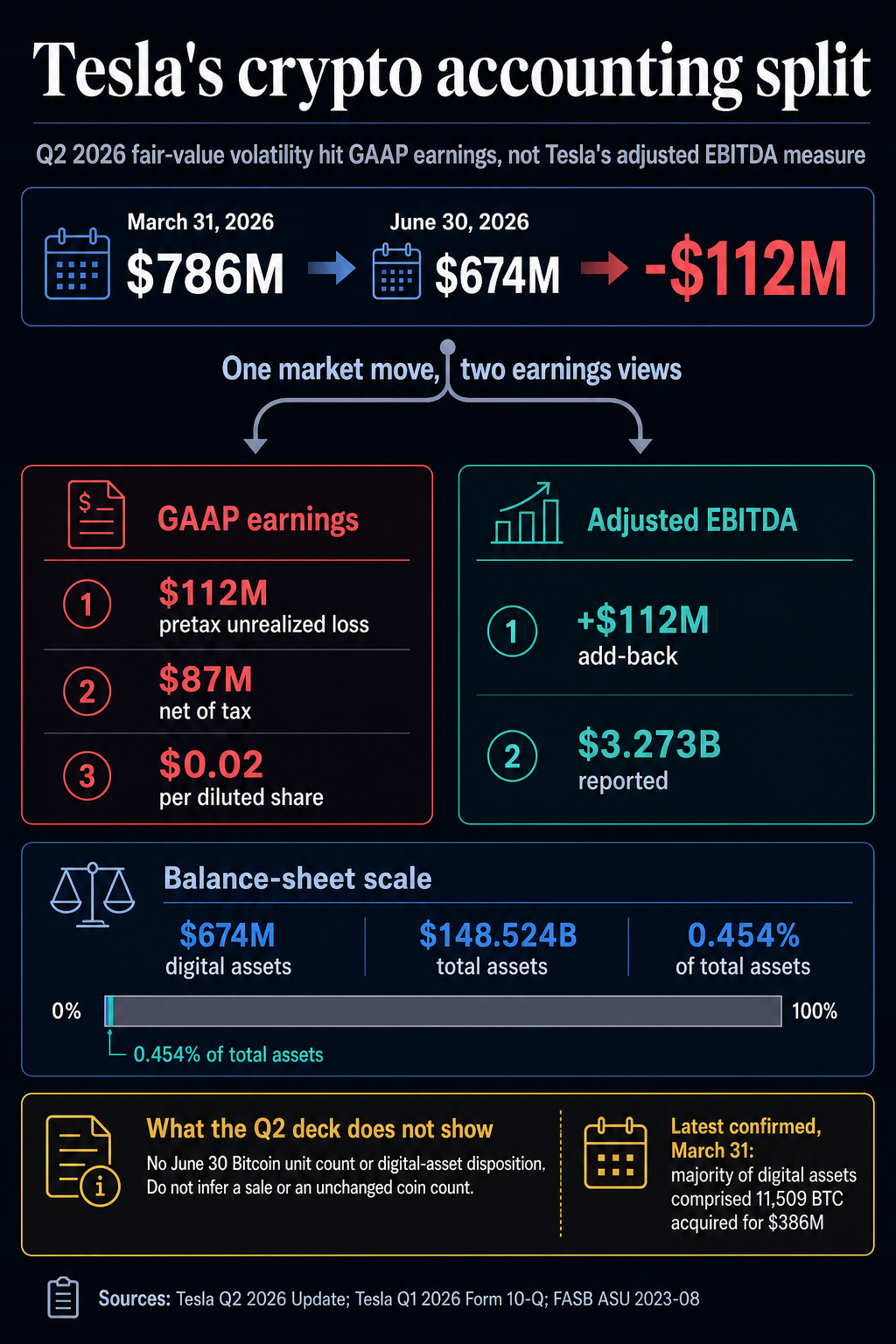
The crypto market slump wiped $112 million from Tesla’s pretax second-quarter results. The unrealized loss reduced earnings for common stockholders by $87 million after tax, or $0.02 per diluted share.
The carrying value of Tesla’s digital assets fell to $674 million at June 30, 2026, from $786 million at March 31, 2026, according to the company’s Q2 shareholder update.
Tesla’s March 31, 2026, filing reported that Bitcoin made up the majority of its digital assets, including 11,509 BTC acquired for $386 million.
The June 30 shareholder deck did not disclose a coin count or any digital-asset disposition, and Tesla’s investor-relations page listed no Q2 Form 10-Q when checked on July 23, 2026.
Under the Financial Accounting Standards Board’s crypto-asset standard, covered holdings are measured at fair value each reporting period, with changes recognized in net income. That makes the earnings effect symmetrical: rising prices can generate an unrealized gain, while falling prices can produce an unrealized loss before any sale.
Tesla’s preferred adjusted measure tells a different story. Its Q2 reconciliation added back the full $112 million digital-asset loss when calculating adjusted EBITDA of $3.273 billion.
The paper loss dragged down Tesla’s GAAP earnings but left adjusted EBITDA untouched. It also did not take cash out of the business.
The difference reshapes how Tesla’s earnings look on paper, not its broader balance-sheet exposure.
The $674 million digital-asset balance represented about 0.454% of Tesla’s $148.524 billion in total assets at quarter-end. Tesla is therefore not operating like a dedicated Bitcoin treasury company whose capital strategy centers on accumulating the asset, even though crypto volatility can still leave a visible mark on its reported profit.
The Q2 result also shows the reverse of Tesla’s fourth-quarter 2024 fair-value benefit. CryptoSlate reported that the accounting treatment contributed a $600 million lift to GAAP net income in that earlier quarter.
If crypto markets keep swinging, Tesla’s reported earnings will swing with them. If Tesla continues the same reconciliation treatment, those swings may again be excluded from adjusted EBITDA.
The next primary filing will be important for any updated Bitcoin unit count or transaction disclosure.
Until then, the change in carrying value establishes the accounting impact, not whether Tesla changed the size of its position.
Michael Saylor pitted Strategy (MSTR) against the Magnificent 7 (Mag 7) on July 2, branding his company the “MoST inteResting” stock on Wall Street as shares recover from last week’s lows.
The comparison rests on derivatives positioning rather than price performance. According to a chart Saylor shared, MSTR options open interest equals 71.9% of the company’s market capitalization, several times higher than any Mag 7 member.
Michael Saylor Pits MSTR Against Mag7 Members as MicroStrategy Stock Stages July Recovery. Source: Saylor on X
MSTR Options Interest Dwarfs the Mag 7
Saylor’s post capitalized select letters in “MoST inteResting” to spell out the MSTR ticker. His chart put Tesla (TSLA) closest at 15.8% and Meta (META) at 10.8%, with the remaining Mag 7 members lower still. Notably, the numbers are Strategy’s own presentation and capture one snapshot in time.
The ratio captures how traders treat the stock. With a beta of 3.54, per S&P Global data, MSTR moves like a leveraged proxy for its $64 billion Bitcoin bet. Options remain the preferred vehicle for that exposure.
MicroStrategy’s latest filing shows 847,363 Bitcoin (BTC), over 4% of the circulating supply. The company paid $64.1 billion, an average of $75,646 per coin.
MSTR jumped 12.5% on Monday after unveiling its capital management overhaul. It then slid 6.2% to $86.93 on Tuesday as TD Cowen cut its target to $260 from $400.
On Thursday, shares climbed more than 7%, effectively recovering above $1009 to suggest a July recovery that is still pending confirmation.
The June 29 framework set aside a $2.55 billion cash reserve, covering 17.4 months of preferred dividends and interest. It also authorized up to $1.25 billion in Bitcoin sales and $2 billion in buybacks. Company leadership cast the change as deliberate.
“Strategy is evolving from one-way capital issuance to active capital management,” Phong Le, CEO of Strategy, said in the announcement.
Meanwhile, Wall Street’s response captures the tension. Citi kept its Buy rating but slashed the price target from $260 to $136, saying the plan buys time for Bitcoin to stabilize.
TD Cowen and BTIG also kept Buy ratings while lowering targets. Separately, Rosen Law Firm opened a securities probe into Strategy.
Saylor also reiterated the $100 STRC target as the preferred stock recovers from its June 26 record low of $71.25.
Supporters read the options dominance as conviction. In contrast, critics counter that the same leverage dragged the stock from a 52-week high of $457.22 to $81.81.
Whether derivatives fervor converts into durable equity performance still hinges on Bitcoin holding above $60,000. Strategy reports earnings on July 30, the first test of the new playbook in action.
MicroStrategy’s $64 billion Bitcoin (BTC) bet has become a stress test for everyone who funded it. BTC now trades below $60,000, and the renamed company, Strategy, sits at a discount to its own holdings.
The question dividing investors is no longer whether Strategy gets liquidated tomorrow. It is who absorbs the losses while the company keeps its coins and keeps paying to hold them.
How the Bitcoin Flywheel was Built
By June 22, Strategy held 847,363 BTC bought for $64.1 billion, an average of $75,651 each. That is the largest corporate Bitcoin position anywhere.
MicroStrategy Bitcoin Purchases in 2026. Source: Strategy
The model runs like a flywheel. The company sells stock and debt, buys more Bitcoin, and its shares climb when BTC rises. However, falling prices spin the machine in reverse.
BTC has fallen below $60,000 this week, its lowest level since 2024. The stock has slid with it, dropping under the value of the Bitcoin on its books.
A new accounting standard made the pain visible. Since 2025, FASB rule ASU 2023-08 forces firms to mark Bitcoin to fair value each quarter. As a result, Strategy booked a $14.46 billion unrealized loss in early 2026. That produced a $12.54 billion net loss, or $38.25 for every diluted share.
Michael Saylor’s Strategy currently has a $14 billion unrealized loss on bitcoin.
Tom Lee’s Bitmine currently has a $10.5 billion unrealized loss on ETH.
This is why it’s foolish to follow the smart money and not take profit.
They can survive a crypto winter, most of will not!
The bill does not fall on Strategy alone. As the flywheel slows, the cost spreads to five groups, in rough order of exposure.
Common shareholders
They stand first in line. When the stock trades below the value of its Bitcoin, the company still raises cash by selling new shares. Each sale buys less Bitcoin than it hands away.
“If we decide to sell $1 billion of MSTR stock and buy $1 billion of Bitcoin… when you do it at 1.0x MNAV… it is dilutive. It is a minus 48 basis point yield. It costs the shareholders $310 million,” Michael Saylor, Executive Chairman, Strategy, said during Q1 2026 earnings call.
Existing owners are left holding a smaller claim on the same coins, and that dilution is how the strategy gets funded.
Investors in other treasury companies
The copycats have fared worse than the original. Their shares once traded far above the Bitcoin they held, lifted by hype.
As that premium faded, many Bitcoin treasury company stocks fell much harder than Bitcoin itself, leaving late buyers deep underwater.
“If that’s not already a bubble burst, how would that bubble burst?” Tom Lee, Chairman of BitMine, said while many treasury stocks traded below net asset value.
Passive and index fund investors
This group never chose the bet. MSCI has proposed removing companies whose digital assets exceed half their total assets from its global indexes.
“Feedback from the consultation confirmed institutional investor concern that some DATCOs exhibit characteristics similar to investment funds, which are not eligible for inclusion in the MSCI Indexes,” MSCI said in its official announcement earlier this year.
Strategy clears that bar with ease. An exclusion would force index funds and pension trusts to sell automatically, whatever the price, just to keep tracking the benchmark.
Convertible bondholders and preferred shareholders
These investors lent on the assumption that MicroStrategy could always refinance. If Bitcoin stays depressed into 2027, that assumption breaks.
“Proceeds from the bitcoin sales are expected to be used to fund distributions on preferred stock,” Strategy indicated in the June 1 Form 8-K.
Bondholders can demand cash, and preferred holders still expect dividends, both drawing on a reserve of just $1.4 billion.
MicroStrategy itself
The company is the backstop of last resort. On its first quarter 2026 earnings call, Michael Saylor again framed Strategy as a net buyer that never sells.
“We will probably sell some Bitcoin to fund a dividend just to inoculate the market, just to send the message that we did it.”
Yet if financing freezes while debt and dividends come due, keeping that vow could become impossible.
“We will sell Bitcoin when it is advantageous to the company. We are not going to sit back and just say we will never sell the Bitcoin,” Strategy co-CEO Phong Le added.
The Real Test Arrives in 2027
MicroStrategy faces no margin call today. Its main debt is unsecured, so a falling price alone cannot trigger a forced sale. The threat is a date, not a level.
Holders of a $1.01 billion convertible note can demand repayment on September 15, 2027. If the shares sit below the conversion price, that claim becomes a cash bill the company must cover.
Strategy has neared this edge before. A 2022 Silvergate loan backed by Bitcoin carried a margin call near $21,000 before the firm repaid it. Moving to unsecured notes and preferred stock removed the automatic trigger, but not the obligation.
Microstrategy took a loan to buy more #bitcoin a few months ago using 19,000 $BTC as collateral.
For now, no forced sale looms. The pressure has simply moved from a price trigger to a calendar. The number that matters is no longer $60,000, but the September 2027 repayment date.
Strategy (formerly MicroStrategy) added another $100 million of Bitcoin to its balance sheet last week, extending a buying campaign that has made the company the world’s largest corporate holder of the digital asset while sharpening a debate over what its common shareholders actually own.
On June 15, Michael Saylor, the company’s chairman, said Strategy bought 1,587 BTC at an average price of $63,024 per token, which lifted its total holdings to 846,842 BTC.
That position is equal to more than 4% of Bitcoin’s fixed 21 million supply cap, a level that has turned Strategy from a software company into one of the market’s most closely watched Bitcoin financing vehicles.
However, the latest purchase landed at a more difficult moment for the company’s equity story. Bitcoin has fallen sharply from recent highs, Strategy’s stock has come under increased pressure, and the company’s preferred per-share metric for tracking Bitcoin ownership moved lower following the transaction.
That decline has reopened a question that has followed Strategy through several rounds of capital raising: Is the company still increasing value for common shareholders, or is it asking them to accept a smaller claim on its Bitcoin stack in exchange for a larger and more complex balance sheet?
Bitcoin stack grows, BTC yield falls
According to the SEC filing, Strategy financed the latest purchase through sales of its Class A common stock.
The company said it sold 1.7 million MSTR shares last week for about $209 million. It used roughly $100 million to buy Bitcoin and allocated another $100 million to its dollar reserve, lifting that reserve to about $1.1 billion.
The company still has $25.75 billion of MSTR shares available for sale under its at-the-market program. It has also expanded its capital markets platform to include up to another $21 billion of common stock, $21 billion of STRC preferred stock, and $2.1 billion of STRK preferred stock.
The scale of those programs has made each new transaction a test of how investors should measure dilution.
Strategy’s BTC Yield, which tracks the change in Bitcoin holdings per assumed diluted share, slipped from 13.0% on June 1 to 12.8% on June 8. It fell again to 12.5% after the latest purchase. The decline came even as Strategy’s Bitcoin holdings rose from 843,706 BTC to 846,842 BTC over the same period.
Strategy’s Bitcoin Per Share (Source: Strategy)
For critics, that is the core issue. Strategy bought more Bitcoin, but common shareholders appear to own less Bitcoin per share when measured using the company’s own Bitcoin-per-share framework.
Matthew Kratter, a Bitcoin advocate and frequent Strategy critic, argued that the drop in BTC Yield showed the transaction was dilutive. He wrote on X:
“Congratulations to Saylor and Strategy for diluting MSTR shareholders once again over the weekend! Bitcoin per share dropped yet again, and the Saylor simps are too st#pid to understand what’s happening to them.”
Saylor defends Strategy against dilution arguments
Saylor has rejected the view that the latest transaction should be judged only by BTC Yield, arguing that the metric captures Bitcoin per share but does not account for the cash Strategy added to its balance sheet.
His defense rests on a broader framework built around common equity Bitcoin exposure (CEBE).
Under that approach, investors distinguish between Bitcoin per share before senior claims and Bitcoin exposure available to common shareholders after accounting for debt, preferred stock, and cash reserves.
Saylor has described BPS as the growth metric for common equity, while CEBE BPS is the more conservative risk measure because it adjusts for senior claims. BTC Yield, in his view, measures execution on the BPS side of the equation but does not fully capture the company’s residual equity value.
That distinction matters more as Strategy’s capital structure becomes more layered. If obligations are short-dated or expensive, CEBE becomes more important because those claims can quickly weigh on common shareholders.
However, when liabilities are longer dated, and Bitcoin appreciates faster than the company’s financing costs, Saylor argues that BPS better reflects the upside available to common equity.
In view of this, he described the gap between BPS and CEBE BPS as “amplification.” Without debt or preferred stock, the two measures would be the same, and a Bitcoin treasury company would more closely track Bitcoin itself. As liabilities increase, the measures diverge, creating both the possibility of outperformance and the risk of underperformance.
For Saylor, that means Strategy’s liabilities should not be treated as a single risk category. Short-duration, high-cost obligations can turn leverage into a drag, while long-duration, low-cost financing can increase common equity upside if Bitcoin’s annual return exceeds the company’s cost of capital.
In that framework, the latest transaction can look dilutive under a Bitcoin-per-share measure while still appearing accretive when cash reserves and senior claims are included.
On this basis, Saylor argued that a well-capitalized Bitcoin treasury company can outperform Bitcoin over time, provided the asset appreciates faster than the cost of financing the structure.
Market analysts remain split over the balance sheet
Despite Saylor’s detailed defense of the capital structure, institutional analysts remain sharply divided on whether Strategy is creating or destroying value.
Quinn Thompson, chief investment officer at Lekker Capital, criticized the continued equity issuance, arguing that Strategy should strengthen its balance sheet rather than use new capital to buy more Bitcoin.
Thompson said MSTR common trades at about 0.8 times net asset value after accounting for debt and preferred equity liabilities.
He wrote:
“They’re selling MSTR shares that are worth 80 cents on the dollar to buy $1 bills.”
In his view, the issue is not whether common equity issuance can improve the capital structure for creditors. It is whether common shareholders benefit when a company with negative cash flow relies on capital markets to service debt and preferred equity obligations while continuing to buy Bitcoin.
Nic Puckrin, CEO of Coin Bureau, made a similar point, saying Strategy has few clean options left if its common stock trades below the value of its Bitcoin holdings.
According to him, issuing more stock can dilute Bitcoin per share, while issuing more preferred shares would add to future cash obligations. At the same time, selling Bitcoin could damage market confidence, while suspending dividends could drive preferred holders away.
However, Dylan LeClair, director of Bitcoin strategy at Metaplanet, pushed back on that view. He argued that once debt and preferred stock are deducted, the common equity can still trade at a premium because Strategy’s enterprise value exceeds its Bitcoin net asset value.
From that perspective, issuing common stock can be positive for the capital structure. LeClair said the move can increase US dollar net asset value per share and reduce leverage, even if it puts some pressure on Bitcoin per share.
Adam Livingston, an independent market analyst, also supported Saylor’s broader framework. He argued that the latest transaction was accretive once Strategy’s new Bitcoin and larger cash reserve were both included.
By Livingston’s calculation, the 1,587 BTC purchase and roughly $100 million reserve increase added about 3,146 BTC-equivalent to the common residual. That lifted common equity Bitcoin exposure from 145,142 satoshis per share to 145,319 satoshis per share.
He said:
“BTC-only looked dilutive. BTC plus cash was accretive.”
His argument mirrors Saylor’s broader case: Common shareholders do not own only the latest Bitcoin purchase. They own the residual claim on Strategy’s entire balance sheet after debt, preferred stock, and other senior claims are considered.
MSTR’s harder test is investor confidence
The dispute reflects a broader shift in how investors are judging Strategy. During Bitcoin rallies, the company’s model was easier to defend: raise capital, buy Bitcoin, and trade at a premium to the value of its holdings.
However, the current market has been less forgiving. Bitcoin’s decline has compressed that premium, while preferred dividends, debt, and future financing needs have become a larger part of the investment case.
That is why today’s $100 million purchase has drawn attention beyond its size. BTC Yield fell, reinforcing the dilution argument. Cash reserves rose, supporting Saylor’s claim that Strategy’s broader residual value improved.
The next test is whether investors continue to accept that framework. Strategy can keep buying Bitcoin as long as capital markets remain open. The harder question is whether common shareholders will continue to treat the strategy as accretive when their direct per-share Bitcoin claim is declining.
Michael Saylor has put SpaceX inside Wall Street’s top technology group after the rocket company joined public markets at a value above $2 trillion. The Strategy (NASDAQ: MSTR) executive chairman posted on X after the June 12, 2026 listing and used the name “Mag8.”
Saylor wrote, “Congratulations @ElonMusk and $SPCX on a historic IPO. Thanks to you, 25% of the Mag8 now holds Bitcoin on the balance sheet.”
The SpaceX ($SPCX) offering became the largest IPO ever completed in the United States. Its opening valuation placed the company ahead of Tesla (NASDAQ: TSLA) and Meta Platforms (NASDAQ: META). Both were already included in the Magnificent Seven. That left investors with a simple problem. A company worth more than two members of the group was sitting outside the name. OpenAI and Anthropic are also possible IPO candidates, so the old label could become outdated quickly.
SpaceX forces Wall Street to rethink the name of its biggest stock group
Shay Boloor, chief market strategist at Futurum Equities, said Mag7 no longer gives investors the full picture. “It becomes very hard to keep using Mag 7 as the clean shorthand for market leadership because one of the most important companies in the world would immediately be outside the label,” he said.
These names are not official stock market categories. Banks, traders, investors, and financial media create them to describe companies receiving the most attention at a particular time. Wall Street has used this habit for decades. The “Nifty 50” covered popular large companies during the 1960s and 1970s. The “Four Horsemen” became a common term for major technology stocks during the late 1990s dot-com boom.
The SpaceX listing has now started another naming contest. One option spreading on X is “MANGOS.” One version includes Meta (NASDAQ: META), Anthropic, Nvidia (NASDAQ: NVDA), Alphabet (NASDAQ: GOOGL), OpenAI, and SpaceX. Some investors use Apple (NASDAQ: AAPL) for the letter A instead of Anthropic. Apple is currently the third-largest U.S.-listed company by market value.
Aga Kuplinska, senior vice president of product development at Tidal Financial Group, said the term is already being used inside the industry. “We are already referring to it internally and the industry is picking up on it as well,” she said. Tidal works with asset managers that want to launch exchange-traded funds.
Dan Boardman-Weston, chief executive of BRI Wealth Management, suggested another option. He called it “Magna Atoms.” His version would combine the current seven companies with SpaceX, OpenAI, and Anthropic.
Bitcoin and AI reshape the list of companies controlling market weight
Michael Hartnett, chief investment strategist at BofA Global Research, created the Magnificent Seven name in late 2023. The group included Nvidia (NASDAQ: NVDA), Apple (NASDAQ: AAPL), Amazon (NASDAQ: AMZN), Alphabet (NASDAQ: GOOGL), Meta (NASDAQ: META), Tesla (NASDAQ: TSLA), and Microsoft (NASDAQ: MSFT).
Earlier versions had already changed several times. FANG included Facebook, Amazon, Netflix (NASDAQ: NFLX), and Google. FAANG later added Apple. The Magnificent Seven removed Netflix and brought in Microsoft, Nvidia, and Tesla.
BofA expanded the idea again in a May 22 note, creating an “AI Big 10” by adding Broadcom (NASDAQ: AVGO), Micron Technology (NASDAQ: MU), and Advanced Micro Devices (NASDAQ: AMD) to the original seven. As of press time, LSEG data placed those ten companies at more than 40% of the S&P 500 by weight.
Saylor’s post also drew attention to the Bitcoin treasury disclosed by SpaceX in its SEC S-1 filing. The company reported 18,712 BTC worth about $1.18 billion at current prices. That total made SpaceX the eighth-largest publicly traded corporate holder of Bitcoin after its IPO.
Strategy remains the largest institutional Bitcoin holder. The company added more than 90,000 BTC during the first quarter of 2026 and passed BlackRock’s iShares Bitcoin Trust (NASDAQ: IBIT). It also sold 32 BTC for about $2.5 million in late May to cover required quarterly dividends on preferred shares. That transaction was Strategy’s first Bitcoin sale since 2022.
Strategy records its Bitcoin at fair market value. That accounting method can cause major changes in reported profit and company valuation whenever Bitcoin’s market price rises or falls.
Strive (NASDAQ: STRV) purchased 2,500 Bitcoins between May 23 and June 1 for approximately $185.2 million, bringing the company’s treasury to 19,000 BTC
The 2,500 BTC purchase was funded almost entirely through the company’s Variable Rate Series A Perpetual Preferred Stock (SATA), with an average cost of about $74,092 per coin.
Is Strive still buying BTC?
An SEC 8-K filing confirmed that Strive raised most of the money used for its most recent Bitcoin purchase through its SATA stock. The company issued 1,754,188 new shares that generated approximately $175.4 million. The remaining $9.8 million came from selling Class A common stock (ASST).
The average price Strive paid per coin was $74,092, which is lower than its previous purchase when it bought 1,109 BTC at about $76,989 per coin. During the latest purchase window, Bitcoin traded below $71,000 at certain points, meaning the treasury firm bought during a price drop.
Strive’s holdings have risen from 16,500 BTC to 19,000 BTC, representing a 15.2% increase in total holdings over a single reporting period. The CEO, Matt Cole, disclosed the deal on X, adding that the company has a quarter-to-date BTC yield of 23.0%, a year-to-date yield of 36.7%, and an amplification ratio of 57.0%.
The 8-K filing also shows cash and equivalents rising from $93.3 million to $137.3 million, even after Strive spent $185 million on Bitcoin. Strive raised about $229 million total from both equity instruments, and the company stated that the higher cash balance helps it maintain an 18-month dividend reserve for SATA holders.
Strategy’s rare Bitcoin sale
Strategy (NASDAQ: MSTR), the largest corporate Bitcoin holder at 843,706 BTC, disclosed that around the same time as Strive’s purchase, it had sold 32 Bitcoins for $2.5 million to fund dividend payments on its own preferred stock, STRC. This is the second time Strategy has ever sold any of its Bitcoin holdings.
Michael Saylor, Strategy’s executive chairman, responded to Cole’s announcement regarding the Bitcoin purchase with a brief endorsement on X, posting “@Strive for Bitcoin.”
Cole previously announced that Strive expects to increase the size of its at-the-market programs by $2.1 billion each for Class A shares and SATA, which would bring total ATM capacity to approximately $5.15 billion. However, the expansion requires amended SEC filings and a certificate of amendment for SATA.
Strive plans to change SATA‘s current dividend payouts from a monthly to a daily basis beginning June 16, in order to smooth out the concentrated buying pressure that currently builds ahead of each monthly ex-dividend date, and potentially reduce the periodic pauses in Bitcoin accumulation that observers have noticed.
Don’t just read crypto news. Understand it. Subscribe to our newsletter. It’s free.