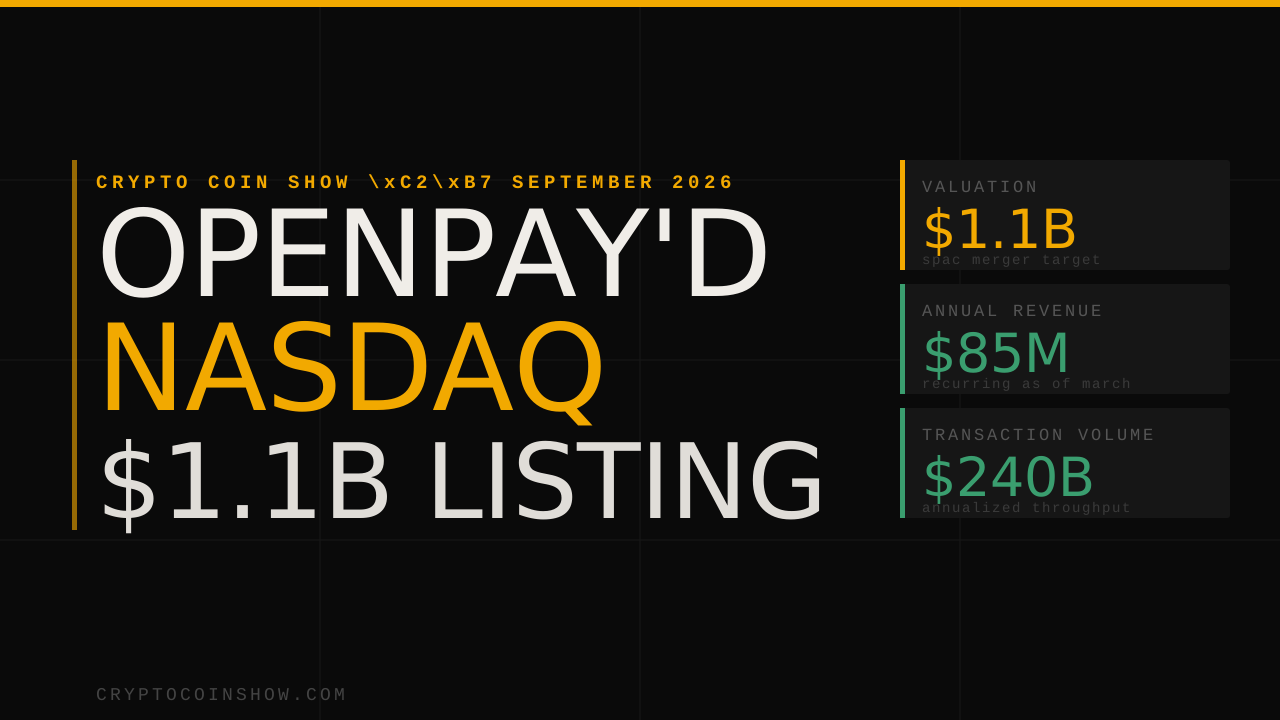
OpenPayd pursues $1.1 billion Nasdaq listing while crypto rivals shelve IPO plans
OpenPayd is moving forward with a $1.1 billion Nasdaq listing via SPAC merger at a time when major crypto firms including Consensys, Grayscale, and Kraken have postponed or shelved their own IPO plans, signaling divergent investor appetite across the sector. For institutional allocators, the deal tests whether crypto-adjacent infrastructure plays command stronger public market valuations than native digital asset platforms.
- OpenPayd processes $240 billion in annualized transaction volume and reports over $85 million in annualized recurring revenue as of March 2026
- The merger with Titan Acquisition Corp. (TACHU) could bring up to $276 million in gross proceeds if no shareholders redeem their holdings
- Deal closes in Q4 2026 pending shareholder approval, arriving as BitGo’s January IPO trades 36 percent below its offering price
- $1.1B Valuation assigned to OpenPayd in Nasdaq listing via SPAC merger
- $240B Annualized transaction volume processed by OpenPayd across 180 countries
- 36% Decline in BitGo share price since January IPO, versus offering price
OpenPayd, a London-based payments infrastructure platform serving crypto exchanges and fintech firms, has signed a definitive merger agreement with Titan Acquisition Corp., a special purpose acquisition company trading on Nasdaq under ticker TACHU. The combination would list OpenPayd on Nasdaq under the symbol “OP” at a $1.1 billion valuation, marking a notable public market entry at a moment when the broader crypto sector is retreating from listing ambitions.
The boards of both companies have unanimously approved the transaction, with final closing expected in the fourth quarter of 2026, subject to shareholder approval and customary closing conditions.
OpenPayd’s platform infrastructure underpins payment flows for major crypto platforms including eToro, Kraken, and OKX, operating across more than 180 countries.
The company reported annualized recurring revenue exceeding $85 million as of March 2026 and manages more than $240 billion in annualized transaction volume, metrics that distinguish it from pure-play exchange and wallet operators that have faced severe investor skepticism in public markets.
If no Titan shareholders redeem their holdings, the SPAC trust account will deliver up to $276 million in gross proceeds, capital OpenPayd intends to deploy toward business expansion and balance sheet strengthening.
OpenPayd’s infrastructure model attracts public capital as exchanges retreat from listings
The OpenPayd-Titan merger arrives as a sharp counterpoint to a wave of postponed crypto IPOs. Consensys, the developer behind MetaMask, has pushed its planned U.S. public offering to at least fall 2026 after crypto prices declined sharply earlier in the year, despite JPMorgan and Goldman Sachs working on the offering.
Grayscale, operator of one of the largest crypto asset management platforms and the Bitcoin Trust ETF (GBTC), has paused IPO preparations and signaled it is unlikely to restart before the fourth quarter of 2026.
Kraken, one of the largest crypto exchanges by volume, suspended its multibillion-dollar IPO earlier in 2026, only months after completing two funding rounds that valued the firm at over $20 billion.
The divergence between OpenPayd’s forward momentum and these halts reflects investor differentiation across the crypto sector.
Payments infrastructure, the backend plumbing connecting exchanges, custody providers, and fintech platforms to fiat and digital asset rails, commands a different investment thesis than exchange tokens, wallet platforms, or asset managers that carry direct exposure to cryptocurrency price volatility and regulatory uncertainty.
OpenPayd’s recurring revenue model, diversified client base spanning multiple continents, and position as a vendor to the crypto sector rather than a direct digital asset operator position it as lower-risk relative to native crypto platforms attempting public listings.
Ledger, the hardware wallet manufacturer, also paused a planned $4 billion listing.
BitGo’s January IPO underperforms as only crypto-native public market entry this year
BitGo, a digital asset custodian, remains the sole crypto-native firm to complete a U.S. IPO in 2026. The company raised approximately $213 million in January but has seen its stock decline roughly 36 percent below the offering price, a stark illustration of public market skepticism toward crypto-sector issuers in the current environment.
That performance has likely hardened hesitation among other crypto firms evaluating IPO timing and valuation expectations, as underwriter risk and shareholder demand have both contracted sharply.
The BitGo precedent carries direct relevance for institutional allocators considering OpenPayd. A payments infrastructure operator with stable revenue and multinational client concentration may prove more defensible in public markets than custodians or exchanges with volatile earnings tied to trading volumes and token volatility.
OpenPayd’s mix of scale (processing $240 billion in annual transaction volume), profitability signals (annualized recurring revenue above $85 million), and geographic diversification across 180 countries offer a cleaner earnings narrative than firms whose revenues spike and contract with crypto market cycles.
Q4 2026 closing date sets timeline for institutional capital deployment and regulatory clarity
The expected Q4 2026 closing date gives regulators and markets roughly nine months to signal any concerns or conditions around the transaction, while also allowing time for shareholder approval processes at both Titan and OpenPayd.
Institutional investors evaluating the deal will likely scrutinize whether public company reporting requirements and SEC oversight of a crypto-linked infrastructure firm trigger new compliance costs or operational friction, and whether those costs compress the unit economics that have supported OpenPayd’s $85 million-plus annualized recurring revenue run rate.
OpenPayd CEO Iana Dimitrova framed the listing as validation of the platform’s strength, while Founder Ozan Ozerk positioned the offering as a capital raise enabling the firm to lead a market he sees driven by autonomous financial systems over the coming decade.
That framing, treating this as infrastructure-layer positioning rather than a bet on crypto adoption or token appreciation, attempts to separate OpenPayd’s narrative from the token-price-dependent stories that have soured institutional sentiment on public crypto companies.
The firm serves eToro, Kraken, OKX and operates in 180 countries, distributing concentration risk across geographies and customer segments.
Institutional investors should monitor whether Titan shareholders approve the merger at scheduled votes and track any redemption levels that could reduce gross proceeds below the $276 million threshold, as lower cash injection may constrain OpenPayd’s planned expansion and affect the profile that justified the $1.1 billion valuation; simultaneously, watch whether the BitGo stock performance triggers additional warrant repricing or valuation compression in the crypto sector that influences investor demand at OpenPayd’s IPO or triggers last-minute redemption waves.
BitGo’s IPO Stumble Sets Cautionary Benchmark for Crypto Infrastructure Listings
OpenPayd’s $1.1 billion valuation enters a public market environment where comparable crypto infrastructure plays have struggled to sustain investor enthusiasm post-launch. BitGo, a custody and settlement platform similar in positioning to OpenPayd, priced its January 2026 IPO at $27 per share but has since declined 36 percent, trading near $17.28 as of late March 2026.
The divergence between IPO pricing and current market performance underscores investor hesitation around pure-play crypto infrastructure, particularly when regulatory uncertainty and rising interest rates compress valuations across fintech sectors.
BitGo’s post-IPO trajectory matters because it shares OpenPayd’s core business model: processing transactions for institutional and retail crypto platforms without holding native token exposure.
BitGo generates revenue from custody fees and settlement services rather than speculative digital asset holdings, a profile that initially appealed to public market investors seeking crypto exposure without direct volatility.
However, the 36 percent decline signals that infrastructure-layer thesis alone has proven insufficient to command premium multiples in a rising-rate environment, where investors increasingly demand profitable growth or clear paths to profitability rather than transaction volume alone.
OpenPayd’s $85 million annualized recurring revenue and $240 billion transaction volume will be benchmarked against BitGo’s operational metrics throughout the merger roadshow and after listing; institutional allocators will scrutinize whether OpenPayd’s 180-country footprint and diversified client base (eToro, Kraken, OKX) command a valuation premium or face similar post-IPO compression when Q4 2026 trading begins.