Blockchain research firm L2BEAT published a comparative analysis of perpetual futures exchanges Hyperliquid and Lighter on July 2. In its findings, the research firm discovered that none of the platforms fully protects traders through verifiable math alone.
The report matters to anyone trading leveraged crypto derivatives on venues that market themselves as decentralized alternatives to the likes of Binance or Bybit.
Are perpetual DEXs delivering on all their promises?
Perpetual DEXs claim to offer custody over user collateral, and execution can be verified independently, according to L2BEAT’s research. The firm evaluated Hyperliquid and Lighter across property rights, order fairness, and position fairness.
Lighter operates as an Ethereum layer-2, posting validity proofs to a chain it does not control.
Hyperliquid, on the other hand, runs its own layer-1, where 28 validators handle both trade execution and settlement. The Hyperliquid Foundation directly controls half the staked tokens, with additional stake routed through a delegation program.
Should Lighter stop working, users are not necessarily left in limbo, as they can generate an account proof against the latest state root on Ethereum and withdraw funds independently.
If the same thing happened to Hyperliquid, L2BEAT reports that there is no permissionless exit path because the platform’s Arbitrum bridge relies on permissioned validator subsets (two groups of four validators each).
Do the validity proofs on Lighter and Hyperliquid have limits?
Lighter runs on zero-knowledge proofs, which means that operators cannot steal idle funds, fabricate USDC balances, or match orders at prices worse than the user’s limit. Similar standards on Hyperliquid are up to validator consensus.
However, L2BEAT’s analysis shows Lighter’s proofs are not evidence of full protection. The research firm discovered that oracle signatures used for mark prices are not verified on-chain or within the proof circuit.
On both platforms, order flow protections are absent. Neither venue prevents the operator from seeing, reordering, front-running, or censoring submitted orders, L2BEAT stated.
Lighter’s proofs guarantee that once an order enters the system, it cannot be altered in price or size. But the operator can insert its own orders ahead of users to become the best quote on the book.
What precedent did the JELLY incident set?
In March 2025, Hyperliquid had to carry out an operator intervention during the JELLY incident. It all started after three coordinated accounts opened opposing positions in the low-liquidity JELLY token. One of the accounts took a $4.1 million short while the other two went long for a combined $4.05 million.
As spot purchases pushed JELLY’s price up, the short position was liquidated and passed to Hyperliquid’s automated market-making vault (HLP), which could not absorb it.
Hyperliquid’s validators voted to delist JELLY and force-settled all positions at $0.0095, which is a fraction of the $0.50 price on decentralized spot markets at the time.
While that action saved the HLP vault from an estimated $13 million loss, it overrode the exchange’s own matching engine. The Hyper Foundation pledged to compensate affected users.
Based on L2BEAT’s analysis, Hyperliquid’s validator acts in ways that are similar to a traditional exchange operator, as they have the power to change trade outcomes through governance.
Lighter’s current contract setup also permits such action through upgradeable contracts with no time delay.
The trust ceiling
The core finding is that both platforms currently require trust in their operators for critical functions. Lighter’s advantage is in its L2 architecture, which could eventually reach Stage 2 decentralization by removing upgrade control, at which point Ethereum’s validator set would enforce the rules.
Hyperliquid’s L1 design means it does not have a similar path to Lighter’s.
The L2BEAT report has brought to the fore the depth of how decentralized these platforms are in terms of protection, and users using them should know the full extent of what is covered and areas where the lines blur between their chosen platforms and centralized exchanges.
Several major South Korean companies have said they have not formally joined the newly announced Open USD (OUSD) consortium, despite being listed among its participating organizations.
Open Standard, the independent entity behind the stablecoin, previously said it had assembled over 140 businesses to launch OUSD, a dollar-pegged stablecoin, later this year.
Korean Companies Push Back
The lineup featured some of the world’s largest companies across multiple industries, such as Visa, Mastercard, BlackRock, Google, Ripple, and Standard Chartered, among the high-profile names. The list of South Korean participants included Samsung Electronics, Dunamu, Shinhan Financial Group, KakaoBank, K Bank, Hyundai Card, KB Kookmin Card, BC Card, Hana Card, Samsung Card, Woori Card, NH Nonghyup Card, and Hanwha.
However, several of those companies have now disputed the nature of their involvement.
According to a report by Chosun Biz, a Samsung Electronics representative told the publication that there had been no official discussions with the OUSD issuer and that the company did not know what role it would play in the consortium. Meanwhile, Shinhan Financial Group, Dunamu, and K Bank similarly said Open Standard had only asked whether they were interested in participating in OUSD and that they had simply responded that they would review the proposal.
Their names were reportedly later included in the consortium list despite no formal commitment.
One company representative also said the firm only discovered it had been identified as an alliance member after reading domestic media reports. The representative added that the company had merely indicated it would consider participation if circumstances aligned and was puzzled to find itself listed as a member.
No Contracts, Only Discussions
The report was later echoed by the founder of digital asset firm Pointsville, Gabor Gurbacs, who said he spoke with several companies listed in the OUSD consortium, and they told him they had never signed or agreed to participate. He added that either the media had significantly distorted the situation or the published participant list was misleading.
The claims also prompted debate across X. One user described listing companies before deals are finalized as a “classic legitimacy-borrowing” move, while another said the situation represents a major credibility risk.
Ordinals developers say their technology will survive BIP-110, a proposed rule change that aims to stop people from storing files on Bitcoin. The fight comes down to one question. Should Bitcoin (BTC) handle only money, or anything users pay for?
Inscriptions let people store images and text on the Bitcoin blockchain, similar to NFTs. BIP-110 would block most of that data for one year. Supporters call it spam, while critics say Bitcoin should stay open to everyone.
What Would BIP-110 Change for Bitcoin?
Every Bitcoin transaction can carry a little extra data, and inscriptions use that space to store pictures and messages forever. The proposal would shrink the allowed space to 256 bytes per piece, about one short paragraph of text.
That limit would break the storage method inscriptions use today. The rule would last for one year, then switch off automatically, and old coins would not be affected.
Its author, who writes under the pen name Dathon Ohm, credits Bitcoin Knots maintainer Luke Dashjr for the first draft.
Miners vote by adding a small flag to the blocks they mine. The plan needs 1,109 flagged blocks out of 2,016 in a two-week window. However, the public monitor counted just three flagged blocks as of June 30, under 1%.
BIP-110 miner signaling chart showing 0.73% support versus the 55% activation threshold, alt text “BIP-110 signaling status”, Source: bip110.org monitor
Support has never passed 1% since voting opened in December 2025. The best two-week stretch reached 0.79% in mid-June.
Here is the twist. The plan does not need a majority to activate. From around early August, computers running the BIP-110 software will reject blocks that do not carry the flag.
Blockstream CEO Adam Back has warned of fork risk, meaning Bitcoin could split into two competing versions. MicroStrategy’s Michael Saylor called the plan a self-inflicted risk.
Dashjr, for his part, framed the stakes as existential on Thursday.
“If BIP110 fails, Bitcoin fails with it. I am not interested in any CBDC, much less an unregulated CBDC pretending to be decentralised,” he wrote.
A CBDC is a government-issued digital currency. In his view, a Bitcoin that cannot reject spam loses what makes it different.
Ordinals Developers Say They Are Ready
On July 2, Ordinals developer lifofifoX published a fix that stores data in a new way. It cuts files into small, allowed pieces instead of using the method that BIP-110 bans. In short, inscriptions would keep working even if the rule passes.
Ordinals creator Casey Rodarmor approved the fix the same day.
“Looks good to me! Let’s wait until BIP-110 activates to merge this,” Rodarmor wrote on GitHub.
The other side has already hit back, filing a counter-update to Bitcoin Knots, the software most BIP-110 supporters run. He argues the software simply does not notice the new format, letting it slip past the size checks.
Money sits at the center of the fight. In October 2024, Runes, a similar data-based format, drove a 32% fee increase that paid miners.
In contrast, supporters say the volunteers who run Bitcoin’s network computers must store all that data forever and get nothing for it.
The forced voting phase is about five weeks away. Back has already dismissed the August deadline as a path to a minority altcoin, a spinoff coin few would follow.
The coming weeks will show whether the miner’s silence means opposition or indifference.
Crypto markets have had plenty to digest today, and this development adds another layer to the picture. Ethereum Institutional Backers Launch Independent Non-Profit to Target Wall Street Wealth gives NewsBTC readers a clean angle on Ethereum at a point where the market is trying to separate durable signals from short-lived noise.
According to the source material reviewed for this report, the story turns on a few concrete details rather than vague sentiment. That matters because crypto headlines can move quickly, but the pieces that tend to last are the ones backed by filings, official releases, data dashboards, or protocol-level records.
TL;DR
Ethereum co-founder Joseph Lubin, alongside ETH treasury firms BitMine and SharpLink, backed the launch of ‘Ethereum Institutional’.
The new group is an independent non-profit designed to serve as a ‘front door’ for Wall Street banks and asset managers on tokenization and stablecoins.
This organization aims to take over business development roles from the Ethereum Foundation, which is focusing more on core research.
A Fresh Signal For The Market
The immediate relevance is that this development fits into one of the market’s main themes for the day: institutional positioning, network usage, regulatory pressure, protocol development, or asset-specific rotation. In this case, the key topic is Ethereum, which is why it deserves a dedicated read rather than being buried inside a broader market recap.
For traders, the useful part is not simply that the headline exists. It is the way the facts line up with the current market backdrop. When official sources, market data, or protocol records show a fresh shift, readers get a better sense of whether the move is just a one-day reaction or part of something more structural.
The Numbers That Matter
The core source for this story is prnewswire.com with supporting data from globenewswire.com. That source trail is important because the final article should not rely on discovery-only media links or second-hand summaries.
Ethereum co-founder Joseph Lubin, alongside ETH treasury firms BitMine and SharpLink, backed the launch of ‘Ethereum Institutional’.
The new group is an independent non-profit designed to serve as a ‘front door’ for Wall Street banks and asset managers on tokenization and stablecoins.
This organization aims to take over business development roles from the Ethereum Foundation, which is focusing more on core research.
The numerical claims in the pack were tied back to specific source material before writing. ‘July 1, 2026’ sourced from Ethereum Institutional official launch release date
The Important Caveat
The caution is just as important as the headline. Do not state this is an official Ethereum Foundation spin-off; it is a separate non-profit.
That means the cleaner read is to treat this as a confirmed development with a defined scope, not as proof of a guaranteed price move or a sweeping market shift. In crypto, the difference matters. A verified data point can strengthen a thesis, but it does not remove execution risk, liquidity risk, regulatory uncertainty, or the possibility that traders fade the initial reaction.
For now, the story gives the market another piece of evidence to weigh. If follow-up filings, dashboard updates, protocol records, or official statements confirm further momentum, the angle can develop into something larger. If not, it still stands as a useful snapshot of where activity is concentrating today.
Polygon just closed the second quarter of 2026 with 743 million transactions, breaking the network’s all-time record with a 160% increase from the same period last year.
The news was confirmed by Blockworks and Polygon team member Abhinav Sharma earlier today.
Payments infrastructure driving the numbers
The milestone summarizes a successful quarter for Polygon after aggressively positioning itself as infrastructure for stablecoin payments. Polygon processed $79.25 billion in stablecoin transfer volume across 198 million stablecoin transactions in May alone, putting it first among all blockchains by stablecoin transaction count.
That figure was also the chain’s second-highest month recorded for stablecoin volume, surpassing both Solana and BNB Chain during the period.
Polygon being in such high demand signals a deliberate shift towards real-world payment settlement. The network offers average fees of about $0.002 per transaction and confirmation times of around two seconds. As such, the cumulative stablecoin transfer volume on its chain has now exceeded $2.4 trillion over its lifetime.
Cross-border payments also contributed to that total. Earlier today, Polygon officially announced that Credible Finance had processed more than $152 million in payments across the United States, India, Brazil, and Germany.
The network also processed $309 million in Latin American stablecoin volume in May, primarily serving regions where dollar-denominated tokens served as hedges against volatile local currencies.
Polygon has also been building dedicated payment rails to support its strategy. One of them includes what they call the Open Money Stack, a framework that allows payouts in a recipient’s local currency from a single stablecoin balance through bank deposits, cash pickups, or crypto transfers.
On-chain activity hasn’t lifted the token
Surprisingly, Polygon’s record transaction figures have not yet translated into direct gains for the network’s native token POL. According to CoinMarketCap, the token is trading near $0.073, down more than 94% from its March 2024 all-time high of $1.29. The token’s market capitalization sits around $779 million.
The disconnect between usage volume and price is not a new thing, though. Several high-transaction networks have posted record activity this year without any corresponding increase in token price.
For example, Tron and Ethereum still have the largest stablecoin balances, while more and more specialized payment chains continue to compete for the same market share.
What does the DeFi and dApp ecosystem say?
DefiLlama data shows Polygon’s total value locked in DeFi protocols at approximately $916 million, with $3.38 billion in stablecoins circulating on the chain. Daily active addresses stood near 554,000, with the network processing about 7.5 million transactions per day at the time of writing. Polymarket, the prediction market platform, accounts for the largest single share of Polygon’s DeFi TVL at $391 million.
Nonetheless, while Polygon has achieved over seven billion lifetime transactions and maintains 99.99% uptime, what everyone will be looking out for will be whether this high transaction volume will finally translate into higher token prices.
Don’t just read crypto news. Understand it. Subscribe to our newsletter. It’s free.
Symbiotic isn’t just restaking — it’s a universal collateral layer designed to power credit, insurance, RWAs, and every financial primitive that’s missing shared infrastructure.
By Ashton AddisonBlockchain InterviewsJuly 2026Exclusive
$1.6B+
Total Value Locked
14+
Active Networks
$34.8M
Total Funding Raised
In the summer of 2024, a question was quietly circulating inside some of crypto’s sharpest engineering rooms: if every new protocol has to rebuild the same security scaffolding from scratch — the validators, the slashing conditions, the capital allocation rails — is the industry actually progressing, or just repeating itself at scale?
For Misha Putiatin, Co-Founder of Symbiotic, the answer was obvious. And the solution was to stop letting every team reinvent the wheel.
The Problem Nobody Wanted to Admit
The multi-chain era opened a Pandora’s box. Rollups, sidechains, app-chains — the ability to launch a new network exploded. Experimentation accelerated. But so did a quieter, more dangerous trend: every protocol was copy-pasting not just ideas, but security models.
“Experimentation in terms of product is really interesting,” Putiatin told CCS. “But experimentation in security models and general capital flow is super dangerous — especially if it’s done not because you’re solving a unique problem, but because you don’t have access to ready-to-use solutions flexible enough for your protocol.”
The consequences showed up on-chain. Bridges hacked. Oracle failures. Liquidity fragmented across dozens of isolated pools, none able to serve each other. The multi-chain world had delivered velocity — but at the cost of coherence.
“The idea was quite simple: let’s build infrastructure anyone can use.”
Misha Putiatin, Co-Founder, Symbiotic
Shared Security, Generalized
Symbiotic launched in January 2025 as the first fully permissionless restaking protocol with slashing support on Ethereum mainnet — backed by Paradigm, Pantera Capital, and Coinbase Ventures. The premise: a single, immutable infrastructure layer that any proof-of-stake network, rollup, oracle, or data availability layer could plug into, without asking permission or paying platform fees.
The core contracts cannot be upgraded. No gatekeeping. No fee changes post-deployment. For a co-founder whose previous companies were smart contract security firms — Statemind and MixBytes — this wasn’t idealism. It was engineering discipline applied to a systemic problem.
By mid-2026, Symbiotic had grown to over $1.6 billion in total value locked across 14+ active networks, with 100,000+ users and a partner ecosystem that includes Chainlink, Lombard, Ethena, Avail, Nexus Mutual, Cap Labs, and Midas.
Core V2: From Restaking to Financial Infrastructure
After nine months of development, Symbiotic is preparing to ship its most significant architectural upgrade: Core V2. The shift is conceptual as much as technical. V1 was designed for proof-of-stake network security. V2 expands the same primitives into finance itself.
The key insight driving the redesign: collateral is collateral. Whether it’s securing a rollup’s validator set or collateralizing an on-chain credit obligation, the underlying mechanism — locking capital, enforcing conditions, enabling slashing — is identical. V1 wasn’t built to express that. V2 is.
“The underwriting segment was actually booming and they didn’t have a solution for the same problem that Symbiotic was already solving,” Putiatin explained. “They didn’t have the common infrastructure that can be used.”
Capital Facilities: The Core V2 Primitive
The headline feature of V2 is what Symbiotic calls capital facilities — a mechanism that allows vault capital to remain enforceable while it’s deployed across whitelisted DeFi protocols between settlement events. Think of it as collateral that stays on-call: deployed and earning, but automatically recalled the moment an obligation triggers.
This matters because V1 vaults had a problem that mirrored what went wrong in TradFi before risk-based frameworks arrived — curator vaults could allocate capital with relatively arbitrary discretion. V2 introduces strict, predetermined limits on what creators can do. Permissioned action sets. Auditable on-chain. No more going “willy-nilly into a protocol that nobody heard of,” as Putiatin put it.
🔒
Enforced Capital Rules
Vault creators operate within predetermined action sets — no arbitrary deployment, auditable at every step.
⚡
Capital Facilities
Collateral stays enforceable while earning yield in whitelisted protocols. Auto-recalled when obligations trigger.
🏦
Underwriting & Credit
Private credit and insurance use cases that couldn’t run on V1 — now first-class citizens in V2.
₿
BTC & ETH as Collateral
Volatile assets with low cost of capital unlock new application categories where stablecoins are too expensive.
The Stablecoin Problem (And the Bitcoin Opportunity)
There’s a cost structure problem at the heart of DeFi collateral that rarely gets discussed openly. Stablecoins — USDC, USDT, yield-bearing variants — are convenient. But at 4–7% annualized cost of capital, they’re expensive. For high-risk applications, the cost climbs further. For low-yield applications — like smart contract insurance — they’re simply uneconomical.
Bitcoin and Ethereum tell a different story. Their cost of capital is structurally lower. They represent an enormous pool of underutilized collateral held by people who want yield but aren’t willing to take excessive risk to get it.
“Most of the protocols and applications that are going to launch on Symbiotic — Bitcoin and ETH is going to be used,” Putiatin said. “Because of the same opportunity here: underutilized capital.”
For Bitcoin specifically, the technical path runs through bridging protocols like Lombard, which bring BTC into Ethereum and Solana’s smart contract environments. It’s a workaround for a network that wasn’t designed with on-chain programmability — but it works, and V2 is built to take full advantage of it.
Liquid Lane: Solving the RWA Liquidity Problem
If Core V2 is the engine, Liquid Lane is the first major application it makes possible — and potentially one of the most important pieces of DeFi infrastructure for institutional adoption.
The problem is well understood: real-world asset tokens (RWAs) — tokenized Treasuries, private credit, money market funds — have illiquid redemption windows. Sixty days. Ninety days. Sometimes 180. That’s fine in traditional finance. In DeFi, it’s a deal-breaker. You can’t use an asset as collateral if you can’t liquidate it. You can’t build a lending market on top of something that might take six months to exit.
“That kind of breaks what we’ve built in DeFi. You can’t use them as collateral anywhere — because if push comes to shove, how do you liquidate it?”
Misha Putiatin, Co-Founder, Symbiotic
Liquid Lane is a Request-for-Quote (RFQ) engine that solves this directly. Liquidity providers deposit into a pool. When a holder needs to exit an RWA position immediately — for liquidity, for strategy, for any reason — Liquid Lane matches them with a buyer at a small discount. The exit is instant. No waiting.
The elegant part is what happens to the liquidity pool while it waits. Rather than sitting idle collecting dust at below-market yield, it gets deployed across multiple Symbiotic applications simultaneously — layered yield, in the restaking tradition. This is what makes the math work: the pool earns enough across multiple applications to justify holding RWA exposure at a discount.
Liquid Lane — How It Works
Liquidity providers deposit into a shared pool, earning yield across multiple Symbiotic applications
RWA holders needing to exit submit a Request for Quote
Liquid Lane matches them with pool liquidity at a small discount — immediate settlement
First live deployment: Fasanara’s mGLOBAL tokenized fund, in partnership with Midas (announced April 2026)
Core V2 is a prerequisite — Liquid Lane cannot run on V1 architecture
Looking Ahead: The Protocol Stack Nobody Built Before
Three financial verticals — credit (Cap Labs), insurance (Nexus Mutual), and RWA liquidity (Liquid Lane with Midas) — are now running on or preparing to run on a single shared collateral infrastructure. That’s not a coincidence. It’s a design thesis playing out in practice.
The question Symbiotic is answering isn’t “what is restaking?” — it’s “what is the minimum shared infrastructure needed for any financial obligation to be expressed and enforced on-chain?” The answer, if V2 ships as designed, is that Symbiotic is that layer.
The next product categories are already visible: delta-neutral strategies, structured products, cross-chain insurance pools, institutional prime brokerage rails. Each one needs what Symbiotic offers: permissionless capital allocation, auditable enforcement, and the ability to layer multiple obligations on the same dollar.
With over $1.6 billion in TVL, a $34.8 million war chest, and a technical architecture that’s spent nine months being rebuilt for exactly this moment — Symbiotic isn’t waiting for institutional crypto to arrive. It’s building the rails it will have to run on.
The protocol that started as “restaking infrastructure” is quietly becoming something larger — the financial operating system for a multi-chain world that finally has somewhere to put its capital.
DeFi’s latest exploit chatter is pointing traders toward a cost that does not appear in pool APYs: the price of staying connected while bridges, keys, frontends, oracles, and contract logic remain active failure points.
For users and liquidity providers, the question now extends beyond yield. They have to decide how much additional return is needed, even though the route itself can add technical, operational, and governance exposure.
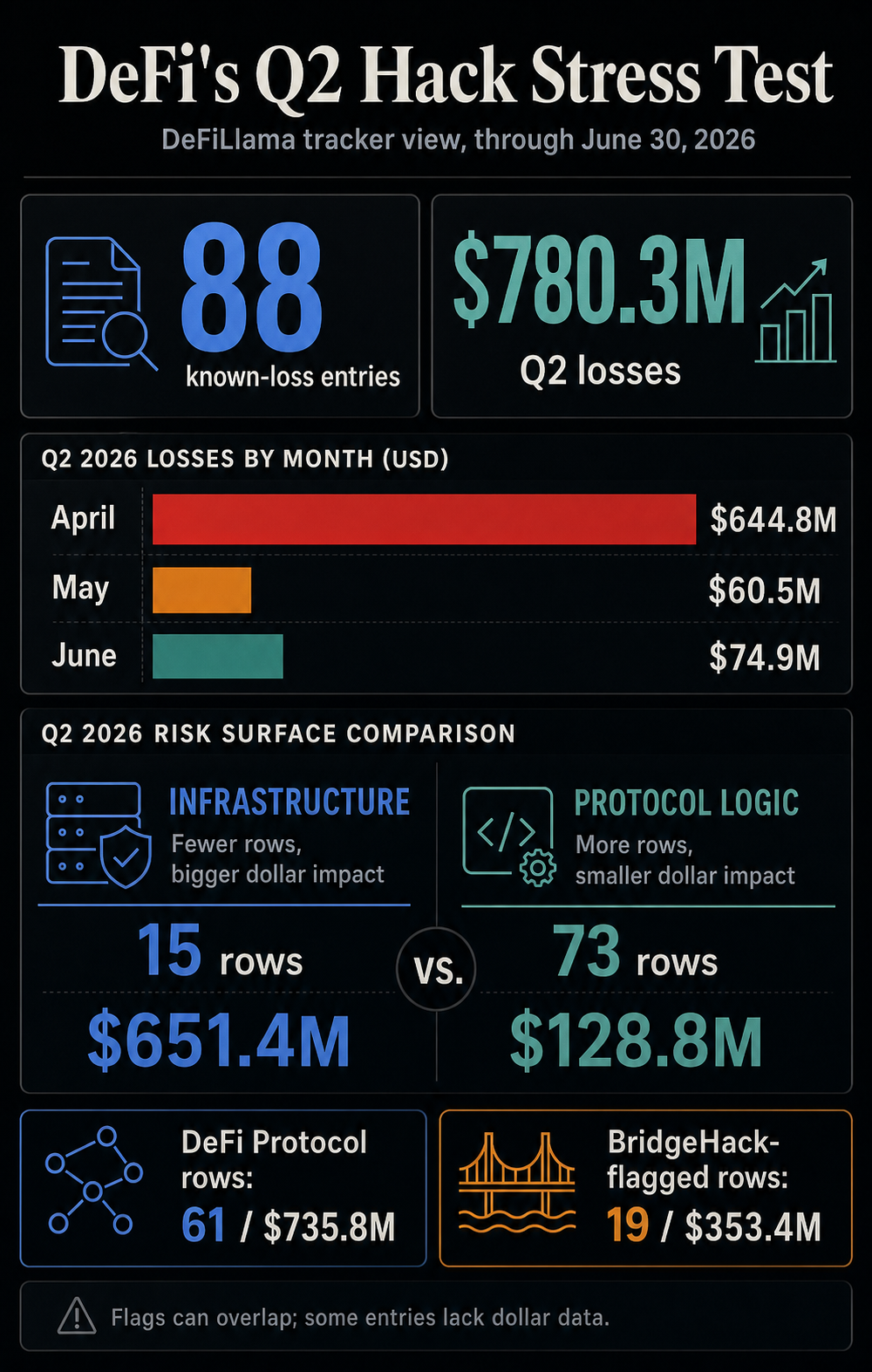
The Q2 dataset behind DeFiLlama’s hacks tracker shows 88 hack entries with known dollar amounts, totaling $780.3 million in losses through June 30.
April carried the largest hit, at $644.8 million, while May and June still added $135.4 million across dozens of entries. The quarter, therefore, looked less like a single blast crater and more like a stress test that kept running even after the headline shock faded.
On June 30, amount-bearing hack entries totaled $16.65 billion. Rows tagged as DeFi Protocol targets accounted for $7.85 billion, while rows flagged as bridge hacks accounted for $3.26 billion.
In Q2 alone, DeFi Protocol target rows accounted for $735.8 million of the $780.3 million total loss, and bridgeHack-flagged rows accounted for $353.4 million.
The dataset needs careful handling. DeFiLlama’s bridge flag can overlap with protocol targets, and some entries have incomplete dollar data.
Even with that caveat, the message is clear: exploit risk is sitting across the routes, permissions, interfaces, and verification systems that make DeFi usable.
Q2 split damage and frequency across distinct risk surfaces. Infrastructure-classified entries accounted for most of the known dollar losses, while protocol-logic entries accounted for most of the incident count.
Q2 2026 DeFiLlama view
Amount-bearing data
Total Q2 incidents
88 entries with known dollar amounts
Total Q2 losses
$780.3 million
DeFi Protocol target rows
61 rows, $735.8 million
BridgeHack-flagged rows
19 rows, $353.4 million
Infrastructure classification
15 numeric-loss rows, $651.4 million
Protocol Logic classification
73 numeric-loss rows, $128.8 million
Monthly losses
April $644.8 million, May $60.5 million, June $74.9 million
The distinction changes how risk gets priced. A protocol-logic bug can be treated as a code-quality problem within a single application.
Infrastructure losses are different. They touch bridges, signing systems, cross-chain messaging, admin permissions, hot wallets and other shared surfaces that capital uses to move between venues.
When that layer is under stress, DeFi’s usual yield math starts to look incomplete. A pool can offer a higher return, but users still have to ask whether the route to that return depends on a bridge, oracle, frontend, signer set, or administrative path they cannot evaluate in real time.
A market maker can keep liquidity available across chains only when the spread compensates for the operational risk of moving assets through those rails.
That is the shift from a postmortem market to a live risk-premium market. Participants are repricing the cost of being connected.
The fee is no longer only gas, slippage, or borrowing costs; it also includes the risk that a permission, route, or proof layer fails while capital is in motion.
That repricing can happen quietly. A venue may maintain its advertised annual percentage yield, while the effective return declines as users demand faster exits, insurance, or compensation for bridge exposure.
The market can express that view through thinner liquidity, wider spreads, and more expensive incentives long before a formal security score appears.
Routing trust becomes part of the trade
Bridge exposure is where the stress test becomes easiest to see. Q2’s bridgeHack-flagged rows totaled $353.4 million, enough to make cross-chain routing more than a convenience question.
If capital has to cross a bridge or messaging layer to reach an opportunity, the route itself becomes part of the trade.
Recent cross-chain incidents have already shown how quickly that can affect behavior. The fallout from the KelpDAO and LayerZero exploits showed how a single exploit can push projects to rethink their security infrastructure.
A THORChain halt following an exploit revealed the other side of the same problem: when routing trust breaks down, systems can stop first and ask questions later.
For users, liquidity may move toward venues where the route is easier to understand, where bridge exposure is lower, or where there is enough depth to avoid fragile paths.
For aggregators and market makers, routing logic may increasingly need to include security assumptions alongside price, depth and gas.
That could leave some bridges and cross-chain venues with a higher cost of capital even when they continue to function. Liquidity can still move through them, but it may demand a wider spread, more explicit insurance, stronger proof systems, or shorter exposure windows.
In DeFi, that is what a risk premium looks like before it becomes a line item.
The same logic can affect launch strategy. A protocol preparing a new market may decide that speed is less valuable than a second review of bridge dependencies, admin permissions, or oracle paths.
A liquidity provider may favor fewer chains if each additional route adds a new security assumption. Those decisions are small individually, but together they determine where depth forms and which venues become expensive to use.
Insurance sits inside that same loop. If underwriters and users start treating bridge exposure as a recurring operating risk, coverage becomes another signal about which venues can attract liquidity at scale.
Protocols that cannot explain their assumptions may still operate, but they could pay for that opacity through lower depth or more expensive incentives.
Security spending becomes a distribution cost
The market response also changes inside protocols. Security spending has often been framed as defense: audits, bug bounties, monitoring, incident response, and emergency controls.
A quarter like this makes it part of distribution. If users can tell why one venue is safer than another, security becomes part of how capital chooses where to sit.
Concentration is one reason the issue extends beyond code quality. A TRM Labs analysis described 2026 crypto theft value as concentrated in a small number of large events.
Chainalysis has emphasized threat mechanics such as private-key and signing infrastructure, social engineering, and the speed with which stolen funds can move through laundering channels.
Those firms measure different universes, and Chainalysis’ hard theft totals in the cited post are based on 2025 data. The common thread is still useful: DeFi risk extends beyond bad Solidity.
It includes who can sign, where users connect, how cross-chain verification works, how quickly stolen assets can be swapped, and whether a protocol can detect abnormal behavior before an attacker finishes the route.
That pushes protocols toward spending that looks less optional. Larger bug bounties, real-time monitoring, insurance cover, withdrawal throttles, admin-key controls, proof-system review, frontend hardening and clearer incident communications become part of the trust product.
They also become easier to justify to tokenholders if the alternative is higher liquidity costs after every visible exploit.
The shift in user behavior is the harder consequence. DeFi users have long accepted that smart-contract risk is part of the yield stack, but persistent pressure from exploits changes how that risk is felt.
A single hack can be dismissed as a bad venue. A quarter of recurring incidents makes the whole route feel expensive.
Products that abstract complexity sit directly in that tension. Automated yield strategies, routers, and frontends can make DeFi easier to use, while also hiding the path capital takes.
CryptoSlate has already covered how automated yield products can concentrate retail risk. Under a quarter-long stress test, users may demand more visibility into where funds are routed, what bridge assumptions are involved, what insurance exists, and what happens if a connected service fails.
There is also an outside pressure point. Crypto crime and scam concerns have been pushing the industry toward more self-policing, as shown by Treasury-warning coverage.
The DeFi exploit problem lands in the same market environment: users, venues and policymakers are all asking whether crypto systems can reduce losses without giving up the speed and openness that made them useful.
For DeFi, that is a difficult balance. Add too much friction, and capital routes elsewhere. Add too little, and the risk premium rises after every incident.
The protocols that win the next phase are likely to be those that can demonstrate where the hidden risks lie and what has been done to contain them.
June’s DeFiLlama rows remain an active threat. The month included front-end vulnerabilities, predictable private-key exploits, fake-proof bridges, unbacked mints, reverse MEV, oracle manipulations, and logic or accounting-flaw entries.
No single label explains all of them.
The next signal is whether capital starts moving before the next postmortem. Watch whether bridge liquidity gets more concentrated in venues perceived as safer, whether protocols delay launches for additional review, whether insurance pricing rises, whether bug bounty budgets grow, and whether aggregators make security assumptions more visible in routing decisions.
If those changes accelerate, Q2 will look less like a bad quarter and more like a repricing event.
DeFi’s hack problem would still be a security problem, but it would also become a market-structure problem: a recurring tax on movement, yield, and trust across the systems that make onchain finance work.
Nick Johnson, the founder and lead developer of ENS, just used about half of the protocol’s active voting power to stop an on-chain proposal to renew the ENS DAO Security Council, adding a new chapter to several weeks of a governance crisis that no one wants to see go any further.
The on-chain vote ended on June 30, 2026, after Johnson did not take part in the earlier off-chain Snapshot vote.
Lefteris Karapetsas, a longtime member of the Ethereum community, said the result was expected and called the DAO “dead.” He claimed that Johnson’s voting power protects a treasury worth about $500 million from outside oversight, according toa post on X.
Another proposal introduced the same day
Hours after the Security Council renewal failed, a draft for a new Security Council appeared on the ENS governance forum. The plan was written by katherine.eth, and suggested replacing the current council with eight members. It also proposed that canceling any timelocked proposal would need a 5 out of 8 supermajority, up from the current 4 out of 8,according to the ENS governance forum.
The official ENS DAO account on X confirmed the submission of the proposal, and said the new council would follow a public mandate. They also stated that nominations are open until July 3, and that there would also be a way to remove members who do not follow the rules.
The current Security Council has a unique power in DAO governance: it can cancel proposals even after they have passed a community vote and entered the timelock queue. While the new draft proposal suggests that this power should be used only to block “malicious, coercive, or exploitative governance attacks.” It also warns that the definition of such attacks has become increasingly unclear.
Treasury dynamics are worsening the conflict
The financial stakes are significant. According to DeFiLlama, the ENS DAO treasury has about $350 million in assets, or $88 million if you remove the ENS token itself. As of today, CoinMarketCap says the ENS token’s market cap is about $166 million, with the token trading at $4.07. This is more than a 95% drop from its peak of $85.69 in November 2021.
This gap, where treasury assets far exceed the circulating market cap, creates the incentive structure the Security Council was meant to address. In theory, a well-funded attacker could buy enough tokens on the open market to control governance votes and extract value from the treasury. This scenario is often referred to as an “RFV raid.”
Different opinions about the vote
AvsA, an active ENS community member, shared a different view on the governance forum. He said the earlier ENS Labs foundation proposal was not a governance attack and that blocking it with the Security Council would have been too much. Still, he warned that not renewing the Council creates a bigger risk.
“The DAO is a $130M treasury safeguarded by at best $20M worth of tokens,”AvsA wrote. He argued that if governance attacks are defined by “the legitimacy of the votes” instead of the proposal’s effect, it could let a wealthy buyer legally take over the protocol for profit.
New proposals despite internal conflict
The Security Council dispute is the second major governance clash at ENS in less than two weeks. On June 19, katherine.eth introduced a separate proposal to transfer operational control, grants, and treasury management to the ENS Foundation.
Some critics, including ENS constitution author Brantly Millegan, argued that this plan would concentrate power away from tokenholders.
Johnson supported that earlier proposal and intended to self-delegate his tokens in its favor, according to the same report.
Cryptopolitan previously reported that the restructuring was driven by delegate fatigue, limited accountability from grant recipients, and the DAO’s challenges in executing long-term capital strategy through token voting alone.
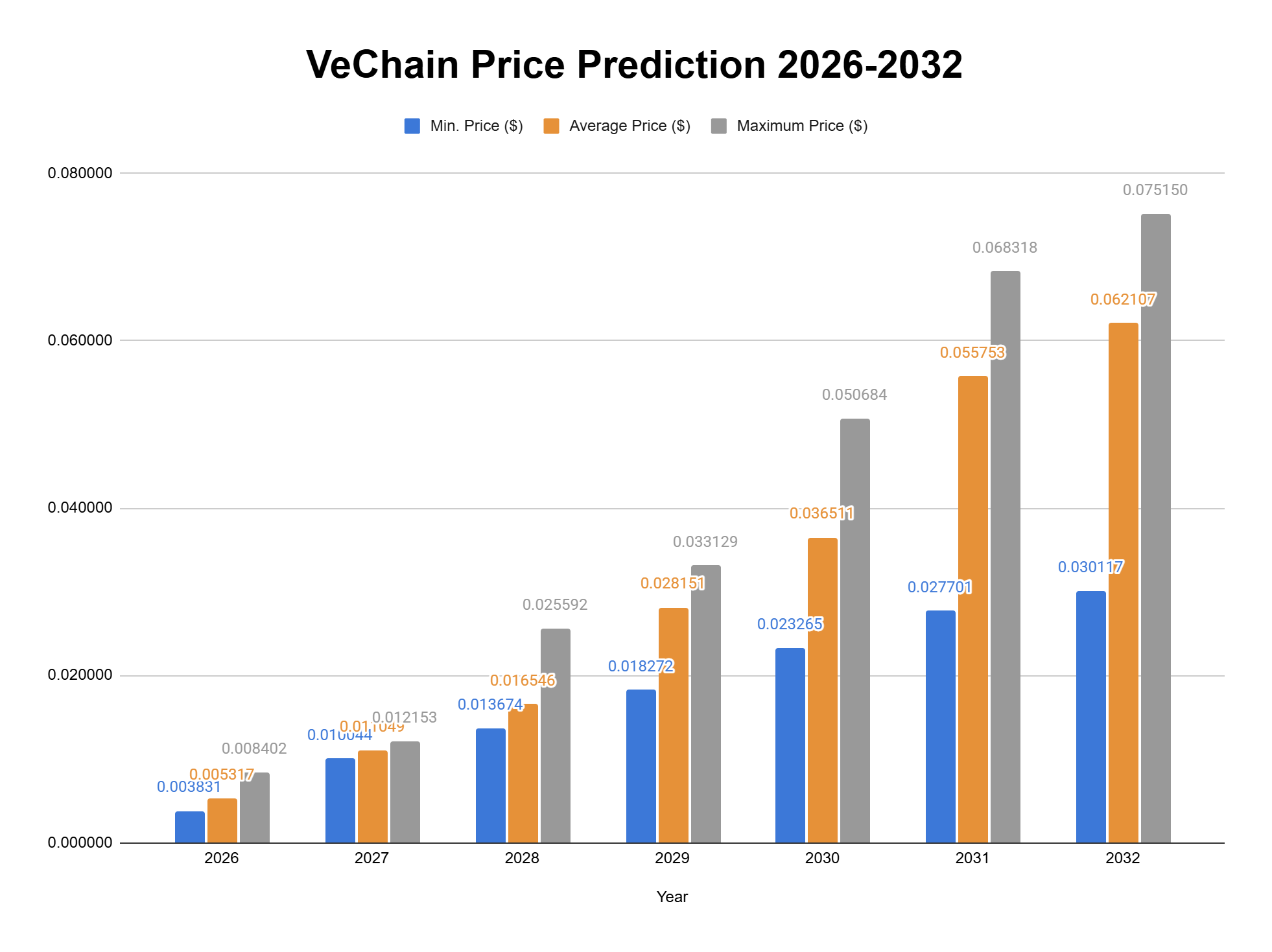
VeChain price projection suggests a peak price of $0.008402 by 2026.
Traders can expect a minimum price of $0.018272 and a maximum price of $0.033129 by 2029.
By 2032, VeChain’s price could potentially surge to $0.075150.
VeChain initially marketed itself as a blockchain network to provide transparency and efficiency to real-world applications enhancing customer trust, providing real-time tracking of goods and items across supply chains and preventing counterfeiting. The main focus of the chain was to track products from their creation to their delivery to the end-consumer as well as provide verification. However, as any good tool, VeChain and its aim have evolved since its launch in 2018.
With global trends shifting towards a greener, a more environment friendly future, VeChain has expanded its focus towards the same. VeChain now offers sustainability incentives, a digital identity as well as rewards environmental friendly actions through its programs. To prove its dedication to the cause, it introduced VeBetter, a Web3-powered ecosystem that rewards users with B3TR tokens for engaging in eco-friendly habits. VeBetter acts as a DAO-governed marketplace for sustainability-focused apps.
With growing optimism around the VeChain ecosystem, especially following recent collaborations with Walmart and other major partners, VeChain is positioning itself as one of the leading blockchain networks for real-world utility and sustainability-focused innovation.
VeChain overview
Cryptocurrency
VeChain
Symbol
VET
Price
$0.004377(-3.6%)
Market Cap
$400.16 Million
Trading Volume (24-h)
$14.24 Million
Circulating Supply
85.98 Billion VET
All-time High
$0.2782, Apr 17, 2021
All-time Low
$0.001678, Mar 13, 2020
24-h High
$0.004544
24-h Low
$0.004328
VeChain price prediction: Technical analysis
Market Sentiment
Bearish
50-Day SMA
$0.00609
200-Day SMA
$0.00820
Price Prediction
$0.00401 (-5%)
Fear & Greed Index
22.64 (Extreme Fear)
Green Days
8/30 (27%)
14-Day RSI
38.65 (Neutral)
VeChain price analysis: VET falls to $0.004370
TL;DR Breakdown:
VeChain price analysis shows fall to $0.004370
Cryptocurrency lost 3.6% of its value in 24 hours
VeChain coin finds support at $0.004370
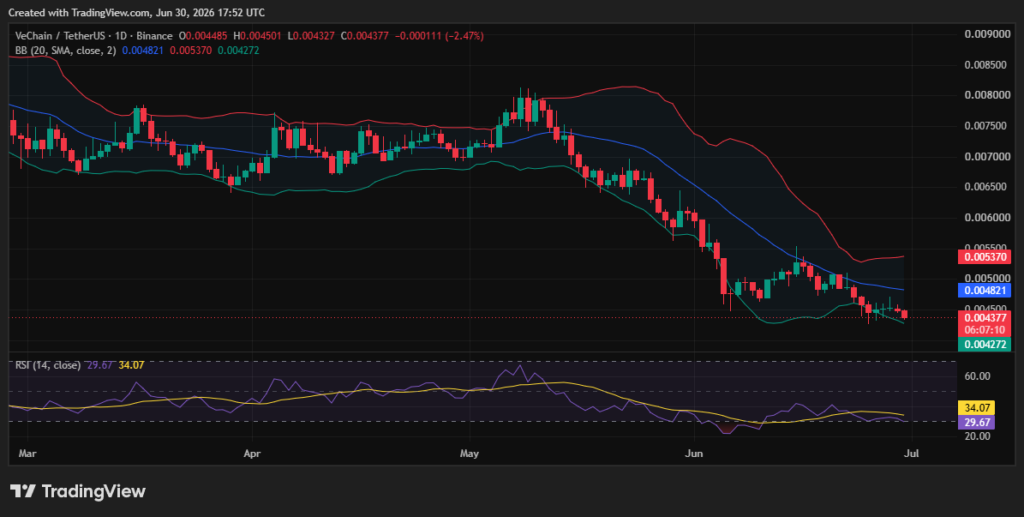
VeChain (VET) current price analysis for 30 June shows strong bearish movement across the last few days as the price fell below the $0.00440 mark.
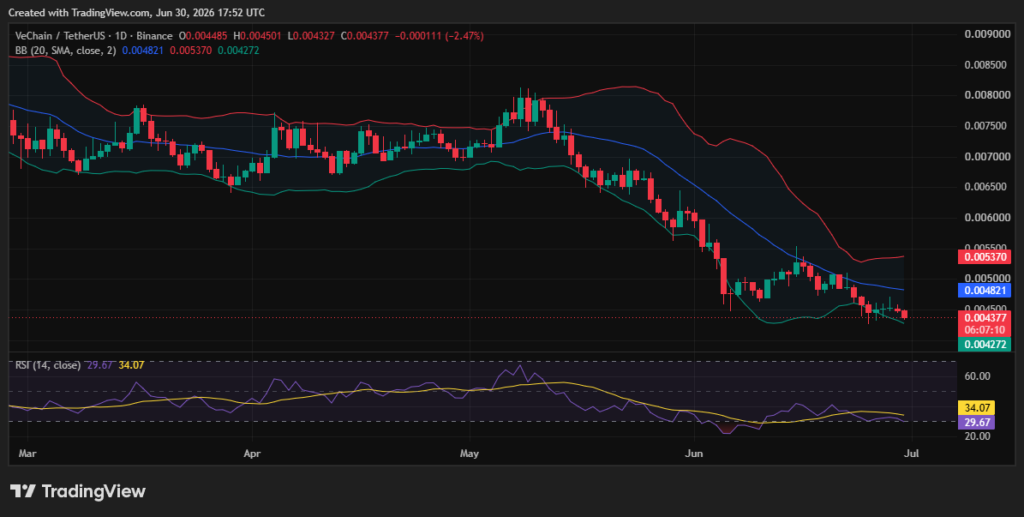
VeChain 1-day price chart: VET falls to $0.00437
VeChain (VET) price action shows a bearish week as the price dropped from the highs of $0.004500 mark to the $0.004370 mark where it trades at press time.
The Relative Strength Index (RSI) falls to 29.67, with the slope showing rising momentum as the price moves back towards $0.004300. The indicator leaves low room for volatile movement in downwards direction. Meanwhile, the Bollinger Bands suggest rising volatility, with the bands diverging across the past few days.
VeChain 4-hour price chart: VET shows neutral momentum
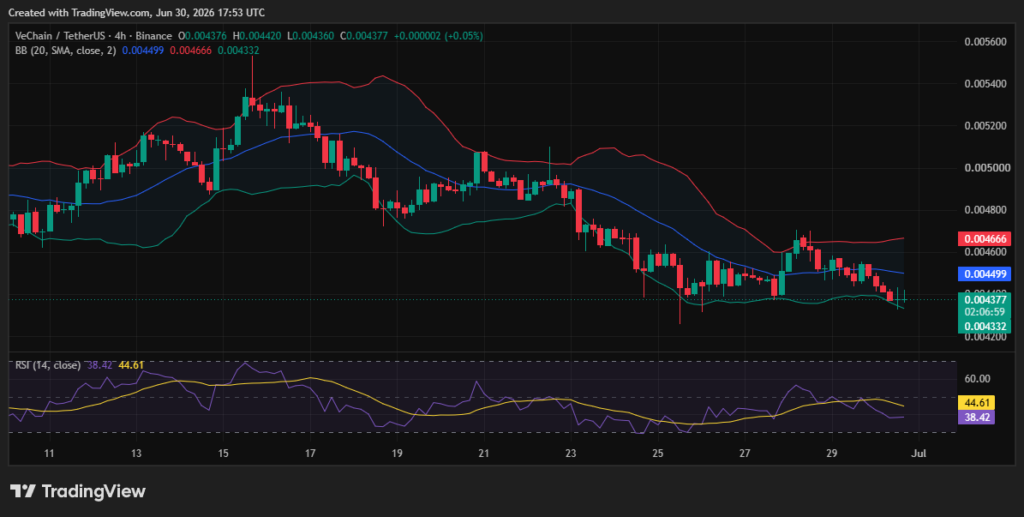
VeChain (VET) live price trades at $0.004377 on the 4-hour chart, showing slight recovery in recent hours.
The Relative Strength Index (RSI) stands at 38.42, showing a bearish market sentiment as VET hovers around $0.004370. The Bollinger Bands are converging and show support and resistance levels at the $0.004332 and $0.004666 levels respectively.
Vechain price analysis showed a sharp decline across the past few days as the price failed to rise past the $0.00460 mark and crashed. VET found support at the $0.004500 mark, before it crumbled causing a decline to the $0.004370 mark.
Overall, Vechain suggests that the price may fall towards $0.004200 as it fails its attempts to climb towards the $0.005600 mark. However, if the bulls are able to hold the $0.004350 level and establish support above $0.004700 mark, VET may rise to the $0.005000 level.
Is Vechain a good investment?
VeChain, as a notable blockchain project, stands out among crypto tokens in cryptocurrency because it focuses on supply chain management and enterprise solutions, which is not considered financial advice. VeChain operates on a dual-token model with two tokens: VET and VTHO. VET tokens are used for staking and governance, while VTHO is used to pay for transaction fees and smart contract execution. Users expend VET to participate in the network, and writing data to the blockchain is managed through VTHO, separating the cost of data submission from the value of VET. Smart contracts play a crucial role in automating business processes and enhancing trust, increasing transparency and efficiency in global trade.
With partnerships with major companies and a strong emphasis on real-world applications, many believe VeChain is a good buy due to its significant growth potential. Its innovative use cases and practical implementations appeal to businesses seeking operational improvements, making it an attractive option for informed investors.
However, it is advised to do your own research and conduct experts opinion before investing in the volatile market.
Why is VET down?
VeChain (VET) price shows that the bulls were rejected at $0.004500 and the rejection caused a crash to the current $0.004370 mark.
Will VeChain recover?
VeChain has experienced a notable selloff in the last thirty days, with the price falling from near the $0.03 mark to its highest price of the period to the current $0.021 level. However, industry analysts suggest that this downturn in the financial markets may not be long-term, a sentiment shared by many VET holders. Most projections indicate that VeChain could regain strength as market conditions improve, with expectations for the asset to potentially close the year between the $0.035 and $0.05 price levels.
Will VeChain reach $0.05?
Analysts suggest VeChain could attain $0.05 by 2031, as the minimum price is projected to be $0.0434 and the average price at $0.0500, as per the VET price prediction 2031. with a potential peak of $0.0585.
Will VeChain reach $0.10?
VET is expected to trade above $0.10 by 2035.
Does VET have a good long-term future?
VET has a good long-term future due to its strong use cases, growing on chain activity, and active development team at the Vechain Foundation.
Recent news/opinion on Vechain
Vechain’s recently revealed its Roadmap for 2026 including key information regarding planned developments including full Ethereum compatibility.
Our 2026 roadmap just dropped & the vision for $VET has never been bigger.
VeChain lived through four ‘chapters’ with a key thesis: trust is its own asset class.
Business needs it, individuals need it, & soon, billions of AI agents will, too.
In June 2026, the price of VeChain is anticipated to reach a minimum of $0.00410. The VET price can be expected to peak at $0.00620, maintaining an average of $0.00510 by the end of the month.
Month
Minimum Price ($)
Average Price ($)
Maximum Price ($)
June
0.00410
0.00510
0.00620
VeChain price prediction 2026
In 2026, the price of the VeChain coin is anticipated to touch a minimum of $0.003831, reflecting the current VeChain sentiment. The VET price might peak at $0.008402, maintaining an average of $0.005317 by the end of the year.
Year
Min. Price ($)
Average Price ($)
Maximum Price ($)
2026
0.003831
0.005317
0.008402
VeChain price prediction 2027-2032
Year
Min. Price ($)
Average Price ($)
Maximum Price ($)
2026
0.003831
0.005317
0.008402
2027
0.010044
0.011049
0.012153
2028
0.013674
0.016546
0.025592
2029
0.018272
0.028151
0.033129
2030
0.023265
0.036511
0.050684
2031
0.027701
0.055753
0.068318
2032
0.030117
0.062107
0.075150
VeChain Price Prediction 2027
For 2027, VeChain (VET) is expected to reach a minimum price of $0.010044. It could potentially climb to a high of $0.012153, averaging around $0.011049.
VeChain Price Prediction 2028
By 2028, VeChain price prediction suggests VET could trade at a minimum value of $0.013674. It might surge to a high of $0.025592, with an average price of $0.016546.
VeChain Price Prediction 2029
VeChain price prediction estimates VET to trade at a minimum of $0.018272 in 2029. It might reach a maximum of $0.033129, with an average value of $0.028151.
VeChain Price Prediction 2030
In 2030, VeChain’s price will likely hit a floor of $0.023265. Based on analysis, it could peak at $0.050684, with an average closing price of $0.036511.
VeChain Price Prediction 2031
The VeChain price prediction for 2031 projects a minimum price of $0.027701, a maximum price of $0.068318, and an average trading price of $0.055753.
VeChain Price Prediction 2032
In 2032, VeChain forecast suggests VET could trade at minimum and maximum prices of $0.030117 and $0.075150, respectively. The price might maintain an average of $0.062107
Vechain price prediction 2026-2032
Vechain Price Forecast: By Analysts
Firm
2026
2027
Coincodex
$0.01498
$0.01274
DigitalCoinPrice
$0.0208
$0.0291
Cryptopolitan’s VeChain (VET) price prediction
Cryptopolitan’s market analysis predictions show that VeChain will achieve a high of $0.008402 in 2026. In 2028, it will range between $0.013674 and $0.025592, with an average of $0.016546. In 2032, it will range between $0.030117 and $0.075150, with an average of $0.062107. Note that these predictions are not investment advice. Seek independent professional consultation or do your own research.
VeChain historic price sentiment
VeChain Price History
VeChain began in 2015 as a private consortium chain for blockchain applications. It transitioned to a public blockchain with the ERC-20 token VEN in 2017 and launched its mainnet as VET in 2018.
In 2018, VeChain partnered with DHL to develop blockchain solutions for logistics but saw a significant price correction, stabilizing at lower levels.
The price remained relatively stable in 2019 and 2020, with occasional spikes as VeChain continued developing technology and forming partnerships.
In 2021, VeChain’s price surged to an all-time high of $0.20 in May but dropped to $0.070 by December.
In 2022, VeChain attempted to recover but remained below $0.10, with continued volatility throughout the year and into early 2023.
Towards the end of 2023, the price saw a slight uptick, stabilizing around $0.020 by early 2024.
In 2024, VeChain’s price fluctuated, recovering to $0.025 by mid-March but dropping due to bearish trends, reaching a low of $0.019 by August.
It traded around $0.021 in September but ended the month above the $0.024 mark. The price remained mostly stable in October, with the occasional bearish movement causing a decline from the $0.02400 level to start November at the $0.02100 price level.
The asset closed November at a high level, with prices near the $0.04600 mark and a strong bullish outlook. However, the bulls only took the price higher in December, as the $0.0500 resistance was crushed swiftly.
As of January 2025, VET traded around the $0.04300 mark as it started and closed the month around the same level.
In February, the price fell towards the $0.03000 mark as bears took over, ending the month at $0.02800. In March, the net movement was low, but the volatility was very high, as the price fell to $0.02200 where it closed the month.
In April the price saw an initial crash but observed sharp recovery ending the month above the $0.02600 mark. In May the price dwindled again ending the month around $0.0250. In June the price continued to struggle as it dropped to $0.0200 to end the month.
July saw a sharp rise to the asset’s volatility with VET crossing the $0.02800 mark. However, the price could not be maintained and VET ended the month around the $0.02200 level. In September, the price saw high volatility reaching as high as $0.0260 but failed to stay at the level and ended the month below the $0.02200 mark.
In October, the price declined further and ended the month below the $0.01500 mark as bears dominated the crypto markets during the later half of the month. in November, the downtrend continued with VET ending the month below the $0.0130 mark. In December, the price continued to move downwards ending the year at $$0.0122.
In January, the trend continued with VET falling below the $0.0100 mark and ended the month below the $0.0080 level. In February the trend continued with the price ending the month below the $0.0070 mark. In March, the trend continued with VET closing the month at the $0.00677 mark.
By the end of April, VET price hovered around $0.007. a trend that did not continue into May as the price saw rapid decline in the month ending below the $0.0050 mark.


![BIP-110 miner signaling chart showing 0.73% support versus the 55% activation threshold, alt text "BIP-110 signaling status", Source: bip110.org monitor]](https://assets.beincrypto.com/img/GJ1DRFXeu_YsEAf0OHhV94kA7XI=/smart/5d346e32f0f14407929adb14c63400da)