Pi Network released three products on Pi2Day 2026 and pitched them as utility tools for outside developers. Most add little usable value today, and PI fell about 8% to a record low.
The question for PI holders is simple. Do the releases create real demand for the token, or only the potential for later? On the evidence so far, the answer leans toward later.
Pi Network’s Products Add Function, Not Token Demand
Pi Core Team detailed the launch in a Pi2Day blog. SoloHost is the headline release. The framework lets developers list apps that run local AI on a user’s own computer. The function is useful, but it needs no PI.
The demo app, Hermes, runs an AI agent on the device for free. The feature that would pay the top ~100 node operators in PI and distributed computing is still in progress. It’s an open, permissionless directory that also skips app review.
Pi Sign-in is a third-party login option released as an initial version. It works much like signing in with Google or Apple, adding convenience without requiring a token.
PiVerify is the exception. It opens Pi’s identity checks, used on more than 18 million people, to outside clients. Those fintech and Web3 clients pay in PI.
That payment is the one clear new source of token demand.
“The three key Pi2Day 2026 releases extend Pi’s services to businesses and developers outside the Pi ecosystem, while inviting them to join Pi Network and take advantage of Pi’s unique benefits and resources, the Pi Network stated.
Still, it depends on businesses choosing Pi over entrenched vendors like Sumsub and Jumio. The service also joins the crowded race for proof of personhood led by Worldcoin (WLD).
Why PI Coin Fell to a Record Low
The market answered fast. PI fell to a record low, trading near $0.117, down about 8% on the day, according to BeInCrypto data.
PI’s $3.00 record came in February 2025, when Pi first opened its mainnet to the outside world. The token has fallen by about 96% since then. PI’s recent price action points to supply, not features.
PI Coin Price Performance Since $3 Peak. Source: TradingView
Daily volume sits near $14 million against a $1.27 billion market cap. Circulating supply keeps climbing toward a 100 billion cap, with about 5.8 billion PI already issued but not yet trading.
Therefore, fresh supply keeps pressuring the price in a way that one launch cannot offset.
So do the products add utility? They expand what Pi Network can already do. But, only PiVerify and the unfinished compute market send real money through PI.
Until outside clients pay at scale, the PI price outlook stays driven by token supply, not announcements.
For more details, visit the official Cryptobriefing platform.
TL;DR
The Cardano Foundation has urged Stake Pool Operators to actively vote on governance actions.
The foundation advised SPOs not to rely on automatic abstention.
The issue matters because Cardano’s governance model depends on visible, accountable participation.
Cardano Foundation Pushes For Active Governance
The Cardano Foundation has urged Stake Pool Operators, or SPOs, to vote on upcoming governance actions rather than allowing automatic abstention to stand in for a decision.
It is not the kind of update that moves like a meme coin headline, but it matters for Cardano’s long-term structure. Governance systems only work if the people with responsibility actually participate. If too many operators default to abstaining, the network may still have rules on paper, but the decision-making process becomes weaker in practice.
For readers who do not live inside Cardano governance, SPOs are important because they help operate the network and represent a meaningful part of its decentralized infrastructure. Their voting behavior can shape whether proposals receive real scrutiny or simply pass through a system where too many participants stay on the sidelines.
Why Auto-Abstaining Is A Problem
Automatic abstention may sound neutral, but in governance it can create a quiet accountability gap.
A vote is a signal. It tells the network where participants stand, what they support, what they reject, and what they are willing to defend publicly. Abstention can be valid when an operator genuinely lacks enough information or has a conflict. But if abstention becomes the default, the system loses some of its transparency.
That is likely why the Cardano Foundation is pushing SPOs toward active participation. Decentralized governance is not just about having many participants. It is about those participants doing the work: reading proposals, forming views, and voting in a way that users can evaluate.
The message is especially relevant as Cardano continues to develop its governance framework. A decentralized system can still become passive if the people inside it treat governance as background noise.
The Bigger Cardano Takeaway
For ADA holders, this is not a price prediction story. It is a network-health story.
Strong governance does not guarantee stronger price action, but weak governance can become a long-term risk. If major decisions are made with limited engagement, users may start questioning how decentralized or accountable the process really is.
The foundation’s call also highlights a broader issue across crypto. Many networks talk about decentralization, but participation is hard. Voting takes time. Proposals can be technical. Incentives are not always clear. That is why governance often needs repeated reminders and social pressure, not just software.
Cardano has built much of its identity around formal governance and decentralization. For that identity to hold up, SPOs need to show up. The foundation’s message is essentially that abstention should be a considered choice, not a default setting.
For readers, the useful approach is to treat this as a signal to monitor rather than a standalone trading call, because confirmation still has to come from follow-through in price, flows, and broader market behavior.
—
This article was written by the News Desk and edited by Samuel Rae.
This report is based on information released by Cryptobriefing. at Cryptobriefing
For more details, visit the official Cryip platform.
TL;DR
Around $73 million worth of tokens are scheduled to unlock between June 29 and July 5.
ENA, SUI and EIGEN are among the largest unlock events to watch.
Token unlocks matter because they can change circulating supply and short-term trading pressure.
Token Unlocks Return To The Watchlist
Around $73 million worth of crypto tokens are scheduled to enter circulation between June 29 and July 5, with Ethena, Sui and EigenLayer among the biggest names on the calendar.
That total is lower than the prior week’s reported $129.67 million unlock value, but it is still large enough for traders to watch. Token unlocks do not automatically create sell pressure, but they do change the supply picture. In a market already dealing with weak sentiment, even moderate unlocks can become part of the short-term trading conversation.
The reason is simple. When locked tokens become available, holders may sell, stake, hold, hedge, or move them into other strategies. The market does not know in advance which path they will choose. That uncertainty can weigh on price before the unlock even happens.
Why ENA, SUI And EIGEN Matter
ENA, SUI and EIGEN are worth watching because they sit in areas of the market where expectations can move quickly.
Ethena has become one of the more closely followed names in the synthetic-dollar and yield-linked corner of crypto. Sui remains one of the major layer-1 ecosystems competing for developer and user activity. EigenLayer is tied to restaking, one of Ethereum’s most important infrastructure narratives.
That means unlocks in these assets are not just mechanical supply events. They also test conviction in some of the market’s bigger themes. If buyers absorb the new supply without much trouble, that can be read as a sign of underlying demand. If prices weaken into or after the unlocks, traders may see it as evidence that liquidity is still too thin.
How Traders Should Read Unlocks
The best way to read token unlocks is not to treat them as automatic sell signals.
A large unlock can be bearish if recipients sell into weak demand. But unlocks can also be well telegraphed and already priced in. Sometimes the market sells before the event and stabilizes once the uncertainty clears. Other times, the unlock becomes a catalyst for further downside.
The key is context. Are volumes rising? Is the asset already near support? Are perpetual futures crowded? Are unlock recipients likely to be early investors, team members, ecosystem funds, or community participants? Each of those details changes the risk profile.
For this week, the useful takeaway is that unlock pressure is lighter than last week but still relevant. ENA, SUI and EIGEN give traders three different windows into market appetite: synthetic-dollar infrastructure, layer-1 risk, and Ethereum restaking.
In a strong market, unlocks can be absorbed quietly. In a fragile one, they can become the excuse for another leg lower. That is why this week’s schedule deserves attention.
—
This article was written by the News Desk and edited by Samuel Rae.
This report is based on information released by Cryip. at Cryip
According to this week’s report from crypto market tracker CryptoRank, DeFi platforms suffered 121 hacks so far this year, resulting in approximately $942 million in losses.
The second quarter accounted for 85 incidents and about $775 million stolen, placing it as the most active period ever for exploits in the crypto sector.
The surge in attacks is against a backdrop of a crypto market struggle, pervaded by weakening investor confidence. Total value locked (TVL) in DeFi protocols has fallen every month this year, dropping from about $115 billion in January to $70 billion in late June.
Drift Protocol, KelpDAO Exploits Hiked Q2 Losses
Per CryptoRank’s data, Q2 2026’s 85 incidents are 49 more than the period with the second-highest frequency of exploits, which happens to be Q1 2026. However, total dollar-denominated losses were not as high as previous peaks, with the data provider reporting that two back-to-back attacks in April accounted for the majority of losses recorded in the quarter.
Drift Protocol and KelpDAO lost a combined $590 million, which is more than half of all the DeFi losses recorded in 2026. Drift Protocol disclosed that attackers had stolen about $285 million in user assets, with blockchain intelligence firm TRM Labs’s investigations linking the operation to hacking outfits connected with North Korea.
According to TRM, preparations for the attack started on-chain as early as March 11 with a 10 ETH withdrawal from Tornado Cash. The crypto tumbler transaction came after months of in-person meetings between the Pyongyang proxies and Drift employees.
“The attacker used social engineering to induce Drift Security Council multisig signers into pre-signing transactions that appeared routine but carried hidden authorizations for critical admin actions,” the firm wrote in a report published April 30.
Just over two weeks later, North Korea’s Lazarus Group exploited the liquid restaking protocol KelpDAO’s LayerZero bridge infrastructure and stole roughly $290 million worth of rsETH.
Chainalysis mentioned at the time that the attackers forged a cross-chain message on April 18 after compromising two remote procedure call nodes used by LayerZero’s Decentralized Verifier Network. At the same time, the criminals struck a third node with a distributed denial-of-service attack, making the system use compromised verifiers.
The verification process was rigged to allow for the creation of rsETH tokens on Ethereum without burning the corresponding assets on Unichain. Within days of the attack, lending protocol Aave’s TVL dropped from $26.4 billion to $14.3 billion, clocking $12 billion in withdrawn funds and a decline of about 46%.
Hacks Were One Problem; a Shrinking Market Was Another
Aave’s TVL dip wasn’t unique, with CryptoRank’s data showing the value locked in all of DeFi falling every single month in 2026, going from $115.3 billion in January to just over $70 billion in June. And while hacks were not the main reason for the decline, the firm noted that the frequency of incidents likely made users less confident, leading to a wider rotation away from the sector.
But the drop hasn’t been as bad as the one in the 2021-2022 cycle when the DeFi TVL tanked more than 70% in seven months. The current dip has been much slower, and the market has also been different structurally, CryptoQuant says, with the stablecoin supply growing to about $300 billion, real-world asset tokenization expanding, and capital dispersed across more sectors like derivatives, infrastructure, and lending, instead of being concentrated in a handful of AMMs and yield farms.
However, among the largest ecosystems by TVL, only Tron and Hyperliquid have managed to grow this year, with the former gaining 5% and the latter adding nearly 7% as it became the dominant venue for on-chain perpetuals. The rest of the top 10 chains are deeply in the red, with the worst hit being Plasma and Arbitrum, which have so far seen their TVL plunge by 74.6% and 55%, respectively.
SUI Group expanded its lending arrangement with Bluefin by an additional 4 million SUI.
The deal brings the outstanding loan to 6 million SUI and matures in September 2028.
SUI Group’s revenue share rises to 11%, payable in SUI tokens.
Public-Company Links To Defi Liquidity: Why This Story Matters
Sui DeFi Receives Boost as SUI Group Lends Additional 4M SUI to Bluefin has become one of the stronger weekend crypto stories because it sits at the intersection of price action, market structure, and the kind of narrative that traders tend to follow closely when the broader news cycle slows down.
The key point is not simply that sUI Group lent an additional 4 million SUI to Bluefin. It is that the development gives the market a fresh way to judge whether the current crypto environment is being driven by genuine network adoption, regulatory progress, liquidity shifts, or short-term speculation.
The Main Details
According to the official source material, Sui Group lent an additional 4 million SUI to Bluefin. The report also notes that the total outstanding loan is 6 million SUI.
That distinction matters because crypto markets often move first on headlines and only later separate durable developments from short-lived momentum. In this case, the verified boundaries are especially important: Do not confuse SUI Group with Mysten Labs or Sui Foundation.
Market Context
For traders, the story arrives at a moment when crypto assets are still trying to define a clearer direction. Bitcoin remains the anchor for broader sentiment, but altcoin narratives are increasingly being judged on their own fundamentals, including usage, liquidity, compliance, treasury activity, and developer progress.
That makes this development relevant beyond a single token or company. If the underlying trend proves durable, it could help shape how investors evaluate Sui, SUI, Bluefin, DeFi, Liquidity over the coming weeks. If it fades, however, it may become another example of a strong weekend narrative that struggled to translate into sustained market follow-through.
What To Watch Next
The next important question is whether the market receives further confirmation from primary sources, dashboards, official announcements, or on-chain data. Follow-up disclosures, exchange data, governance updates, or wallet activity could all help clarify whether this is an isolated headline or the start of a broader theme.
Readers should also watch whether liquidity responds. In crypto, even fundamentally meaningful developments can fail to move prices if traders remain defensive, leverage is being unwound, or capital is rotating into other sectors. That is why this story should be read alongside broader market structure rather than in isolation.
This report is based on information from Sui network data and Mysten Labs documentation.
This article was written by the News Desk and edited by Samuel Rae.
GnosisDAO’s GIP-151 passed with 215% of the required quorum, 49 votes representing a voting weight roughly 2.15 times the 75,000 GNO minimum threshold.
The proposal authorized a one-time pro rata treasury redemption, allowing GNO holders to surrender tokens in exchange for a proportional share of liquid treasury assets. A passed governance vote on a treasury of this size redefines what governance tokens can be used for.
Until now, a governance token’s value rested on a stack of soft arguments, such as control over protocol direction, fee switches that might get activated, and treasury grants that might boost network growth.
When a DAO can be voted to return assets to holders, the token functions as a probability-weighted claim on the balance sheet, regardless of how it is legally classified.
Background reporting on the earlier GIP-150 redemption push cited a GnosisDAO treasury of roughly $223 million, an estimated redemption value near $170 per GNO, and a market price around $132, a 27% discount.
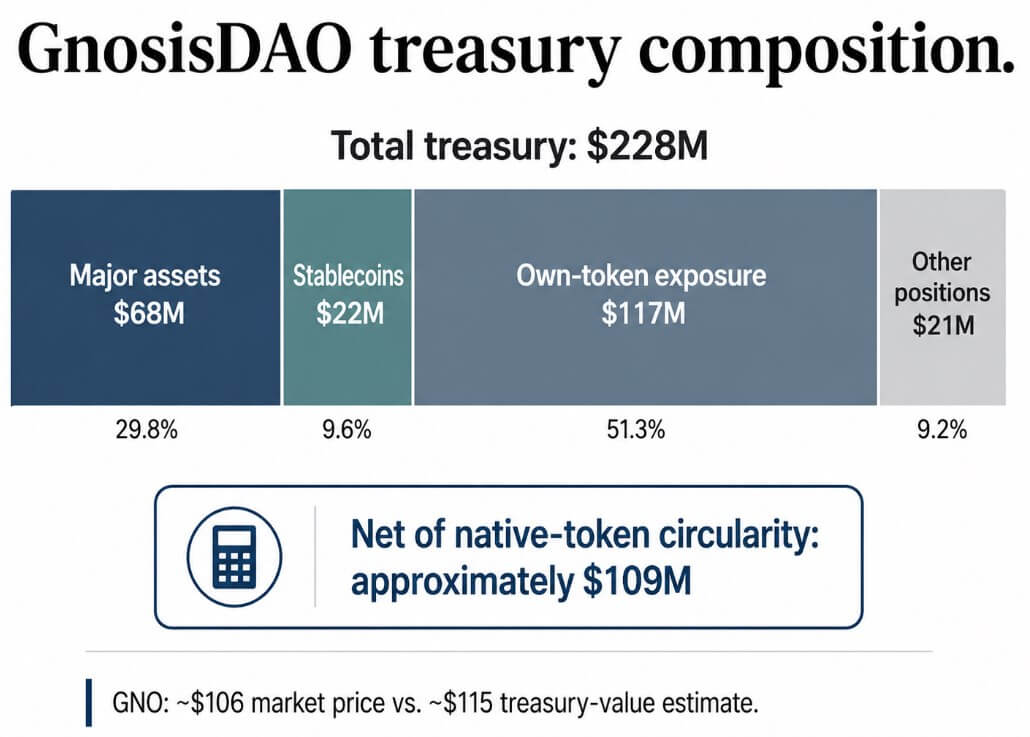
Current DeFiLlama data put the total treasury near $228 million, with approximately $68 million in major assets, $22 million in stablecoins, $117 million in own-token exposure, and $21 million in other positions.
Net of native token circularity, the liquid treasury sits at around $109 million. DeFi analyst Ignas put GNO at approximately $106 against roughly $115 in treasury value per token around the time of GIP-151’s passage.
Gnosis DAO’s $228 million treasury is 51.3% own-token exposure, leaving roughly $109 million in liquid assets against a $115 per-token redemption estimate.
The trade that GIP-151 validates
That discount creates an investable structure consisting of buying tokens below the adjusted treasury value, accumulating governance influence, voting for redemption, and closing the gap.
That is the closed-end fund activism playbook applied to decentralized infrastructure, and Gnosis has now demonstrated it can be executed.
The Investment Company Institute put total closed-end fund assets at roughly $791 billion at year-end 2025, a market large enough to have given rise to decades of activist doctrine around NAV discounts, and DAO treasuries now sit inside that doctrine.
At a GNO price near $104 and a quorum threshold of 75,000 GNO, a position meeting the quorum costs approximately $7.8 million before slippage or opposition. GIP-151’s reported 215% quorum implies an actual voting weight of roughly 161,250 GNO, or about $16.8 million at that price.
Insider blocs, delegation structures, eligibility rules, and organized opposition all affect whether a given position wins a vote, but the numbers show why governance tokens over large liquid treasuries now carry a control premium the market has not historically priced.
The trade generates a straightforward screen: liquid treasury per token, market discount to adjusted NAV, quorum threshold, delegate concentration, foundation or multisig veto risk, treasury composition, and execution path.
DAOs with legally inaccessible, foundation-controlled, or native-token-heavy treasuries stay stranded at their discounts.
Screen factor
Why it matters
What activists are looking for
Liquid treasury per token
Determines whether there is real redeemable value
Stablecoins, ETH, majors, low-haircut assets
Market discount to adjusted NAV
Defines the potential trade spread
Token price materially below treasury value
Quorum threshold
Measures how much voting weight is needed
Low enough threshold for coordinated holders
Delegate concentration
Shows whether votes can be influenced
Fragmented delegates or persuadable blocs
Insider / foundation control
Determines whether the treasury is practically reachable
Low veto risk from founders, foundations, multisigs
Treasury composition
Separates real NAV from paper NAV
Less native-token circularity, fewer illiquid bets
Execution path
Tests whether a vote can actually move assets
Onchain execution, clear legal wrapper, defined claims
Legal risk
Affects exchanges, holders, and future DAO design
Redemption framed as governance, not investment product
How governance changes when capital enters the room
Traditional DAO governance assumes voters are builders, delegates, users, and participants with operational stakes in the protocol’s future.
Treasury activism imports a different voter through the NAV buyer, who holds governance tokens to extract balance-sheet value and has no particular interest in what the DAO builds next.
A governance forum that used to debate grant allocations, roadmap priorities, and fee-switch parameters now has to answer a prior question: should the DAO retain these assets and, if so, on what terms?
In the bull case, GIP-151 executes cleanly, with liquid assets distributed, illiquid positions handled through a claim token, and legal friction staying contained.
Governance tokens gain a credible new valuation anchor: the probability-weighted right to extract value from the treasury.
Other DAOs with liquid, transparent treasuries and permeable governance face immediate demands to justify why their tokens should trade below the value of the assets they govern. A clean execution could pull GNO toward or briefly above the $115 treasury-value estimate as remaining holders reprice the governance premium.
The bear case runs through execution delays, disputes over eligible supply, heavy haircuts on illiquid assets, or a treasury-defense campaign that exposes insider concentration, leading the market to discount both payout certainty and the post-redemption protocol’s capacity to function.
The wider risk for the DAO market is that several copycat redemption pushes fail simultaneously, demonstrating that most treasury discounts are structurally inaccessible, and the NAV-activism thesis deflates before it fully takes hold.
GNO trades closer to or above the ~$115 treasury-value estimate
DAO tokens with clean liquid treasuries reprice higher on redemption optionality
Base case
Redemption works, but with delays, haircuts, or limited participation
GNO trades around adjusted treasury value, not full headline NAV
Treasury-rich DAOs face pressure to explain reserves, spending, and governance control
Bear case
Execution disputes, eligibility fights, insider resistance, or heavy illiquid-asset haircuts
Market discounts payout certainty and post-redemption protocol value
Most DAO treasury discounts are treated as inaccessible
Black swan
Regulatory, exchange, or litigation pressure reframes redemption as security-like behavior
GNO and similar tokens face sharp legal/liquidity discount
Governance tokens split between “usable governance” and “fund-like treasury claim” buckets
The legal exposure that follows
The SEC’s 2026 crypto guidance holds that a non-security crypto asset can still be sold as part of an investment contract when surrounding facts satisfy the Howey test: investment of money, common enterprise, expectation of profits, and reliance on the managerial efforts of others.
Pro-rata treasury redemption gives regulators cleaner facts to run that analysis.
Regulators can now ask more directly whether buyers hold a governance token to participate in protocol decisions or expect returns from a pooled treasury managed and distributed by others.
Legal risk rises sharply if projects, delegates, activists, or market materials frame tokens explicitly as treasury claims.
The distinction between “governance token that enables redemption” and “redeemable treasury interest” is the line that litigation and enforcement will contest.
A second exposure follows from treasury composition. The Investment Company Act applies to issuers whose primary business resembles investing, reinvesting, or holding securities, with a 40% investment-securities threshold embedded in the statute.
A passed redemption mechanism raises the question of whether a DAO that holds ETH, stablecoins, tokenized securities, RWAs, and LP positions, and can be voted to distribute them pro rata, starts to resemble a redeemable asset pool more than an operating network.
The CLARITY Act debate adds a structural wrinkle, as the Senate bill distinguishes between decentralized and centralized platforms, with the latter subject to financial institution-style obligations, including transaction monitoring and suspicious-activity reporting.
A DAO can be genuinely decentralized at the protocol layer while concentrating treasury control in insiders, multisigs, or delegate blocs. Gnosis provides regulators with a real-world example of that gap.
The DeFi spillover
DAO treasuries fund liquidity programs, grants, market-making budgets, protocol contributors, and LP positions.
Redemption votes, whether isolated or part of an activist norm, force treasuries to liquidate assets, such as stablecoin outflows, ETH sales, unwound LP positions, and cut incentive programs.
The total stablecoin market cap is near $314 billion, with Ethereum holding roughly half, according to DeFiLlama. With the Fed holding its target range at 3.50% to 3.75%, the opportunity cost of idle DAO stablecoin reserves is quantifiable and easy to argue in a governance forum.
The risk from Gnosis compounds if five or ten treasury-rich DAOs simultaneously face coordinated redemption campaigns, because the resulting asset sales and incentive cuts run across protocols that share liquidity, validators, and grant recipients.
Rook DAO, Fei/Tribe, and Aragon each demonstrated that DAO treasury conflicts can be resolved through redemption structures.
Aragon’s roughly $115 million ANT redemption came after a protracted governance fight, which the foundation resolved by returning capital to ANT holders. GIP-151 arrived by passing through standard governance, above quorum, without the DAO visibly collapsing first.
That procedural route converts a pattern of isolated governance crises into a repeatable strategic tool.
Every DAO governing a treasury larger than its market cap now trades at a discount that serves as an activist target. Whether DAO structures prove resilient to that, and whether US regulators settle the legal question before the market does, are the forward-looking variables that Gnosis left open.
BitMEX co-founder Arthur Hayes is facing another round of exit liquidity allegations after on-chain observers flagged that his fund, Maelstrom, appeared to offload $1.92 million worth of $CARDS tokens within days of Hayes publicly promoting the project.
The move, which is recognized as using others as “exit liquidity” to get out of a trade, is coming just roughly three weeks after blockchain investigator ZachXBT called out Hayes for similar actions that involved four different tokens.
Why is Arthur Hayes getting criticized?
On June 23, Hayes posted on X that “$CARDS degens” had a “solid” thesis and predicted the token’s price would be “pamping,” according to his post on X. Maelstrom’s official account shared a link to the project around the same time, according to a post from the fund’s X account.
Four days later, crypto analytics account SolanaFloor reported on X that Hayes had set a $4 price target for $CARDS when the token was trading around $0.30 and that Maelstrom sent $1.92 million worth of $CARDS to market maker Flowdesk the following day. SolanaFloor added that it was “likely for selling.”
That was all Crypto Twitter needed to fire a barrage of posts and criticism at the socially active Arthur Hayes.
The token was trading near $0.23 at the time of SolanaFloor’s post, a decline of roughly 23% from where it sat when Hayes endorsed it. Currently, it trades around $0.24
Another on-chain analyst, Ericonomic, also flagged the sequence on X, noting that Hayes “shilled $CARDS 4 days ago” and that three days later an address sold “his entire stack through Fireblocks.”
Ericonomic added that the wallet address was never publicly disclosed by Hayes, and the link was based on timing and token patterns.
What did ZachXBT call out Hayes?
On June 6, Cryptopolitan reported that ZachXBT confronted Hayes over a similar cycle of endorsing tokens and then liquidating his holdings of those tokens. That time it involved four tokens, HYPE, NEAR, ZEC, and WLD.
ZachXBT documented how Hayes exited all four positions within a two-week window after publicly endorsing each one.
Hayes had called HYPE, ZEC, and NEAR the “Holy Trinity” on May 22, then went on to sell his HYPE and NEAR holdings by June 4 and dumped ZEC on June 5 after citing an exploit in its Orchard Pool.
He also closed his WLD position the next day, less than 24 hours after framing Worldcoin as a SpaceX IPO play.
ZachXBT asked Hayes directly how much exit liquidity his followers had absorbed. Hayes responded that he “sold to a willing seller at a price” and that he “happened to call it right this time” regarding his trading goals.
ZachXBT’s history of flagging suspicious actions
ZachXBT has built a track record of flagging this kind of promote-then-sell dynamic across crypto.
His investigations into RAVE, SIREN, and LAB tokens over the past two months have all centered on the role insiders or prominent figures play in generating retail buying interest and then selling into the demand they created.
In a May 14 investigation into LAB, ZachXBT documented how insiders allegedly controlled over 95% of the token’s supply while the project reached a fully diluted valuation above $6 billion. He characterized that case as “everything wrong with the current meta of retail extraction on major centralized exchanges.”
So far, Hayes has not publicly responded to the latest $CARDS allegations, and the connection between the Maelstrom fund wallet and the Flowdesk transfers has not been independently confirmed beyond what was cited by SolanaFloor and similar sources.
Security Remediation And User Refund Preparation: Why This Story Matters
SecondFi Completes Refund Snapshot for Wallets Impacted by Recent Cardano Exploit has become one of the stronger weekend crypto stories because it sits at the intersection of price action, market structure, and the kind of narrative that traders tend to follow closely when the broader news cycle slows down.
The key point is not simply that secondFi took a final balance snapshot on June 26, 2026. It is that the development gives the market a fresh way to judge whether the current crypto environment is being driven by genuine network adoption, regulatory progress, liquidity shifts, or short-term speculation.
The Main Details
According to on-chain data, SecondFi took a final balance snapshot on June 26, 2026. The report also notes that the exploit affected 374 wallets between June 21 and June 23.
That distinction matters because crypto markets often move first on headlines and only later separate durable developments from short-lived momentum. In this case, the verified boundaries are especially important: Do not imply refunds have already landed.
Market Context
For traders, the story arrives at a moment when crypto assets are still trying to define a clearer direction. Bitcoin remains the anchor for broader sentiment, but altcoin narratives are increasingly being judged on their own fundamentals, including usage, liquidity, compliance, treasury activity, and developer progress.
That makes this development relevant beyond a single token or company. If the underlying trend proves durable, it could help shape how investors evaluate Cardano, ADA, SecondFi, Yoroi, Security over the coming weeks. If it fades, however, it may become another example of a strong weekend narrative that struggled to translate into sustained market follow-through.
What To Watch Next
The next important question is whether the market receives further confirmation from primary sources, dashboards, official announcements, or on-chain data. Follow-up disclosures, exchange data, governance updates, or wallet activity could all help clarify whether this is an isolated headline or the start of a broader theme.
Readers should also watch whether liquidity responds. In crypto, even fundamentally meaningful developments can fail to move prices if traders remain defensive, leverage is being unwound, or capital is rotating into other sectors. That is why this story should be read alongside broader market structure rather than in isolation.
This report is based on information shared by SecondFi on X.
This article was written by the News Desk and edited by Samuel Rae.
Sony Interactive Entertainment is removing 551 purchased films from UK PlayStation Store accounts on September 1, 2026, citing content licensing agreements with StudioCanal.
The affected library spans decades of cinema, from Terminator 2: Judgment Day and Rambo: First Blood to Bridget Jones’ Diary, Pan’s Labyrinth, and Paddington. Customers who paid for those titles will lose access regardless of their purchase history.
When a Purchase is Not Ownership
Sony published a formal legal notice confirming the removal, attributing it to the expiration of its licensing agreement with StudioCanal. The notice offered no refunds or alternative compensation for affected buyers.
The situation exposes a structural reality most consumers overlook at checkout. A digital “purchase” on any platform-controlled storefront functions more like a temporary license than outright ownership.
Therefore, Sony and StudioCanal can modify or terminate that license, and the buyer absorbs the loss.
With 551 titles set for deletion, this is one of the largest single-event disappearances of purchased digital content in recent memory.
PlayStation is deleting 551 purchased movies from its customers’ accounts, reminding us nothing digital is ever truly ours https://t.co/sXW4Uj10FR
PlayStation Digital Ownership and the Gaming Parallel
The concern is not limited to films. When GTA 6 pre-orders opened this week, Rockstar confirmed that physical retail editions would include only a digital download code, with no disc.
For buyers who assumed a boxed copy meant a physical artifact they owned outright, that detail reinforced a growing unease. The GTA launch also sent shockwaves through crypto markets that same day, highlighting how far the digital ownership question now extends across gaming and finance.
Together, the two events make the same point. Across entertainment and gaming, consumers are paying for access, not ownership.
The Web3 Argument Gets Louder
Non-fungible tokens (NFTs) were built to address exactly this problem by creating on-chain, portable title deeds that no single platform can revoke. If StudioCanal had issued film rights as NFTs, Sony could not have overridden them.
Those tokens would remain in the buyer’s wallet, transferable and verifiable, independent of any licensing dispute between corporations.
That argument is gaining fresh credibility. Earlier this year, market observers noted a shift in the NFT sector away from speculation toward tangible utility, with digital ownership emerging as the strongest long-term use case.
Meanwhile, Worldcoin’s biometric identity push brought parallel questions about who controls proof-of-ownership in digital spaces into mainstream debate. Across the broader GameFi sector, 2026 has already seen renewed investor appetite for blockchain-backed digital economies.
The PlayStation film deletions may appear to be a routine licensing dispute on paper.
However, they crystallize a question that streaming, gaming, and digital media platforms have not resolved: when a platform changes its terms, what does a consumer actually own?
For blockchain advocates, Sony just provided the most mainstream illustration yet.
Filecoin price predictions suggest an average market price of $1.26 in 2026.
By 2029, the price is projected to reach $4.45.
By 2032, FIL may reach $13.43.
Filecoin is a decentralized storage network designed to securely and efficiently store humanity’s most important information. Launched by Protocol Labs in October 2020, it utilizes blockchain technology to create a peer-to-peer digital storage marketplace. Users can rent unused hard drive space to earn Filecoin tokens (FIL), the network’s native cryptocurrency.
The system operates on a proof-of-replication and proof-of-spacetime consensus mechanism, ensuring that data is reliably stored over time and that storage providers hold the exact copies they claim. This approach incentivizes a robust and distributed network of storage providers, enhancing data retrieval speeds and security compared to traditional centralized servers.
Filecoin aims to reduce storage costs by leveraging the global surplus of storage capacity. As part of the broader Web3 ecosystem, it supports decentralized applications (dApps) and services that require secure, decentralized data storage, significantly advancing the decentralized internet infrastructure.
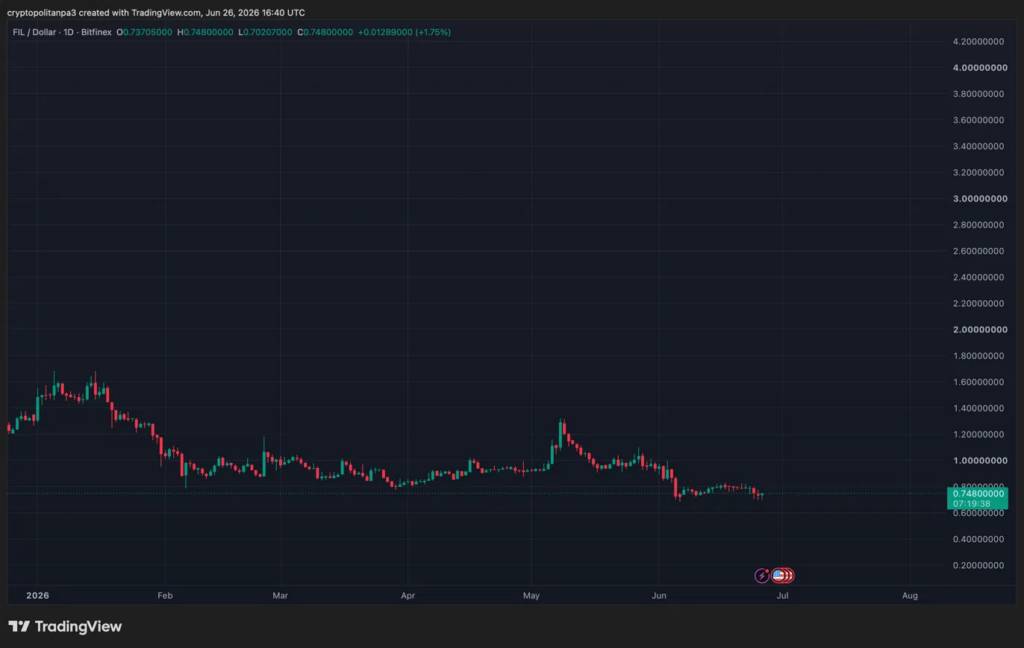
Filecoin is trading at $0.748, up 1.75% on the day, staging a modest relief bounce after yesterday’s sell-off pushed price to a low of $0.702 — dangerously close to fresh 2026 lows. The 1D structure remains broadly bearish, with FIL declining from January’s $1.75 peak through a volatile year of lower highs. The brief May spike to $1.35 has been entirely erased, with price now consolidating in a tight $0.70–$0.80 horizontal zone that represents critical 2026 support. Today’s green candle shows tentative buyer interest emerging at depressed levels. A daily close above $0.80 would signal short-term stabilization; losing $0.70 risks a drop toward $0.60.
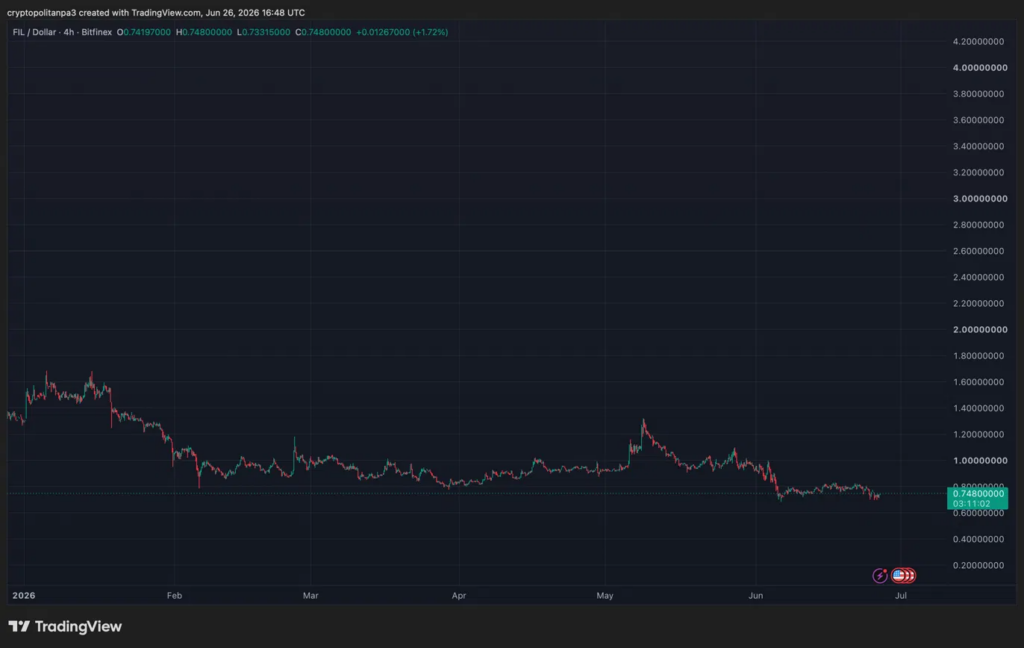
Filecoin’s 4H chart shows price at $0.748, up 1.72%, attempting a tentative recovery after yesterday’s sharp drop to the $0.70 support floor — the lowest level of 2026. The 4H structure mirrors the 1D, revealing a prolonged decline from January’s $1.75 peak with the entire May spike to $1.35 fully retraced. Price is now compressing tightly in the $0.73–$0.75 range, with small candles reflecting cautious buyer interest rather than strong conviction. The $0.80 horizontal level remains the key barrier to overcome for any meaningful recovery. A 4H close below $0.72 would signal renewed selling pressure toward $0.60 lows.
Filecoin technical indicators: Levels and action
Daily simple moving average (SMA)
Period
Value
Action
SMA 3
$0.7564
SELL
SMA 5
$0.7676
SELL
SMA 10
$0.7815
SELL
SMA 21
$0.7711
SELL
SMA 50
$0.9073
SELL
SMA 100
$0.9047
SELL
SMA 200
$1.04
SELL
Daily exponential moving average (EMA)
Period
Value
Action
EMA 3
$0.7513
SELL
EMA 5
$ 0.7611
SELL
EMA 10
$0.7730
SELL
EMA 21
$0.7982
SELL
EMA 50
$ 0.8569
SELL
EMA 100
$0.9265
SELL
EMA 200
$ 1.13
SELL
Filecoin technical analysis: Conclusion
Filecoin remains in a broadly bearish state across both timeframes, though today’s modest +1.75% bounce from the $0.70 support floor offers a rare glimmer of hope. The 1D and 4H charts tell a consistent story — FIL has lost over 57% from January’s $1.75 peak, with every recovery attempt, including May’s sharp spike to $1.35, quickly reversed by sellers. Price is now compressing in the $0.73–$0.75 zone with no strong buying conviction. A confirmed close above $0.80 could signal short-term stabilization, but until that happens, the path of least resistance remains downward with $0.60 as the next major risk level.
Why is Filecoin up today?
FIL is up today due to a technical bounce from deeply oversold levels combined with a slight improvement in broader market sentiment. On the charts, yesterday’s drop to the $0.70 support floor triggered natural relief buying after price became significantly oversold. Trading volume increased 6.60% in the last 24 hours, signaling a recent rise in market activity supporting the bounce. Fundamentally, Filecoin is undergoing a major narrative shift from storage hype to real revenue generation, with AI and enterprise data demand growing and the network pushing into decentralized cloud infrastructure to compete with centralized providers like AWS, keeping long-term buyer interest alive at depressed price levels.
Is Filecoin a good investment?
Filecoin is a decentralized storage network aiming to revolutionize data storage. Its investment potential depends on market adoption and competition. Like all cryptocurrencies, it carries significant risks due to volatility. Investors should carefully research and assess their risk tolerance before considering investing.
What will Filecoin be worth in 2026?
Filecoin is predicted to reach a high of $2.67 by 2026.
How high can Filecoin go?
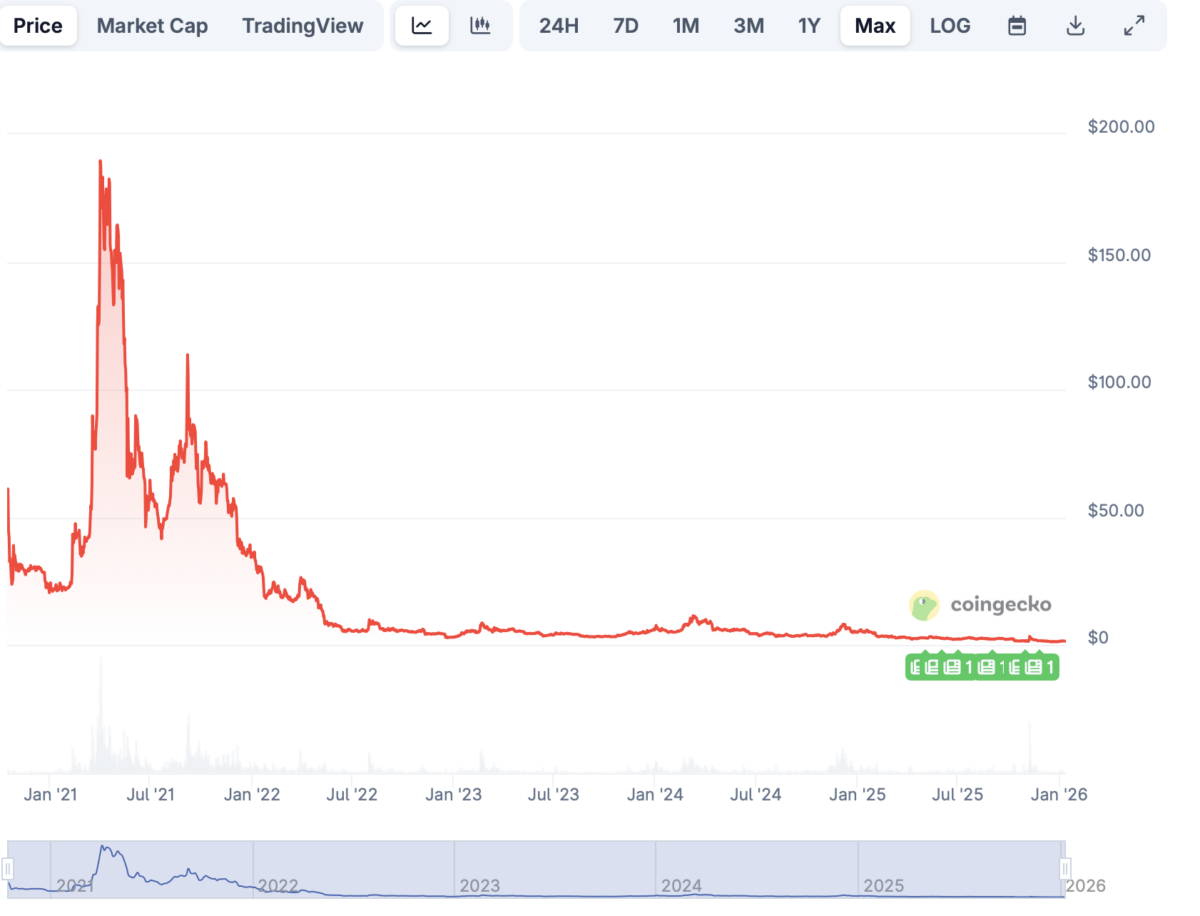
Filecoin (FIL) has the potential for significant price appreciation, especially if adoption in the decentralized storage sector increases. Historically, FIL reached an all-time high of $236.84 in 2021, but its price has since retraced significantly. Looking forward, realistic long-term projections depend on market conditions, demand for decentralized storage, and crypto adoption.
In a bullish scenario, FIL could reach $2.67 by 2026 if institutional interest and on-chain activity increase. More optimistic forecasts suggest $50+ in the next major bull run. However, market risks remain, and sustained growth depends on ecosystem developments and competitive advantages over traditional cloud storage solutions.
Can Filecoin reach 100 dollars?
Filecoin (FIL) reaching $100 is possible, but it would require significant market momentum, adoption, and favorable conditions in the broader crypto space. The token hit an all-time high of $236.84 in 2021, proving that such price levels are achievable during bullish cycles.
For FIL to reach $100 again, it would need strong institutional adoption, increased demand for decentralized storage solutions, and a broader crypto bull market. However, competition from traditional cloud providers and other blockchain-based storage networks could limit growth. While possible, it would require a massive market resurgence and sustained network adoption to materialize.
What is the all-time high price of Filecoin?
For FIL to reach $100 again, it would need strong institutional adoption, increased demand for decentralized storage solutions, and a broader crypto bull market. However, competition from traditional cloud providers and other blockchain-based storage networks could limit growth. While possible, it requires a massive market resurgence and sustained network adoption to materialize.
Does Filecoin have a future?
Filecoin’s future appears promising, given its unique position in decentralized data storage and its ability to address the growing demand for secure alternatives to traditional cloud services. Analysts predict potential price increases, with estimates suggesting it could reach $6.64 by 2032, contingent on market conditions and adoption rates.
Is it worth investing in Filecoin?
Investing in Filecoin may be worthwhile due to its innovative approach to decentralized data storage, which meets growing demand in the tech sector. However, potential investors should consider market volatility and conduct thorough research, as price predictions vary widely, reflecting both optimism and caution among analysts
Is Filecoin safe?
Filecoin uses cryptographic security for its decentralized storage network and employs robust security protocols, including cryptographic proofs of data integrity; however, it is not without risks. Potential issues include market volatility, regulatory uncertainty, and technical vulnerabilities. Users should thoroughly research and exercise caution when using or investing in Filecoin.
Is Filecoin built on Ethereum?
Filecoin is not built on Ethereum; it operates on its own blockchain. However, it has integrated with Ethereum to enhance functionality, enabling smart contracts and facilitating interactions between the two ecosystems. This collaboration allows developers to leverage both platforms for decentralized storage and applications.
Recent news/opinions on Filecoin
Filecoin Onchain Cloud targets AI agent payments with sub-cent transactions and automatic settlement
Filecoin Onchain Cloud enables AI agents to execute sub-cent micro-payments automatically, bypassing legacy payment rails that charge a $0.30 minimum per transaction.
Legacy payment rails charge $0.30 minimum per transaction.
Agents execute hundreds of sub-cent micro-payments per workflow. That math doesn’t work.
Filecoin Onchain Cloud gives agents storage that proves what it holds, payments settle automatically, and a full audit trail. pic.twitter.com/DlbpNkb3JC
In June 2026, the Filecoin price is expected to hit a low of $0.8304, with an average expected price of $1.01, and the FIL price might reach a maximum of $1.25.
Filecoin price prediction
Potential Low
Potential Average
Potential High
Filecoin Price Prediction June 2026
$0.8304
$1.01
$1.25
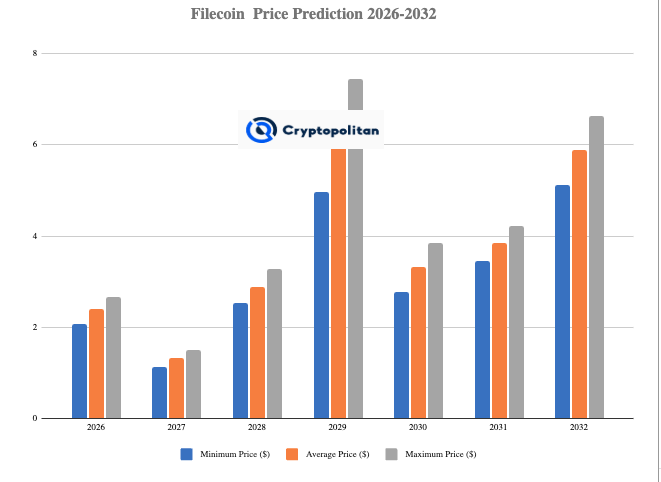
Filecoin FIL price forecast 2026
The price of Filecoin (FIL) is predicted to reach a minimum value of $1.22 in 2026, with a maximum of $1.44 and an average trading price of $1.26. This projection is driven by increasing use of decentralized cloud storage, continuous protocol improvements, and expanding partnerships, while cautious market sentiment keeps growth steady rather than explosive.
Filecoin price prediction
Potential Low
Potential Average
Potential High
Filecoin price prediction 2026
$2.07
$2.41
$2.67
Filecoin price forecast 2027- 2032
Filecoin price prediction
Potential Low ($)
Potential Average ($)
Potential High ($)
2027
1.13
1.32
1.50
2028
2.52
2.89
3.27
2029
4.96
6.20
7.44
2030
2.78
3.31
3.84
2031
3.45
3.84
4.22
2032
5.11
5.88
6.64
Filecoin price prediction 2027
Filecoin’s price is forecast to decline to $1.13 in 2027. According to analysts, the FIL price could reach a maximum of $1.50, with an average forecast of $1.32.
Filecoin price prediction 2028
According to forecasts and technical analysis, in 2028 the price of Filecoin (FIL) is expected to range from $2.52 to $3.27, with an average of $2.89. This growth outlook is fueled by expanding demand for decentralized data storage, integration with AI and cloud services, and broader enterprise adoption, strengthening Filecoin’s position as a leading Web3 storage infrastructure provider.
Filecoin (FIL) price prediction 2029
According to technical analysis of past FIL price data, in 2029 the price of Filecoin is forecast to reach a minimum of $4.96, a maximum of $7.444, and an average trading price of $6.20. This projection is driven by increasing global demand for decentralized cloud storage, enhanced data privacy awareness, and Filecoin’s expanding ecosystem supporting Web3 and AI-driven data solutions, fostering consistent network utility and long-term value growth.
Filecoin price prediction 2030
The price of 1 Filecoin (FIL) is expected to reach a minimum level of $2.78 in 2030, with a maximum of $3.84 and an average price of $3.31.
Filecoin price prediction 2031
The price of Filecoin is predicted to reach a minimum level of $3.45 in 2031. The FIL price can reach a maximum level of $4.22, with the average trading price of $3.84.
Filecoin (FIL) price prediction 2032
The price of Filecoin (FIL) is predicted to reach a minimum price of $5.11 in 2032, with a maximum of $6.64 and an average price of $5.88. This projection reflects Filecoin’s maturity as a global decentralized storage network, large-scale enterprise integration, and increasing demand for secure, censorship-resistant data solutions, solidifying its position as a key infrastructure layer in the Web3 economy.
According to Cryptopolitan’s projections, FIL’s price could reach $1.89 by 2026. However, traders should also be aware of potential market volatility. The average trading price for FIL is expected to hover around $1.82, indicating both optimistic market trends and the risks of potential declines.
2017–2021 boom: FIL traded under $30 until mid-2020, then surged to an all-time high of $237.24 on April 1, 2021, before reversing sharply lower.
2022–2023 slump: Entered 2022 at higher levels but slid with the wider crypto downturn; in 2023, it ranged mostly between $3 and $4.32, showing only modest recovery.
2024–early 2025 weakness: Fell from $7.65 early 2024 to around $3.4 late in the year, briefly spiked to $8.03 (Dec 5), then slid through early 2025 toward $2.3–$3.0.
Mid-2025 grind lower: Mostly traded in the $2.2–$2.8 zone July–September, briefly bounced near $4.2–$4.8, then collapsed in October–November toward $1.45–$1.95.
Late-2025 to Jan 2026 stabilization: A November rally to ~$3.0 faded into December lows near $1.25–$1.35, followed by a mild rebound and consolidation around $1.28–$1.33 in early January 2026.
Early January to late January 2026 — FIL started around about $1.28–$1.33 and showed modest recovery and sideways consolidation through mid-January.
Late January to February 9, 2026 — The price remained relatively stable with low volatility around similar levels near $1.25–$1.35, reflecting continued consolidation rather than strong upward or downward moves.
FIL opened March 3 at around $0.95–1.00, attempted a brief recovery toward $1.10 in mid-March, before aggressive selling pushed the price below the critical $1.00 psychological level by March 27, closing the month at approximately $0.84.
Through late March into April 5, FIL continued sliding to lows near $0.81, representing a total decline of roughly 15–18% over the period — with the bearish structure intact, down 69.57% year-over-year as selling pressure showed no signs of reversal.
FIL entered April 5 trading around $0.84, having already declined sharply from its earlier highs, with the token sitting near multi-year lows as bearish momentum dominated across both daily and weekly timeframes.
By May 5, FIL recovered to around $0.93 to $0.95, posting a 6.20% gain over the past seven days and outperforming the broader crypto market, supported by the launch of Filecoin’s Onchain Cloud mainnet and renewed buying interest following Bitcoin’s push above $80,000.
FIL entered May 4 trading around $0.90 to $0.95, recovering from its all-time low of $0.775 set on March 29, 2026, before surging over 10% during the week of May 5 to 10 alongside infrastructure tokens, driven by renewed AI storage narrative interest and the Filecoin Onchain Cloud launch.
By June 5, FIL had pulled back sharply to around $0.86 to $0.87, down 8.80% over the past seven days and significantly underperforming the broader crypto market, with declining on-chain activity, record-low social dominance, and quiet development activity keeping sellers firmly in control heading into June.