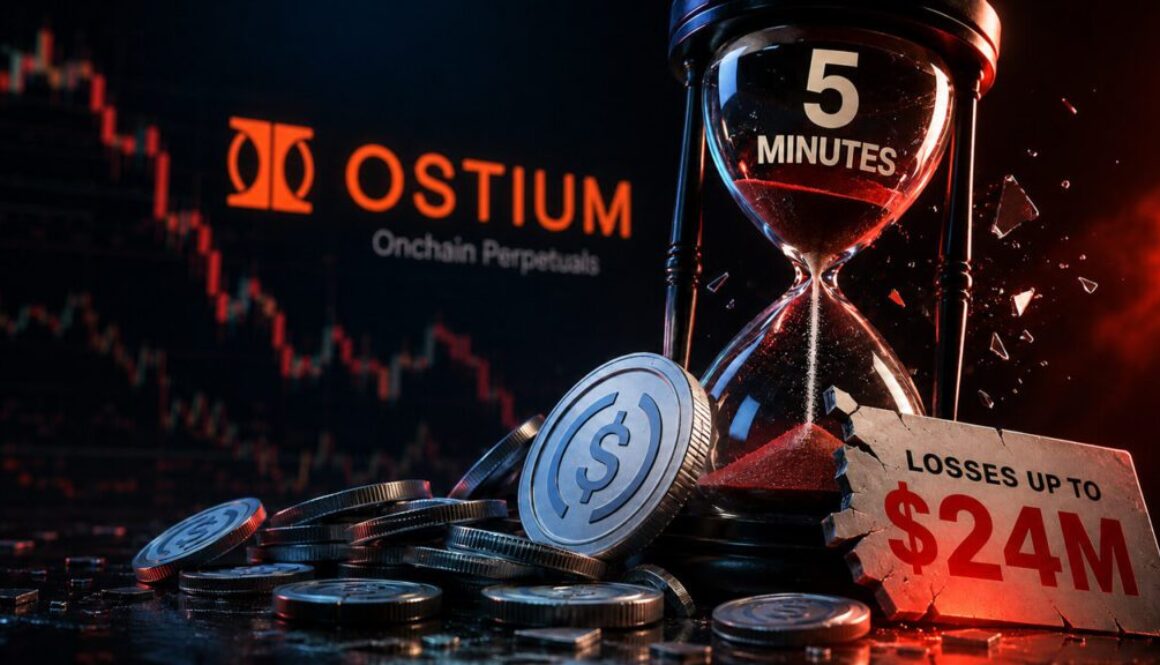
How prices from the future fooled a crypto oracle into paying out up to $24 million
An authorized oracle signer submitted future-dated price reports that tricked Ostium’s perpetuals platform into paying out up to $24 million in artificial trading profits within five minutes on July 15. The incident exposes a critical gap in on-chain oracle design: cryptographic signature verification alone cannot prevent price manipulation when timestamp validation and plausibility checks are missing, a vulnerability that threatens institutional custody vaults and collateral systems across DeFi.
- An authorized PriceUpKeep forwarder submitted validly signed but future-dated oracle reports between 14:18 and 14:23 UTC on July 15.
- Security firms estimated losses between $11.86 million and $24 million, with PeckShield tracking 10,540 ETH routed to Tornado Cash.
- Ostium’s on-chain verifier checked only ECDSA signature validity and signer authorization, enforcing no timestamp bounds or price-plausibility controls.
- 5 minutes Duration of the incident from initial exploit to trading pause coordination
- $24 million Upper-bound loss estimate versus $11.86 million low estimate across security firms
- 10,540 ETH Quantity of extracted Ethereum confirmed reaching Tornado Cash by incident date
Ostium, an on-chain perpetuals platform, suffered a targeted exploit that drained its public liquidity vault of up to $24 million through a flaw in oracle data validation.
Between 14:18 and 14:23 UTC on July 15, an attacker with access to an authorized PriceUpKeep forwarder submitted validly signed price reports bearing future timestamps, allowing the protocol to accept artificial trading profits as legitimate settlements.
Co-founder Kaledora Kiernan-Linn confirmed the team identified the five-minute window and coordinated a trading pause within the hour, but Ostium has not released a detailed postmortem or specified the exact loss total.
The incident is notable not because oracle keys were stolen, but because the protocol’s signature verification layer lacked the secondary controls, timestamp freshness checks and price-plausibility bounds, necessary to catch manipulated data even when cryptographically authentic.
Authorized signer supplied validly signed reports bearing future dates and artificial prices
Three independent security firms tracked the same attack vector: an actor with legitimate access to Ostium’s oracle infrastructure submitted price updates bearing timestamps from the future. Blockaid and Cyvers identified the mechanism as a registered PriceUpKeep forwarder posting authorized but temporally impossible oracle reports.
SlowMist’s analysis described an authorized signer supplying validly signed manipulated data enabling repeated profitable trades. In each case, the attacker exploited a structural flaw, not a compromised key: the reports passed all cryptographic checks because they were legitimately signed by an authorized party, yet their timestamps and price data were false.
The OstiumVerifier code, linked from the protocol’s own security documentation, performs only two checks: it recovers the ECDSA signer from the signed data and verifies that the recovered signer appears in an authorized list.
Neither check validates whether the price is plausible relative to market data, whether the timestamp is fresh (not in the past or future), or whether the report is replaying an old signature. The verifier does not enforce any settlement safety measures and does not indicate whether separate contracts elsewhere in the execution path apply those controls.
For a perpetuals platform that pays out winning trades immediately on-chain from the OLP vault, accepting any signed report as truth creates a direct path from signature validation to vault depletion.
Loss estimates diverged as tracing continued. Blockaid put the immediate payout near $18 million, Cyvers estimated $23.7 million, and PeckShield later described roughly $24 million drained in total.
SlowMist’s lower figure of $11.86 million appears to track a single observable vault outflow of 11,862,444.782 USDC in one transaction, suggesting that different security firms may have captured different phases of the same attack or separate extractions.
PeckShield confirmed that extracted USDC was swapped into approximately 12,080 ETH, with 10,540 ETH reaching Tornado Cash by the time of its update.
Ostium’s verifier skips timestamp bounds and price-deviation safeguards entirely
The vulnerability illustrates a design principle often overlooked in oracle architecture: cryptographic authentication and operational authorization are not sufficient for data integrity. A signed message proves only that a holder of the private key created it; signature verification does not confirm that the data inside is correct, timely, or reasonable.
For an oracle submitting prices to a protocol that settles trades immediately, three additional layers of validation are required but were missing from Ostium’s verifier. First, a timestamp bound must reject any report outside a narrow freshness window, typically within the last block or few seconds.
Second, a price-deviation check must flag reports that move the price beyond a plausible range relative to recent history or external price feeds. Third, a multi-source safeguard may require multiple independent signers or cross-checks with alternative feeds.
Ostium’s code performs none of these checks at the verifier level. The gap is particularly acute because the OLP vault holds traders’ collateral and is responsible for funding payouts to winners immediately on settlement.
If a malicious or compromised authorized signer supplies false price data, the vault has no secondary defense: it accepts the report as canonical and drains liquidity to honor the artificial profits.
The code linked from Ostium’s documentation does not clarify which implementation was active during the incident, whether separate contracts applied additional checks, or whether timestamp and price logic existed elsewhere in the execution chain. That ambiguity is itself a red flag for institutional auditors and custody operators evaluating on-chain collateral systems.
The Ostium case echoes design failures in other DeFi protocols. In prior exploits affecting tokenized equities and credit markets, vaults have been drained not by breaking signatures but by exploiting gaps between cryptographic validation and economic reality, cases where a mathematically correct proof still authorizes an economically false outcome.
Each incident reinforces that permissioned on-chain systems require the same defense-in-depth approach as public ones: signature checks are the outer layer, but timestamp freshness, price plausibility, and rate-of-change limits must operate independently.
Kiernan-Linn says Ostium engaged law enforcement and will pursue security specialists
Ostium’s co-founder stated that the team is coordinating with law enforcement, SEAL 911 (a blockchain incident response firm), and external security specialists to investigate the full scope and origin of the exploit. She confirmed the trading pause was enforced within an hour of discovery, limiting further damage.
However, Ostium has not yet released a detailed postmortem, named the authorized signer involved, or explained how future-dated reports bypassed internal safeguards before reaching the chain.
The incident raises questions about how authorized signers are managed and monitored. In a perpetuals platform, oracle signers often include the protocol team, partner data providers, or automated upkeep contracts. An authorized signer could be compromised, coerced, or acting with knowledge of the vulnerability.
Alternatively, the signer may have been operating under incorrect assumptions about what validation occurs downstream, unaware that future-dated signed reports would be accepted without timestamp checks. Neither scenario is reassuring for institutional users of Ostium’s vault or for competitors using similar oracle patterns.
The loss estimates remain third-party findings pending Ostium’s postmortem. The divergence between $11.86 million and $24 million suggests that either multiple extractions occurred, different tracing methods captured different transaction sets, or initial estimates will be revised.
Institutional investors and custody providers watching Ostium and similar platforms should expect a full incident report naming the signer, confirming the exact loss, detailing the remediation, and announcing concrete controls added to the verifier.
Ostium has not announced a date for its postmortem or specified whether the OstiumVerifier will be redeployed with timestamp bounds and price-plausibility checks before the vault reopens. Kiernan-Linn’s statement commits to working with law enforcement and security firms but does not confirm whether the authorized signer involved has been suspended, whether internal key management processes will be audited, or whether users will receive compensation. The open questions are whether Ostium will dis