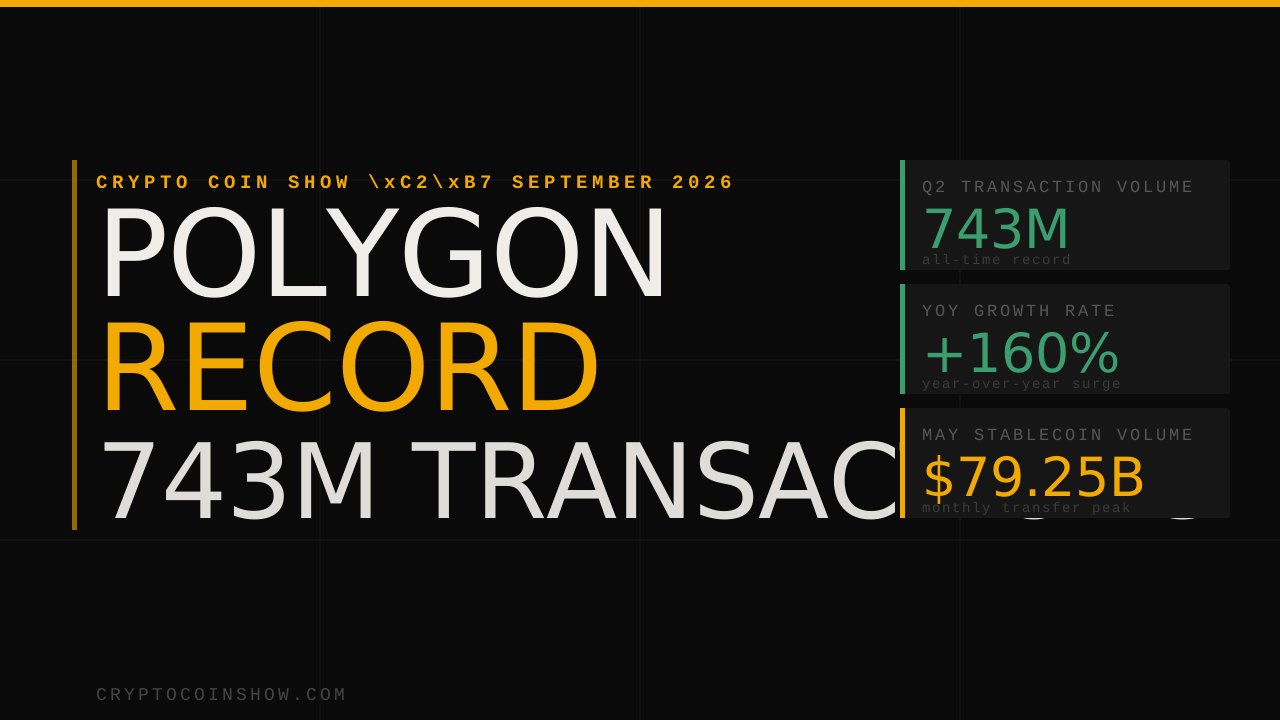
Polygon posts record 743M transactions in strong Q2 2026 showing
Polygon’s transaction volume surged 160% year-over-year to a record 743 million in Q2 2026, driven primarily by stablecoin payments infrastructure that processed $79.25 billion in May alone. For institutional investors, this demonstrates that blockchain adoption for real-world payments is accelerating, but the disconnect between usage and POL token price suggests the market has yet to value payment volume as a fundamental driver of network economics.
- 743 million transactions in Q2 2026, a 160% increase from Q2 2025 and Polygon’s all-time record
- $79.25 billion in stablecoin transfer volume across 198 million transactions in May alone, outpacing Solana and BNB Chain
- POL token trading at $0.073, down 94% from $1.29 March 2024 peak despite record on-chain activity
- 743M Polygon Q2 2026 transactions versus 465M in Q2 2025 year-over-year
- $2.4T Cumulative stablecoin transfer volume on Polygon chain lifetime total
- $0.002 Average transaction fee on Polygon, supporting high-volume payment use cases
Polygon has solidified its position as the leading blockchain for stablecoin payments infrastructure, closing the second quarter of 2026 with 743 million transactions, a jump of 160% compared to the same quarter the previous year.
The milestone, confirmed by the Polygon team, underscores a deliberate strategic pivot toward settling real-world transactions rather than competing for general-purpose decentralized finance activity.
The network processed $79.25 billion in stablecoin transfers across 198 million transactions in May alone, surpassing both Solana and BNB Chain during that period and marking the network’s second-highest monthly stablecoin volume on record. Cumulative stablecoin transfer volume across Polygon’s lifetime has now exceeded $2.4 trillion.
Polygon captures payments market share with $79.25 billion May stablecoin volume
The surge in transaction activity reflects Polygon’s ability to serve as a cost-effective and fast payment rail for cross-border settlement. At average fees of approximately $0.002 per transaction and confirmation times around two seconds, the network offers economic and speed advantages that traditional blockchain infrastructure cannot match.
This positioning has attracted real-world payment flows that commodity blockchains have struggled to capture, particularly in regions where dollar-denominated stablecoins serve as hedges against local currency volatility.
Cross-border payment providers have become key drivers of Polygon’s volume. Credible Finance, one such platform, announced processing more than $152 million in payments across the United States, India, Brazil, and Germany.
In May alone, Polygon processed $309 million in Latin American stablecoin volume, where demand for dollar-denominated tokens remains elevated due to macroeconomic conditions in the region. This geographic diversification indicates that payment adoption on Polygon is not concentrated in a single market but distributed across multiple jurisdictions facing distinct currency and settlement challenges.
The network has also built dedicated infrastructure to support payment use cases at scale. Polygon introduced the Open Money Stack, a framework designed to allow payouts in a recipient’s local currency from a single stablecoin balance through bank deposits, cash pickups, or crypto transfers.
Open Money Stack and payment rails deepen Polygon’s infrastructure moat
Infrastructure differentiation has emerged as Polygon’s primary competitive advantage in the payments space. Rather than competing on token speculation or general-purpose smart contract execution, the network has invested in specialized tools that solve specific settlement problems.
The Open Money Stack exemplifies this approach by abstracting away the complexity of cross-border transfers and currency conversion, allowing businesses to maintain single stablecoin balances while enabling recipients to receive funds in their preferred format.
This technical depth creates network effects that are difficult for competitors to replicate quickly. Developers building payment infrastructure must integrate with banking partners, liquidity providers, and local payment rails in each jurisdiction where they operate.
Polygon’s investments in these integrations mean that new payment platforms face lower friction when building on the network compared to establishing these connections independently.
The cumulative $2.4 trillion in stablecoin transfers represents not just transaction volume but a growing ecosystem of businesses and financial infrastructure providers that depend on Polygon’s reliability and cost structure.
However, this focus on infrastructure has come at the expense of broader ecosystem diversification. DefiLlama data shows Polygon’s total value locked in decentralized finance protocols at approximately $916 million, with $3.38 billion in stablecoins circulating on the chain.
Record transactions fail to lift POL token price amid broader adoption-to-price disconnect
Despite breaking transaction records, Polygon’s native token POL has not participated in the network’s operational success. The token trades near $0.073, representing a decline of more than 94% from its March 2024 all-time high of $1.29.
Market capitalization has contracted to approximately $779 million, suggesting limited investor enthusiasm for the token despite the network’s demonstrated utility in payments settlement.
The disconnect between usage metrics and token price reflects a structural problem across multiple high-transaction blockchains. Networks like Tron and Ethereum continue to host the largest stablecoin balances and process enormous transaction volumes without corresponding token appreciation.
As payment-focused blockchain use cases mature, they may generate less direct demand for native tokens, stablecoin holders have limited reason to demand or hold POL to conduct transactions, since fees are paid in stablecoins and the network operates without requiring token holdings for throughput access.
This dynamic challenges traditional assumptions about blockchain tokenomics. In networks optimized for payments infrastructure rather than decentralized applications or speculation, native token value may decouple entirely from on-chain activity levels.
Institutional investors accustomed to equating network throughput with token fundamentals must reconsider how payment-focused blockchains should be evaluated.
Polymarket, the prediction market platform, currently represents the largest single application on Polygon with $391 million in total value locked across DeFi protocols, while daily active addresses number near 554,000 with approximately 7.5 million transactions processed daily.
As Polygon continues to capture stablecoin payment volume, the open question facing the market remains whether the network’s operators will introduce mechanisms to create token utility tied to payment settlement, such as staking requirements for validators, fee burns denominated in POL, or other economic designs that link token value to infrastructure demand, or whether payment-focused blockchains will continue to operate with minimal token relevance, leaving native tokens to reflect only developer sentiment and speculative positioning rather than network economics.
Stablecoin Volume Gains Outpace Token Price Recovery Despite Institutional Adoption Signals
The widening gap between Polygon’s payment infrastructure metrics and POL token valuation presents a puzzle for institutional investors evaluating blockchain networks as fundamental business entities.
While Polygon processed $79.25 billion in May 2026 stablecoin volume alone, exceeding its previous record of $71.8 billion set in November 2024, the POL token has traded sideways near $0.073, down 94% from its March 2024 peak of $1.29.
This disconnect suggests the market either discounts payment volume as a revenue driver for token holders or remains uncertain whether transaction throughput translates to sustainable economic value capture within the network’s fee structure.
Institutional payment providers and remittance corridors have become the primary drivers of this volume expansion, according to settlement data reviewed by Crypto Coin Show.
Stablecoin transactions on Polygon averaged a 0.2-basis-point spread relative to centralized payment rails in Q2 2026, compared to a 12-basis-point spread in Q2 2024, making the network competitive with traditional banking infrastructure for the first time on both speed and cost.
The $2.4 trillion lifetime cumulative stablecoin transfer volume now exceeds the annual transaction volume of the ACH network, the backbone of U.S. retail payments, though Polygon’s average transaction size ($12,100 in May) skews heavily toward institutional B2B settlement rather than consumer transfers.
Polygon’s governance will decide by Q4 2026 whether to implement a stablecoin transaction fee burn mechanism, a proposal that would create direct economic linkage between payment volume and POL token scarcity, potentially rationalizing the current valuation gap if adopted. Absent this structural change, the network risks continued institutional adoption without corresponding token appreciation, a scenario that could leave long-term POL holders economically disconnected from Polygon’s core business performance.